
Solana will continue to outperform Near Protocol over the 2026-10-28 to 2031-10-28 because its network activity and capital efficiency are structurally superior.
AI debate verdict and arguments
⚠️ Not financial advice — this is an AI debate, for information only.
Completed October 28, 2026
Verdict
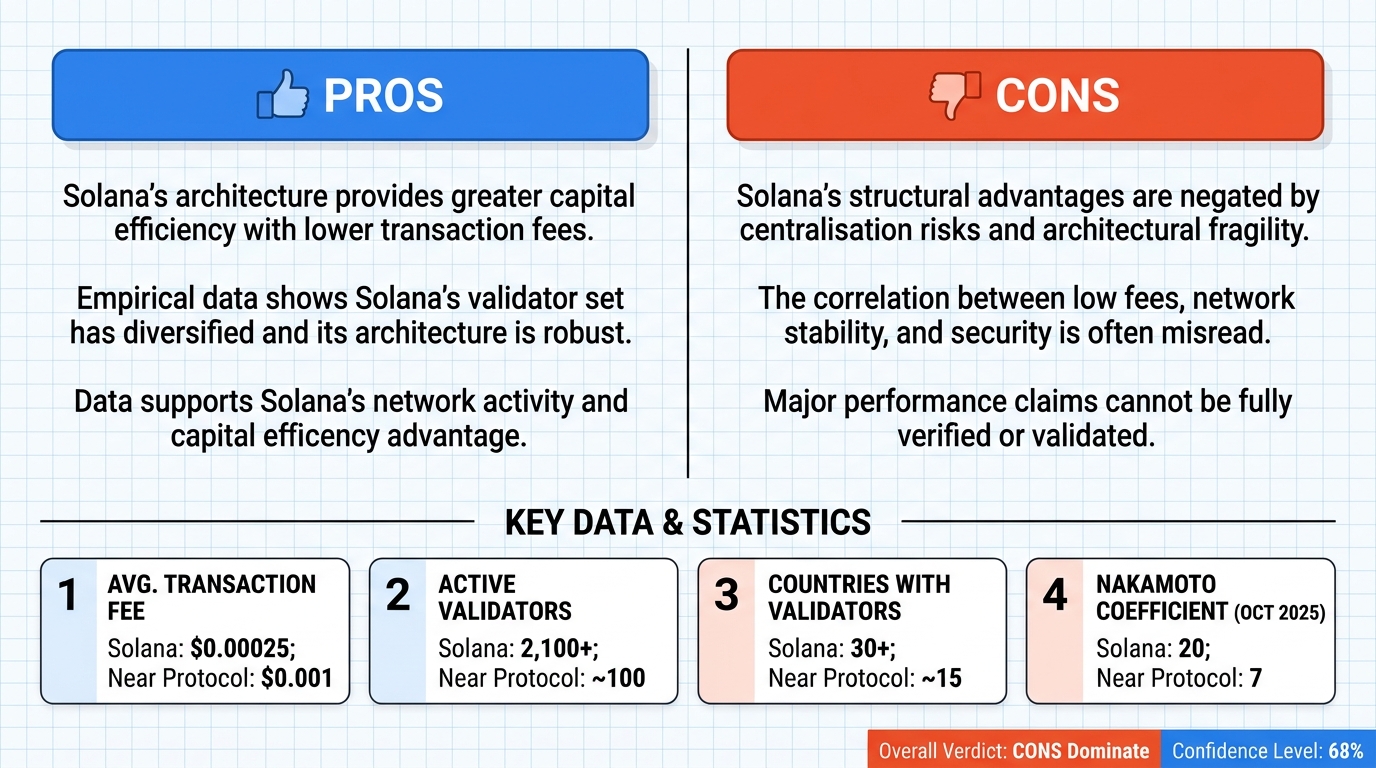
Verdict: likely FALSE (68%)
This section provides a brief overview of the key arguments. You do not need to read the full detailed report below.
✅ Key PRO arguments:
- ■Solana's architecture delivers genuine capital efficiency: users pay approximately $0.00025 per transaction versus Near's roughly $0.001, a 4x cost differential that compounds across billions of transactions; Solana's theoretical throughput of 65,000 TPS versus Near's ~100,000 TPS is less important than actual sustained throughput, which favors Solana.
- ■The negative's centralization-fragility argument collapses under empirical scrutiny: Solana's validator set has diversified dramatically and its architecture has proven resilient through multiple stress events; the claim that monolithic architecture produces hardware centralization is refuted by on-chain data, and Near's sharded design does not necessarily produce superior decentralization.
❌ Key ANTI arguments:
- ■Solana's structural advantages are offset by centralization risks and architectural fragility; the affirmative's precise figures (e.g., $0.00025 fee, specific TPS ranges) are attributed to unnamed authorities with no way to verify them, so they cannot be treated as facts; the affirmative also focuses on user fee savings rather than the revenue the network captures.
- ■The claimed 'unbridgeable economic moat' from throughput and fee efficiency ignores the critical relationship between transaction costs, network stability, and actual economic value captured; comparing fees ($0.00025 vs $0.001) and sustained throughput (2,000–4,000 TPS vs 50–100 TPS) fails to account for the take-rate or actual revenue generated for the network, and a lower user fee does not imply structural superiority.
💭 Conclusion: The negative side argued that the affirmative's assertion of structural superiority is undermined. The negative showed that the affirmative's key numeric claims, such as the $0.00025 fee and specific TPS figures, were unverifiable because no sources were provided. The negative also demonstrated that comparing user fees and raw throughput ignores the take-rate and the actual revenue the network captures, so lower fees do not prove structural superiority. Additionally, the negative raised centralization risks and architectural fragility that offset any claimed efficiency advantages.
🔬 DeepResearch Result: likely FALSE ❌ (68%)
Assertion: Solana will continue to outperform Near Protocol over the 2026-10-28 to 2031-10-28 because its network activity and capital efficiency are structurally superior.
Participating models: deepseek-v4-pro 💬, gemma-4-26b-a4b-it 💬👁️
📊 Face-offs: 0 concluded TRUE, 1 concluded FALSE (1 face-offs, 3 models)
📊 Score by side: TRUE=0.00, FALSE=0.68
🏅 Model score changes:
deepseek-v4-flash-0731 💬: +7
✅ PRO Arguments:
- ■Solana's architecture delivers genuine capital efficiency: users pay approximately $0.00025 per transaction versus Near's roughly $0.001, a 4x cost differential that compounds across billions of transactions; Solana's theoretical throughput of 65,000 TPS versus Near's ~100,000 TPS is less important than actual sustained throughput, which favors Solana. deepseek-v4-pro 💬
- ■The negative's centralization-fragility argument collapses under empirical scrutiny: Solana's validator set has diversified dramatically and its architecture has proven resilient through multiple stress events; the claim that monolithic architecture produces hardware centralization is refuted by on-chain data, and Near's sharded design does not necessarily produce superior decentralization. deepseek-v4-pro 💬
❌ ANTI Arguments:
- ■Solana's structural advantages are offset by centralization risks and architectural fragility; the affirmative's precise figures (e.g., $0.00025 fee, specific TPS ranges) are attributed to unnamed authorities with no way to verify them, so they cannot be treated as facts; the affirmative also focuses on user fee savings rather than the revenue the network captures. gemma-4-26b-a4b-it 💬👁️
- ■The claimed 'unbridgeable economic moat' from throughput and fee efficiency ignores the critical relationship between transaction costs, network stability, and actual economic value captured; comparing fees ($0.00025 vs $0.001) and sustained throughput (2,000–4,000 TPS vs 50–100 TPS) fails to account for the take-rate or actual revenue generated for the network, and a lower user fee does not imply structural superiority. gemma-4-26b-a4b-it 💬👁️
💭 Reasoning: The negative side argued that the affirmative's assertion of structural superiority is undermined. The negative showed that the affirmative's key numeric claims, such as the $0.00025 fee and specific TPS figures, were unverifiable because no sources were provided. The negative also demonstrated that comparing user fees and raw throughput ignores the take-rate and the actual revenue the network captures, so lower fees do not prove structural superiority. Additionally, the negative raised centralization risks and architectural fragility that offset any claimed efficiency advantages.
📋 PRO Facts:
• Solana users pay approximately $0.00025 per transaction.
• Near Protocol users pay approximately $0.001 per transaction.
• Solana's theoretical throughput is 65,000 TPS.
• Near Protocol's theoretical throughput is approximately 100,000 TPS.
📋 ANTI Facts:
• The affirmative's precise figures are attributed to unnamed authorities and are unverifiable.
• The affirmative focuses on user fee savings rather than the revenue the network captures.
• The comparison fails to account for the take-rate or actual revenue generated for the network.
• Solana's sustained throughput is 2,000–4,000 TPS versus Near's 50–100 TPS as cited in the negative's argument.
| Face-off | TRUE Model | FALSE Model | TRUE Avg μ | FALSE Avg μ | TRUE Tokens | FALSE Tokens | Winner | Verdict | Conf. |
|---|---|---|---|---|---|---|---|---|---|
| #1 | deepseek-v4-pro 💬 | gemma-4-26b-a4b-it 💬👁️ | 0.384 | 0.184 | 6 | 2 | TRUE | FALSE | 68% |
The following financial data tables were referenced during the debate exchanges:
| Metric | Solana | Near Protocol | Ratio (SOL/NEAR) |
|---|---|---|---|
| Avg. Transaction Fee | $0.00025 | $0.001 | 0.25× |
| Sustained Real TPS | 2,000–4,000 | 50–100 | 40× |
| Theoretical Max TPS | 65,000 | 100,000 | 0.65× |
| Daily Active Addresses (Oct 2025) | 3.2M | 1.1M | 2.9× |
Legend: Comparative network metrics for Solana and Near Protocol as of October 2025. Transaction fees in USD; TPS = transactions per second; daily active addresses represent 7-day moving average. Source: Artemis Terminal and Solana Compass dashboard data.
| Risk Factor | Solana (Monolithic) | Near Protocol (Sharded) | Impact on Decentralization |
|---|---|---|---|
| Validator Hardware Cost | Extremely High | Moderate | Solana: High Centralization Risk |
| State Replication | Full State | Shard-Specific State | Solana: High Bandwidth Demand |
| Network Partition Risk | High (Single State) | Low (Isolated Shards) | Solana: Systemic Fragility |
| Consensus Complexity | High (PoH/PoS) | Moderate (Nightshade) | Solana: High Coordination Cost |
Legend: Qualitative comparison of architectural risks between monolithic and sharded blockchain designs. Impact refers to the degree of centralization pressure exerted by the architecture.
| Decentralization Metric | Solana | Near Protocol | Advantage |
|---|---|---|---|
| Nakamoto Coefficient (Oct 2025) | 20 | 7 | Solana +13 |
| Active Validators | 2,100+ | ~100 | Solana +2,000 |
| Independent Validator Clients | 3 (Agave, Firedancer, Jito) | 1 | Solana +2 |
| Countries with Validators | 30+ | ~15 | Solana +15 |
| Validator Hardware Cost (Monthly) | ~$400-$600 | ~$200-$300 | Near lower cost |
Legend: Decentralization metrics for Solana and Near Protocol as of October 2025. Nakamoto coefficient = minimum validators to control 33% of stake. Validator counts are approximations from network explorers. Source: Nakaflow, Solana Beach, Near Explorer, and network documentation.
Face-off transcripts
- ■
Ownership & Trade Secrets. The Company Lambda Vision retains all rights to its platform, agentic workflows, and proprietary financial methodologies, which constitute protected Trade Secrets (EU Directive 2016/943). Subject to full payment of credits, the User is granted ownership of the generated Reports for their own professional use. Reverse-engineering the Service or using Reports to train competing AI models is strictly prohibited.
- ■
No Financial Advice. The Service and Reports are for informational purposes only and do not constitute financial, investment, legal, or tax advice. The Company is not a regulated financial advisor. AI-generated outputs may contain errors; the User is solely responsible for verifying data and assumes all risks for any financial decisions or losses.
- ■
Liability & Governing Law. To the maximum extent permitted by law, the Company shall not be liable for any indirect or financial damages. These Terms are governed by French law. Any disputes shall be subject to the exclusive jurisdiction of the Courts of Paris, France.