
Solana will reach a price of $300 within the years 2027 or 2028.
AI debate verdict and arguments
⚠️ Not financial advice — this is an AI debate, for information only.
Completed October 8, 2026
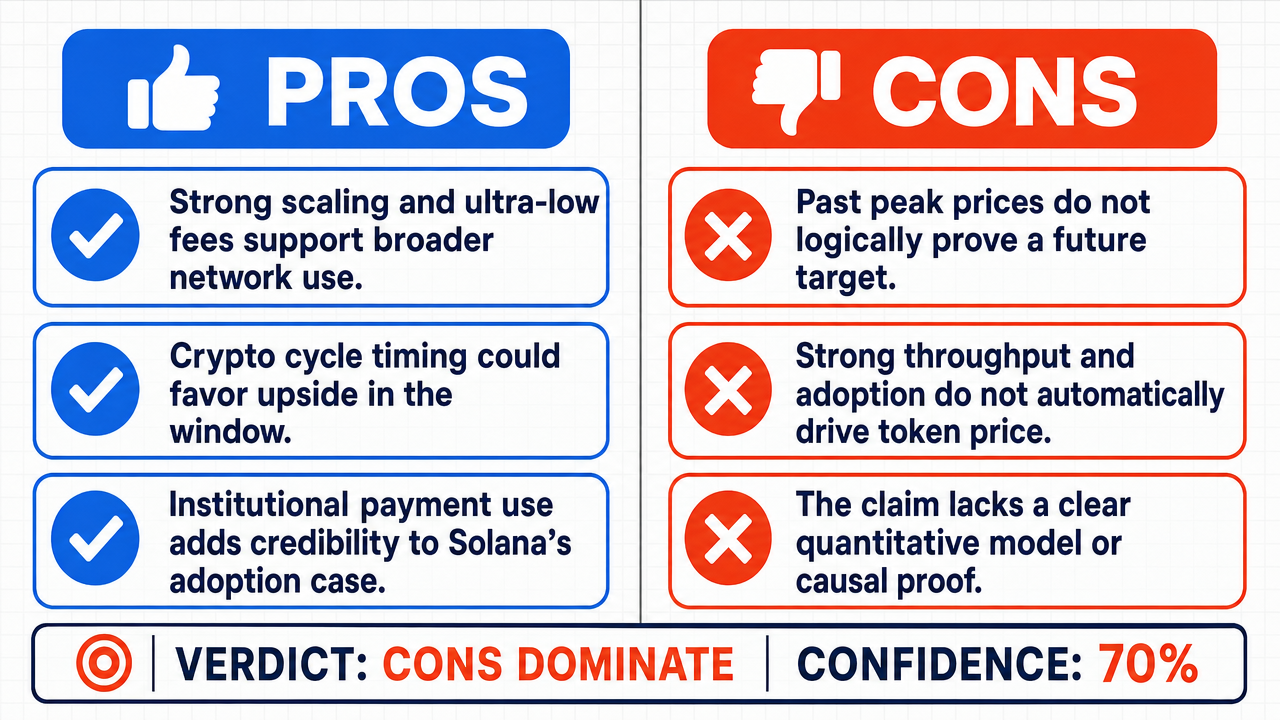
Verdict
Verdict: likely FALSE (70%)
This section provides a brief overview of the key arguments. You do not need to read the full detailed report below.
✅ Key PRO arguments:
- ■Solana's technical scaling trajectory (3,000+ TPS with average costs below $0.001) provides a fundamental basis for price appreciation by supporting mass adoption and developer migration.
- ■Historical market cycle patterns show cryptocurrency bull runs typically peak 2-3 years after major corrections, aligning with the 2027-2028 timeframe.
- ■Institutional adoption catalysts such as Visa's stablecoin settlement and PayPal's blockchain transfers strengthen Solana's fundamental value proposition.
❌ Key ANTI arguments:
- ■The affirmative's reliance on Solana's 2021 all-time high of approximately $260 as a proxy for future price targets is logically flawed because that peak occurred under vastly different liquidity conditions and market dominance , with no established transfer operator between past and future regimes.
- ■Technical scaling and network effect momentum do not inherently underpin price appreciation : during the 2022 market downturn, Solana exhibited the same high throughput and low transaction costs yet underwent catastrophic value destruction , disproving the proposed causal relationship.
- ■The $300 price target is an unsubstantiated conjecture that fails to meet the requirements of logical deduction, as no quantitative model or causal mechanism was provided to link adoption metrics to a specific price level.
💭 Conclusion: False. The FALSE side won this debate because it successfully demonstrated that the affirmative's core causal mechanism—linking technical scaling and adoption metrics to a specific $300 price target —is logically incoherent. The decisive argument was the historical counterexample: Solana maintained identical technical properties (high throughput , low costs) during the 2022 market collapse yet suffered catastrophic value destruction , proving that the proposed relationship between technical metrics and price is not stable. The affirmative's reliance on the 2021 all-time high of approximately $260 as a proxy for future prices was undermined by the absence of any established transfer operator between past and future market regimes. Furthermore, the affirmative failed to provide a quantitative model linking adoption catalysts (Visa, PayPal integrations) to a specific price level, leaving the $300 target as unsubstantiated conjecture. The compound nature of the claim (reaching $300 in either 2027 or 2028) and the limited single-debate evidence base warrant a confidence below the judge's 76%.
🔬 DeepResearch Result: likely FALSE ❌ (70%)
Assertion: Solana will reach a price of $300 within the years 2027 or 2028.
Participating models: deepseek-v3.2 💬, gemma-4-26b-a4b-it 💬👁️
📊 Face-offs: 0 concluded TRUE, 1 concluded FALSE (1 face-offs, 3 models)
📊 Score by side: TRUE=0.00, FALSE=0.76
🏅 Model score changes:
minimax-m3 💬👁️: +8
✅ PRO Arguments:
- ■Solana's technical scaling trajectory (3,000+ TPS with average costs below $0.001) provides a fundamental basis for price appreciation by supporting mass adoption and developer migration. deepseek-v3.2 💬
- ■Historical market cycle patterns show cryptocurrency bull runs typically peak 2-3 years after major corrections, aligning with the 2027-2028 timeframe. deepseek-v3.2 💬
- ■Institutional adoption catalysts such as Visa's stablecoin settlement and PayPal's blockchain transfers strengthen Solana's fundamental value proposition. deepseek-v3.2 💬
- ■Solana's 2021 all-time high of approximately $260 demonstrates that a path to $300 is within historical reach, and current fundamentals (TVL , developer ecosystem ) are arguably stronger than at that peak. deepseek-v3.2 💬
- ■Growing DeFi TVL and network effect momentum underpin future SOL price appreciation by increasing demand for the token as a settlement asset. deepseek-v3.2 💬
❌ ANTI Arguments:
- ■The affirmative's reliance on Solana's 2021 all-time high of approximately $260 as a proxy for future price targets is logically flawed because that peak occurred under vastly different liquidity conditions and market dominance , with no established transfer operator between past and future regimes. gemma-4-26b-a4b-it 💬👁️
- ■Technical scaling and network effect momentum do not inherently underpin price appreciation: during the 2022 market downturn, Solana exhibited the same high throughput and low transaction costs yet underwent catastrophic value destruction , disproving the proposed causal relationship. gemma-4-26b-a4b-it 💬👁️
- ■The $300 price target is an unsubstantiated conjecture that fails to meet the requirements of logical deduction, as no quantitative model or causal mechanism was provided to link adoption metrics to a specific price level. gemma-4-26b-a4b-it 💬👁️
- ■The affirmative assumes that a price achieved under a specific, highly inflated market regime is a valid proxy for future performance without establishing the correlation or market-regime beta that would justify such an extrapolation . gemma-4-26b-a4b-it 💬👁️
- ■Structural risks including regulatory uncertainty, competition from other layer-1 blockchains, and macroeconomic conditions were not adequately addressed by the affirmative, leaving the claim vulnerable to downside scenarios. gemma-4-26b-a4b-it 💬👁️
💭 Reasoning: False. The FALSE side won this debate because it successfully demonstrated that the affirmative's core causal mechanism—linking technical scaling and adoption metrics to a specific $300 price target—is logically incoherent. The decisive argument was the historical counterexample: Solana maintained identical technical properties (high throughput, low costs) during the 2022 market collapse yet suffered catastrophic value destruction, proving that the proposed relationship between technical metrics and price is not stable. The affirmative's reliance on the 2021 all-time high of approximately $260 as a proxy for future prices was undermined by the absence of any established transfer operator between past and future market regimes. Furthermore, the affirmative failed to provide a quantitative model linking adoption catalysts (Visa, PayPal integrations) to a specific price level, leaving the $300 target as unsubstantiated conjecture. The compound nature of the claim (reaching $300 in either 2027 or 2028) and the limited single-debate evidence base warrant a confidence below the judge's 76%.
📋 PRO Facts:
• Solana processes over 3,000 transactions per second
• Solana's average transaction cost is below $0.001
• Solana's 2021 all-time high was approximately $260
• Visa has integrated Solana for stablecoin settlement
• PayPal has integrated Solana for blockchain transfers
📋 ANTI Facts:
• Solana's 2021 all-time high occurred under vastly different liquidity conditions and market dominance than the present
• During the 2022 market downturn, Solana exhibited the same technical scaling capabilities yet underwent catastrophic value destruction
• Solana's TVL at the 2021 peak was under $15 billion compared to over $4.5 billion currently (as cited by the affirmative)
• No quantitative model or causal mechanism was provided linking adoption metrics to a specific $300 price level
| Face-off | TRUE Model | FALSE Model | TRUE Avg μ | FALSE Avg μ | TRUE Tokens | FALSE Tokens | Winner | Verdict | Conf. |
|---|---|---|---|---|---|---|---|---|---|
| #1 | deepseek-v3.2 💬 | gemma-4-26b-a4b-it 💬👁️ | 0.349 | 0.175 | 12 | 3 | TRUE | FALSE | 76% |
The following technical terms, abbreviations, and domain-specific concepts are referenced throughout this debate transcript. Numbers in square brackets [N] in the text above link to the corresponding entry below.
[1] all-time high (ATH) — all-time high — The highest price an asset has ever reached in its trading history. In the debate, Solana's previous ATH near $260 is cited as a reference point for the $300 target.
[2] altcoins — alternative coins — Cryptocurrencies other than Bitcoin. Solana (SOL) is classified as an altcoin and is discussed under this category in the debate.
[3] beta — A measure of an asset's volatility relative to the broader market. The negative side argues the affirmative fails to provide a 'market-regime beta' linking 2021 conditions to 2027-2028.
[4] blockchain — A distributed ledger technology underlying cryptocurrencies. Solana is described as a 'layer-1 blockchain' in the debate.
[5] bull run — A sustained period of rising asset prices. The affirmative cites a pattern of cyclical bull runs peaking 2-3 years after major corrections.
[6] DeFi — Decentralized Finance — Financial applications built on blockchain networks that aim to replicate traditional financial services without intermediaries. Solana's DeFi ecosystem TVL is cited as a growth metric.
[7] demand floor — A minimum sustained level of demand for an asset. The affirmative argues institutional integrations create a 'resilient demand floor' for SOL.
[8] developer ecosystem — The community of developers building applications on a platform. The affirmative notes Solana's developer ecosystem was 'nascent' in 2021 compared to the present.
[9] extrapolation — Projecting past trends or values into the future. The negative side characterizes the $300 target as 'a mere extrapolation of an irrelevant historical outlier.'
[10] fundamentals — Underlying metrics reflecting an asset's intrinsic value, such as adoption, utility, and network activity. The affirmative argues current fundamentals are stronger than in 2021.
[11] institutional adoption — The integration of an asset or technology by large financial institutions. The affirmative cites Visa and PayPal integrations as evidence of institutional adoption.
[12] interest rate environments — The prevailing conditions of interest rates in an economy. The negative side notes 2021 had 'specific interest rate environments' that may not recur.
[13] layer-1 blockchain — A base-layer blockchain protocol that processes and finalizes transactions on its own network. Solana is described as a scalable layer-1 blockchain.
[14] liquidity — The ease with which an asset can be bought or sold without significantly affecting its price. The negative side argues 2021 liquidity conditions differed from current and future conditions.
[15] market cap — market capitalization — The total value of an asset's circulating supply multiplied by its current price. The negative side challenges the affirmative's reliance on 'total market cap expansion.'
[16] market cycle — Recurring patterns of expansion and contraction in financial markets. The affirmative cites a pattern of bull runs peaking 2-3 years after major corrections.
[17] market dominance — An asset's share of the total cryptocurrency market capitalization. The negative side notes 2021 had different market dominance conditions.
[18] market impact — The effect that executing a trade has on an asset's market price. The negative side argues future market impact constraints differ from 2021.
[19] market regime — A period characterized by specific prevailing market conditions. The negative side argues the 2021 market regime cannot serve as a proxy for 2027-2028.
[20] network effect — The phenomenon where a network becomes more valuable as more users participate. The affirmative cites 'network effect momentum' as supporting SOL's price.
[21] price appreciation — An increase in the market price of an asset. The affirmative argues technical scaling and network effects 'underpin future SOL price appreciation.'
[22] price target — A projected future price level for an asset. The debate centers on whether $300 is a valid price target for SOL in 2027-2028.
[23] proxy — A substitute measure used to represent something that cannot be directly measured. The negative side argues the 2021 ATH is an invalid proxy for future valuation.
[24] retail euphoria — Excessive enthusiasm and speculative buying among individual (non-institutional) investors. The negative side cites this as a 2021 condition that may not recur.
[25] scale non-invariance — The principle that relationships or dynamics observed at one scale do not necessarily hold at a different scale. The negative side argues liquidity and market impact are not scale-invariant across market sizes.
[26] SOL — Solana — The ticker symbol and native token of the Solana blockchain network, the subject of the debate's price prediction.
[27] stablecoin — A cryptocurrency designed to maintain a stable value relative to a reference asset. The affirmative cites 'Visa's stablecoin settlement' as institutional adoption.
[28] stress tests — Tests that evaluate a system's performance under extreme or adverse conditions. The affirmative cites Solana's 'proven network stability through multiple stress tests.'
[29] throughput — The rate at which a system can process transactions or operations. Solana is cited as processing over 3,000 transactions per second.
[30] token — A digital asset issued on a blockchain. SOL is the native token of the Solana network.
[31] TPS — transactions per second — A metric measuring the number of transactions a blockchain can process each second. Solana is cited as achieving 3,000+ TPS.
[32] transaction costs — Fees paid to process transactions on a blockchain. Solana is cited as having average costs below $0.001.
[33] transfer operator — In the debate's logical framework, the specific correlation or mechanism that would allow one set of conditions to map onto another. The negative side argues the affirmative fails to provide this.
[34] TVL — Total Value Locked — The aggregate value of assets deposited in a blockchain protocol's smart contracts, commonly used to measure DeFi ecosystem size. Solana's TVL grew from ~$1.3B to over $4.5B in 2024.
[35] USD — United States Dollar — The fiat currency used as the denomination for the $300 price target in the debate.
[36] value destruction — A significant and sustained decline in an asset's market value. The negative side cites Solana's 2022 collapse of over 90% as 'catastrophic value destruction.'
Face-off transcripts
- ■
Ownership & Trade Secrets. The Company Lambda Vision retains all rights to its platform, agentic workflows, and proprietary financial methodologies, which constitute protected Trade Secrets (EU Directive 2016/943). Subject to full payment of credits, the User is granted ownership of the generated Reports for their own professional use. Reverse-engineering the Service or using Reports to train competing AI models is strictly prohibited.
- ■
No Financial Advice. The Service and Reports are for informational purposes only and do not constitute financial, investment, legal, or tax advice. The Company is not a regulated financial advisor. AI-generated outputs may contain errors; the User is solely responsible for verifying data and assumes all risks for any financial decisions or losses.
- ■
Liability & Governing Law. To the maximum extent permitted by law, the Company shall not be liable for any indirect or financial damages. These Terms are governed by French law. Any disputes shall be subject to the exclusive jurisdiction of the Courts of Paris, France.