
SpaceX's direct-to-satellite mobile phone service and use of 800 MHz frequencies will cause a sustained 15-20% stock price drop for traditional telecom companies like AT&T, T-Mobile, and Verizon by the end of 2027.
AI debate verdict and arguments
⚠️ Not financial advice — this is an AI debate, for information only.
Completed October 11, 2026
Verdict
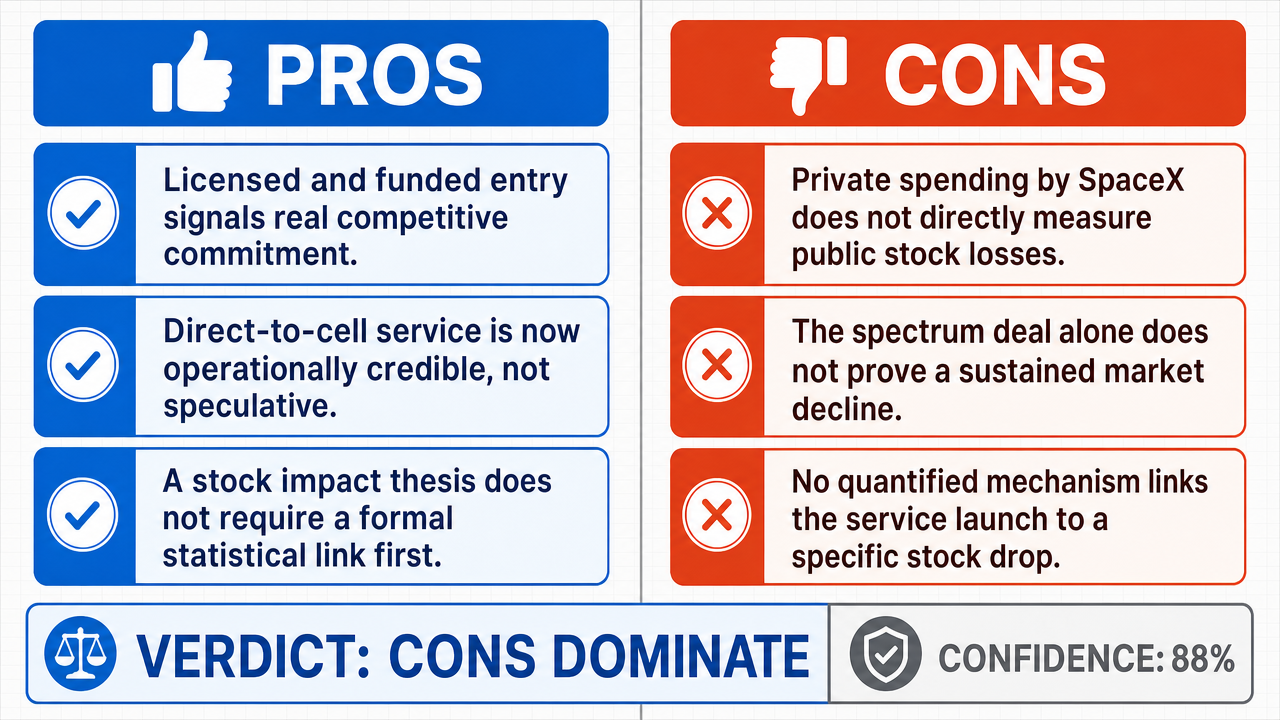
Verdict: likely FALSE (88%)
This section provides a brief overview of the key arguments. You do not need to read the full detailed report below.
✅ Key PRO arguments:
- ■SpaceX's $17 billion acquisition of EchoStar's 800 MHz MSS spectrum (announced 1 September 2025) represents a capitalized, licensed commitment that should force equity markets to re-price the terminal value of telecom incumbents , not merely 2026 revenue.
- ■The direct-to-cell entry is no longer hypothetical — it is licensed and capitalized at scale, so the market must incorporate the competitive threat into incumbent valuations.
- ■A formal statistical link (beta , correlation , or cointegration ) between SpaceX's private expenditure and public telecom stock prices is not logically required for equity markets to price in a competitive entrant effect.
❌ Key ANTI arguments:
- ■The affirmative commits a fundamental entity-substitution error: SpaceX's $17 billion private capital commitment is a measurement of a private balance sheet , not a measurement of AT&T, T-Mobile, or Verizon's market capitalization or cash flows , and no transfer operator (beta , correlation , cointegration ) bridges the two.
- ■The $17 billion spectrum acquisition is an anomaly that the affirmative's account does not explain, and it does not by itself justify a specific 15–20% sustained decline in incumbent telecom market caps by end of 2027.
- ■Even granting that direct-to-cell capability alters the competitive landscape , the affirmative provides no quantitative mechanism linking the magnitude of SpaceX's investment to the precise 15–20% sustained drop claimed in the assertion.
💭 Conclusion: False. The winning side correctly identified that the affirmative's argument suffers from a fatal entity-substitution error: it cites SpaceX's $17 billion private spectrum acquisition as evidence for a specific 15–20% sustained decline in the public market capitalization of AT&T, T-Mobile, and Verizon, but provides no transfer operator — no beta , correlation , or cointegration — to bridge a private company's capital commitment to a public incumbent's stock price. The affirmative's rebuttal that such a statistical link is not logically required does not resolve the problem, because the claim is not merely that competition exists but that it will produce a precise, sustained magnitude of de-rating by a specific date. Without a quantitative mechanism, the assertion is unfalsifiable speculation rather than a defensible forecast. The confidence is set at a high level rather than higher because the underlying competitive premise (that direct-to-cell is a real, capitalized threat) is partially supported by the EchoStar spectrum deal, even though the magnitude and timing of any stock-price impact remain unsubstantiated.
🔬 DeepResearch Result: likely FALSE ❌ (88%)
Assertion: SpaceX's direct-to-satellite mobile phone service and use of 800 MHz frequencies will cause a sustained 15-20% stock price drop for traditional telecom companies like AT&T, T-Mobile, and Verizon by the end of 2027.
Participating models: deepseek-v3.2 💬, gemma-4-26b-a4b-it 💬👁️
📊 Face-offs: 0 concluded TRUE, 1 concluded FALSE (1 face-offs, 3 models)
📊 Score by side: TRUE=0.00, FALSE=0.88
🏅 Model score changes:
minimax-m3 💬👁️: +9
✅ PRO Arguments:
- ■SpaceX's $17 billion acquisition of EchoStar's 800 MHz MSS spectrum (announced 1 September 2025) represents a capitalized, licensed commitment that should force equity markets to re-price the terminal value of telecom incumbents , not merely 2026 revenue. deepseek-v3.2 💬
- ■The direct-to-cell entry is no longer hypothetical — it is licensed and capitalized at scale, so the market must incorporate the competitive threat into incumbent valuations. deepseek-v3.2 💬
- ■A formal statistical link (beta , correlation , or cointegration ) between SpaceX's private expenditure and public telecom stock prices is not logically required for equity markets to price in a competitive entrant effect. deepseek-v3.2 💬
❌ ANTI Arguments:
- ■The affirmative commits a fundamental entity-substitution error: SpaceX's $17 billion private capital commitment is a measurement of a private balance sheet , not a measurement of AT&T, T-Mobile, or Verizon's market capitalization or cash flows , and no transfer operator (beta, correlation, cointegration) bridges the two. gemma-4-26b-a4b-it 💬👁️
- ■The $17 billion spectrum acquisition is an anomaly that the affirmative's account does not explain, and it does not by itself justify a specific 15–20% sustained decline in incumbent telecom market caps by end of 2027. gemma-4-26b-a4b-it 💬👁️
- ■Even granting that direct-to-cell capability alters the competitive landscape , the affirmative provides no quantitative mechanism linking the magnitude of SpaceX's investment to the precise 15–20% sustained drop claimed in the assertion. gemma-4-26b-a4b-it 💬👁️
💭 Reasoning: False. The winning side correctly identified that the affirmative's argument suffers from a fatal entity-substitution error: it cites SpaceX's $17 billion private spectrum acquisition as evidence for a specific 15–20% sustained decline in the public market capitalization of AT&T, T-Mobile, and Verizon, but provides no transfer operator — no beta, correlation, or cointegration — to bridge a private company's capital commitment to a public incumbent's stock price. The affirmative's rebuttal that such a statistical link is not logically required does not resolve the problem, because the claim is not merely that competition exists but that it will produce a precise, sustained magnitude of de-rating by a specific date. Without a quantitative mechanism, the assertion is unfalsifiable speculation rather than a defensible forecast. The confidence is set at a high level rather than higher because the underlying competitive premise (that direct-to-cell is a real, capitalized threat) is partially supported by the EchoStar spectrum deal, even though the magnitude and timing of any stock-price impact remain unsubstantiated.
📋 PRO Facts:
• On 1 September 2025, SpaceX announced an agreement to acquire EchoStar's mobile-satellite-service spectrum holdings, including the 800 MHz band and AWS-4 2 GHz , for approximately $17 billion.
📋 ANTI Facts:
• The $17 billion figure measures a private entity 's balance sheet expenditure, not the public incumbents' market capitalization or cash flows.
• No beta, correlation, or cointegration was provided linking SpaceX's private spectrum investment to AT&T, T-Mobile, or Verizon stock returns.
| Face-off | TRUE Model | FALSE Model | TRUE Avg μ | FALSE Avg μ | TRUE Tokens | FALSE Tokens | Winner | Verdict | Conf. |
|---|---|---|---|---|---|---|---|---|---|
| #1 | deepseek-v3.2 💬 | gemma-4-26b-a4b-it 💬👁️ | 0.441 | 0.248 | 8 | 2 | TRUE | FALSE | 88% |
The following technical terms, abbreviations, and domain-specific concepts are referenced throughout this debate transcript. Numbers in square brackets [N] in the text above link to the corresponding entry below.
[1] 800 MHz — 800 megahertz — A radio frequency band used for mobile communications; in the debate it is cited as the spectrum SpaceX acquired for direct-to-cell service.
[2] anomaly — In statistics and finance, an observation or data point that deviates significantly from the expected pattern; the negative debater describes the $17 billion figure as an anomaly their account does not yet explain.
[3] AWS-4 — Advanced Wireless Services-4 (2 GHz band) — A specific block of spectrum in the 2 GHz range acquired alongside the 800 MHz band in the EchoStar transaction discussed in the debate.
[4] balance sheet — A financial statement summarizing a company's assets, liabilities, and equity at a point in time; the negative debater argues that SpaceX's balance sheet measurement says nothing about the incumbents' valuation.
[5] beta — A measure of an asset's sensitivity to movements in the overall market, used in finance to quantify systematic risk; cited in the debate as a potential link between private and public valuations.
[6] capital expenditure — capex — Funds used by a company to acquire, upgrade, or maintain physical assets; the affirmative notes the $17 billion commitment exceeds AT&T's or Verizon's annual capital expenditure.
[7] cash flows — The net movement of money into and out of a business; the negative debater argues the $17 billion figure does not measure the incumbents' cash flows.
[8] cointegration — An econometric property indicating that two or more time series move together over the long run despite short-term deviations; cited in the debate as a potential statistical link between private and public valuations.
[9] competitive landscape — The structure of competitors and competitive dynamics within an industry; the negative debater argues direct-to-cell capability fundamentally alters the competitive landscape.
[10] correlation — A statistical measure of the degree to which two variables move together; cited in the debate as a potential link between SpaceX's private expenditure and public telecom valuations.
[11] de-rating — A sustained reduction in a stock's valuation multiple (such as P/E or EV/EBITDA) relative to peers or its own history; the affirmative claims a 15–20% telecom de-rating by 2027.
[12] direct-to-cell — A satellite service architecture allowing standard mobile phones to connect directly to satellites without specialized hardware; the core technology at issue in the debate.
[13] direct-to-device — A satellite service allowing ordinary consumer devices (such as phones) to connect directly to satellites; used interchangeably with direct-to-cell in the debate.
[14] discount parameters — Inputs to a valuation model (such as discount rate or risk premium) used to convert future cash flows into present value; the negative debater argues no mechanism forces a change in the discount parameters of the public carriers.
[15] entrant — A new participant entering an established market; the affirmative characterizes SpaceX as a facilities-based national mobile entrant.
[16] equity risk premium — The excess return demanded by investors for holding equities over a risk-free asset; cited in the debate as a valuation parameter the negative debater argues is unaffected by the transaction.
[17] equity value — The total value of a company's outstanding shares, equal to market capitalization; the negative debater argues the $17 billion figure says nothing about the equity value of the incumbents.
[18] facilities-based — A telecom business model in which the carrier owns or controls the underlying network infrastructure (towers, spectrum, backhaul) rather than reselling another carrier's capacity; the affirmative argues SpaceX becomes a facilities-based national mobile entrant.
[19] forward-looking — Based on expectations about future events rather than historical data; the affirmative argues markets price forward-looking risks even when no historical correlation exists.
[20] GHz — gigahertz — A unit of frequency equal to one billion hertz, used to designate radio spectrum bands; the AWS-4 band is described as 2 GHz.
[21] incumbents — Established companies already operating in a market; the debate refers to AT&T, T-Mobile, and Verizon as the incumbent terrestrial carriers.
[22] large cap — large capitalization — A category of publicly traded companies with the largest market capitalizations; the debate is organized under a 'Large Cap' facet referring to the major telecom stocks.
[23] market capitalization — The total market value of a company's outstanding shares, calculated as share price multiplied by shares outstanding; the negative debater argues the $17 billion figure is not a measurement of the incumbents' market capitalization.
[24] MHz — megahertz — A unit of frequency equal to one million hertz, used to designate radio spectrum bands; the 800 MHz band is central to the debate.
[25] mobile-satellite-service spectrum — MSS spectrum — Radio frequencies allocated for mobile-satellite communications; the EchoStar acquisition included MSS spectrum holdings used for the direct-to-cell network.
[26] private entity — A company whose shares are not publicly traded; the negative debater emphasizes that SpaceX is a private entity whose balance sheet is distinct from the public incumbents.
[27] publicly traded entities — Companies whose shares are listed and traded on public stock exchanges; AT&T, T-Mobile, and Verizon are described as publicly traded entities in the debate.
[28] re-rating — A change in the valuation multiple (such as P/E or EV/EBITDA) that the market assigns to a stock or sector; the affirmative argues the market must re-price terminal value through a re-rating.
[29] spectrum — radio spectrum — The range of radio frequencies used for wireless communications; in the debate, spectrum refers to the licensed frequency bands (800 MHz, AWS-4) acquired by SpaceX.
[30] structural cost advantage — A persistent cost benefit arising from a firm's underlying business model or asset base rather than from temporary factors; the affirmative argues SpaceX gains a structural cost advantage by owning spectrum and satellites.
[31] substitution — In economics, the replacement of one good or service by another; the negative debater accuses the affirmative of substituting the valuation of a private company for that of public incumbents.
[32] terminal value — The present value of all future cash flows beyond an explicit forecast period in a discounted cash flow model; the affirmative argues the market must re-price terminal value, not just near-term revenue.
[33] terrestrial cell towers — Ground-based cellular network infrastructure; the affirmative cites SpaceX's stated goal of letting customers 'cut the cord' on terrestrial cell towers.
[34] transfer operator — In the debate, a mechanism that links or translates between two different valuation contexts (here, SpaceX's private expenditure and the public market's valuation of incumbents); the negative debater argues no such transfer operator is provided.
[35] wholesaler — In telecom, a carrier that sells network capacity or services to other carriers rather than directly to end users; the affirmative argues the EchoStar acquisition converts SpaceX from a capacity wholesaler to a facilities-based entrant.
The following financial data tables were referenced during the debate exchanges:
| Scenario (constant dividend) | Current required yield | Post-entry required yield | Implied price decline |
|---|---|---|---|
| Mild re-rating | 6.0% | 7.0% | -14.3% |
| Central case | 6.0% | 7.3% | -17.8% |
| Upper case | 6.0% | 7.5% | -20.0% |
Legend: Illustrative sensitivity of a constant-dividend, bond-proxy-style stock to a rise in the required yield. Price is proportional to D/y, so the implied decline is 1 − (6.0 / new yield). The 6.0% starting yield is an assumed input, not an attributed statistic; the only quantity that matters is the required-yield shift (100–150 basis points).
Face-off transcripts
- ■
Ownership & Trade Secrets. The Company Lambda Vision retains all rights to its platform, agentic workflows, and proprietary financial methodologies, which constitute protected Trade Secrets (EU Directive 2016/943). Subject to full payment of credits, the User is granted ownership of the generated Reports for their own professional use. Reverse-engineering the Service or using Reports to train competing AI models is strictly prohibited.
- ■
No Financial Advice. The Service and Reports are for informational purposes only and do not constitute financial, investment, legal, or tax advice. The Company is not a regulated financial advisor. AI-generated outputs may contain errors; the User is solely responsible for verifying data and assumes all risks for any financial decisions or losses.
- ■
Liability & Governing Law. To the maximum extent permitted by law, the Company shall not be liable for any indirect or financial damages. These Terms are governed by French law. Any disputes shall be subject to the exclusive jurisdiction of the Courts of Paris, France.