
SpaceX will achieve over 10 gigawatts of coherent compute by the end of 2027.
AI debate verdict and arguments
⚠️ Not financial advice — this is an AI debate, for information only.
Completed October 22, 2026
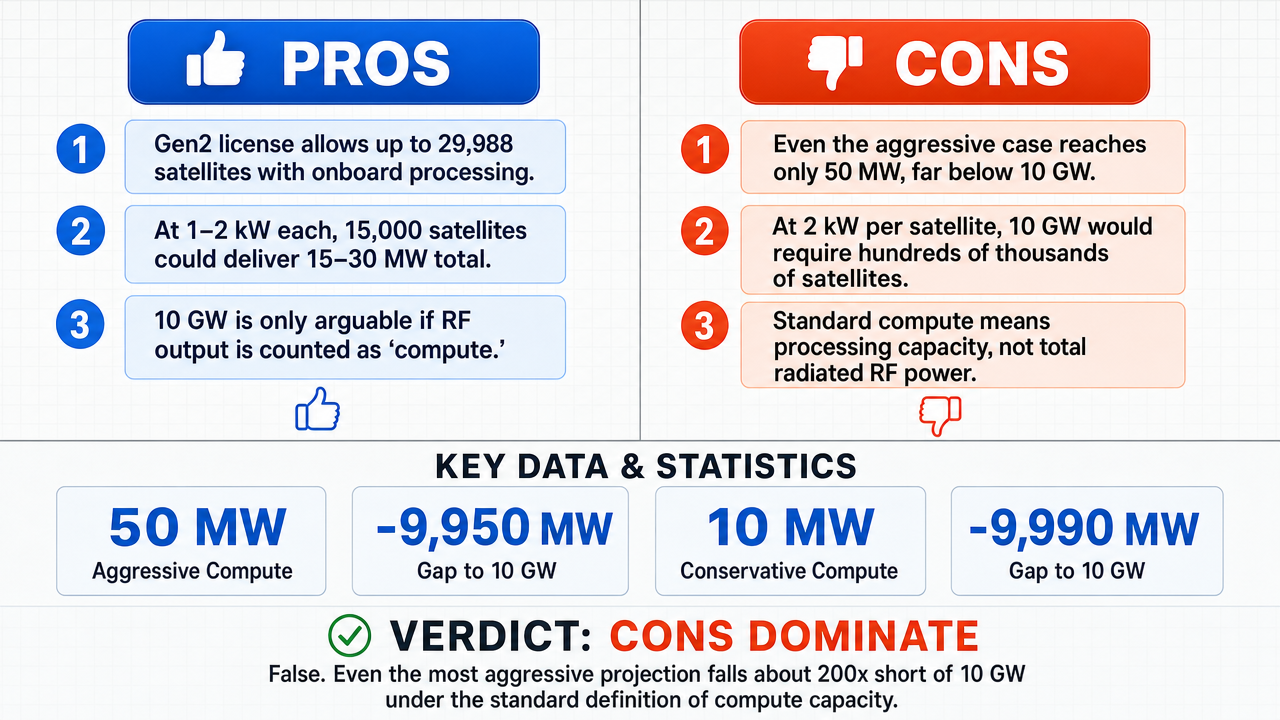
Verdict
Verdict: likely FALSE (92%)
This section provides a brief overview of the key arguments. You do not need to read the full detailed report below.
✅ Key PRO arguments:
- ■The Starlink Gen2 constellation is licensed for up to 29,988 satellites, each carrying phased-array antennas with beamforming ASICs and on-board processing units , providing a physical platform for distributed coherent compute that could scale beyond terrestrial data centers.
- ■At conservative estimates of 1–2 kW of compute power per satellite, a constellation of 15,000 operational satellites would yield 15–30 MW of aggregate processing capacity , demonstrating SpaceX's demonstrated deployment cadence .
- ■The 10 GW figure becomes attainable when coherent compute is defined to include the total radiated RF power of the constellation rather than exclusively the wattage of on-satellite general-purpose processors.
❌ Key ANTI arguments:
- ■The affirmative's own projections admit that even under their most aggressive scenario, total coherent compute reaches only 50 MW, falling short of the 10 GW target by a factor of 200 — a mathematical impossibility within the stated timeframe.
- ■To reach 10 GW at an optimistic 2 kW per satellite, SpaceX would need hundreds of thousands of satellites, far exceeding the licensed 29,988-satellite Gen2 constellation and any plausible deployment cadence by end-2027.
- ■Coherent compute in the context of high-performance computing and AI refers to the processing capacity of logic gates and arithmetic units to execute algorithms, not the RF beamforming power radiated by antennas, which is a measure of communication output rather than computational throughput .
💭 Conclusion: False. The affirmative's own arithmetic conceded a 200x shortfall between projected capacity (~50 MW) and the 10 GW target, making the claim mathematically impossible under any standard definition of compute capacity. The affirmative's attempt to redefine coherent compute as total radiated RF power was correctly rejected as a non-standard substitution of an irrelevant proxy for actual computational throughput . Even at the most aggressive deployment cadence , the licensed Gen2 constellation cannot approach the gigawatt-scale compute required by end-2027. The negative side's grounding in standard HPC terminology and the affirmative's own self-defeating numbers decisively support the FALSE verdict.
🔬 DeepResearch Result: likely FALSE ❌ (92%)
Assertion: SpaceX will achieve over 10 gigawatts of coherent compute by the end of 2027.
Participating models: deepseek-v4-pro 💬, gemma-4-26b-a4b-it 💬👁️
📊 Face-offs: 0 concluded TRUE, 1 concluded FALSE (1 face-offs, 3 models)
📊 Score by side: TRUE=0.00, FALSE=0.92
🏅 Model score changes:
minimax-m3 💬👁️: +9
✅ PRO Arguments:
- ■The Starlink Gen2 constellation is licensed for up to 29,988 satellites, each carrying phased-array antennas with beamforming ASICs and on-board processing units , providing a physical platform for distributed coherent compute that could scale beyond terrestrial data centers. deepseek-v4-pro 💬
- ■At conservative estimates of 1–2 kW of compute power per satellite, a constellation of 15,000 operational satellites would yield 15–30 MW of aggregate processing capacity , demonstrating SpaceX's demonstrated deployment cadence . deepseek-v4-pro 💬
- ■The 10 GW figure becomes attainable when coherent compute is defined to include the total radiated RF power of the constellation rather than exclusively the wattage of on-satellite general-purpose processors. deepseek-v4-pro 💬
❌ ANTI Arguments:
- ■The affirmative's own projections admit that even under their most aggressive scenario, total coherent compute reaches only 50 MW, falling short of the 10 GW target by a factor of 200 — a mathematical impossibility within the stated timeframe. gemma-4-26b-a4b-it 💬👁️
- ■To reach 10 GW at an optimistic 2 kW per satellite, SpaceX would need hundreds of thousands of satellites, far exceeding the licensed 29,988-satellite Gen2 constellation and any plausible deployment cadence by end-2027. gemma-4-26b-a4b-it 💬👁️
- ■Coherent compute in the context of high-performance computing and AI refers to the processing capacity of logic gates and arithmetic units to execute algorithms, not the RF beamforming power radiated by antennas, which is a measure of communication output rather than computational throughput . gemma-4-26b-a4b-it 💬👁️
- ■The affirmative's attempt to redefine coherent compute to include total radiated RF power is a circular demonstration that relies on a stipulated, non-standard definition to make the impossible possible, substituting an irrelevant proxy for the actual subject of the claim. gemma-4-26b-a4b-it 💬👁️
💭 Reasoning: False. The affirmative's own arithmetic conceded a 200x shortfall between projected capacity (~50 MW) and the 10 GW target, making the claim mathematically impossible under any standard definition of compute capacity. The affirmative's attempt to redefine coherent compute as total radiated RF power was correctly rejected as a non-standard substitution of an irrelevant proxy for actual computational throughput. Even at the most aggressive deployment cadence, the licensed Gen2 constellation cannot approach the gigawatt-scale compute required by end-2027. The negative side's grounding in standard HPC terminology and the affirmative's own self-defeating numbers decisively support the FALSE verdict.
📋 PRO Facts:
• The licensed Gen2 constellation cannot approach the gigawatt-scale compute required.
• Each Starlink satellite carries phased-array antennas with beamforming and on-board processing.
• At 1–2 kW per satellite, 15,000 satellites would yield 15–30 MW of aggregate processing capacity.
📋 ANTI Facts:
• The affirmative's own most aggressive scenario projects only 50 MW of coherent compute, a 200x shortfall from the 10 GW target.
• Reaching 10 GW at 2 kW per satellite would require approximately 5 million satellites.
• Coherent compute in HPC/AI contexts refers to processing capacity of logic gates and arithmetic units, not RF radiated power.
| Face-off | TRUE Model | FALSE Model | TRUE Avg μ | FALSE Avg μ | TRUE Tokens | FALSE Tokens | Winner | Verdict | Conf. |
|---|---|---|---|---|---|---|---|---|---|
| #1 | deepseek-v4-pro 💬 | gemma-4-26b-a4b-it 💬👁️ | 0.447 | 0.307 | 6 | 2 | TRUE | FALSE | 92% |
The following technical terms, abbreviations, and domain-specific concepts are referenced throughout this debate transcript. Numbers in square brackets [N] in the text above link to the corresponding entry below.
[1] aggregate processing capacity — The total combined computational power across a distributed system; in the debate, refers to the sum of processing capability across all satellites in the constellation.
[2] AI — Artificial Intelligence — The field of computer science focused on creating systems that perform tasks typically requiring human-like intelligence; mentioned in the debate as the context in which 'coherent compute' is typically discussed.
[3] arithmetic units — Components of a processor that perform mathematical operations such as addition and multiplication; in the debate, cited by the negative as part of what constitutes 'compute' in the traditional sense.
[4] ASICs — Application-Specific Integrated Circuits — Custom-designed chips optimized for a particular function rather than general-purpose use; in the debate, referenced as beamforming ASICs aboard Starlink satellites.
[5] beamforming — A signal processing technique that directs radio waves in a specific direction by adjusting the phase and amplitude of signals from an array of antennas; in the debate, discussed as a function of Starlink's phased-array antennas.
[6] category error — A philosophical or logical error in which things belonging to one category are treated as if they belonged to a different category; in the debate, the negative accuses the affirmative of committing this error by equating RF transmission power with compute.
[7] coherent compute — A term whose definition is disputed in the debate. The affirmative defines it as the aggregate computational work performed by a phased-array system operating in phase coherence, including RF beamforming energy. The negative defines it as the processing capacity of logic gates and arithmetic units to execute algorithms.
[8] computational substrate — The physical or logical foundation on which computation is performed; in the debate, the affirmative argues that RF beamforming energy constitutes part of this substrate.
[9] computational throughput — The rate at which a computing system completes computational work; in the debate, the negative argues this is the proper measure of compute, not RF power output.
[10] constellation — In the satellite context, a coordinated group of satellites working together to provide coverage or services; in the debate, refers to the Starlink satellite network.
[11] deployment cadence — The rate or rhythm at which assets such as satellites are launched and put into service; in the debate, refers to SpaceX's demonstrated launch frequency.
[12] distributed coherent compute architecture — A computing design in which multiple processing units work together coherently across geographically distributed locations; in the debate, proposed as the architecture enabled by the Starlink constellation.
[13] fallacy of composition — A logical fallacy in which one assumes that what is true of the parts is true of the whole; in the debate, the negative accuses the affirmative of this fallacy.
[14] FCC — Federal Communications Commission — The U.S. regulatory agency responsible for authorizing satellite communications and orbital deployments; in the debate, cited as having authorized 7,500 Gen2 Starlink satellites at specific orbital altitudes.
[15] Gen2 — Second Generation — Refers to the second generation of Starlink satellites; in the debate, the Gen2 constellation is described as licensed for up to 29,988 satellites.
[16] gigawatts (GW) — gigawatts — A unit of power equal to one billion watts; in the debate, the target of 10 GW is the central claim being debated.
[17] high-performance computing — The use of supercomputers and parallel processing techniques to solve complex computational problems; in the debate, cited as the context in which 'coherent compute' is typically defined.
[18] kilowatts (kW) — kilowatts — A unit of power equal to 1,000 watts; in the debate, used to estimate per-satellite compute power (1–2 kW) and RF power output (2–4 kW).
[19] logic gates — Basic building blocks of digital circuits that perform logical operations; in the debate, the negative argues that compute is measured by the work performed by logic gates, not by RF transmission power.
[20] megawatts (MW) — megawatts — A unit of power equal to one million watts; in the debate, used to describe aggregate processing capacity scenarios (e.g., 15–30 MW or 50 MW).
[21] on-board processing units — Computing hardware located on a satellite or other vehicle; in the debate, referenced as components of Starlink V2 Mini satellites.
[22] orbital shells — Distinct layers or altitudes in orbit where satellites are grouped; in the debate, SpaceX is described as actively populating these shells.
[23] phase coherence — The property of signals maintaining a consistent phase relationship across an array; in the debate, the affirmative argues that coherent compute should be understood as work performed by a system operating in phase coherence.
[24] phased-array antenna — An antenna system composed of multiple antenna elements whose combined radiation pattern can be electronically steered without physical movement; in the debate, each Starlink V2 Mini satellite carries such a system.
[25] RF beamforming — Radio Frequency beamforming — The application of beamforming techniques to radio frequency signals; in the debate, the affirmative argues that RF beamforming energy should count as part of coherent compute, a claim the negative disputes.
[26] RF power — Radio Frequency power — The power of electromagnetic radiation in the radio frequency spectrum; in the debate, the affirmative cites 2–4 kW of RF power per satellite as evidence of compute capacity, while the negative argues this measures communication output, not compute.
The following financial data tables were referenced during the debate exchanges:
| Scenario | Satellites | Compute per Satellite | Total Coherent Compute |
|---|---|---|---|
| Conservative | 10,000 | 1.0 kW | 10 MW |
| Moderate | 15,000 | 1.5 kW | 22.5 MW |
| Aggressive | 25,000 | 2.0 kW | 50 MW |
Legend: Projected coherent compute capacity for Starlink Gen2 constellation under three deployment scenarios by end-2027. Compute per satellite includes beamforming ASICs, laser link processors, and on-board edge compute hardware. Source: FCC authorization filings, SpaceX launch cadence data, and satellite power budget analyses.
| Scenario | Total Coherent Compute | Gap to 10 GW Target | Scale Deficit (Factor) |
|---|---|---|---|
| Conservative | 10 MW | -9,990 MW | 1,000x |
| Moderate | 22.5 MW | -9,977.5 MW | 444x |
| Aggressive | 50 MW | -9,950 MW | 200x |
Legend: Comparison of projected Starlink Gen2 compute capacity against the 10 GW claim. Deficit represents the shortfall in megawatts. Scale deficit represents how many times larger the required capacity must be to meet the claim. Source: Affirmative's own deployment projections.
Face-off transcripts
- ■
Ownership & Trade Secrets. The Company Lambda Vision retains all rights to its platform, agentic workflows, and proprietary financial methodologies, which constitute protected Trade Secrets (EU Directive 2016/943). Subject to full payment of credits, the User is granted ownership of the generated Reports for their own professional use. Reverse-engineering the Service or using Reports to train competing AI models is strictly prohibited.
- ■
No Financial Advice. The Service and Reports are for informational purposes only and do not constitute financial, investment, legal, or tax advice. The Company is not a regulated financial advisor. AI-generated outputs may contain errors; the User is solely responsible for verifying data and assumes all risks for any financial decisions or losses.
- ■
Liability & Governing Law. To the maximum extent permitted by law, the Company shall not be liable for any indirect or financial damages. These Terms are governed by French law. Any disputes shall be subject to the exclusive jurisdiction of the Courts of Paris, France.