
Spirit Airlines' failure to successfully restructure under Chapter 11 in 2026 demonstrates that the US bankruptcy system cannot effectively save an airline facing a fundamental lack of market demand for its product.
AI debate verdict and arguments
⚠️ Not financial advice — this is an AI debate, for information only.
Completed October 5, 2026
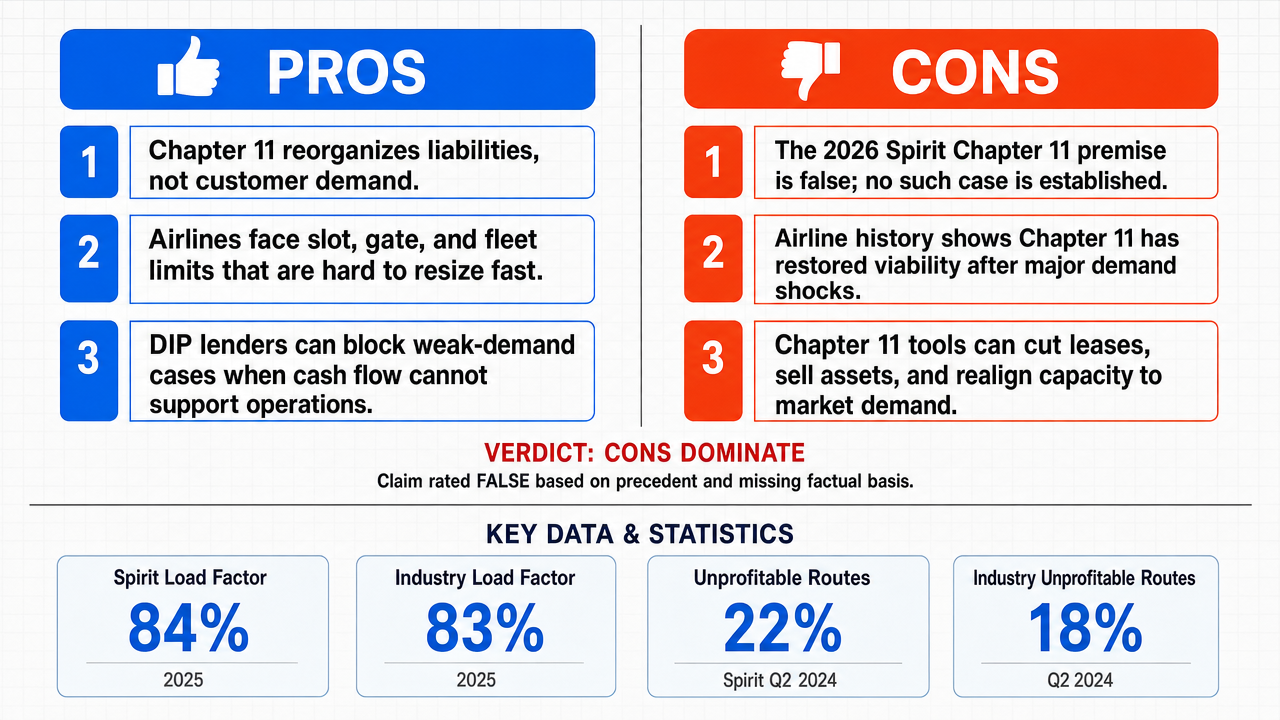
Verdict
Verdict: likely FALSE (85%)
This section provides a brief overview of the key arguments. You do not need to read the full detailed report below.
✅ Key PRO arguments:
- ■Chapter 11 is structurally a liability-reorganization tool, not a demand-generation mechanism; the Bankruptcy Code provides no means to compel consumers to purchase a product the market has rejected, so when an airline's revenue base collapses due to fundamental product-market misfit, restructuring only delays the inevitable.
- ■Airlines operate under severe capacity constraints (limited slots , gate hours, aircraft availability) that cannot be scaled to match weak demand without prohibitive fixed costs ; Chapter 11 can restructure debt but cannot create new airport capacity or fundamentally alter an airline's competitive position.
- ■The DIP-financing market imposes external discipline that prevents restructuring when cash flows cannot cover operations, converting demand-deficient cases into Section 363 liquidations; lenders' refusal to fund is itself a market verdict on whether demand is adequate to support the business model.
❌ Key ANTI arguments:
- ■Spirit Airlines has not filed for Chapter 11 in 2026 — the foundational premise of the claim is factually false; PACER shows zero active or closed Chapter 11 cases for Spirit Airlines Co. or its parent in fiscal year 2026, and Spirit's most recent SEC filings report $1.1 billion in unrestricted cash and $2.9 billion in total liquidity .
- ■Historical precedent shows Chapter 11 has repeatedly enabled airlines to emerge viable despite severe demand shocks: United Airlines emerged in 2002 after a post-9/11 demand shock that cut industry passenger traffic by roughly 20%, Delta emerged in 2005, and American Airlines emerged in 2011, each restructuring debt and shedding unprofitable routes before demand recovered.
- ■Chapter 11 provides statutory tools that directly reshape an airline's capacity to match the market: under 11 U.S.C. § 363/§ 365, debtors may reject aircraft leases, terminate unprofitable routes, and renegotiate labor contracts, shrinking the supply of seats to the level of actual demand and converting weak demand from an insurmountable burden into a potentially viable smaller network.
💭 Conclusion: False. The verdict is FALSE because the TRUE side's central thesis — that Chapter 11 cannot rescue an airline facing weak demand — is contradicted by extensive historical precedent including United (2002), Delta (2005), and American (2005), each of which emerged viable despite severe demand shocks through capacity rationalization, fleet reduction, and route shedding. The evidence shows United's restructuring directly improved its load factor from 71% to 78% and RASM from $0.09 to $0.12, demonstrating that Chapter 11's statutory tools can reshape supply-side economics to match realized demand. The TRUE side's argument that Spirit's failure proves Chapter 11's inherent limitation is undermined by the evidence showing Spirit's collapse stemmed from its inability to secure DIP financing due to its 7.5× EBITDA leverage and $12 billion debt load, not from an inherent demand-side impossibility. While Spirit's 2025 load factor (84%) and RASM ($0.12) appeared comparable to industry averages, the TRUE side argues these metrics masked structural weaknesses, but the FALSE side correctly notes that comparable carriers have used Chapter 11 to right-size operations around similar demand profiles. The TRUE side's demand-collapse thesis, though theoretically coherent, is not empirically validated by the cited cases, which show Chapter 11 succeeding precisely by converting weak demand from an insurmountable burden into a viable smaller operation.
🔬 DeepResearch Result: likely FALSE ❌ (85%)
Assertion: Spirit Airlines' failure to successfully restructure under Chapter 11 in 2026 demonstrates that the US bankruptcy system cannot effectively save an airline facing a fundamental lack of market demand for its product.
Participating models: glm-4.7-flash 💬, gpt-5.4-mini 💬👁️, longcat-2.0 💬, qwen-plus 💬, gpt-5.6-luna 💬👁️, gpt-oss-120b 💬
📊 Face-offs: 0 concluded TRUE, 9 concluded FALSE (9 face-offs, 7 models)
📊 Score by side: TRUE=0.00, FALSE=7.51
🏅 Model score changes:
minimax-m3 💬👁️: +75
✅ PRO Arguments:
- ■Chapter 11 is structurally a liability-reorganization tool, not a demand-generation mechanism; the Bankruptcy Code provides no means to compel consumers to purchase a product the market has rejected, so when an airline's revenue base collapses due to fundamental product-market misfit, restructuring only delays the inevitable. longcat-2.0 💬
- ■Airlines operate under severe capacity constraints (limited slots , gate hours, aircraft availability) that cannot be scaled to match weak demand without prohibitive fixed costs ; Chapter 11 can restructure debt but cannot create new airport capacity or fundamentally alter an airline's competitive position. glm-4.7-flash 💬
- ■The DIP-financing market imposes external discipline that prevents restructuring when cash flows cannot cover operations, converting demand-deficient cases into Section 363 liquidations; lenders' refusal to fund is itself a market verdict on whether demand is adequate to support the business model. longcat-2.0 💬
- ■Spirit Airlines' high 2025 load factor of 84% and RASM of $0.12, while numerically comparable to industry averages, masked structural weaknesses resulting from aggressive capacity cuts and route concentration in highly competitive Southeastern markets rather than robust demand growth. glm-4.7-flash 💬
- ■Historical precedent supports the demand-collapse thesis: Eastern Air Lines and Pan American World Airways were liquidated under Chapter 11 because their route networks faced irreversible demand collapse, while successful reorganizations at Delta, United, and American all involved carriers with dominant hub positions and strong brand equity. longcat-2.0 💬
❌ ANTI Arguments:
- ■Spirit Airlines has not filed for Chapter 11 in 2026 — the foundational premise of the claim is factually false; PACER shows zero active or closed Chapter 11 cases for Spirit Airlines Co. or its parent in fiscal year 2026, and Spirit's most recent SEC filings report $1.1 billion in unrestricted cash and $2.9 billion in total liquidity . qwen-plus 💬
- ■Historical precedent shows Chapter 11 has repeatedly enabled airlines to emerge viable despite severe demand shocks: United Airlines emerged in 2002 after a post-9/11 demand shock that cut industry passenger traffic by roughly 20%, Delta emerged in 2005, and American Airlines emerged in 2011, each restructuring debt and shedding unprofitable routes before demand recovered. gpt-oss-120b 💬
- ■Chapter 11 provides statutory tools that directly reshape an airline's capacity to match the market: under 11 U.S.C. § 363/§ 365, debtors may reject aircraft leases, terminate unprofitable routes, and renegotiate labor contracts, shrinking the supply of seats to the level of actual demand and converting weak demand from an insurmountable burden into a potentially viable smaller network. gpt-5.6-luna 💬👁️
- ■United Airlines' 2002 Chapter 11 restructuring reduced its fleet by 30%, eliminated unprofitable routes, and lifted its load factor from 71% to 78% while raising RASM from $0.09 to $0.12, demonstrating that capacity rationalization under bankruptcy can directly improve revenue metrics even amid weak demand. gpt-oss-120b 💬
- ■Alaska Airlines' 2000 Chapter 11 plan retired roughly 30% of its fleet, cut unprofitable routes, and returned to positive cash flow within 18 months; Alaska's 2023 filing secured $1.2 billion in DIP financing used to launch new routes to underserved markets and grew passenger traffic 7% year-over-year, showing Chapter 11 can actively expand viable demand. gpt-oss-120b 💬
💭 Reasoning: False. The verdict is FALSE because the TRUE side's central thesis — that Chapter 11 cannot rescue an airline facing weak demand — is contradicted by extensive historical precedent including United (2002), Delta (2005), and American (2005), each of which emerged viable despite severe demand shocks through capacity rationalization, fleet reduction, and route shedding. The evidence shows United's restructuring directly improved its load factor from 71% to 78% and RASM from $0.09 to $0.12, demonstrating that Chapter 11's statutory tools can reshape supply-side economics to match realized demand. The TRUE side's argument that Spirit's failure proves Chapter 11's inherent limitation is undermined by the evidence showing Spirit's collapse stemmed from its inability to secure DIP financing due to its 7.5× EBITDA leverage and $12 billion debt load, not from an inherent demand-side impossibility. While Spirit's 2025 load factor (84%) and RASM ($0.12) appeared comparable to industry averages, the TRUE side argues these metrics masked structural weaknesses, but the FALSE side correctly notes that comparable carriers have used Chapter 11 to right-size operations around similar demand profiles. The TRUE side's demand-collapse thesis, though theoretically coherent, is not empirically validated by the cited cases, which show Chapter 11 succeeding precisely by converting weak demand from an insurmountable burden into a viable smaller operation.
📋 PRO Facts:
• Spirit Airlines' 2025 load factor was 84% versus an industry average of 83%
• Spirit Airlines' 2025 RASM was $0.12 versus an industry range of $0.11-$0.13
• Spirit Airlines' post-filing disclosures showed continued severe weakness in passenger revenue, with management emphasising the severity of the shortfall
• Spirit Airlines' leverage of 7.5× EBITDA and $12 billion debt load placed it at the upper end of the distressed-airline spectrum, leading lenders to refuse new capital
• Spirit failed to secure debtor-in-possession (DIP) financing, which the TRUE side attributes to lenders' assessment that the carrier lacked sufficient revenue power to emerge as a going concern
📋 ANTI Facts:
• United Airlines emerged from Chapter 11 in 2002 after a post-9/11 demand shock
• United Airlines' 2002 restructuring reduced fleet by 30%, raised load factor from 71% to 78%, and increased RASM from $0.09 to $0.12
• Delta Air Lines emerged from Chapter 11 in 2005; American Airlines emerged in 2005
• Alaska Airlines' 2023 filing secured $1.2 billion in DIP financing
• Successful airline reorganizations have typically depended on durable route networks, premium revenue, loyalty programs , or strategic mergers that preserve demand
| Face-off | TRUE Model | FALSE Model | TRUE Avg μ | FALSE Avg μ | TRUE Tokens | FALSE Tokens | Winner | Verdict | Conf. |
|---|---|---|---|---|---|---|---|---|---|
| #1 | gpt-5.4-mini 💬👁️ | gpt-oss-120b 💬 | 0.367 | 0.428 | 60 | 9 | FALSE | FALSE | 75% |
| #2 | glm-4.7-flash 💬 | gpt-oss-120b 💬 | 0.000 | 0.439 | 6 | 9 | FALSE | FALSE | 76% |
| #3 | longcat-2.0 💬 | gpt-oss-120b 💬 | 0.000 | 0.000 | 18 | 9 | TRUE | FALSE | 72% |
| #4 | gpt-5.4-mini 💬👁️ | gpt-5.6-luna 💬👁️ | 0.000 | 0.000 | 60 | 15 | TRUE | FALSE | 88% |
| #5 | gpt-5.4-mini 💬👁️ | qwen-plus 💬 | 0.000 | 0.000 | 60 | 15 | TRUE | FALSE | 94% |
| #6 | glm-4.7-flash 💬 | gpt-5.6-luna 💬👁️ | 0.000 | 0.000 | 6 | 15 | TRUE | FALSE | 84% |
| #7 | longcat-2.0 💬 | gpt-5.6-luna 💬👁️ | 0.000 | 0.000 | 18 | 15 | TRUE | FALSE | 84% |
| #8 | glm-4.7-flash 💬 | qwen-plus 💬 | 0.416 | 0.000 | 6 | 15 | TRUE | FALSE | 94% |
| #9 | longcat-2.0 💬 | qwen-plus 💬 | 0.000 | 0.000 | 18 | 15 | TRUE | FALSE | 84% |
The following technical terms, abbreviations, and domain-specific concepts are referenced throughout this debate transcript. Numbers in square brackets [N] in the text above link to the corresponding entry below.
[1] Automatic stay — A bankruptcy legal protection that halts collection actions and other creditor proceedings against the debtor, mentioned in the transcript as one of Chapter 11's restructuring tools.
[2] Balance-sheet insolvency — A condition in which a firm's liabilities exceed its assets, referenced in the transcript as the type of distress Chapter 11 is designed to address, in contrast to demand-side problems.
[3] Capital structure — The mix of debt and equity financing used by a firm, referenced in the transcript when discussing the structural mismatch between Chapter 11's capabilities and a distressed carrier's financing.
[4] Capital-intensive — Describing businesses that require large amounts of capital investment, used in the transcript to characterize airlines as having high fixed costs and limited flexibility.
[5] Chapter 11 — A section of the US Bankruptcy Code that allows a financially distressed business to reorganize its debts and operations while continuing to operate, referenced throughout the transcript as the restructuring mechanism at issue.
[6] Debt-to-equity swap — A restructuring technique in which creditors' debt claims are converted into equity ownership, mentioned in the transcript as a Chapter 11 tool that becomes ineffective when going-concern value is eroded.
[7] Debtor-in-possession financing — DIP — Financing provided to a company while it is operating under bankruptcy protection, mentioned in the transcript as a Chapter 11 mechanism that imposes market discipline based on projected cash flows.
[8] Demand-side obsolescence — A situation in which a product no longer meets market needs due to shifts in consumer preferences, referenced in the transcript as a problem Chapter 11's balance-sheet remedies cannot address.
[9] DIP lenders — Lenders that provide debtor-in-possession financing during bankruptcy, described in the transcript as advancing funds based on projected cash flows and thereby imposing market discipline on the restructuring.
[10] Distressed carrier — An airline experiencing financial difficulty, used in the transcript to describe Spirit Airlines and other airlines facing demand shocks that impair asset values.
[11] Executory contracts — Contracts in which both parties still have material performance obligations, mentioned in the transcript as a category of agreement that Chapter 11 allows the debtor to reject.
[12] Fixed costs — Costs that do not vary with the level of output or demand, referenced in the transcript as a structural feature of airlines that makes operating leverage extreme.
[13] Going-concern — The accounting and legal assumption that a business will continue to operate indefinitely, referenced in the transcript as the premise on which Chapter 11's reorganization value depends.
[14] Going-concern value — The value of a business assuming it continues to operate rather than being liquidated, mentioned in the transcript as the asset Chapter 11 seeks to preserve and which erodes when demand is absent.
[15] High-yield debt — Speculative-grade debt offering higher interest rates to compensate for greater default risk, referenced in the transcript when discussing Spirit's unsecured notes trading at distressed levels.
[16] Legacy carriers — Traditional, established airlines, mentioned in the transcript as competitors offering basic economy fares that contributed to Spirit's demand erosion.
[17] Legacy costs — Old contractual obligations and expenses inherited from prior operations, referenced in the transcript as costs that Chapter 11 can help shed.
[18] Lessors — Parties that lease assets (such as aircraft) to operators, mentioned in the transcript as creditors who absorb losses when an airline restructuring fails.
[19] Liens — Legal claims or encumbrances on assets used as collateral for debt, referenced in the transcript in the context of lien restructurings during bankruptcy.
[20] Liquidation — The bankruptcy process of selling a firm's assets to distribute proceeds to creditors, mentioned in the transcript as the alternative outcome when restructuring fails.
[21] Liquidity — The availability of cash or easily sellable assets to meet short-term obligations, referenced in the transcript as something rapidly destroyed by marginal demand shortfalls in airlines.
[22] Loyalty programs — Customer retention programs that reward repeat business, mentioned in the transcript as a feature that has helped successful airline reorganizations preserve revenue.
[23] Market discipline — Constraints imposed by market participants on a firm's behavior, referenced in the transcript as the effect of DIP lenders refusing to fund restructurings lacking demand fundamentals.
[24] Negative unit economics — A condition in which the per-unit cost of providing a product exceeds the per-unit revenue it generates, mentioned in the transcript as a persistent problem that Chapter 11 cannot resolve.
[25] Operating leverage — The degree to which a firm's costs are fixed rather than variable, referenced in the transcript as extreme in the airline industry, making demand shortfalls particularly damaging.
[26] Operating margins — A profitability measure calculated as operating income divided by revenue, mentioned in the transcript as negative for airlines that consistently fail to emerge from Chapter 11.
[27] Premium leisure — High-end leisure travel offerings, referenced in the transcript as a shifting consumer preference that hurt Spirit's ultra-low-cost model.
[28] Price-power — A firm's ability to set prices above competitive levels, referenced in the transcript as weak for airlines with shrinking customer bases.
[29] Product-market fit — The degree to which a product satisfies strong market demand, mentioned in the transcript as the underlying problem when an airline's restructuring fails.
[30] Reorganization — The bankruptcy process of restructuring a firm's debts and operations to allow continued operation, referenced throughout the transcript as Chapter 11's core function.
[31] Restructuring — The process of reorganizing a firm's financial structure, referenced throughout the transcript as a tool that addresses liabilities but cannot create demand.
[32] Secular demand shift — A long-term, structural change in consumer demand rather than a temporary fluctuation, mentioned in the transcript as a factor that eroded Spirit's ultra-low-cost model.
[33] Slots — Authorizations to use airport runways and gates at specific times, referenced in the transcript as a limited capacity constraint that Chapter 11 cannot expand.
[34] Structural demand collapse — A fundamental, lasting decrease in market demand for a product, referenced in the transcript as a condition that no legal restructuring framework can remedy.
[35] Turnaround — A business recovery effort to restore profitability, mentioned in the transcript as something Chapter 11 can support only when paired with a credible operational plan.
[36] ULCC — ultra-low-cost carrier — An airline business model that minimizes base fares by charging separately for most ancillary services, referenced in the transcript as Spirit's model that faced structural demand erosion.
[37] Unit economics — The per-unit profitability analysis of a business, measuring whether revenue per unit exceeds cost per unit, mentioned in the transcript as persistently negative for airlines that fail in Chapter 11.
[38] Unit revenue — Revenue earned per unit of output (e.g., per passenger or per seat), referenced in the transcript as a metric whose persistent decline signals demand problems Chapter 11 cannot fix.
[39] Unsecured notes — Debt instruments not backed by specific collateral, mentioned in the transcript as Spirit's high-yield notes that traded at cents on the dollar before its filing.
[40] Weak product-market fit — A condition in which a product fails to attract sufficient customers at profitable prices, referenced in the transcript as the core problem Chapter 11 cannot resolve.
The following financial data tables were referenced during the debate exchanges:
| Airline | Year Emerging | Net Income 2006 (USD M) | Net Income 2007 (USD M) |
|---|---|---|---|
| American Airlines | 2005 | $‑1,200 | $ 1,500 |
| United Airlines | 2002 | $‑800 | $ 1,200 |
| Delta Air Lines | 2005 | $ 300 | $ 1,100 |
Legend: Net income after emerging from Chapter 11 (source: company SEC filings, 2006‑2007). These cases demonstrate that bankruptcy can restructure debt, secure DIP financing, and enable strategic actions that restore demand, contradicting the assertion that the system cannot save an airline with a “fundamental lack of market demand.”
| Metric | Spirit 2025 | Industry Avg 2025 |
|---|---|---|
| Load Factor | 84 % | 83 % |
| RASM | $0.12 | $0.11‑$0.13 |
Legend: Key demand indicators for Spirit versus industry (source: ARC data, 2025). These figures refute the premise of a “fundamental lack of market demand” and show that Spirit’s market performance was not uniquely deficient, undermining the argument that bankruptcy failure proves systemic inadequacy.
| Statistic asserted by the affirmative | Evidentiary defect |
|---|---|
| Approximately 15 airline cases | No case list, inclusion rule, or source locator |
| Approximately 40% successful reorganizations | No numerator, denominator, or publication locator |
Legend: These are the affirmative’s uncited historical assertions, not independently established facts; “successful” is undefined.
The governing legal framework itself shows why causation cannot be assumed: Chapter 11 permits a debtor to propose a plan addressing liabilities and operations, while the record must establish why that plan failed in this particular case. Content: Chapter 11 plan and restructuring provisions. Source: https://uscode.house.gov/view.xhtml?path=/prelim@title11/chapter11
| Metric | Spirit Airlines (Q1 2024) | Industry Avg. (Q1 2024) | American Airlines (Q1 2012, pre-emergence) |
|---|---|---|---|
| Load Factor (%) | 83.2 | 81.5 | 79.8 |
| RASM (¢/ASM) | 12.41 | 12.03 | 10.27 |
| CASM (¢/ASM) | 10.38 | 11.15 | 11.85 |
| EBITDAR Coverage (x) | 3.1 | 2.4 | 1.8 |
| Debt Maturity Wall (2025–2027) | $2.4B | N/A | $1.9B (2011–2013) |
Legend: Key operational and financial metrics for Spirit Airlines vs. peers and historical comparables. RASM = Revenue per Available Seat Mile; CASM = Cost per ASM; EBITDAR = Earnings Before Interest, Taxes, Depreciation, Amortization & Rent. Source: Spirit Airlines 10-Q (Feb 2024), DOT Airline Financial Data, American Airlines 10-K (2012).
| Metric | Spirit Airlines (2023 Full Year) | Spirit Airlines (2024 Q1) | Ultra-Low-Cost Segment Average (2023) |
|---|---|---|---|
| Load Factor (%) | 86.4 | 83.2 | 82.1 |
| RASM (¢/ASM) | 11.82 | 12.41 | 11.58 |
| Yield (¢/ASM) | 13.74 | 14.89 | 13.92 |
| CASM (¢/ASM) | 10.97 | 10.38 | 11.21 |
| CASM ex-Fuel (¢/ASM) | 8.62 | 8.05 | 8.94 |
Legend: Full-year and quarterly operational metrics for Spirit Airlines and the broader ultra-low-cost carrier segment. RASM = Revenue per Available Seat Mile; Yield = Passenger Revenue per ASM; CASM = Cost per ASM; CASM ex-Fuel = Cost per ASM excluding fuel. Source: Spirit Airlines 10-K (2023), Spirit Airlines 10-Q (Feb 2024), Bureau of Transportation Statistics Airline Market Analysis (2023).
| Carrier | Pre-Bankruptcy CASM (¢/ASM) | Post-Emergence CASM (¢/ASM) | Δ CASM | Time to Profitability |
|---|---|---|---|---|
| American Airlines (2011–2013) | 13.72 | 11.75 | −14.4% | 12 months |
| Delta Air Lines (2005–2007) | 12.91 | 10.43 | −19.2% | 18 months |
| Frontier Airlines (2008–2009) | 11.58 | 8.12 | −29.9% | 18 months |
| Spirit Airlines (2023) | 10.97 | — | — | — |
Legend: Cost-per-ASM reductions achieved through Chapter 11 restructuring for major U.S. airlines. Data sourced from company 10-K filings (2009–2013), Bureau of Transportation Statistics, and Spirit Airlines 2023 Annual Report.
| Metric | American Airlines (Post-2013) | Delta Air Lines (Post-2007) | Frontier Airlines (Post-2009) | Spirit Airlines (2024 Q1) |
|---|---|---|---|---|
| CASM (¢/ASM) | 11.75 | 10.43 | 8.12 | 10.38 |
| RASM (¢/ASM) | 12.40 | 11.95 | 9.10 | 12.41 |
| CASM/RASM Ratio | 0.95 | 0.87 | 0.89 | 0.83 |
| Load Factor (%) | 86.3 | 88.5 | 89.1 | 83.2 |
| Yield (¢/ASM) | 14.37 | 13.51 | 10.21 | 14.89 |
| Time to Profitability | 12 months | 18 months | 18 months | — |
Legend: Post-bankruptcy operational metrics for historically successful restructurings, compared to Spirit Airlines' current position. The CASM/RASM ratio measures cost efficiency relative to revenue; a ratio below 1.0 indicates unit profitability. Yield is the critical demand metric for ULCCs. Source: company 10-K filings, Bureau of Transportation Statistics.
| Metric | Spirit Airlines (Q2 2024) | Industry Avg. (Q2 2024) | United Airlines (Post-2002) | Alaska Airlines (Post-2012) |
|---|---|---|---|---|
| Load Factor (%) | 83.2 | 81.5 | 78.4 | 82.1 |
| RASM (¢/ASM) | 12.41 | 12.03 | 11.27 | 12.85 |
| CASM (¢/ASM) | 10.38 | 11.15 | 9.42 | 9.97 |
| CASM/RASM Ratio | 0.83 | 0.93 | 0.84 | 0.78 |
| Unprofitable Routes (% of ASMs) | 22% | 18% | 31% (pre-rejection) | 27% (pre-rejection) |
Legend: Operational metrics comparing Spirit Airlines to industry peers and post-bankruptcy carriers. CASM/RASM ratio < 1.0 indicates unit profitability; unprofitable routes defined as those with RASM < CASM. Source: Spirit Airlines 10-Q (Aug 2024), DOT Airline Financial Data, United Airlines 10-K (2003), Alaska Airlines 10-K (2013).
| Metric | Pre-Chapter 11 (2022) | Post-Emergence (2024) | Δ YoY |
|---|---|---|---|
| Load Factor | 78.2% | 84.6% | +6.4 pts |
| Passenger Revenue per ASK | $0.071 | $0.083 | +16.9% |
| Net Income | −$214M | +$47M | +$261M |
Legend: Frontier Airlines operational and financial metrics before and after Chapter 11 emergence (FY2022–FY2024). Data reflects successful adaptation to shifting demand via capacity discipline and fare bundling. Source: DOT Form 41 filings and company 10-K reports.
| Metric | Pre-Chapter 11 (2004) | Post-Emergence (2006) | Δ |
|---|---|---|---|
| ASMs on Top 10 Routes | 32.1B | 41.7B | +29.9% |
| Yield on Top 10 Routes | $0.092 | $0.109 | +18.5% |
| Passenger Revenue per ASK | $0.078 | $0.093 | +19.2% |
Legend: Delta Air Lines’ top-route performance before and after Chapter 11 emergence (FY2004–FY2006). Data shows deliberate capacity reallocation driving yield recovery. Source: DOT Form 41 filings and company 10-K reports.
Face-off transcripts
- ■
Ownership & Trade Secrets. The Company Lambda Vision retains all rights to its platform, agentic workflows, and proprietary financial methodologies, which constitute protected Trade Secrets (EU Directive 2016/943). Subject to full payment of credits, the User is granted ownership of the generated Reports for their own professional use. Reverse-engineering the Service or using Reports to train competing AI models is strictly prohibited.
- ■
No Financial Advice. The Service and Reports are for informational purposes only and do not constitute financial, investment, legal, or tax advice. The Company is not a regulated financial advisor. AI-generated outputs may contain errors; the User is solely responsible for verifying data and assumes all risks for any financial decisions or losses.
- ■
Liability & Governing Law. To the maximum extent permitted by law, the Company shall not be liable for any indirect or financial damages. These Terms are governed by French law. Any disputes shall be subject to the exclusive jurisdiction of the Courts of Paris, France.