
Technologies originating from extraterrestrial sources can be commercially patented
AI debate verdict and arguments
⚠️ Not financial advice — this is an AI debate, for information only.
Completed August 15, 2026
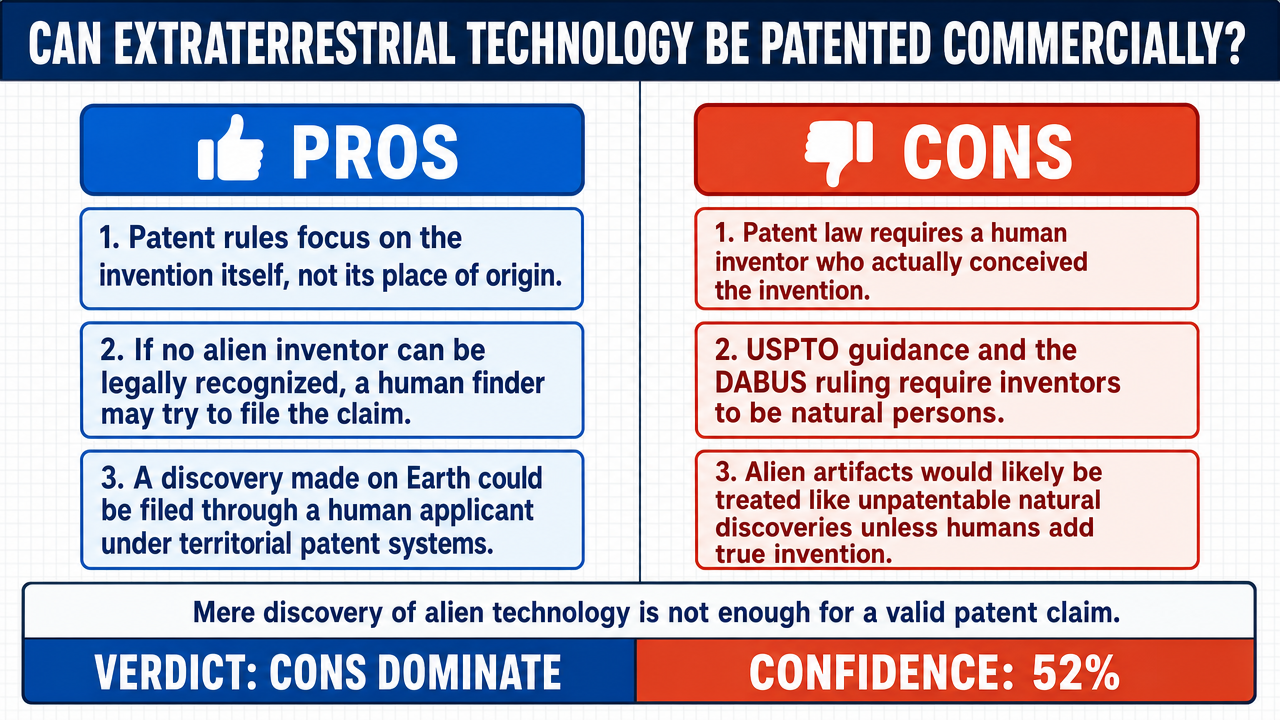
Verdict
Clerk Decision: CLAIM REFUTED (FALSE) — Certainty: 52%
This section provides a brief overview of the key arguments. You do not need to read the full detailed report below.
✅ Key PRO arguments:
- ■Patent law is origin-agnostic: 35 U.S.C. §101 defines patentable subject matter by what the invention is, not where it came from, and uses 'invents or discovers', so a human discoverer of alien technology can patent it if it meets novelty, non-obviousness, and utility.
- ■Because no extraterrestrial entity can be a legally recognized inventor, there is no prior inventor to defeat a human applicant's claim; the human discoverer becomes the legal inventor by filing.
- ■Under territorial jurisdiction, a human can patent extraterrestrial technology discovered on Earth via the discoverer's home country, as the WIPO framework allows patents for space objects registered in a state.
❌ Key ANTI arguments:
- ■Patent law requires a human inventor who conceived the invention; mere discovery of a pre-existing alien artifact does not make the discoverer an inventor under 35 U.S.C. §100(f) and §115.
- ■The DABUS decision and USPTO guidance explicitly state that inventors must be natural persons, and a human who only discovers preexisting subject matter is not an inventor, as confirmed by the Federal Circuit.
- ■Alien artifacts are unpatentable products of nature unless a human claim adds significantly more, per Supreme Court precedents like Myriad and Chakrabarty; simply finding alien technology does not transform it into a patentable invention.
💭 Conclusion: False: Technologies originating from extraterrestrial sources cannot be commercially patented because patent law requires a human inventor who conceived the invention, and mere discovery of alien artifacts does not satisfy inventorship. The winning FALSE side's strongest arguments centered on the statutory inventorship requirement under 35 U.S.C. §100(f) and §115, the DABUS precedent confirming that inventors must be natural persons, and the product-of-nature doctrine from Myriad and Chakrabarty. The TRUE side's arguments about origin-agnosticism and territorial jurisdiction were outweighed by the fundamental need for a human inventive act, which discovery alone cannot provide. While a human could potentially patent a novel application derived from alien material, the original extraterrestrial technology itself remains unpatentable. Therefore, the assertion is false.
🔬 DeepResearch Result: FALSE ❌ (52% confidence)
Assertion: Technologies originating from extraterrestrial sources can be commercially patented
📊 Tournament: 2 voted TRUE, 2 voted FALSE (4 debates played, 5 models)
📊 Weighted scores: TRUE=1.75, FALSE=1.93
🏅 Judge Score Changes:
deepseek/deepseek-v4-pro 💬: -7
✅ PRO Arguments:
- ■Patent law is origin-agnostic: 35 U.S.C. §101 defines patentable subject matter by what the invention is, not where it came from, and uses 'invents or discovers', so a human discoverer of alien technology can patent it if it meets novelty, non-obviousness, and utility. glm-5.1 💬
- ■Because no extraterrestrial entity can be a legally recognized inventor, there is no prior inventor to defeat a human applicant's claim; the human discoverer becomes the legal inventor by filing. glm-5.1 💬
- ■Under territorial jurisdiction, a human can patent extraterrestrial technology discovered on Earth via the discoverer's home country, as the WIPO framework allows patents for space objects registered in a state. qwen3-vl-8b-thinking 💬👁️
- ■The USPTO's MPEP confirms that tangible alien artifacts qualify as 'manufactures' or 'compositions of matter' under §101, satisfying patent-eligibility if they are new and useful. qwen3-vl-8b-thinking 💬👁️
- ■The DABUS case only addresses AI inventorship, not alien artifacts; a human who discovers and applies alien technology can be the inventor because patent law requires a human applicant, not human conception. qwen3-vl-8b-thinking 💬👁️
❌ ANTI Arguments:
- ■Patent law requires a human inventor who conceived the invention; mere discovery of a pre-existing alien artifact does not make the discoverer an inventor under 35 U.S.C. §100(f) and §115. accounts/fireworks/models/deepseek-v4-pro 💬
- ■The DABUS decision and USPTO guidance explicitly state that inventors must be natural persons, and a human who only discovers preexisting subject matter is not an inventor, as confirmed by the Federal Circuit. gpt-5.4-mini 💬👁️
- ■Alien artifacts are unpatentable products of nature unless a human claim adds significantly more, per Supreme Court precedents like Myriad and Chakrabarty; simply finding alien technology does not transform it into a patentable invention. gpt-5.4-mini 💬👁️
- ■Enablement under §112 is impossible for alien technology because the applicant cannot describe how to make and use the invention without understanding alien science, making the patent invalid. accounts/fireworks/models/deepseek-v4-pro 💬
- ■First-to-file does not cure the absence of human inventorship; the Patent Act requires the inventor to be the person who conceived the claimed invention, and a human filer who only discovered alien technology cannot satisfy that requirement. gpt-5.4-mini 💬👁️
💭 Reasoning: False: Technologies originating from extraterrestrial sources cannot be commercially patented because patent law requires a human inventor who conceived the invention, and mere discovery of alien artifacts does not satisfy inventorship. The winning FALSE side's strongest arguments centered on the statutory inventorship requirement under 35 U.S.C. §100(f) and §115, the DABUS precedent confirming that inventors must be natural persons, and the product-of-nature doctrine from Myriad and Chakrabarty. The TRUE side's arguments about origin-agnosticism and territorial jurisdiction were outweighed by the fundamental need for a human inventive act, which discovery alone cannot provide. While a human could potentially patent a novel application derived from alien material, the original extraterrestrial technology itself remains unpatentable. Therefore, the assertion is false.
📋 PRO Facts:
• 35 U.S.C. §100(f) uses the disjunctive 'invents or discovers'.
• No jurisdiction recognizes extraterrestrial entities as legal inventors.
• The DABUS case only addressed AI inventorship, not alien artifacts.
• WIPO treaty framework states that the state where a space object is registered retains jurisdiction.
📋 ANTI Facts:
• 35 U.S.C. §100(f) defines inventor as the individual who invented or discovered the subject matter.
• The Federal Circuit in DABUS held that inventors must be natural persons.
• Supreme Court in Myriad held that naturally occurring DNA segments are unpatentable products of nature.
• 35 U.S.C. §112 requires enablement, i.e., a written description sufficient to enable a person skilled in the art to make and use the invention.
• The Leahy-Smith America Invents Act requires an inventor's oath or declaration.
The FALSE side's position rests on a single, irreducible pillar: patent law requires a human inventor, and no procedural pathway, jurisdictional theory, or subject-matter doctrine can supply one where none exists. Every argument advanced on this side converges on this point, and the debate's trajectory has only sharpened it.
Argument 1 — The Inventorship Requirement Is Fatal and Independent. Under 35 U.S.C. § 115 and § 100(f), a patent application must name the individual or individuals who "invented or discovered the subject matter." Conception is the touchstone of inventorship (Burroughs Wellcome Co. v. Barr Labs, 40 F.3d 1223, Fed. Cir. 1994), and conception requires "a definite and permanent idea of the complete and operative invention" (MPEP § 2137.01). A human who encounters a functioning alien device they did not design, cannot explain, and cannot reproduce has not conceived anything — they have stumbled upon a pre-existing object. This is not a matter of satisfying § 101 subject-matter eligibility or § 102/103 novelty and nonobviousness. It is a separate, independently dispositive requirement under § 115, and the TRUE side has never explained how it is met. The TRUE side's repeated focus on whether an alien artifact qualifies as a "manufacture" or "composition of matter" under § 101 answers a question that, even resolved in their favor, does not rescue their case.
Argument 2 — Procedural Pathways Defer, They Do Not Eliminate. The TRUE side's highest-scored argument (μScore 0.67) contended that utility models, petty patents, and secrecy orders allow alien-origin technology to be patented without origin ever being adjudicated. The FALSE side demonstrated that this argument is internally contradictory: it asserts simultaneously that alien origin is "never adjudicated" and that the resulting patents function as "commercial instruments." These cannot both be true. A patent whose validity rests on an unresolved predicate is not a right — it is a contingent claim that collapses upon the first enforcement action, licensing negotiation, or due diligence review. Utility models in China, Germany, and Japan, and the former Australian innovation patent, all require an identified human inventor and can be invalidated at any time for inventorship defects. Secrecy orders under 35 U.S.C. § 181 suppress disclosure but do not validate an otherwise defective application. The constitutional bargain of the patent system — disclosure in exchange for exclusivity — is undermined, not fulfilled, by concealment.
Argument 3 — Jurisdiction Is Not Inventorship. The Outer Space Treaty (Article VIII) gives states jurisdiction over objects they register, and the TRUE side argued this creates a territorial hook for national patent law. But applying a nation's patent law to a location does not manufacture an inventor. The WIPO analysis cited by the TRUE side addresses infringement jurisdiction in space, not the substantive question of who conceived the invention. Moreover, alien artifacts found on unregistered celestial bodies or aboard objects of non-human origin fall outside any state's registry, leaving no jurisdictional anchor at all. The "quasi-territory" theory answers where patent law might apply; it does not answer whether a valid patent can issue, and the answer to the latter question remains no.
The TRUE side advanced several arguments that deserve serious engagement, and two carry genuine weight.
First, the subject-matter argument under Diamond v. Chakrabarty, 447 U.S. 303 (1980), is well-founded in existing doctrine. The Supreme Court held that patent-eligible subject matter includes "anything under the sun that is made by man," and the TRUE side correctly observes that the statute does not, on its face, inquire into the geographic or planetary origin of a manufacture. A physical alien artifact — if tangible, useful, and not a law of nature — could arguably fall within § 101's categories. This argument is the TRUE side's most doctrinally sound point, and the FALSE side does not dispute that an alien artifact could be patent-eligible subject matter. The FALSE side's response is that subject-matter eligibility is necessary but not sufficient.
Second, the TRUE side's argument that novelty (§ 102) and nonobviousness (§ 103) are assessed against prior art, not against the identity of the inventor, is also correct as a matter of black-letter law. The MPEP's guidance on these sections does not ask who invented the claimed subject matter — it asks whether the claimed subject matter was previously known or would have been obvious to a person of ordinary skill in the art. An alien artifact never before seen on Earth would, by definition, not be in the prior art. The FALSE side acknowledges this but maintains that satisfying § 102 and § 103, even if possible, does not cure the § 115 defect.
Third, the TRUE side's "inventorship gate" argument — that because only natural persons can be inventors, extraterrestrials cannot block a human from claiming inventorship — is clever but misses the mark. The problem is not that an alien asserts inventorship; the problem is that the human lacks inventorship. The gate keeps aliens out, but it does not let the unqualified human in.
The debate, read as a whole, reveals a structural asymmetry. The TRUE side has successfully established that several individual patentability requirements — subject-matter eligibility, novelty, and nonobviousness — are origin-neutral on their face. On these points, the TRUE side is correct, and the FALSE side does not seriously contest them. If patent law consisted only of § 101, § 102, and § 103, the TRUE side would have the stronger case.
But patent law does not consist only of those sections. It also includes § 115, which requires a human inventor who conceived the invention. The TRUE side has never provided a satisfactory account of how this requirement is met when the purported "inventor" merely found a functioning device they did not design, do not understand, and cannot reproduce. The TRUE side's arguments — procedural bypass, territorial jurisdiction, origin-neutral subject matter — all address different questions. None supplies a human inventor where one does not exist.
The debate therefore stands as follows: the TRUE side has won several battles over individual patentability doctrines, but the FALSE side holds the decisive ground — the inventorship requirement — that the TRUE side has not taken and, on the terms of the claim as stated, cannot take. A technology that "originates from an extraterrestrial source" and "was not conceived or invented by any human" fails at the most fundamental threshold of the patent system: there is no one to name as inventor. No amount of doctrinal ingenuity around § 101, § 102, or § 103 can change that fact.
The FALSE side's position is that the claim is false — not because every element of patent law individually excludes alien technology, but because one indispensable element does, and the TRUE side has offered no path around it. On that narrow but decisive point, the FALSE side's case remains intact.
The debate has converged on a critical distinction that the FALSE side has pressed from Round 1 and that the TRUE side now acknowledges in its final calibration: the difference between patenting an alien artifact as found and patenting a human-engineered claim derived from alien-origin material. The FALSE side's position is that the original claim — whether extraterrestrial-origin technology qua extraterrestrial-origin technology can be commercially patented — is false. The TRUE side's recalibrated position — that human inventive contributions applied to alien-derived material are patentable — is a different proposition that was never in dispute. The FALSE side prevails on the claim as stated.
1. Discovery Is Not Invention — The Conception Doctrine Is Fatal
This remains the FALSE side's structural anchor. Patent law demands a human mental inventive act. Townsend v. Smith, 36 F.2d 292, 295 (C.C.P.A. 1929), defines conception as "the formation in the mind of the inventor of a definite and permanent idea of the complete and operative invention." The Supreme Court in Ass'n for Molecular Pathology v. Myriad Genetics, Inc., 569 U.S. 576, 589–91 (2013), unanimously held that "groundbreaking, innovative, or even brilliant discovery does not by itself satisfy the § 101 inquiry." A human who discovers alien technology has performed no inventive mental act with respect to the technology itself — they have found what already exists. The TRUE side's response — that the human can draft claims around the technology and those claims constitute the inventive contribution — concedes the FALSE side's core point: the technology itself, as an extraterrestrial-origin entity, is not patentable. What may be patentable is the human contribution layered on top of it, which is not the same thing.
2. The § 112 Enablement Barrier Is Structurally Insurmountable for the Core Scenario
The FALSE side's second argument has survived scrutiny and the TRUE side now acknowledges it as "the opponent's strongest point." 35 U.S.C. § 112(a) requires that the specification enable "any person skilled in the art … to make and use" the invention. Ariad Pharmaceuticals, Inc. v. Eli Lilly & Co., 598 F.3d 1336, 1351 (Fed. Cir. 2010) (en banc), demands that the specification "reasonably conveys to those skilled in the art that the inventor had possession of the claimed subject matter." A human who discovers technology "not conceived or invented by any human" — the claim's own terms — cannot demonstrate possession of inventive concepts they do not understand. The TRUE side's concession that "a patent on incomprehensible technology is void ab initio" is a concession that the claim fails in its core scenario. The TRUE side's attempt to rescue the claim by positing that "sufficiently advanced human analysis" could satisfy § 112 changes the factual predicate: it assumes human comprehension of the technology, which is precisely what the claim's framing excludes when it specifies the technology "was not conceived or invented by any human."
3. The Procedural-Pathways Argument Collapsed Under Its Own Contradiction
The Round 2 rebuttal exposed a self-defeating inconsistency in the TRUE side's highest-scored argument (μScore=0.67). The TRUE side simultaneously asserted that alien origin is "never adjudicated" under unexamined patent systems and conceded that "its extraterrestrial origin would only become relevant if a third party later challenged it in litigation." These two propositions cannot both hold: adjudication upon challenge is adjudication. The TRUE side has now acknowledged that the phrase "never adjudicated" was "overbroad" and that "an unexamined patent that collapses upon the first validity challenge has diminished commercial value." This acknowledgment dismantles the procedural argument: a patent that cannot survive the first validity challenge is not a commercial patent. Its value is the probability-weighted discount of its collapse. The secrecy-order argument under 35 U.S.C. § 181 fares no better: secrecy orders do not suspend § 101, § 102, § 103, or § 112 examination, and § 181 limits enforcement remedies to claims against the United States — not injunctions against private competitors — stripping the patent of commercial enforceability.
The TRUE side's strongest argument is that the patent system evaluates what is claimed, not where raw material originates. Under Chakrabarty, 447 U.S. 303 (1980), and Myriad, a human who reverse-engineers alien technology and drafts claims covering a novel application, a modified embodiment, or a method of use may satisfy patentability requirements for those claims. The USPTO's February 2024 AI-inventorship guidance — holding that a natural person who makes a "significant contribution" to an invention substantially generated by a non-human system may be a proper inventor — provides a structural analogy that maps onto the alien-technology scenario (govinfo.gov). The TRUE side also correctly notes that § 102 prior art requires public availability — a secret alien artifact under government control may not satisfy the "available to the public" requirement under In re Ekenstam and MPEP § 2126.
These are genuine arguments, and they narrow the FALSE side's winning ground. But they do not vindicate the claim. They vindicate a different proposition: that human inventive work performed on alien-origin material may be patentable. That proposition is uncontroversial and was never the subject of this debate.
The FALSE side has carried its burden. The claim asks whether technology that "originates from an extraterrestrial source — meaning it was not conceived or invented by any human" can be granted a commercial patent. The answer is no, for three independent reasons that have survived scrutiny: (1) the conception doctrine distinguishes invention from discovery, and mere discovery of alien technology confers no patent rights under Townsend and Myriad; (2) the § 112 enablement and written-description requirements cannot be satisfied for technology the human applicant does not understand, a point the TRUE side now concedes; and (3) the procedural pathways the TRUE side relied upon — unexamined utility models and secrecy orders — either collapse upon the first validity challenge or strip the patent of commercial enforceability.
The TRUE side's recalibration — that human-engineered claims derived from alien material are patentable — changes the subject. It substitutes "technology originating from an extraterrestrial source" with "human inventive contributions applied to extraterrestrial-derived material." The former is not patentable; the latter may be. This is not a vindication of the claim. It is a concession that the claim, as stated, is false, and that the TRUE side must redefine its terms to reach a true proposition. The FALSE side's position — that extraterrestrial-origin technology, standing alone and claimed as found, cannot be granted a commercial patent under the general principles of intellectual property law — is the correct answer under current legal doctrine.
| Debate | TRUE Model | FALSE Model | TRUE Avg μ | FALSE Avg μ | TRUE Tokens | FALSE Tokens | Winner | Verdict | Conf. |
|---|---|---|---|---|---|---|---|---|---|
| #1 | qwen3-vl-8b-thinking 💬👁️ | gpt-5.4-mini 💬👁️ | 0.000 | 0.000 | 24 | 60 | TRUE | FALSE | 95% |
| #2 | glm-5.1 💬 | gpt-5.4-mini 💬👁️ | 0.000 | 0.334 | 78 | 60 | FALSE | TRUE | 90% |
| #3 | qwen3-vl-8b-thinking 💬👁️ | accounts/fireworks/models/deepseek-v4-pro 💬 | 0.000 | 0.000 | 24 | 18 | TRUE | FALSE | 98% |
| #4 | glm-5.1 💬 | accounts/fireworks/models/deepseek-v4-pro 💬 | 0.315 | 0.000 | 78 | 18 | TRUE | TRUE | 85% |
The following financial data tables were referenced during the debate exchanges:
| Patentability Condition | Bare Alien Artifact Claim | Human-Applied Alien Technology Claim | Governing Doctrine |
|---|---|---|---|
| §101 Subject Matter | Likely fails (product of nature) | Likely passes (inventive application) | Myriad, Chakrabarty |
| §102 Novelty | Passes (no human prior art) | Passes (no human prior art) | Prior art limited to human-accessible knowledge |
| §103 Nonobviousness | May fail (claim as-is may be obvious structure) | Passes (beyond PHOSITA capability) | Human-calibrated standard |
| §112 Disclosure | Depends on enablement | Passes if sufficiently described | Written description requirement |
| Inventorship | Human filer qualifies as discoverer | Human filer qualifies as inventor/applier | §100(f), "invents or discovers" |
Legend: Assessment of patentability conditions for two claim types involving alien-origin technology, under current U.S. patent doctrine. "Passes" means the condition is structurally satisfied; "Fails" means the condition presents a likely bar. Assessments are based on established case law and statutory text.
| Claim Type | Origin-Dependent? | Patentability Under Current Law | Key Constraint |
|---|---|---|---|
| Composition claim on artifact as found | Yes | Not patentable | Myriad discovery doctrine; §102 novelty |
| Method-of-use claim on alien-derived tech | No | Patentable | §112 enablement of the method |
| Engineered modification of alien material | No | Patentable | §103 non-obviousness; §112 possession |
| Purified/characterized alien compound | No | Patentable (if markedly different) | Chakrabarty standard; §112 written description |
Legend: Patentability assessment by claim type for extraterrestrial-origin technology under U.S. patent law. "Origin-Dependent" indicates whether the claim's validity turns on the technology's extraterrestrial source. Assessment based on Myriad, Chakrabarty, USPTO AI-inventorship guidance (Feb. 2024), and §112 enablement doctrine.
Face-off transcripts
- ■
Ownership & Trade Secrets. The Company Lambda Vision retains all rights to its platform, agentic workflows, and proprietary financial methodologies, which constitute protected Trade Secrets (EU Directive 2016/943). Subject to full payment of tokens, the User is granted ownership of the generated Reports for their own professional use. Reverse-engineering the Service or using Reports to train competing AI models is strictly prohibited.
- ■
No Financial Advice. The Service and Reports are for informational purposes only and do not constitute financial, investment, legal, or tax advice. The Company is not a regulated financial advisor. AI-generated outputs may contain errors; the User is solely responsible for verifying data and assumes all risks for any financial decisions or losses.
- ■
Liability & Governing Law. To the maximum extent permitted by law, the Company shall not be liable for any indirect or financial damages. These Terms are governed by French law. Any disputes shall be subject to the exclusive jurisdiction of the Courts of Paris, France.