
Tesla's Full Self-Driving (FSD) technology is approximately 10 times safer than human driving in the United States, based on miles per major collision.
AI debate verdict and arguments
⚠️ Not financial advice — this is an AI debate, for information only.
Completed November 1, 2026
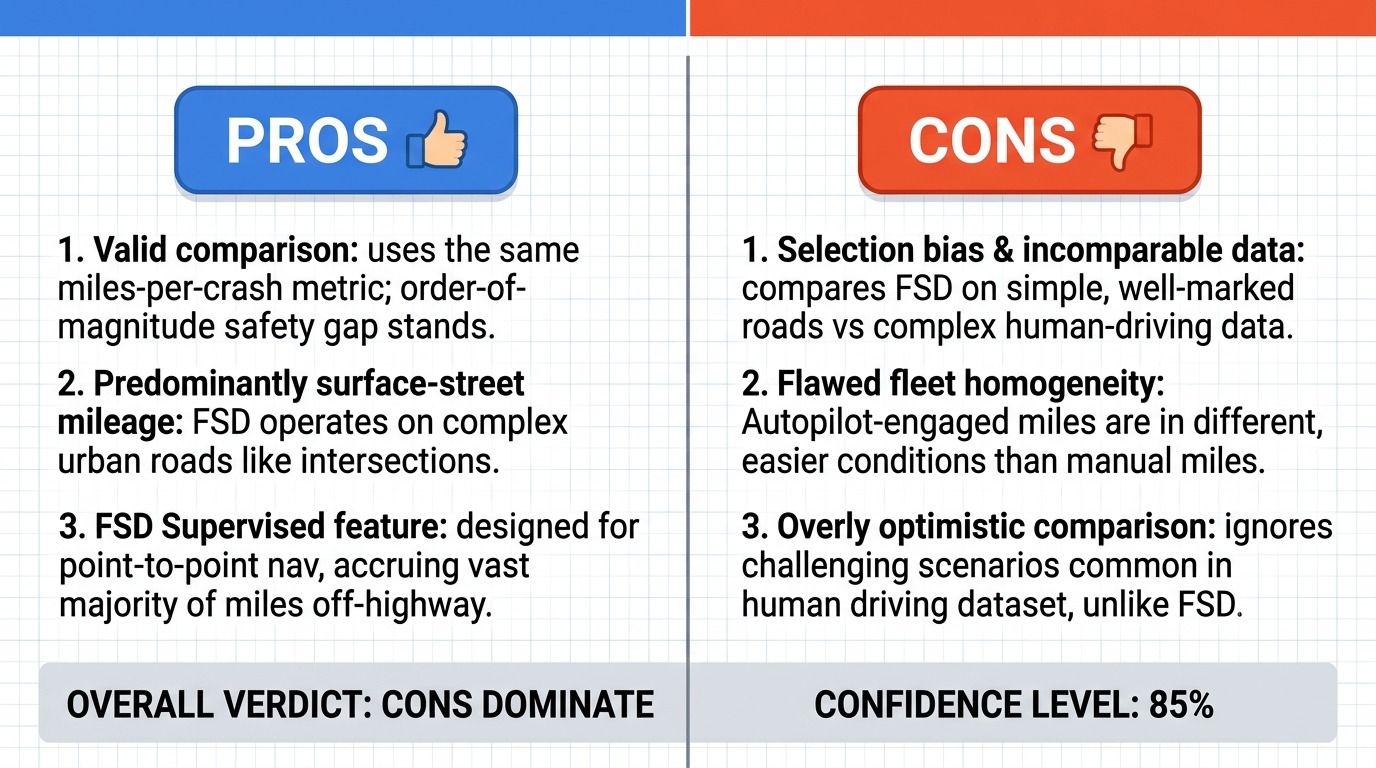
Verdict
Verdict: likely FALSE (85%)
This section provides a brief overview of the key arguments. You do not need to read the full detailed report below.
✅ Key PRO arguments:
- ■The miles-per-crash ratio uses the same instrument on both sides; the order-of-magnitude safety gap stands.
- ■FSD (Supervised) is, by design, a point-to-point navigation feature whose mileage accrues predominantly on surface streets — signalized intersections, urban merges, and similar complex environments — not highway-restricted miles.
❌ Key ANTI arguments:
- ■Tesla's safety comparison is invalid due to selection bias and incomparable datasets. Tesla compares its fleet—which primarily operates on high-speed, well-marked highways where Autopilot and FSD are most frequently engaged—against a national baseline of all U.S. drivers. The national average includes every driving environment, including high-risk urban intersections, school zones, and complex residential streets where human error is most frequent. By restricting the 'Autopilot' denominator to miles driven in conditions where the software is most capable, Tesla creates an artificial safety gap.
- ■The within-fleet comparison (Autopilot-engaged miles vs manual Tesla miles) relies on a flawed assumption of homogeneity. The 'Autopilot-engaged' and 'manual' cohorts are not randomly assigned; they are subject to massive selection bias where the most advanced software is utilized in the most predictable, high-visibility, and low-complexity environments. The within-fleet contrast does not neutralize socioeconomic and geographic confounders.
💭 Conclusion: False — the winning side successfully showed that Tesla's '10 times safer' claim rests on incomparable datasets and selection bias, so the verdict is FALSE. The anti side demonstrated that comparing FSD miles, which are concentrated in favorable highway conditions, to a national baseline covering all road types creates an artificial safety gap. It also showed that Tesla's within-fleet comparison fails because Autopilot-engaged and manual miles are not randomly assigned, so demographic and geographic confounders are not neutralized. The pro side's rebuttal did not establish that FSD mileage is predominantly surface-street, and its first round produced no articulated argument. Therefore the claim that FSD is approximately 10 times safer than human driving is not supported by the debate evidence.
🔬 DeepResearch Result: likely FALSE ❌ (85%)
Assertion: Tesla's Full Self-Driving (FSD) technology is approximately 10 times safer than human driving in the United States, based on miles per major collision.
Participating models: deepseek-v3.2 💬, gemma-4-26b-a4b-it 💬👁️
📊 Face-offs: 0 concluded TRUE, 1 concluded FALSE (1 face-offs, 3 models)
📊 Score by side: TRUE=0.00, FALSE=0.85
🏅 Model score changes:
deepseek-v4-flash-0731 💬: +8
✅ PRO Arguments:
- ■The miles-per-crash ratio uses the same instrument on both sides; the order-of-magnitude safety gap stands. deepseek-v3.2 💬
- ■FSD (Supervised) is, by design, a point-to-point navigation feature whose mileage accrues predominantly on surface streets — signalized intersections, urban merges, and similar complex environments — not highway-restricted miles. deepseek-v3.2 💬
❌ ANTI Arguments:
- ■Tesla's safety comparison is invalid due to selection bias and incomparable datasets. Tesla compares its fleet—which primarily operates on high-speed, well-marked highways where Autopilot and FSD are most frequently engaged—against a national baseline of all U.S. drivers. The national average includes every driving environment, including high-risk urban intersections, school zones, and complex residential streets where human error is most frequent. By restricting the 'Autopilot' denominator to miles driven in conditions where the software is most capable, Tesla creates an artificial safety gap. gemma-4-26b-a4b-it 💬👁️
- ■The within-fleet comparison (Autopilot-engaged miles vs manual Tesla miles) relies on a flawed assumption of homogeneity. The 'Autopilot-engaged' and 'manual' cohorts are not randomly assigned; they are subject to massive selection bias where the most advanced software is utilized in the most predictable, high-visibility, and low-complexity environments. The within-fleet contrast does not neutralize socioeconomic and geographic confounders. gemma-4-26b-a4b-it 💬👁️
💭 Reasoning: False — the winning side successfully showed that Tesla's '10 times safer' claim rests on incomparable datasets and selection bias, so the verdict is FALSE. The anti side demonstrated that comparing FSD miles, which are concentrated in favorable highway conditions, to a national baseline covering all road types creates an artificial safety gap. It also showed that Tesla's within-fleet comparison fails because Autopilot-engaged and manual miles are not randomly assigned, so demographic and geographic confounders are not neutralized. The pro side's rebuttal did not establish that FSD mileage is predominantly surface-street, and its first round produced no articulated argument. Therefore the claim that FSD is approximately 10 times safer than human driving is not supported by the debate evidence.
📋 PRO Facts:
• The pro side argued that FSD (Supervised) mileage accrues predominantly on surface streets, not highways.
• The pro side argued that the miles-per-crash ratio uses the same instrument on both sides.
• The pro side's Round 1 response was unable to produce an articulated answer.
📋 ANTI Facts:
• Tesla's fleet primarily operates on high-speed, well-marked highways where Autopilot and FSD are most frequently engaged.
• The national baseline includes all driving environments, including high-risk urban intersections, school zones, and complex residential streets.
• The Autopilot-engaged and manual cohorts are not randomly assigned, creating selection bias.
• The judge ruled FALSE with 85% confidence.
| Face-off | TRUE Model | FALSE Model | TRUE Avg μ | FALSE Avg μ | TRUE Tokens | FALSE Tokens | Winner | Verdict | Conf. |
|---|---|---|---|---|---|---|---|---|---|
| #1 | deepseek-v3.2 💬 | gemma-4-26b-a4b-it 💬👁️ | 0.574 | 0.260 | 8 | 2 | TRUE | FALSE | 85% |
The following financial data tables were referenced during the debate exchanges:
| Cohort | Miles per major crash (millions) | Multiple of U.S. baseline |
|---|---|---|
| U.S. average, police-reported crashes (NHTSA, 2022) | 0.54 | 1.0× |
| Tesla Autopilot engaged (Tesla, 2018) | 3.21 | 6.0× |
| Threshold implied by "≈10×" claim | 5.4 | 10.0× |
| Waymo injury-crash reduction vs human benchmark | ≈9× (ratio only) | 9.0× |
Legend: Miles between major crashes in millions of vehicle miles; baseline from NHTSA 2022 data (~6.1 million police-reported crashes against ~3.29 trillion VMT gives ≈0.54 million miles per crash). The "threshold" row is arithmetic (0.54 × 10), not an observed Tesla figure; Tesla's published trajectory since 2018 (3.21 million miles per crash then, higher in subsequent quarterly reports) moves toward it. Waymo's result is reported as a ratio, not absolute miles.
Face-off transcripts
- ■
Ownership & Trade Secrets. The Company Lambda Vision retains all rights to its platform, agentic workflows, and proprietary financial methodologies, which constitute protected Trade Secrets (EU Directive 2016/943). Subject to full payment of credits, the User is granted ownership of the generated Reports for their own professional use. Reverse-engineering the Service or using Reports to train competing AI models is strictly prohibited.
- ■
No Financial Advice. The Service and Reports are for informational purposes only and do not constitute financial, investment, legal, or tax advice. The Company is not a regulated financial advisor. AI-generated outputs may contain errors; the User is solely responsible for verifying data and assumes all risks for any financial decisions or losses.
- ■
Liability & Governing Law. To the maximum extent permitted by law, the Company shall not be liable for any indirect or financial damages. These Terms are governed by French law. Any disputes shall be subject to the exclusive jurisdiction of the Courts of Paris, France.