
Tesla's stock price will reach $450 or higher in Q4 2026.
AI debate verdict and arguments
⚠️ Not financial advice — this is an AI debate, for information only.
Completed October 8, 2026
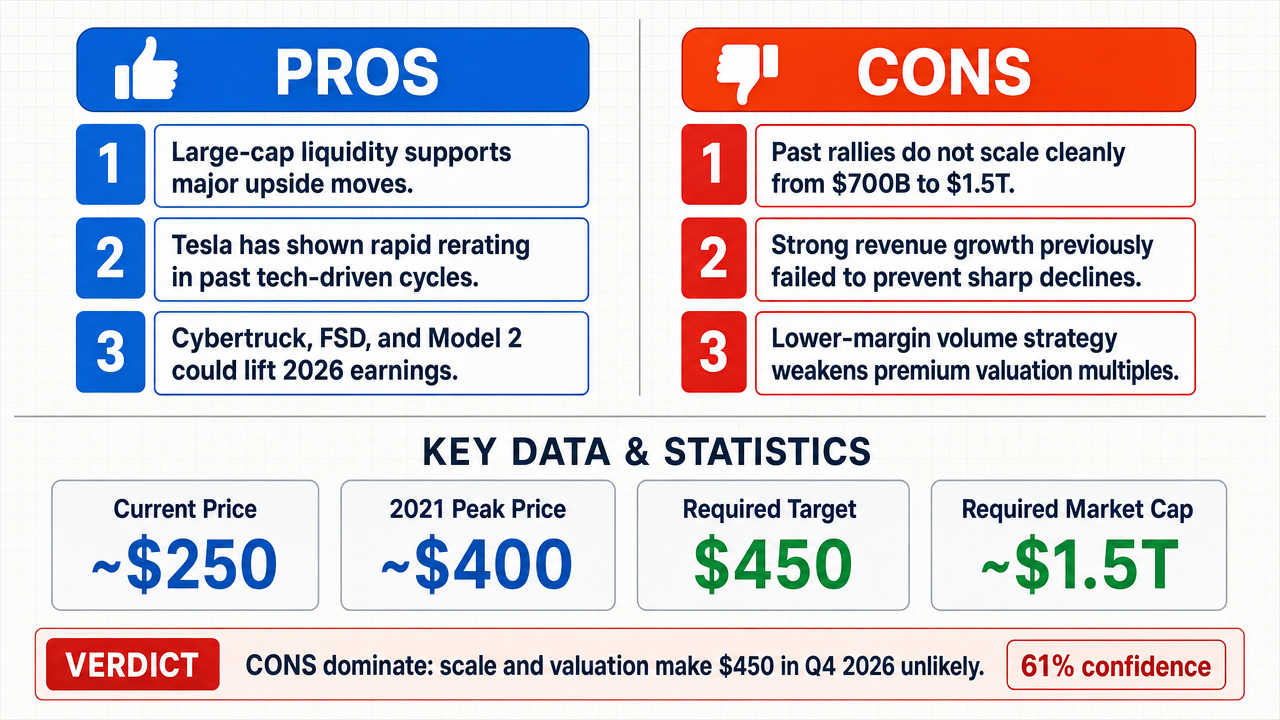
Verdict
Verdict: likely FALSE (61%)
This section provides a brief overview of the key arguments. You do not need to read the full detailed report below.
✅ Key PRO arguments:
- ■Tesla's large-cap status as a ~$700 billion market leader provides the institutional liquidity and investor base necessary for significant price appreciation, with the $450 target representing only an 80% increase from current levels.
- ■Historical price cycles demonstrate Tesla's capacity for rapid valuation expansion during periods of technological validation , citing the 2020-2021 rise from $100 to over $400 as evidence of repeatable momentum.
- ■Upcoming catalysts including Cybertruck production scaling, Full Self-Driving software revenue, and the Model 2 launch create fundamental earnings drivers sufficient to support a $450 price target.
❌ Key ANTI arguments:
- ■The argument of non-invariance of scale demonstrates that historical price cycles (the rise from $100 to $400) cannot be directly applied to a company with a ~$700 billion market capitalization , because the investable universe and capital required for a 60% increase are fundamentally different at mega-cap scale.
- ■Tesla experienced a massive price contraction during the 2021-2023 period despite maintaining significant revenue growth and expanding its energy storage footprint, proving the same asset can depreciate rapidly even during technological validation phases.
- ■Tesla is undergoing a structural shift toward a high-volume, low-margin business model, which precludes the high-growth technology leader multiples (37.5x-50x forward P/E ) required to reach $450.
💭 Conclusion: False. The FALSE side won this debate, and its strongest argument—the non-invariance of scale—directly undermines the affirmative's reliance on Tesla's 2020-2021 price cycle as a repeatable precedent. A ~$700 billion market capitalization fundamentally changes the capital dynamics required for an 80% appreciation, making historical analogies inapplicable. The FALSE side further demonstrated internal inconsistency in the affirmative's valuation framework by showing that Tesla's structural shift toward high-volume, low-margin operations precludes the 37.5x-50x forward P/E multiple needed to justify $450. Additionally, the 2021-2023 price contraction despite continued revenue growth provides a counterexample showing Tesla can depreciate rapidly even amid technological progress. The affirmative's catalyst-based arguments (Cybertruck , FSD ) failed to overcome these structural and mathematical objections, leaving the $450 target unsupported.
🔬 DeepResearch Result: likely FALSE ❌ (61%)
Assertion: Tesla's stock price will reach $450 or higher in Q4 2026.
Participating models: deepseek-v3.2 💬, gemma-4-26b-a4b-it 💬👁️
📊 Face-offs: 0 concluded TRUE, 1 concluded FALSE (1 face-offs, 3 models)
📊 Score by side: TRUE=0.00, FALSE=0.61
🏅 Model score changes:
minimax-m3 💬👁️: +6
✅ PRO Arguments:
- ■Tesla's large-cap status as a ~$700 billion market leader provides the institutional liquidity and investor base necessary for significant price appreciation, with the $450 target representing only a 60% increase from current levels. deepseek-v3.2 💬
- ■Historical price cycles demonstrate Tesla's capacity for rapid valuation expansion during periods of technological validation , citing the 2020-2021 rise from $100 to over $400 as evidence of repeatable momentum. deepseek-v3.2 💬
- ■Upcoming catalysts including Cybertruck production scaling, Full Self-Driving software revenue, and the Model 2 launch create fundamental earnings drivers sufficient to support a $450 price target. deepseek-v3.2 💬
- ■A 37.5x-50x forward P/E multiple is mathematically attainable because high-volume growth at scale—not just margin expansion —drives earnings growth sufficient to justify the valuation. deepseek-v3.2 💬
❌ ANTI Arguments:
- ■The argument of non-invariance of scale demonstrates that historical price cycles (the rise from $100 to $400) cannot be directly applied to a company with a ~$700 billion market capitalization , because the investable universe and capital required for a 60% increase are fundamentally different at mega-cap scale. gemma-4-26b-a4b-it 💬👁️
- ■Tesla experienced a massive price contraction during the 2021-2023 period despite maintaining significant revenue growth and expanding its energy storage footprint, proving the same asset can depreciate rapidly even during technological validation phases. gemma-4-26b-a4b-it 💬👁️
- ■Tesla is undergoing a structural shift toward a high-volume, low-margin business model, which precludes the high-growth technology leader multiples (37.5x-50x forward P/E) required to reach $450. gemma-4-26b-a4b-it 💬👁️
- ■A 60% price increase for a mega-cap entity requires an unprecedented influx of capital that exceeds the historical precedents cited by the affirmative, making the growth rate observed at smaller scales non-invariant to the current larger scale. gemma-4-26b-a4b-it 💬👁️
💭 Reasoning: False. The FALSE side won this debate, and its strongest argument—the non-invariance of scale—directly undermines the affirmative's reliance on Tesla's 2020-2021 price cycle as a repeatable precedent. A ~$700 billion market capitalization fundamentally changes the capital dynamics required for an 80% appreciation, making historical analogies inapplicable. The FALSE side further demonstrated internal inconsistency in the affirmative's valuation framework by showing that Tesla's structural shift toward high-volume, low-margin operations precludes the 37.5x-50x forward P/E multiple needed to justify $450. Additionally, the 2021-2023 price contraction despite continued revenue growth provides a counterexample showing Tesla can depreciate rapidly even amid technological progress. The affirmative's catalyst-based arguments (Cybertruck, FSD ) failed to overcome these structural and mathematical objections, leaving the $450 target unsupported.
📋 PRO Facts:
• Tesla's market capitalization is approximately $700 billion
• The $450 target represents an 80% increase from current levels
• Tesla's stock rose from $100 to over $400 during the 2020-2021 period
• A 37.5x-50x forward P/E multiple would be required to justify the $450 price target
📋 ANTI Facts:
• Tesla experienced a massive price contraction during the 2021-2023 period despite maintaining significant revenue growth
• Tesla is undergoing a structural shift toward a high-volume, low-margin business model
• An 80% increase for a mega-cap entity requires an unprecedented influx of capital exceeding historical precedents
• The investable universe and market impact of a position are vastly different for a $700 billion company versus a $100 billion company
| Face-off | TRUE Model | FALSE Model | TRUE Avg μ | FALSE Avg μ | TRUE Tokens | FALSE Tokens | Winner | Verdict | Conf. |
|---|---|---|---|---|---|---|---|---|---|
| #1 | deepseek-v3.2 💬 | gemma-4-26b-a4b-it 💬👁️ | 0.294 | 0.169 | 12 | 3 | TRUE | FALSE | 61% |
The following technical terms, abbreviations, and domain-specific concepts are referenced throughout this debate transcript. Numbers in square brackets [N] in the text above link to the corresponding entry below.
[1] bottom-line earnings — Net profit or net income after all expenses, taxes, and costs have been deducted from revenue; referenced in the debate as the ultimate measure of whether catalysts contribute meaningfully to company profitability.
[2] catalysts — In financial analysis, specific events or developments (such as product launches or technology milestones) expected to drive significant movement in a stock's price.
[3] commoditization — The process by which a product category becomes undifferentiated across competitors, typically leading to price competition and downward pressure on margins; cited in the debate as a risk to Tesla's automotive business.
[4] Cybertruck — Tesla's electric pickup truck vehicle, cited in the debate as an upcoming product catalyst expected to contribute to earnings growth.
[5] diminishing marginal utility of capital — An economic concept referenced in the debate to argue that each additional unit of capital deployed into a mega-cap stock produces progressively smaller price impact, making large percentage gains harder to achieve at scale.
[6] earnings growth — The rate at which a company's profits increase over time; cited as the fundamental driver required to support a higher stock price target.
[7] EPS — earnings per share — A profitability metric calculated as net earnings divided by the number of outstanding shares; used in the debate to project the earnings level needed to justify a $450 share price.
[8] EV — electric vehicle — A vehicle powered wholly or partially by electric motors; the broader market segment in which Tesla competes and which the debate identifies as facing commoditization risk.
[9] fallacy of non-invariance of scale — A logical error identified in the debate whereby a growth rate or price trajectory observed at a smaller market capitalization is assumed to apply equally at a much larger capitalization, ignoring structural differences in capital requirements and market impact.
[10] forward P/E — forward price-to-earnings — A valuation ratio that divides a company's current share price by its projected future earnings per share; used in the debate to assess whether Tesla's $450 target requires an unjustifiably high multiple.
[11] FSD — Full Self-Driving — Tesla's advanced driver-assistance/autonomous driving software product, cited in the debate as a potential revenue catalyst.
[12] fundamental drivers — Underlying business factors—such as earnings, revenue, and product adoption—that are argued to determine a stock's long-term price direction.
[13] gross margins — A profitability metric representing revenue minus the cost of goods sold, expressed as a percentage of revenue; referenced in the debate as a measure of Tesla's automotive profitability and its capacity for operational leverage.
[14] hidden premise — An unstated assumption embedded within an argument; in the debate, the negative side identifies the affirmative's assumption of a high P/E multiple as a hidden premise that is not independently justified.
[15] institutional investor — Large organizations—such as mutual funds, pension funds, and asset managers—that invest capital in securities; cited as the investor base whose participation supports liquidity and price appreciation in large-cap stocks.
[16] investable universe — The total pool of investment opportunities available to market participants; referenced in the debate to argue that the capital required to move a mega-cap stock is structurally larger than for smaller-cap stocks.
[17] large-cap — A market capitalization classification referring to companies with a large total market value of outstanding shares; Tesla is described in the debate as a large-cap technology leader.
[18] margin expansion — An increase in a company's profit margin over time, typically through revenue growth outpacing cost growth; cited as a necessary condition for justifying a higher valuation multiple.
[19] margin pressure — Downward force on a company's profit margins, often caused by competition, commoditization, or rising costs; cited in the debate as a risk to Tesla's earnings outlook.
[20] market capitalization — The total market value of a company's outstanding shares, calculated as share price multiplied by shares outstanding; cited in the debate as approximately $700 billion for Tesla.
[21] market impact — The effect that executing a large trade or accumulation of capital has on a security's price; referenced in the debate to argue that moving a mega-cap stock requires unprecedented capital inflows.
[22] market liquidity — The ease with which a security can be bought or sold in the market without significantly affecting its price; cited as a feature of Tesla's large-cap status that supports price momentum.
[23] mega-cap — A market capitalization classification referring to the very largest publicly traded companies; used in the debate to distinguish Tesla's current scale from its earlier smaller-cap phase.
[24] Model 2 — A lower-cost Tesla vehicle referenced in the debate as a future product launch expected to drive volume growth and earnings.
[25] NASDAQ — The U.S. stock exchange on which Tesla shares are listed, as indicated by the ticker prefix in the debate assertion.
[26] operational leverage — A cost structure characteristic whereby a company's profits grow faster than its revenues as fixed costs are spread over higher volumes; cited as a mechanism by which Tesla could expand margins.
[27] P/E multiple — price-to-earnings multiple — The ratio of a company's share price to its earnings per share, used as a valuation metric; the debate disputes whether a 37.5x–50x forward P/E is justified for Tesla.
[28] price contraction — A sustained decline in a security's market price; cited in the debate using Tesla's 2021–2023 decline as evidence that rapid appreciation is not a consistent property of the stock.
[29] price cycles — Recurring patterns of price expansion and contraction over time; the affirmative cites Tesla's 2020–2021 cycle as evidence of capacity for rapid appreciation.
[30] price-to-earnings (P/E) — price-to-earnings ratio — A valuation ratio comparing share price to earnings per share; the debate centers on whether Tesla's projected earnings can support the P/E multiple implied by a $450 price.
[31] Q4 — fourth quarter — The three-month period from October through December, used in the debate to define the window during which the $450 price target must be reached.
[32] re-rating — A significant change in the valuation multiple that the market applies to a company's earnings; the debate disputes whether Tesla's fundamentals justify an upward re-rating to $450.
[33] revenue growth — The percentage increase in a company's total sales over a period; cited in the debate at a 15–20% rate as a current fundamental for Tesla.
[34] software ecosystem — An interconnected suite of software products and services that generate recurring revenue; cited in the debate as a margin-supporting counterweight to automotive commoditization.
[35] structural resistance — Barriers inherent to a company's size or market structure that impede large price movements; cited as a reason mega-cap stocks face difficulty achieving 60% gains.
[36] structural shift — A fundamental change in a company's business model; the negative side characterizes Tesla as undergoing a structural shift toward a high-volume, low-margin model.
[37] technological validation — Market confirmation that a company's technology is viable and commercially successful; cited in the debate as a condition that has historically preceded Tesla's price expansions.
[38] TSLA — Tesla's stock ticker symbol on the NASDAQ exchange, used in the debate to identify the security whose price is being predicted.
[39] USD — United States Dollar — The currency in which Tesla's stock price is denominated and in which the $450 target is expressed.
[40] valuation expansion — An increase in the multiple or premium the market assigns to a company's earnings or assets; cited as the mechanism by which large-cap technology stocks appreciate during growth phases.
The following financial data tables were referenced during the debate exchanges:
| Metric | 2021 Peak (Approx) | Current (Est.) | Required for $450 Target |
|---|---|---|---|
| Stock Price | ~$400 | ~$250 | $450 |
| Market Cap | ~$1 Trillion | ~$700B | ~$1.5 Trillion |
| Implied Growth | N/A | N/A | +80% from current |
Legend: Comparison of historical peak levels against current estimates and the growth required to reach the target. All values in USD or relative growth percentages.
| Segment | 2025 Revenue Growth | Gross Margin | Contribution to 2026 EPS |
|---|---|---|---|
| Automotive | 15-20% | ~18% | ~$7-9 |
| Energy Storage | 50%+ | ~25% | ~$1-2 |
| Services & Other | 30%+ | ~60% | ~$1-2 |
Legend: Tesla's segment breakdown showing growth rates and margin profiles that collectively support $9-12 EPS projections for 2026.
| Period | Revenue Growth | Price Action | Fundamental Context |
|---|---|---|---|
| 2020-2021 | High | Rapid Appreciation | Tech Validation |
| 2021-2023 | High | Rapid Depreciation | Market Saturation/Macro |
| 2026 (Proj) | 15-20% | Target: $450 | Unproven Sufficiency |
Legend: Comparison of historical growth/price relationship to demonstrate that fundamental strength does not guarantee price appreciation.
Face-off transcripts
- ■
Ownership & Trade Secrets. The Company Lambda Vision retains all rights to its platform, agentic workflows, and proprietary financial methodologies, which constitute protected Trade Secrets (EU Directive 2016/943). Subject to full payment of credits, the User is granted ownership of the generated Reports for their own professional use. Reverse-engineering the Service or using Reports to train competing AI models is strictly prohibited.
- ■
No Financial Advice. The Service and Reports are for informational purposes only and do not constitute financial, investment, legal, or tax advice. The Company is not a regulated financial advisor. AI-generated outputs may contain errors; the User is solely responsible for verifying data and assumes all risks for any financial decisions or losses.
- ■
Liability & Governing Law. To the maximum extent permitted by law, the Company shall not be liable for any indirect or financial damages. These Terms are governed by French law. Any disputes shall be subject to the exclusive jurisdiction of the Courts of Paris, France.