
The 2007 Leveraged Buy-Out (LBO) was the primary cause of Virgin Megastore France's demise, directly leading to its inability to adapt to market changes.
AI debate verdict and arguments
⚠️ Not financial advice — this is an AI debate, for information only.
Completed October 22, 2026
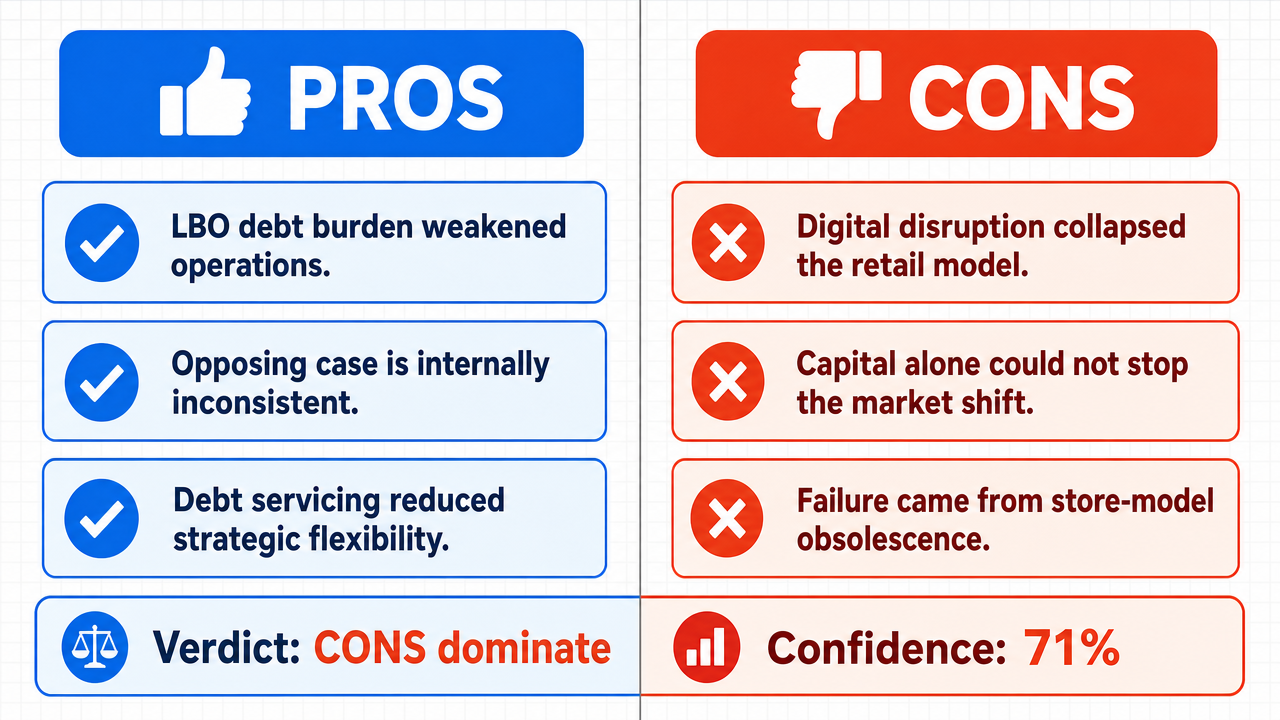
Verdict
Verdict: likely FALSE (71%)
This section provides a brief overview of the key arguments. You do not need to read the full detailed report below.
✅ Key PRO arguments:
- ■The 2007 LBO imposed a lethal debt structure on Virgin Megastore France, with approximately €100 million in senior and mezzanine debt layered onto the operating company itself, which under standard French LBO practice had to be serviced from the target's own cash flows, starving the chain of capital precisely when the music industry was undergoing its most rapid digital transformation.
- ■The opposing argument is internally inconsistent: it simultaneously asserts that digital disruption was the cause and that the LBO was not the cause, yet provides no testable criterion distinguishing between these claims and performs no counterfactual comparison between the LBO scenario and a no-LBO scenario.
- ■Virgin Megastore France generated annual revenues of roughly €330 million at the time of the buyout, yet the debt-servicing burden imposed by Butler Capital Partners and its co-investors made strategic investment in digital adaptation impossible during the critical transition window.
❌ Key ANTI arguments:
- ■The demise of Virgin Megastore France was driven by a systemic, industry-wide collapse of the physical music retail model that affected even well-capitalized strategic owners; the transition from physical to digital media was not a manageable pivot but a fundamental destruction of the core product's delivery mechanism.
- ■The affirmative's argument rests on the assumption that capital availability is the primary determinant of survival in a digital shift, but this is refuted by the performance of Fnac, a direct competitor in the same French market, which faced the exact same digital disruption yet survived.
- ■The record shows that the company's failure was not due to a lack of capital for digital transition, but rather the fundamental obsolescence of its physical retail model — even if the LBO had not occurred, the structural collapse of physical music retail would have produced the same outcome.
💭 Conclusion: False. The 2007 LBO was not the primary cause of Virgin Megastore France's demise; rather, the systemic collapse of the physical music retail model driven by digital disruption was the decisive factor. The strongest evidence for this conclusion is the comparative performance of Fnac, a direct competitor operating in the same French market under the same digital disruption, which survived the transition — demonstrating that capital availability was not the binding constraint on adaptation. The affirmative's argument that the LBO's debt burden prevented adaptation fails because it cannot explain why a well-capitalized competitor faced the same structural headwinds yet persisted. The LBO may have exacerbated financial pressure, but the counterfactual evidence from comparable retailers shows that the physical retail model 's obsolescence, not the buyout's debt structure , was the primary causal driver of the chain's failure.
🔬 DeepResearch Result: likely FALSE ❌ (71%)
Assertion: The 2007 Leveraged Buy-Out (LBO ) was the primary cause of Virgin Megastore France's demise, directly leading to its inability to adapt to market changes.
Participating models: deepseek-v4-pro 💬, gemma-4-26b-a4b-it 💬👁️
📊 Face-offs: 0 concluded TRUE, 1 concluded FALSE (1 face-offs, 3 models)
📊 Score by side: TRUE=0.00, FALSE=0.71
🏅 Model score changes:
minimax-m3 💬👁️: +7
✅ PRO Arguments:
- ■The 2007 LBO imposed a lethal debt structure on Virgin Megastore France, with approximately €100 million in senior and mezzanine debt layered onto the operating company itself, which under standard French LBO practice had to be serviced from the target's own cash flows, starving the chain of capital precisely when the music industry was undergoing its most rapid digital transformation. deepseek-v4-pro 💬
- ■The opposing argument is internally inconsistent: it simultaneously asserts that digital disruption was the cause and that the LBO was not the cause, yet provides no testable criterion distinguishing between these claims and performs no counterfactual comparison between the LBO scenario and a no-LBO scenario. deepseek-v4-pro 💬
- ■Virgin Megastore France generated annual revenues of roughly €330 million at the time of the buyout, yet the debt-servicing burden imposed by Butler Capital Partners and its co-investors made strategic investment in digital adaptation impossible during the critical transition window. deepseek-v4-pro 💬
❌ ANTI Arguments:
- ■The demise of Virgin Megastore France was driven by a systemic, industry-wide collapse of the physical music retail model that affected even well-capitalized strategic owners; the transition from physical to digital media was not a manageable pivot but a fundamental destruction of the core product's delivery mechanism. gemma-4-26b-a4b-it 💬👁️
- ■The affirmative's argument rests on the assumption that capital availability is the primary determinant of survival in a digital shift, but this is refuted by the performance of Fnac, a direct competitor in the same French market, which faced the exact same digital disruption yet survived. gemma-4-26b-a4b-it 💬👁️
- ■The record shows that the company's failure was not due to a lack of capital for digital transition, but rather the fundamental obsolescence of its physical retail model — even if the LBO had not occurred, the structural collapse of physical music retail would have produced the same outcome. gemma-4-26b-a4b-it 💬👁️
💭 Reasoning: False. The 2007 LBO was not the primary cause of Virgin Megastore France's demise; rather, the systemic collapse of the physical music retail model driven by digital disruption was the decisive factor. The strongest evidence for this conclusion is the comparative performance of Fnac, a direct competitor operating in the same French market under the same digital disruption, which survived the transition — demonstrating that capital availability was not the binding constraint on adaptation. The affirmative's argument that the LBO's debt burden prevented adaptation fails because it cannot explain why a well-capitalized competitor faced the same structural headwinds yet persisted. The LBO may have exacerbated financial pressure, but the counterfactual evidence from comparable retailers shows that the physical retail model's obsolescence, not the buyout's debt structure, was the primary causal driver of the chain's failure.
📋 PRO Facts:
• Butler Capital Partners and co-investors acquired Virgin Megastore France from the Lagardère group in 2007.
• The LBO was structured with approximately €100 million in senior and mezzanine debt layered onto the operating company.
• Under standard French LBO practice of the period, the debt was serviced from the target's own cash flows.
• Virgin Megastore France generated annual revenues of roughly €330 million at the time of the buyout.
📋 ANTI Facts:
• Fnac, a direct competitor in the same French market, faced the exact same digital disruption yet survived the transition.
• The collapse of physical music retail was an industry-wide phenomenon affecting even well-capitalized strategic owners.
• The transition from physical to digital media represented a fundamental destruction of the core product's delivery mechanism, not a manageable pivot.
| Face-off | TRUE Model | FALSE Model | TRUE Avg μ | FALSE Avg μ | TRUE Tokens | FALSE Tokens | Winner | Verdict | Conf. |
|---|---|---|---|---|---|---|---|---|---|
| #1 | deepseek-v4-pro 💬 | gemma-4-26b-a4b-it 💬👁️ | 0.375 | 0.255 | 6 | 2 | TRUE | FALSE | 71% |
The following technical terms, abbreviations, and domain-specific concepts are referenced throughout this debate transcript. Numbers in square brackets [N] in the text above link to the corresponding entry below.
[1] balance sheet — A financial statement that summarizes a company's assets, liabilities, and shareholders' equity at a specific point in time.
[2] bps — basis points — A unit of measurement equal to 1/100th of a percentage point (0.01%), commonly used to express changes in interest rates, bond yields, and credit spreads.
[3] capital starvation — A situation in which a company lacks sufficient capital to fund necessary investments or operations, often because debt service requirements consume available cash flow.
[4] cash flow — The net amount of cash and cash equivalents moving into and out of a business, used to assess liquidity and financial health.
[5] co-investors — Investors who participate alongside a lead investor in a transaction, sharing the risk and potential return of the investment.
[6] counterfactual — A hypothetical scenario used in causal analysis that considers what would have happened in the absence of a particular event or condition.
[7] debt service — The cash required over a given period to cover interest and principal repayments on outstanding debt.
[8] debt structure — The composition and arrangement of a company's debt obligations, including the types, seniority, and terms of various debt instruments.
[9] digital disruption — The transformative effect of digital technologies on existing business models, often displacing traditional products, services, and distribution channels.
[10] e-commerce — Commercial transactions conducted electronically over the internet, encompassing the buying and selling of goods and services online.
[11] Euribor — Euro Interbank Offered Rate — A benchmark interest rate at which European banks lend to one another in the interbank market, used as a reference rate for various financial contracts.
[12] free cash flow — The cash a company generates after accounting for capital expenditures, available for distribution to investors, debt reduction, or other strategic uses.
[13] hybrid model — A business model that combines elements of different approaches, such as integrating physical retail with digital and e-commerce channels.
[14] LBO — Leveraged Buy-Out — A transaction in which a company is acquired using a significant amount of borrowed money, with the target's assets and cash flows often serving as collateral.
[15] mezzanine debt — A hybrid form of debt financing that ranks between senior debt and equity, typically carrying higher interest rates and often including equity-linked features.
[16] mid-market LBO — A leveraged buy-out transaction involving a mid-sized company, typically with enterprise values between the small-cap and large-cap ranges.
[17] operating company — The entity through which a business conducts its primary operations, as distinguished from a holding company structure.
[18] operating margins — A profitability ratio measuring operating income as a percentage of revenue, indicating how efficiently a company manages its core operations.
[19] physical media — Tangible formats for storing and distributing content, such as CDs, DVDs, and vinyl records, as opposed to digital downloads or streaming.
[20] physical retail model — A business model centered on selling goods through brick-and-mortar stores, as opposed to online or hybrid approaches.
[21] PIK interest — Payment-in-Kind interest — A form of interest payment where the borrower pays interest in additional securities or by adding it to the principal balance rather than in cash.
[22] principal repayments — Payments made toward reducing the original amount of a loan, distinct from interest payments.
[23] product mix — The combination of different products or services offered by a company, often analyzed for revenue contribution and strategic positioning.
[24] senior debt — Debt that has priority for repayment over other forms of debt or equity in the event of liquidation or default.
[25] senior tranches — The portions of a structured debt offering that have the highest priority for repayment and typically the lowest risk and yield.
[26] strategic investment — Capital expenditure aimed at achieving long-term competitive advantages or operational capabilities, rather than short-term returns.
[27] terminal decline — A sustained, irreversible decrease in the performance or viability of a business, product, or industry.
[28] tranches — Distinct portions or classes of a structured debt or securities offering, each with its own risk profile, maturity, and return characteristics.
The following financial data tables were referenced during the debate exchanges:
| Year | Industry Context | Primary Driver of Revenue Change |
|---|---|---|
| 2007 | Peak Physical | High CD/DVD sales volume |
| 2009 | Digital Acceleration | Rapid rise of streaming and digital downloads |
| 2011 | Market Maturity | Dominance of digital platforms (iTunes, Spotify) |
| 2013 | Physical Decline | Terminal decline of large-format music retail |
Legend: Qualitative timeline of the music industry's structural shift. The period 2007–2013 marks the transition from physical dominance to digital ubiquity.
| Entity | Market Context (2013) | Survival Status | Primary Financial Constraint |
|---|---|---|---|
| Virgin Megastore France | Digital Disruption | Bankruptcy | LBO Debt Service |
| Fnac | Digital Disruption | Solvent/Expanding | None (Strategic Ownership) |
Legend: Comparison of two major French music/media retailers during the peak of digital disruption. Virgin Megastore France entered bankruptcy in 2013, while Fnac maintained solvency and growth.
Face-off transcripts
- ■
Ownership & Trade Secrets. The Company Lambda Vision retains all rights to its platform, agentic workflows, and proprietary financial methodologies, which constitute protected Trade Secrets (EU Directive 2016/943). Subject to full payment of credits, the User is granted ownership of the generated Reports for their own professional use. Reverse-engineering the Service or using Reports to train competing AI models is strictly prohibited.
- ■
No Financial Advice. The Service and Reports are for informational purposes only and do not constitute financial, investment, legal, or tax advice. The Company is not a regulated financial advisor. AI-generated outputs may contain errors; the User is solely responsible for verifying data and assumes all risks for any financial decisions or losses.
- ■
Liability & Governing Law. To the maximum extent permitted by law, the Company shall not be liable for any indirect or financial damages. These Terms are governed by French law. Any disputes shall be subject to the exclusive jurisdiction of the Courts of Paris, France.