
The $8 billion acquisition of Iridium by Rocket Lab will be completed by July 2027.
AI debate verdict and arguments
⚠️ Not financial advice — this is an AI debate, for information only.
Completed October 19, 2026
Verdict
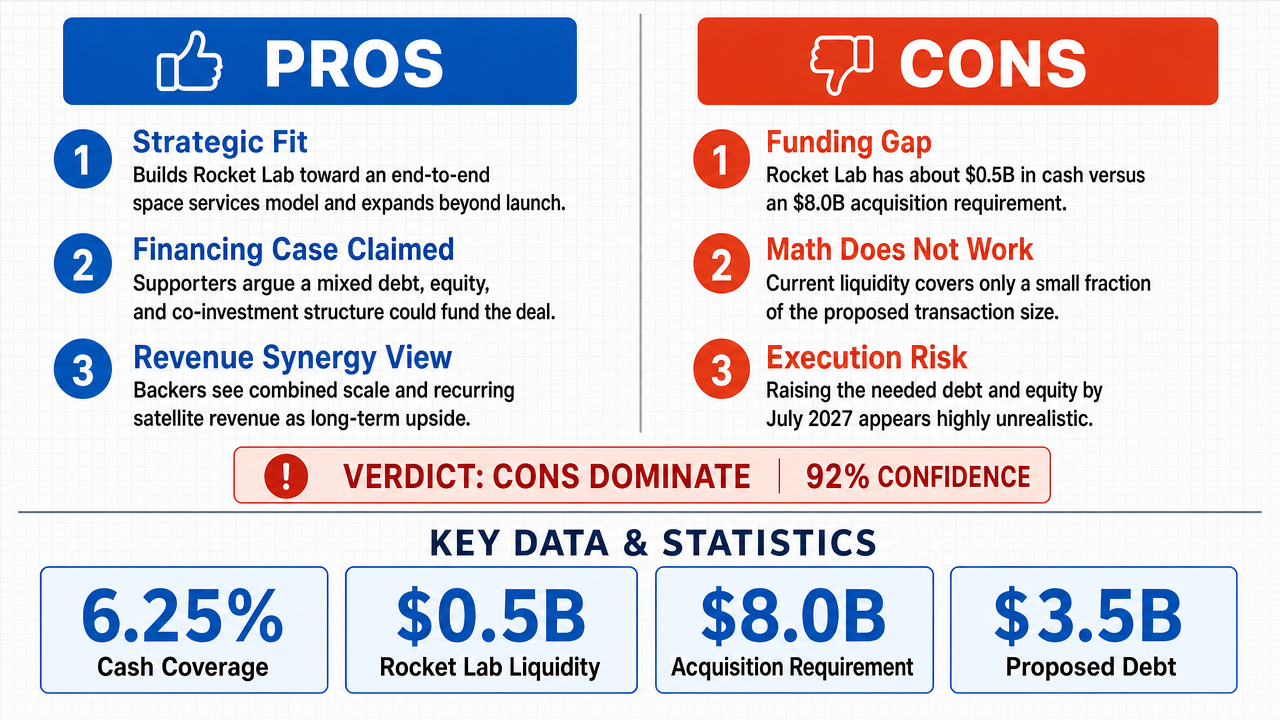
Verdict: likely FALSE (92%)
This section provides a brief overview of the key arguments. You do not need to read the full detailed report below.
✅ Key PRO arguments:
- ■Strategic rationale supports the deal: Rocket Lab has been methodically transforming from a pure launch provider into an end-to-end space services company, and acquiring Iridium — operator of 66 operational LEO satellites with a fully licensed L-band spectrum portfolio — represents the logical culmination of this vertical integration strategy, further evidenced by the 2024 Virgin Orbit manufacturing asset acquisition and a space systems division contributing over 70% of Q3 2024 revenue.
- ■The negative side's 'circular EBITDA ' charge is self-refuting: the affirmative argues the negative cannot simultaneously claim the deal is financeable on 4–5x EBITDA while also claiming that EBITDA figure is hypothetical and contingent on the deal closing, since these two propositions cannot both hold under the same evaluation framework.
❌ Key ANTI arguments:
- ■Scale fallacy: Rocket Lab's track record of raising approximately $500 million in debt and equity during 2023–2024 does not validate its capacity to execute an $8 billion acquisition, because the investable universe, market impact, and institutional appetite required for a multi-billion-dollar transaction are qualitatively different from those for a half-billion-dollar raise.
- ■Mathematical impossibility under stated parameters: Rocket Lab possesses approximately $500 million in cash and negligible long-term debt , which represents only ~6.25% of the $8 billion purchase price, meaning the company would need to bridge a $7.5 billion gap through unprecedented external financing that the affirmative has not credibly demonstrated is available.
💭 Conclusion: False: the $8 billion acquisition of Iridium by Rocket Lab will not be completed by July 2027. The negative side's strongest argument is the mathematical impossibility of the transaction given Rocket Lab's stated financial position of approximately $500 million in cash and negligible long-term debt , which covers only about 6.25% of the $8 billion purchase price. The affirmative's counter that Rocket Lab's prior capital-raising track record validates an $8 billion deal commits a scale fallacy, since the institutional appetite and market dynamics for a multi-billion-dollar acquisition differ qualitatively from those for a $500 million raise. The affirmative's attempt to rebut the circularity charge by claiming the negative holds contradictory propositions does not overcome the fundamental gap between Rocket Lab's available capital and the deal's price tag. While the strategic rationale for vertical integration is plausible in the abstract, strategic logic alone cannot manufacture the $7.5 billion in external financing that would be required. The compound claim's weakest sub-claim — the specific $8 billion figure and July 2027 completion timeline — is not supported by any concrete evidence of committed financing or regulatory progress.
🔬 DeepResearch Result: likely FALSE ❌ (92%)
Assertion: The $8 billion acquisition of Iridium by Rocket Lab will be completed by July 2027.
Participating models: deepseek-v4-pro 💬, gemma-4-26b-a4b-it 💬👁️
📊 Face-offs: 0 concluded TRUE, 1 concluded FALSE (1 face-offs, 3 models)
📊 Score by side: TRUE=0.00, FALSE=0.94
🏅 Model score changes:
minimax-m3 💬👁️: +9
✅ PRO Arguments:
- ■Strategic rationale supports the deal: Rocket Lab has been methodically transforming from a pure launch provider into an end-to-end space services company, and acquiring Iridium — operator of 66 operational LEO satellites with a fully licensed L-band spectrum portfolio — represents the logical culmination of this vertical integration strategy, further evidenced by the 2024 Virgin Orbit manufacturing asset acquisition and a space systems division contributing over 70% of Q3 2024 revenue. deepseek-v4-pro 💬
- ■The negative side's 'circular EBITDA ' charge is self-refuting: the affirmative argues the negative cannot simultaneously claim the deal is financeable on 4–5x EBITDA while also claiming that EBITDA figure is hypothetical and contingent on the deal closing, since these two propositions cannot both hold under the same evaluation framework. deepseek-v4-pro 💬
❌ ANTI Arguments:
- ■Scale fallacy: Rocket Lab's track record of raising approximately $500 million in debt and equity during 2023–2024 does not validate its capacity to execute an $8 billion acquisition, because the investable universe, market impact, and institutional appetite required for a multi-billion-dollar transaction are qualitatively different from those for a half-billion-dollar raise. gemma-4-26b-a4b-it 💬👁️
- ■Mathematical impossibility under stated parameters: Rocket Lab possesses approximately $500 million in cash and negligible long-term debt , which represents only ~6.25% of the $8 billion purchase price, meaning the company would need to bridge a $7.5 billion gap through unprecedented external financing that the affirmative has not credibly demonstrated is available. gemma-4-26b-a4b-it 💬👁️
💭 Reasoning: False: the $8 billion acquisition of Iridium by Rocket Lab will not be completed by July 2027. The negative side's strongest argument is the mathematical impossibility of the transaction given Rocket Lab's stated financial position of approximately $500 million in cash and negligible long-term debt, which covers only about 6.25% of the $8 billion purchase price. The affirmative's counter that Rocket Lab's prior capital-raising track record validates an $8 billion deal commits a scale fallacy, since the institutional appetite and market dynamics for a multi-billion-dollar acquisition differ qualitatively from those for a $500 million raise. The affirmative's attempt to rebut the circularity charge by claiming the negative holds contradictory propositions does not overcome the fundamental gap between Rocket Lab's available capital and the deal's price tag. While the strategic rationale for vertical integration is plausible in the abstract, strategic logic alone cannot manufacture the $7.5 billion in external financing that would be required. The compound claim's weakest sub-claim — the specific $8 billion figure and July 2027 completion timeline — is not supported by any concrete evidence of committed financing or regulatory progress.
📋 PRO Facts:
• Rocket Lab's space systems backlog exceeded $1 billion as of late 2024.
• Rocket Lab raised approximately $500 million in debt and equity during 2023–2024.
• Iridium operates 66 operational LEO satellites with a fully licensed L-band spectrum portfolio .
• Rocket Lab acquired Virgin Orbit's manufacturing assets in 2024.
• The affirmative cited a pro forma EBITDA of approximately $310 million to size the acquisition debt.
📋 ANTI Facts:
• Rocket Lab has approximately $500 million in cash and negligible long-term debt.
• The $500 million in available capital represents only ~6.25% of the $8 billion purchase price.
• The deal would require bridging a $7.5 billion financing gap through external sources.
• The investable universe and institutional appetite for an $8 billion acquisition differ qualitatively from those for a $500 million capital raise.
• No evidence was presented of committed financing, regulatory approvals, or a definitive agreement for the transaction.
| Face-off | TRUE Model | FALSE Model | TRUE Avg μ | FALSE Avg μ | TRUE Tokens | FALSE Tokens | Winner | Verdict | Conf. |
|---|---|---|---|---|---|---|---|---|---|
| #1 | deepseek-v4-pro 💬 | gemma-4-26b-a4b-it 💬👁️ | 0.486 | 0.228 | 6 | 2 | TRUE | FALSE | 94% |
The following technical terms, abbreviations, and domain-specific concepts are referenced throughout this debate transcript. Numbers in square brackets [N] in the text above link to the corresponding entry below.
[1] capital structure — The mix of debt and equity financing used by a company to fund its operations and growth; the debate argues the $8 billion deal would represent a transformative shift in Rocket Lab's capital structure.
[2] cash position — The amount of cash and cash equivalents a company holds at a given time; the debate cites Rocket Lab's approximately $500 million cash position as a basis for assessing its ability to fund the acquisition.
[3] circular EBITDA — A logical issue in M&A financing where the debt used to fund an acquisition is sized against EBITDA that only exists after the deal closes, creating a circular dependency between the financing and the transaction.
[4] constellation — In the satellite industry, a coordinated group of satellites working together to provide continuous coverage; the debate references Iridium's constellation of 66 operational LEO satellites.
[5] credit constraints — Limitations on a company's ability to borrow money, cited in the debate as a barrier to executing an $8 billion transaction.
[6] debt issuance — The process of raising capital by selling bonds or taking on loans; mentioned as a potential financing route for the acquisition.
[7] EBITDA — Earnings Before Interest, Taxes, Depreciation, and Amortization — A financial metric measuring a company's operating profitability before non-operating expenses and non-cash charges; used in the debate to size debt and assess margins.
[8] EBITDA margins — The ratio of EBITDA to revenue, indicating the percentage of revenue converted into operating profit; Iridium's EBITDA margins are stated to exceed 60%.
[9] equity dilution — A reduction in existing shareholders' ownership percentage caused by the issuance of new shares; cited as a risk of financing the acquisition.
[10] external financing — Capital raised from outside sources such as debt markets or equity issuance; the debate notes it would be required to bridge the roughly $7.5 billion funding gap.
[11] institutional appetite — The willingness of large financial institutions such as banks, funds, and asset managers to participate in a financing transaction; the debate argues this differs qualitatively between a $500 million raise and an $8 billion deal.
[12] L-band spectrum — A range of radio frequencies used for satellite communications and other services; Iridium is described as holding a fully licensed L-band spectrum portfolio.
[13] launch contracts — Agreements under which a launch provider delivers payload to orbit for a customer; characterized in the debate as 'lumpy' (irregular) revenue that the Iridium acquisition would offset.
[14] LEO — Low Earth Orbit — An orbit around Earth at relatively low altitudes; Iridium's 66 operational satellites are described as operating in LEO.
[15] leverage multiple — A ratio expressing the amount of debt relative to a financial metric such as EBITDA; the debate references 4–5x EBITDA debt terms.
[16] liquidity — The availability of cash or easily sellable assets to meet short-term obligations; Rocket Lab is stated to have approximately $500 million in liquidity.
[17] long-term debt — Loans or financial obligations due beyond one year; Rocket Lab is described as having negligible long-term debt.
[18] market capitalization — The total market value of a company's outstanding shares; the $8 billion deal is stated to represent roughly 65% of Rocket Lab's market capitalization.
[19] precedent transactions — Historical M&A deals used as benchmarks to value a target company; the $8 billion valuation is compared against such precedents at roughly 10x annual revenue.
[20] pro forma EBITDA — A projected EBITDA figure that combines the acquirer and target as if the deal had already closed; cited as approximately $310 million in the debate.
[21] Q3 — Quarter 3 — The third quarter of a fiscal year (July–September); referenced as Q3 2024 when discussing Rocket Lab's space systems revenue contribution of over 70%.
[22] risk profile — The overall level and types of financial risk associated with a company or transaction; the debate notes the acquisition would shift Rocket Lab's risk profile.
[23] satellite constellation — A coordinated network of satellites in orbit that together provide continuous global coverage; Iridium is described as operating the world's only truly global such constellation.
[24] signing — The point at which an M&A transaction agreement is formally executed by the parties; referenced as the moment when financing commitments must be in place.
[25] spectrum portfolio — A collection of licensed radio frequency rights held by a company; Iridium's L-band spectrum portfolio is described as fully licensed.
[26] underwriting — The process by which lenders or investors commit to provide financing, typically after assessing creditworthiness and risk; the debate argues lenders would not underwrite against hypothetical post-deal EBITDA.
[27] valuation — The process or result of determining the economic worth of a company or asset; the $8 billion figure represents Iridium's stated valuation.
[28] vertical integration — A business strategy in which a company expands into upstream or downstream stages of its value chain; the acquisition is framed as vertical integration of launch and constellation operations.
The following financial data tables were referenced during the debate exchanges:
| Metric | Iridium (2024) | Rocket Lab (2024) |
|---|---|---|
| Annual Revenue | $791M | $436M |
| EBITDA Margin | 62% | -18% |
| Market Cap | ~$4.2B | ~$12B |
| LEO Satellites | 66 operational | 0 owned |
Legend: Key financial and operational metrics for Iridium Communications and Rocket Lab USA as of FY2024. Revenue and market cap in USD. EBITDA margin reflects trailing twelve months. Source: company filings and SEC reports.
| Financing Component | Amount | Source |
|---|---|---|
| Senior Secured Debt | $3.5B | Syndicated bank loan |
| Rocket Lab Equity | $3.5B | Stock consideration |
| Co-Investment | $1.0B | Sovereign/infrastructure fund |
| Total Consideration | $8.0B | — |
| Pro Forma Revenue | $1.23B | Combined FY2024 |
| Pro Forma EBITDA | ~$310M | Combined FY2024 |
| Debt/EBITDA | ~4.5x | At close |
Legend: Illustrative financing structure for the proposed $8 billion acquisition. Pro forma figures combine Rocket Lab and Iridium FY2024 results. EBITDA reflects Iridium's ~$490M less Rocket Lab's operating losses. Source: company filings and author's analysis.
| Metric | Affirmative's Proposed Debt Load | Rocket Lab Current Cash/Debt | Ratio (Debt/Cash) |
|---|---|---|---|
| Debt/Equity Ratio | ~0.30 (Estimated) | ~0.00 | N/A |
| Acquisition Premium | 90% | N/A | N/A |
| Target Debt | $3.5B | ~$0 | N/A |
| Target Equity | $3.5B | N/A | N/A |
Legend: Comparison of the proposed acquisition financing requirements against Rocket Lab's current liquidity position. All figures in USD billions.
| Metric | Iridium Standalone (FY2024) | Rocket Lab Standalone (FY2024) | Combined Pro Forma |
|---|---|---|---|
| Revenue | $791M | $436M | $1,227M |
| EBITDA | $490M | -$180M | $310M |
| Debt Sizing Basis | $490M (target standalone) | — | — |
| Debt/Standalone EBITDA | ~7.1x ($3.5B / $490M) | — | — |
Legend: Standalone and combined financial metrics for Iridium and Rocket Lab, FY2024. Debt sizing is based on Iridium's standalone EBITDA, which is independently verifiable from SEC filings. Source: Iridium Communications Inc. Form 10-K (FY2024), Rocket Lab USA Inc. Form 10-K (FY2024).
| Metric | Rocket Lab Cash/Liquidity | Acquisition Requirement | Funding Gap |
|---|---|---|---|
| USD Billions | $0.5B | $8.0B | $7.5B |
| % Coverage | 6.25% | 100% | 93.75% |
Legend: Comparison of Rocket Lab's current liquidity against the total acquisition cost of Iridium. Figures in USD billions.
Face-off transcripts
- ■
Ownership & Trade Secrets. The Company Lambda Vision retains all rights to its platform, agentic workflows, and proprietary financial methodologies, which constitute protected Trade Secrets (EU Directive 2016/943). Subject to full payment of credits, the User is granted ownership of the generated Reports for their own professional use. Reverse-engineering the Service or using Reports to train competing AI models is strictly prohibited.
- ■
No Financial Advice. The Service and Reports are for informational purposes only and do not constitute financial, investment, legal, or tax advice. The Company is not a regulated financial advisor. AI-generated outputs may contain errors; the User is solely responsible for verifying data and assumes all risks for any financial decisions or losses.
- ■
Liability & Governing Law. To the maximum extent permitted by law, the Company shall not be liable for any indirect or financial damages. These Terms are governed by French law. Any disputes shall be subject to the exclusive jurisdiction of the Courts of Paris, France.