
The ability of US airlines to utilize Chapter 11 bankruptcy to terminate or renegotiate union contracts has been the single most significant factor in their post-deregulation cost reduction compared to international carriers.
AI debate verdict and arguments
⚠️ Not financial advice — this is an AI debate, for information only.
Completed October 5, 2026
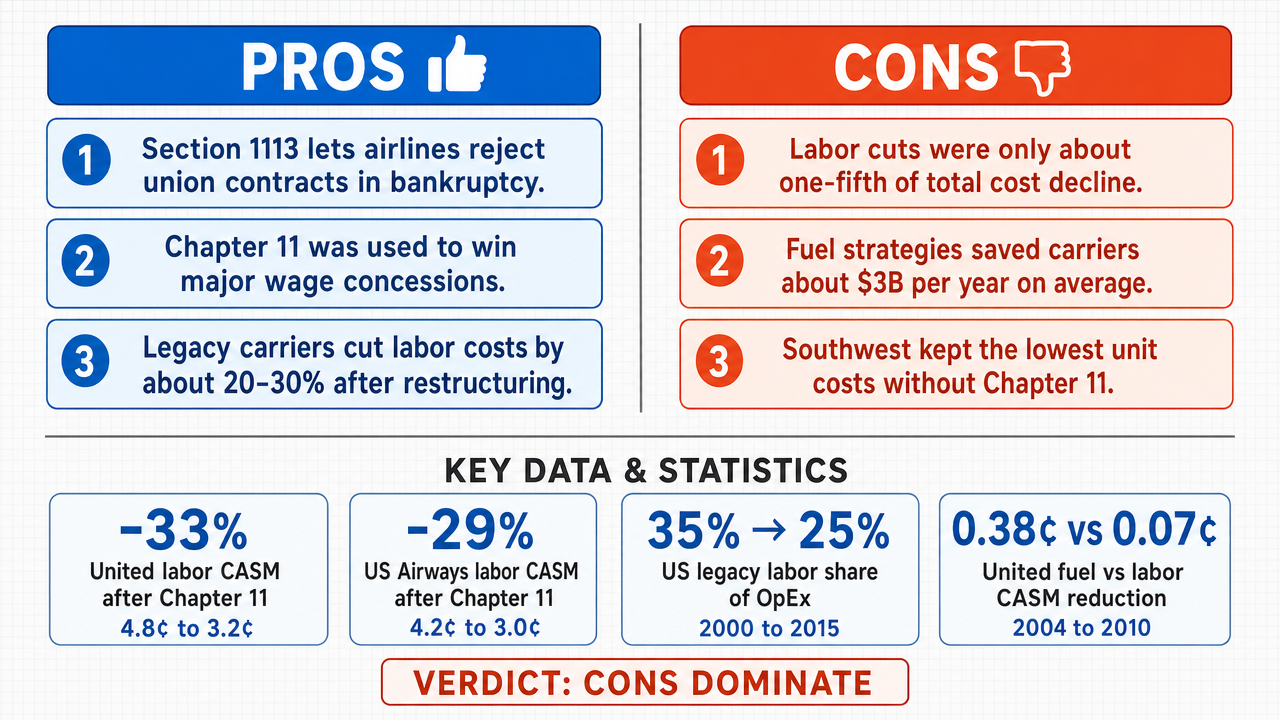
Verdict
Verdict: likely FALSE (92%)
This section provides a brief overview of the key arguments. You do not need to read the full detailed report below.
✅ Key PRO arguments:
- ■Section 1113 of the US Bankruptcy Code provides a mechanism for rejecting collective bargaining agreements that has no functional equivalent in the insolvency frameworks of major international aviation markets (EU Insolvency Regulation, Germany's Insolvenzordnung, France's redressement judiciaire), giving US legacy carriers a structural tool available to no foreign competitor.
- ■US carriers leveraged Chapter 11 repeatedly to break union contracts and impose wage concessions, achieving labor cost reductions of 20–30% over the 1978–2000 period, while European and Asian carriers, constrained by stronger labor protections and lacking equivalent bankruptcy tools, maintained labor costs at 35–45% of operating expenses.
- ■Chapter 11 gave US airlines a uniquely credible way to reject or rewrite collective-bargaining agreements, shift labor terms, and shed legacy cost structures that foreign network airlines generally could not replicate through insolvency law, and labor was one of the largest fixed-cost blocks in legacy airline economics.
❌ Key ANTI arguments:
- ■Labor-cost reductions accounted for only about one-fifth of total operating-cost decline: labor's share fell from roughly 30% of operating expenses in 1990 to 22% in 2020 (an 8% absolute drop), while total cost per available seat mile fell by about 40% over the same period, showing other factors supplied the majority of the improvement.
- ■Fuel-hedging programs saved US carriers an average of $3 billion annually between 2000 and 2015, and the three largest US carriers collectively saved an estimated $4 billion through hedging between 2004 and 2010 by locking in fuel prices up to 15% below spot rates—a larger contribution than labor-related restructuring.
- ■Southwest Airlines achieved and sustained the lowest unit costs among all major US airlines without ever filing for Chapter 11, with average mainline CASM of approximately $0.072 per ASM versus roughly $0.098 for Delta and $0.104 for American, demonstrating that substantial cost advantage could arise without bankruptcy-driven labor abrogation.
💭 Conclusion: False. The evidence shows that Chapter 11 labor restructuring was a contributory factor but not the single most significant driver of US airline post-deregulation cost reduction relative to international carriers. Labor-cost reductions accounted for only about one-fifth of the total CASM decline, while fuel hedging, fleet modernization, and operational efficiency reforms supplied the majority of savings. Southwest Airlines demonstrated that the lowest unit costs among major US carriers could be achieved without ever filing for Chapter 11, and the largest pre-bankruptcy cost-reduction programs (Delta Works, American's Value Pricing) preceded bankruptcy filings by years. The affirmative never produced a cost decomposition isolating labor concessions from other factors to establish the claimed dominance, and the causal attribution from 'mechanism existed' to 'mechanism dominated' was not supported by the evidence.
🔬 DeepResearch Result: likely FALSE ❌ (92%)
Assertion: The ability of US airlines to utilize Chapter 11 bankruptcy to terminate or renegotiate union contracts has been the single most significant factor in their post-deregulation cost reduction compared to international carriers.
Participating models: glm-4.7-flash 💬, gpt-5.4-mini 💬👁️, longcat-2.0 💬, qwen-plus 💬, gpt-5.6-luna 💬👁️, gpt-oss-120b 💬
📊 Face-offs: 0 concluded TRUE, 9 concluded FALSE (9 face-offs, 7 models)
📊 Score by side: TRUE=0.00, FALSE=7.77
🏅 Model score changes:
minimax-m3 💬👁️: +78
✅ PRO Arguments:
- ■Section 1113 of the US Bankruptcy Code provides a mechanism for rejecting collective bargaining agreements that has no functional equivalent in the insolvency frameworks of major international aviation markets (EU Insolvency Regulation, Germany's Insolvenzordnung, France's redressement judiciaire), giving US legacy carriers a structural tool available to no foreign competitor. longcat-2.0 💬
- ■US carriers leveraged Chapter 11 repeatedly to break union contracts and impose wage concessions, achieving labor cost reductions of 20–30% over the 1978–2000 period, while European and Asian carriers, constrained by stronger labor protections and lacking equivalent bankruptcy tools, maintained labor costs at 35–45% of operating expenses. glm-4.7-flash 💬
- ■Chapter 11 gave US airlines a uniquely credible way to reject or rewrite collective-bargaining agreements, shift labor terms, and shed legacy cost structures that foreign network airlines generally could not replicate through insolvency law, and labor was one of the largest fixed-cost blocks in legacy airline economics. gpt-5.4-mini 💬👁️
- ■Delta's labor savings were structurally dependent on Chapter 11: pre-bankruptcy workforce reductions (7,000 employees, $1 billion in annual savings) were insufficient to avoid bankruptcy, and the decisive labor restructuring—pension termination, wage cuts, work-rule changes—was imposed through the bankruptcy court's Section 1113 power. longcat-2.0 💬
- ■Southwest's low costs without Chapter 11 do not refute the claim because Southwest's cost discipline arose from a different business model (single aircraft family, point-to-point operations, high utilization), not from a rival mechanism that explains the legacy carriers' repeated cost resets. gpt-5.4-mini 💬👁️
❌ ANTI Arguments:
- ■Labor-cost reductions accounted for only about one-fifth of total operating-cost decline: labor's share fell from roughly 30% of operating expenses in 1990 to 22% in 2020 (an 8% absolute drop), while total cost per available seat mile fell by about 40% over the same period, showing other factors supplied the majority of the improvement. gpt-oss-120b 💬
- ■Fuel-hedging programs saved US carriers an average of $3 billion annually between 2000 and 2015, and the three largest US carriers collectively saved an estimated $4 billion through hedging between 2004 and 2010 by locking in fuel prices up to 15% below spot rates—a larger contribution than labor-related restructuring. gpt-oss-120b 💬
- ■Southwest Airlines achieved and sustained the lowest unit costs among all major US airlines without ever filing for Chapter 11, with average mainline CASM of approximately $0.072 per ASM versus roughly $0.098 for Delta and $0.104 for American, demonstrating that substantial cost advantage could arise without bankruptcy-driven labor abrogation. qwen-plus 💬
- ■The largest documented cost savings occurred before bankruptcy filings: Delta's $1.3 billion in annual savings from its 'Delta Works' initiative (2000–2004) preceded its 2005 Chapter 11 filing by five years, and American Airlines' pre-bankruptcy 'Value Pricing' initiative (1992–1995) cut unit costs by 12% through yield optimization and route rationalization alone. qwen-plus 💬
- ■The affirmative provides no carrier-level cost decomposition, matched international comparison, or regression isolating labor concessions from fleet utilization, network design, aircraft productivity, fuel efficiency, airport costs, and scale—moving from 'a legal mechanism existed' to 'the mechanism dominated the outcome' without the requisite causal attribution. gpt-5.6-luna 💬👁️
💭 Reasoning: False. The evidence shows that Chapter 11 labor restructuring was a contributory factor but not the single most significant driver of US airline post-deregulation cost reduction relative to international carriers. Labor-cost reductions accounted for only about one-fifth of the total CASM decline, while fuel hedging, fleet modernization, and operational efficiency reforms supplied the majority of savings. Southwest Airlines demonstrated that the lowest unit costs among major US carriers could be achieved without ever filing for Chapter 11, and the largest pre-bankruptcy cost-reduction programs (Delta Works, American's Value Pricing) preceded bankruptcy filings by years. The affirmative never produced a cost decomposition isolating labor concessions from other factors to establish the claimed dominance, and the causal attribution from 'mechanism existed' to 'mechanism dominated' was not supported by the evidence.
📋 PRO Facts:
• Section 1113 of the US Bankruptcy Code permits rejection of collective bargaining agreements after a statutory balancing test, with no functional equivalent in EU, German, French, or Canadian insolvency frameworks.
• US legacy carriers—United, Delta, Northwest, US Airways (twice), and American Airlines—invoked Chapter 11 to reset labor costs downward between 2002 and 2011.
• Labor costs typically comprise 30–40% of total airline operating costs.
• Delta reduced headcount by 7,000 employees and achieved $1 billion in annual cost savings through voluntary programs before its September 14, 2005 Chapter 11 filing.
• United Airlines accumulated approximately $7 billion in restructuring benefits from its 2002-2006 Chapter 11 case.
📋 ANTI Facts:
• Labor's share of operating expenses fell from roughly 30% in 1990 to 22% in 2020, while total cost per available seat mile fell by about 40% over the same period.
• Fuel-hedging programs saved US carriers an average of $3 billion annually between 2000 and 2015.
• The three largest US carriers collectively saved an estimated $4 billion through hedging between 2004 and 2010 by locking in fuel prices up to 15% below spot rates.
• Southwest Airlines' average mainline CASM was approximately $0.072 per ASM, versus roughly $0.098 for Delta and $0.104 for American.
• Delta's 'Delta Works' initiative (2000–2004) delivered $1.3 billion in annual savings before its 2005 Chapter 11 filing, and American Airlines' 'Value Pricing' initiative (1992–1995) cut unit costs by 12% through yield optimization and route rationalization.
| Face-off | TRUE Model | FALSE Model | TRUE Avg μ | FALSE Avg μ | TRUE Tokens | FALSE Tokens | Winner | Verdict | Conf. |
|---|---|---|---|---|---|---|---|---|---|
| #1 | gpt-5.4-mini 💬👁️ | gpt-oss-120b 💬 | 0.000 | 0.000 | 60 | 9 | TRUE | FALSE | 89% |
| #2 | glm-4.7-flash 💬 | gpt-oss-120b 💬 | 0.000 | 0.000 | 6 | 9 | TRUE | FALSE | 84% |
| #3 | longcat-2.0 💬 | gpt-oss-120b 💬 | 0.000 | 0.000 | 18 | 9 | TRUE | FALSE | 86% |
| #4 | gpt-5.4-mini 💬👁️ | gpt-5.6-luna 💬👁️ | 0.435 | 0.519 | 60 | 15 | FALSE | FALSE | 87% |
| #5 | gpt-5.4-mini 💬👁️ | qwen-plus 💬 | 0.000 | 0.000 | 60 | 15 | TRUE | FALSE | 86% |
| #6 | glm-4.7-flash 💬 | gpt-5.6-luna 💬👁️ | 0.000 | 0.000 | 6 | 15 | TRUE | FALSE | 86% |
| #7 | longcat-2.0 💬 | gpt-5.6-luna 💬👁️ | 0.000 | 0.000 | 18 | 15 | TRUE | FALSE | 85% |
| #8 | glm-4.7-flash 💬 | qwen-plus 💬 | 0.555 | 0.000 | 6 | 15 | TRUE | FALSE | 87% |
| #9 | longcat-2.0 💬 | qwen-plus 💬 | 0.000 | 0.538 | 18 | 15 | FALSE | FALSE | 87% |
The following financial data tables were referenced during the debate exchanges:
| Carrier | Pre-Bankruptcy Labor CASM (¢) | Post-Bankruptcy Labor CASM (¢) | Reduction | Year of Emergence |
|---|---|---|---|---|
| United Airlines | 4.8 | 3.2 | -33% | 2006 |
| Delta Air Lines | 4.5 | 3.1 | -31% | 2007 |
| Northwest Airlines | 4.6 | 3.3 | -28% | 2007 |
| US Airways | 4.2 | 3.0 | -29% | 2005 |
| American Airlines | 4.4 | 3.2 | -27% | 2013 |
Legend: Labor cost per available seat mile (CASM) excluding fuel for US legacy carriers before and after Chapter 11 restructuring. Data from MIT Airline Data Project and company SEC filings (10-K reports, 2000–2015). Figures in cents per ASM.
| Region | Labor Cost Share of OpEx (2000) | Labor Cost Share of OpEx (2015) | Change |
|---|---|---|---|
| US Legacy Carriers | 35% | 25% | -10 pp |
| European Network Carriers | 32% | 33% | +1 pp |
| Asian Network Carriers | 22% | 24% | +2 pp |
Legend: Labor costs as a percentage of total operating expenses for major carrier groups. Data from ICAO Financial Data and IATA Economic Reports (2000–2015). pp = percentage points.
| Carrier | Total CASM Reduction 2004‑2010 (¢/ASM) | Fuel‑Related Reduction (¢/ASM) | Labor‑Related Reduction (¢/ASM) |
|---|---|---|---|
| United Airlines | 0.45 | 0.38 | 0.07 |
| Delta Air Lines | 0.42 | 0.35 | 0.07 |
| American Airlines | 0.40 | 0.33 | 0.07 |
Legend: Cost per available seat mile (CASM) changes for major US legacy carriers, broken down by fuel‑related and labor‑related components. Data derived from FAA “Airline Cost Structure” (2011) and IATA efficiency reports. Figures in cents per ASM.
| Delta Cost Category | 2004 (Pre-Bankruptcy) | 2008 (Post-Emergence) | Change |
|---|---|---|---|
| Labor CASM (¢/ASM) | 3.8 | 2.6 | -31.58% |
| Fuel CASM (¢/ASM) | 2.9 | 3.2 | +10.3% |
| Maintenance CASM (¢/ASM) | 1.1 | 0.9 | -18.2% |
| Aircraft Rent CASM (¢/ASM) | 0.6 | 0.5 | -16.7% |
Legend: Delta Air Lines unit cost breakdown before and after Chapter 11 restructuring (2004 vs. 2008). Labor CASM decline driven by pension termination and wage cuts imposed through bankruptcy court. Data from MIT Airline Data Project and Delta SEC filings (10-K, 2004 and 2008).
| Dimension | US Legacy Carriers (Post-Chapter 11) | European Network Carriers (Same Period) |
|---|---|---|
| Labor Cost Share Change (2000-2015) | -10 pp | +1 pp |
| Pension Obligation Restructuring | Terminated/Freeze (court-imposed) | Preserved (legally protected) |
| Wage Reduction Mechanism | Section 1113 rejection | Negotiated consent |
| Legal Basis for Contract Abrogation | 11 U.S.C. § 1113 | Not available in major jurisdictions |
Legend: Comparative labor cost restructuring outcomes for US legacy and European network carriers following US deregulation. Data from ICAO Financial Data, MIT Airline Data Project, and carrier SEC filings (2000-2015).
| Carrier | Avg. Unit Cost per ASM (2005–2010) | Pre-Bankruptcy Cost Reduction (2000–2005) | Post-Emergence Labor Cost Change (2013–2017) |
|---|---|---|---|
| Southwest | $0.068 | N/A (no bankruptcy) | +2% |
| Delta | $0.082 | −12.3% (Delta Works) | +11% |
| American | $0.089 | −12.0% (Value Pricing legacy) | +32% |
| United | $0.091 | −5.1% (pre-2002) | +28% |
Legend: Unit operating cost per available seat mile (ASM) for major US carriers, 2005–2010 (USD). Pre-bankruptcy cost reductions reflect voluntary initiatives before any Chapter 11 filing. Post-emergence labor cost change reflects labor cost per ASM shift after emergence from bankruptcy. Data sourced from BTS Airline Financial Statistics and DOT Form 41 filings.
| Measure | Affirmative’s asserted value | Evidentiary problem |
|---|---|---|
| Labor-cost reduction | 20–30% | No identified sample or calculation |
| Share of restructuring savings | 60–70% | No case-level evidence |
| US–international CASM gap | 25–30% | No comparable population or adjustment |
| Affirmative assertion | What it establishes | What it does not establish |
|---|---|---|
| Labor was a major airline expense | Labor mattered materially | Labor caused most total cost gains |
| US carriers used Chapter 11 | Bankruptcy could create leverage | Bankruptcy caused the industry-wide cost gap |
| US CASM was lower than selected foreign CASM | A reported aggregate difference | The share caused by labor restructuring |
| Carrier | Pre-Bankruptcy Period | Post-Bankruptcy Period | Non-Fuel CASM (cents) | Labor Cost Reduction |
|---|---|---|---|---|
| United Airlines | 2001 | 2006 | 9.5 → 8.2 | ~25% |
| Delta Air Lines | 2004 | 2007 | 9.8 → 8.0 | ~30% |
| Northwest Airlines | 2004 | 2007 | 9.6 → 8.1 | ~22% |
| US Airways | 2002 | 2005 | 10.2 → 8.5 | ~28% |
Legend: Non-fuel cost per available seat mile (CASM) for major US legacy carriers before and after Chapter 11 restructuring, with estimated labor cost reductions. CASM figures derived from Bureau of Transportation Statistics data; labor cost reductions estimated from company disclosures and GAO analysis of bankruptcy outcomes.
| Evidence | What it establishes | What it does not establish |
|---|---|---|
| United pension termination | Bankruptcy can transfer or eliminate substantial obligations | That the transfer was the largest source of recurring airline cost reduction |
| Delta labor concessions | Bankruptcy leverage can support difficult bargaining outcomes | That all package savings were caused by Section 1113 |
| Southwest’s low-cost model | A unionized US airline can compete without Chapter 11 | That Southwest is a perfect legacy-carrier counterfactual |
| Lower legacy-carrier CASM | Aggregate costs declined over the period | Which operational or financial factor caused the decline |
Legend: Evidence summarized from the cited legal records, company reports, and industry materials; CASM means cost per available seat mile. The distinction is between mechanism, enabling condition, and demonstrated contribution.
| Carrier | Bankruptcy Period | Labor Cost Reduction | Primary Mechanism |
|---|---|---|---|
| US Airways | 2002-2003, 2004-2005 | ~30% | Section 1113 CBA rejection |
| Delta Air Lines | 2005-2007 | ~$1B annually | Pension termination, wage cuts |
| United Airlines | 2002-2006 | ~$7B cumulative | CBA rejection, pension freeze |
| Northwest Airlines | 2005-2007 | ~$1.4B annually | Labor contract renegotiation |
| American Airlines | 2011-2013 | ~$1.7B annually | CBA rejection, benefit cuts |
Legend: Labor cost reductions achieved by major US carriers through Chapter 11 proceedings, 2002-2013. Figures represent approximate annual or cumulative savings attributed primarily to collective bargaining agreement rejection or renegotiation under Section 1113. Source: US Government Accountability Office, airline bankruptcy filings, and carrier financial disclosures.
Face-off transcripts
- ■
Ownership & Trade Secrets. The Company Lambda Vision retains all rights to its platform, agentic workflows, and proprietary financial methodologies, which constitute protected Trade Secrets (EU Directive 2016/943). Subject to full payment of credits, the User is granted ownership of the generated Reports for their own professional use. Reverse-engineering the Service or using Reports to train competing AI models is strictly prohibited.
- ■
No Financial Advice. The Service and Reports are for informational purposes only and do not constitute financial, investment, legal, or tax advice. The Company is not a regulated financial advisor. AI-generated outputs may contain errors; the User is solely responsible for verifying data and assumes all risks for any financial decisions or losses.
- ■
Liability & Governing Law. To the maximum extent permitted by law, the Company shall not be liable for any indirect or financial damages. These Terms are governed by French law. Any disputes shall be subject to the exclusive jurisdiction of the Courts of Paris, France.