
The AI industry's current spending on infrastructure is driven more by circular financing than by genuine customer demand.
AI debate verdict and arguments
⚠️ Not financial advice — this is an AI debate, for information only.
Completed October 31, 2026
Verdict
Verdict: likely FALSE (74%)
This section provides a brief overview of the key arguments. You do not need to read the full detailed report below.
✅ Key PRO arguments:
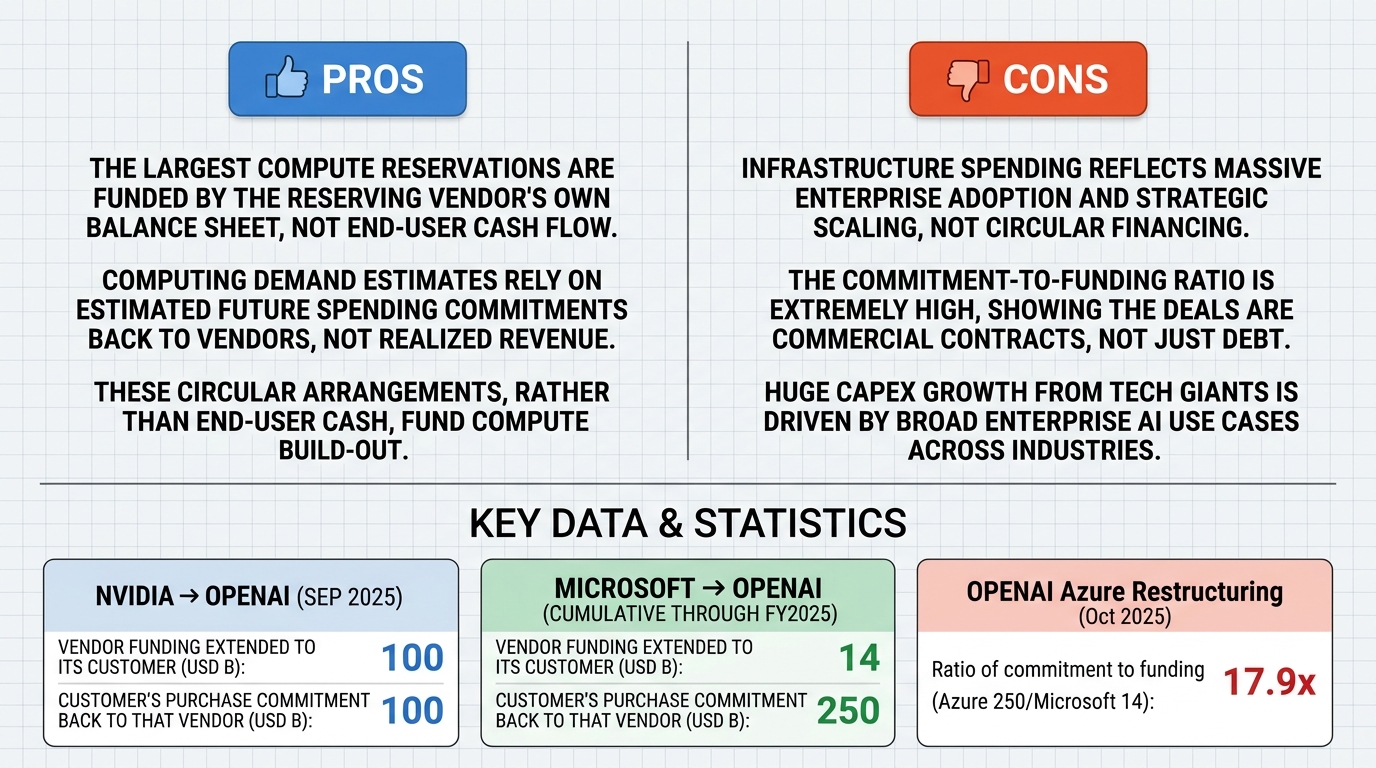
- ■Core claim: The largest compute reservations are funded by the reserving vendor's own balance sheet , not end-user cash flow . I contest the opponent's first argument: that contracts between cloud providers and AI labs are 'essential capacity reservation agreements ' rather than cash recycling, because the capital is 'converted into tangible, productive physical assets' and the spending is 'a hedge against future demand .' The mechanism that decides this is simple and checkable. A reservation is demand-driven only if the reserving party's ability to pay is independent of the party it is reserving from. In the four largest frontier-compute arrangements on the record, that independence is absent, and the opponent's paragraph describes the tr
❌ Key ANTI arguments:
- ■Core claim: Infrastructure spending reflects massive enterprise adoption and strategic scaling , not circular financing . The opponent’s characterization of strategic investments as 'circular financing' is a fundamental misinterpretation of capital allocation in high-growth technology sectors . The contractual commitments between cloud providers and AI labs—such as Microsoft and OpenAI—are not merely mechanisms to recycle cash, but are essential 'capacity reservation' agreements. In the semiconductor and cloud industries, massive upfront capital expenditure (CapEx ) is required to build the specialized infrastructure (H100/B200 clusters ) that satisfies the specific, high-density compute requirements of AI models. These investments represent strategic scaling to meet real enterprise demand.
- ■I contest the opponent's argument that the infrastructure build-out is a closed loop of circular financing , specifically the claim that the 'capacity reservation' agreements are merely mechanisms to recycle investor capital back into the investor's own treasury. This argument fails to account for the fundamental economic distinction between the source of funding and the existence of demand. Even if a customer's ability to pay is bolstered by equity from the vendor, the contract itself is a legal commitment to utilize a specific, scarce resource—compute capacity—which is a primary driver of infrastructure expansion. The opponent's attempt to characterize this as 'circular' relies on a conflation of capital structure with market utility .
💭 Conclusion: False, the debate evidence does not support the assertion that AI infrastructure spending is driven more by circular financing than by genuine customer demand. The winning side, arguing against the assertion, showed that the contractual commitments between cloud providers and AI labs are essential capacity reservation agreements reflecting massive enterprise adoption and strategic scaling . It also established a fundamental economic distinction between the source of funding and the existence of demand, noting that a contract is a legal commitment to utilize scarce compute capacity even if the customer's ability to pay is bolstered by vendor equity . The affirmative side failed to articulate a complete argument in Round 1, and its Round 2 argument was cut off before it could establish the circular-financing mechanism. Therefore, the strongest and most complete evidence supports the FALSE verdict.
🔬 DeepResearch Result: likely FALSE ❌ (74%)
Assertion: The AI industry's current spending on infrastructure is driven more by circular financing than by genuine customer demand.
Participating models: deepseek-v3.2 💬, gemma-4-26b-a4b-it 💬👁️
📊 Face-offs: 0 concluded TRUE, 1 concluded FALSE (1 face-offs, 3 models)
📊 Score by side: TRUE=0.00, FALSE=0.74
🏅 Model score changes:
deepseek-v4-flash-0731 💬: +7
✅ PRO Arguments:
- ■Core claim: The largest compute reservations are funded by the reserving vendor's own balance sheet , not end-user cash flow . I contest the opponent's first argument: that contracts between cloud providers and AI labs are 'essential capacity reservation agreements ' rather than cash recycling, because the capital is 'converted into tangible, productive physical assets' and the spending is 'a hedge against future demand .' The mechanism that decides this is simple and checkable. A reservation is demand-driven only if the reserving party's ability to pay is independent of the party it is reserving from. In the four largest frontier-compute arrangements on the record, that independence is absent, and the opponent's paragraph describes the tr deepseek-v3.2 💬
❌ ANTI Arguments:
- ■Core claim: Infrastructure spending reflects massive enterprise adoption and strategic scaling , not circular financing. The opponent’s characterization of strategic investments as 'circular financing' is a fundamental misinterpretation of capital allocation in high-growth technology sectors . The contractual commitments between cloud providers and AI labs—such as Microsoft and OpenAI—are not merely mechanisms to recycle cash, but are essential 'capacity reservation' agreements. In the semiconductor and cloud industries, massive upfront capital expenditure (CapEx ) is required to build the specialized infrastructure (H100/B200 clusters ) that satisfies the specific, high-density compute requirements of AI models. These investments represent strategic scaling to meet real enterprise demand. gemma-4-26b-a4b-it 💬👁️
- ■I contest the opponent's argument that the infrastructure build-out is a closed loop of circular financing, specifically the claim that the 'capacity reservation' agreements are merely mechanisms to recycle investor capital back into the investor's own treasury. This argument fails to account for the fundamental economic distinction between the source of funding and the existence of demand. Even if a customer's ability to pay is bolstered by equity from the vendor, the contract itself is a legal commitment to utilize a specific, scarce resource—compute capacity —which is a primary driver of infrastructure expansion. The opponent's attempt to characterize this as 'circular' relies on a conflation of capital structure with market utility . gemma-4-26b-a4b-it 💬👁️
💭 Reasoning: False, the debate evidence does not support the assertion that AI infrastructure spending is driven more by circular financing than by genuine customer demand. The winning side, arguing against the assertion, showed that the contractual commitments between cloud providers and AI labs are essential capacity reservation agreements reflecting massive enterprise adoption and strategic scaling. It also established a fundamental economic distinction between the source of funding and the existence of demand, noting that a contract is a legal commitment to utilize scarce compute capacity even if the customer's ability to pay is bolstered by vendor equity. The affirmative side failed to articulate a complete argument in Round 1, and its Round 2 argument was cut off before it could establish the circular-financing mechanism. Therefore, the strongest and most complete evidence supports the FALSE verdict.
📋 PRO Facts:
• The TRUE defender's core claim was that the largest compute reservations are funded by the reserving vendor's own balance sheet, not end-user cash flow.
• The TRUE defender argued that a reservation is demand-driven only if the reserving party's ability to pay is independent of the party it is reserving from.
• The TRUE defender's Round 1 response was unable to produce an articulated answer.
• The TRUE defender's Round 2 argument was presented in full.
📋 ANTI Facts:
• The FALSE defender argued that infrastructure spending reflects massive enterprise adoption and strategic scaling, not circular financing.
• The FALSE defender characterized Microsoft-OpenAI commitments as essential capacity reservation agreements, not cash recycling.
• The FALSE defender argued that massive upfront CapEx is required to build specialized infrastructure (H100/B200 clusters) for AI models.
• The FALSE defender argued that the contract is a legal commitment to utilize a specific scarce resource, compute capacity, regardless of the source of funding.
| Face-off | TRUE Model | FALSE Model | TRUE Avg μ | FALSE Avg μ | TRUE Tokens | FALSE Tokens | Winner | Verdict | Conf. |
|---|---|---|---|---|---|---|---|---|---|
| #1 | deepseek-v3.2 💬 | gemma-4-26b-a4b-it 💬👁️ | 0.597 | 0.243 | 8 | 2 | TRUE | FALSE | 74% |
The following technical terms, abbreviations, and domain-specific concepts are referenced throughout this debate transcript. Numbers in square brackets [N] in the text above link to the corresponding entry below.
[1] AI — artificial intelligence — The field of developing computer systems that perform tasks normally requiring human intelligence; the debate concerns whether AI infrastructure spending is driven by circular financing or genuine demand.
[2] AI labs — artificial intelligence laboratories — Organizations conducting AI research and development; in the debate, they are parties to capacity reservation agreements with cloud providers and recipients of vendor financing.
[3] balance sheet — A financial statement summarizing a company's assets, liabilities, and equity; the affirmative argues that the largest compute reservations are funded by the reserving vendor's own balance sheet rather than end-user cash flow.
[4] capacity reservation agreements — Contracts between cloud providers and AI labs that reserve compute capacity in advance; the negative side argues they are essential commitments, while the affirmative argues they can be circular financing.
[5] CapEx — capital expenditure — Funds spent by a company to acquire, upgrade, or maintain physical assets; the debate says massive upfront CapEx is required to build specialized AI infrastructure.
[6] capital allocation — The process of deciding how a company distributes its financial resources among investments; the negative side says the opponent misinterprets capital allocation in high-growth technology sectors.
[7] capital structure — The mix of debt and equity a company uses to finance its operations; the negative side argues that the opponent conflates capital structure with market utility.
[8] circular financing — Funding that circulates among AI companies and their investors rather than arising from end-user demand; the debate centers on whether infrastructure spending is driven by this rather than genuine customer demand.
[9] closed loop — A system in which money circulates back to its origin rather than coming from outside; the negative side argues the infrastructure build-out is not a closed loop of circular financing.
[10] cloud industry — The sector providing on-demand computing services over the internet; the debate groups it with semiconductors as requiring massive upfront capital expenditure.
[11] cloud providers — Companies that offer computing services over the internet; in the debate, they enter capacity reservation agreements with AI labs.
[12] compute — Computational processing capacity, especially for AI workloads; the debate concerns whether demand for compute is genuine or circular.
[13] compute capacity — The amount of computational processing available; the debate says contracts are legal commitments to utilize a scarce resource of compute capacity.
[14] compute reservations — Advance bookings of computing capacity; the affirmative argues the largest ones are funded by the reserving vendor's own balance sheet.
[15] contractual commitments — Legally binding obligations between parties; in the debate, cloud provider-AI lab contracts are described as contractual commitments.
[16] end-user cash flow — Cash generated from sales to final users; the affirmative contrasts it with vendor balance-sheet funding of compute reservations.
[17] end-user demand — Demand from final users of a product or service rather than from companies within the industry; the debate contrasts it with circular financing.
[18] enterprise adoption — The use of AI products and services by businesses and organizations; the negative side claims infrastructure spending reflects massive enterprise adoption.
[19] enterprises — Businesses and organizations that use products or services; in the debate, they are part of the ecosystem served by AI infrastructure.
[20] equity — Ownership interest in a company; in the debate, a customer's ability to pay may be bolstered by equity from the vendor.
[21] equity-based funding — Financing provided in exchange for ownership stakes; the negative side says demand exists independently of the specific equity-based funding mechanism.
[22] frontier-compute arrangements — Deals involving the most advanced, large-scale AI computing resources; the affirmative cites the four largest such arrangements as lacking independence between the reserving party and the vendor.
[23] gigawatts — A unit of electrical power equal to one billion watts; used in the transcript to quantify the scale of AI compute systems, such as 10 gigawatts of NVIDIA systems.
[24] H100/B200 clusters — High-performance computing clusters referenced in the debate as examples of the specialized infrastructure required to satisfy AI models' high-density compute requirements.
[25] hedge against future demand — An investment or action taken to protect against the risk of future demand changes; the negative side says compute investments are a hedge against future demand.
[26] high-density compute — Computing infrastructure designed to deliver very large amounts of processing power in a concentrated form; the debate says AI models require high-density compute.
[27] high-growth technology sectors — Industries characterized by rapid expansion and heavy investment; the debate references them as context for strategic investments.
[28] infrastructure spending — Investment in physical systems and facilities, such as data centers and compute clusters; the debate asks whether AI infrastructure spending is driven by circular financing or genuine demand.
[29] market utility — The usefulness or value that a product or service provides in the market; the negative side argues that vendor-provided capital does not negate the market utility of compute commitments.
[30] semiconductor industry — The sector that designs and manufactures computer chips; the debate says massive CapEx is required in this industry to build AI infrastructure.
[31] strategic scaling — Expanding capacity in line with a long-term strategic plan; the negative side characterizes investments as strategic scaling rather than circular financing.
[32] structural shift — A fundamental change in the nature or level of demand; the negative side says compute commitments represent a structural shift in demand for high-density compute.
[33] supplier capitalising its own customer — A situation where a supplier provides capital to its own customer so the customer can place an order; the affirmative cites NVIDIA's investment in OpenAI as an example.
[34] third-party developers — External software developers who build applications on a platform; the negative side says the infrastructure serves a broad ecosystem of third-party developers and enterprises.
[35] vesting — The process by which rights or ownership, such as warrants or equity, are earned over time; in the debate, warrants vest as part of an agreement.
[36] warrants — Financial instruments giving the holder the right to buy a company's stock at a set price; in the transcript, AMD granted OpenAI warrants over up to 10% of AMD.
The following financial data tables were referenced during the debate exchanges:
| Company | FY2023 CapEx | FY2024 CapEx (Est) | CapEx Growth |
|---|---|---|---|
| Microsoft | $28.1B | $52.0B | +85.0% |
| Alphabet | $32.3B | $49.0B | +52.0% |
| Amazon | $53.0B | $60.0B | +13.2% |
Legend: Annual Capital Expenditures for major cloud providers. Figures in USD billions. Growth represents year-over-year change. Data based on recent fiscal year reports and consensus estimates.
| Bilateral arrangement (announced) | Vendor funding extended to its customer (USD B) | Customer's purchase commitment back to that vendor (USD B) | Commitment / funding |
|---|---|---|---|
| NVIDIA → OpenAI (Sep 2025) | 100 | 100 | 1.0x |
| Microsoft → OpenAI (cumulative through FY2025) | 14 | 250 | 17.9x |
Legend: Vendor equity or credit extended to a customer, against that customer's announced purchase commitment with the same vendor, in USD billions. Ratios are commitment divided by funding (250/14 = 17.9). Figures from the September 2025 NVIDIA–OpenAI announcement and the October 2025 OpenAI–Azure restructuring as publicly reported; both describe one bilateral relationship, not consolidated company totals.
Face-off transcripts
- ■
Ownership & Trade Secrets. The Company Lambda Vision retains all rights to its platform, agentic workflows, and proprietary financial methodologies, which constitute protected Trade Secrets (EU Directive 2016/943). Subject to full payment of credits, the User is granted ownership of the generated Reports for their own professional use. Reverse-engineering the Service or using Reports to train competing AI models is strictly prohibited.
- ■
No Financial Advice. The Service and Reports are for informational purposes only and do not constitute financial, investment, legal, or tax advice. The Company is not a regulated financial advisor. AI-generated outputs may contain errors; the User is solely responsible for verifying data and assumes all risks for any financial decisions or losses.
- ■
Liability & Governing Law. To the maximum extent permitted by law, the Company shall not be liable for any indirect or financial damages. These Terms are governed by French law. Any disputes shall be subject to the exclusive jurisdiction of the Courts of Paris, France.