
The AI trade is not over, and the overall boom in AI will continue despite market downturns and challenges since July 2026.
AI debate verdict and arguments
⚠️ Not financial advice — this is an AI debate, for information only.
Completed October 19, 2026
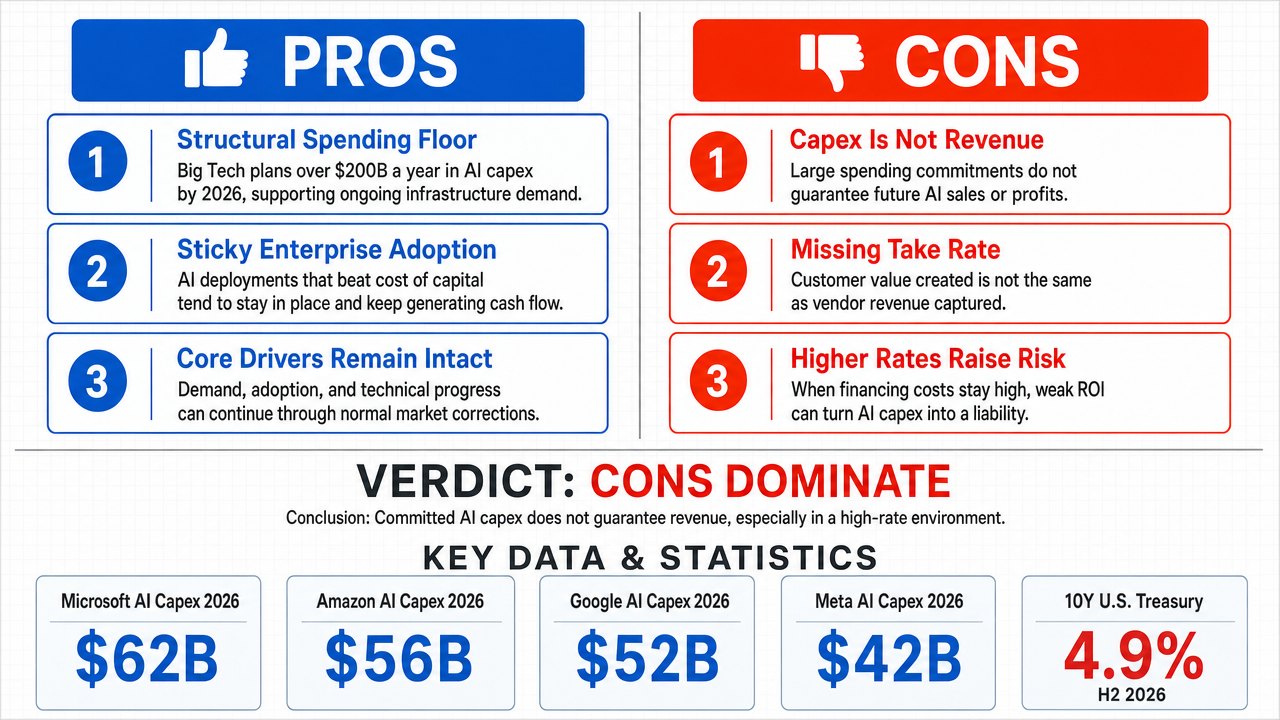
Verdict
Verdict: likely FALSE (60%)
This section provides a brief overview of the key arguments. You do not need to read the full detailed report below.
✅ Key PRO arguments:
- ■Multi-year capital expenditure commitments from Microsoft, Amazon, Google, and Meta totaling over $200 billion annually for 2026 create a structural floor for AI demand, as these contracts with construction firms, power utilities, and semiconductor suppliers are largely irreversible.
- ■Enterprise AI adoption is sticky and generates cash flows exceeding its cost of capital , meaning deployments that remain valuable when capital is free continue to be assets rather than liabilities even when capital becomes expensive.
- ■Infrastructure demand, enterprise adoption, and technological progress remain structurally intact despite cyclical market corrections since July 2026, suggesting the AI boom's underlying drivers are not disrupted by short-term volatility.
❌ Key ANTI arguments:
- ■The affirmative commits a fallacy of scale and purpose: massive capital expenditure does not equal guaranteed revenue. Committed capex is not a proxy for guaranteed revenue, and these two variables are fundamentally different.
- ■The affirmative fails to provide a take-rate , presenting the surplus created for buyers (e.g., 8-12% fuel savings for a logistics firm) as a proxy for revenue captured by AI suppliers, which is a fundamental logical error.
- ■In a high-interest-rate environment , capital expenditure is not a structural floor but a liability. When projected ROI for massive infrastructure projects fails to materialize, committed capex becomes stranded assets.
💭 Conclusion: False. The negative successfully argued that the affirmative's defense of the AI trade rests on a fundamental logical error equating committed capital expenditure with guaranteed revenue. In a high-interest-rate environment (10-Year Treasury at 4.9%, IG borrowing costs at 6.0%), the over $200 billion in annual capex commitments from major hyperscalers functions as a liability rather than a structural floor , since projected ROI may fail to materialize and convert these investments into stranded assets. The affirmative failed to demonstrate a take-rate showing how AI suppliers capture economic value from the surplus they create for enterprise customers. The 60% confidence reflects that while the negative's argument about capital inefficiency was compelling, the structural capex commitments and continued enterprise adoption do provide some qualified support for ongoing AI investment, preventing a higher-confidence verdict.
🔬 DeepResearch Result: likely FALSE ❌ (60%)
Assertion: The AI trade is not over, and the overall boom in AI will continue despite market downturns and challenges since July 2026.
Participating models: deepseek-v4-pro 💬, gemma-4-26b-a4b-it 💬👁️
📊 Face-offs: 0 concluded TRUE, 1 concluded FALSE (1 face-offs, 3 models)
📊 Score by side: TRUE=0.00, FALSE=0.60
🏅 Model score changes:
minimax-m3 💬👁️: +6
✅ PRO Arguments:
- ■Multi-year capital expenditure commitments from Microsoft, Amazon, Google, and Meta totaling over $200 billion annually for 2026 create a structural floor for AI demand, as these contracts with construction firms, power utilities, and semiconductor suppliers are largely irreversible. deepseek-v4-pro 💬
- ■Enterprise AI adoption is sticky and generates cash flows exceeding its cost of capital , meaning deployments that remain valuable when capital is free continue to be assets rather than liabilities even when capital becomes expensive. deepseek-v4-pro 💬
- ■Infrastructure demand, enterprise adoption, and technological progress remain structurally intact despite cyclical market corrections since July 2026, suggesting the AI boom's underlying drivers are not disrupted by short-term volatility. deepseek-v4-pro 💬
- ■The largest technology firms have not meaningfully reduced their AI infrastructure budgets since July 2026, indicating sustained commitment to the AI trade at the corporate level. deepseek-v4-pro 💬
- ■AI deployments deliver measurable cost savings to enterprise customers (e.g., a logistics company saving 8-12% on fuel), demonstrating real economic value that supports continued adoption. deepseek-v4-pro 💬
❌ ANTI Arguments:
- ■The affirmative commits a fallacy of scale and purpose: massive capital expenditure does not equal guaranteed revenue. Committed capex is not a proxy for guaranteed revenue, and these two variables are fundamentally different. gemma-4-26b-a4b-it 💬👁️
- ■The affirmative fails to provide a take-rate , presenting the surplus created for buyers (e.g., 8-12% fuel savings for a logistics firm) as a proxy for revenue captured by AI suppliers, which is a fundamental logical error. gemma-4-26b-a4b-it 💬👁️
- ■In a high-interest-rate environment , capital expenditure is not a structural floor but a liability. When projected ROI for massive infrastructure projects fails to materialize, committed capex becomes stranded assets. gemma-4-26b-a4b-it 💬👁️
- ■The AI trade is collapsing due to massive capital inefficiency and a failure to capture value, as hyperscalers continue spending without demonstrating that the economic surplus they create translates into sustainable supplier revenue. gemma-4-26b-a4b-it 💬👁️
- ■The affirmative's argument that sticky AI deployments remain valuable under expensive capital is internally contradictory: if a deployment's value depends on capital being cheap, then high rates expose it as a liability rather than an asset. gemma-4-26b-a4b-it 💬👁️
💭 Reasoning: False. The negative successfully argued that the affirmative's defense of the AI trade rests on a fundamental logical error equating committed capital expenditure with guaranteed revenue. In a high-interest-rate environment (10-Year Treasury at 4.9%, IG borrowing costs at 6.0%), the over $200 billion in annual capex commitments from major hyperscalers functions as a liability rather than a structural floor, since projected ROI may fail to materialize and convert these investments into stranded assets. The affirmative failed to demonstrate a take-rate showing how AI suppliers capture economic value from the surplus they create for enterprise customers. The 60% confidence reflects that while the negative's argument about capital inefficiency was compelling, the structural capex commitments and continued enterprise adoption do provide some qualified support for ongoing AI investment, preventing a higher-confidence verdict.
📋 PRO Facts:
• Microsoft, Amazon, Google, and Meta collectively committed over $200 billion in annual capex for 2026, predominantly directed toward AI data centers and GPU clusters .
• Enterprise AI adoption has crossed into production deployment, with over 65% of Fortune 500 companies running at least one AI workload in production by mid-2026.
• The largest technology firms have not meaningfully reduced their AI infrastructure budgets since July 2026.
📋 ANTI Facts:
• The debate occurred in a high-interest-rate environment where capital expenditure functions as a liability rather than a floor.
• The affirmative did not provide a take-rate demonstrating how AI suppliers capture revenue from the economic surplus created for buyers.
• Committed capex and guaranteed revenue are distinct variables, and conflating them constitutes a fallacy of scale.
| Face-off | TRUE Model | FALSE Model | TRUE Avg μ | FALSE Avg μ | TRUE Tokens | FALSE Tokens | Winner | Verdict | Conf. |
|---|---|---|---|---|---|---|---|---|---|
| #1 | deepseek-v4-pro 💬 | gemma-4-26b-a4b-it 💬👁️ | 0.454 | 0.183 | 6 | 2 | TRUE | FALSE | 60% |
The following technical terms, abbreviations, and domain-specific concepts are referenced throughout this debate transcript. Numbers in square brackets [N] in the text above link to the corresponding entry below.
[1] AI infrastructure — Artificial Intelligence infrastructure — The physical and computational backbone supporting AI workloads, including data centers, GPU clusters, networking, and power systems used to train and run AI models.
[2] AI optimization — Artificial Intelligence optimization — The application of AI techniques to improve efficiency, reduce costs, or enhance performance in business processes such as logistics, fuel consumption, or supply chain management.
[3] AI trade — Artificial Intelligence trade — An investment thesis centered on companies positioned to benefit from the development and deployment of AI technologies, encompassing hardware makers, cloud providers, and AI software firms.
[4] Blackwell Ultra — NVIDIA Blackwell Ultra — A next-generation NVIDIA GPU platform referenced in the debate as part of the booked semiconductor supply chain through 2028.
[5] cancellation costs — The sunk costs incurred when abandoning a partially completed infrastructure project, which the affirmative argues exceed the costs of completion for large AI data centers.
[6] capex — capital expenditure — Funds spent by a company to acquire, upgrade, or maintain physical assets such as data centers and semiconductor equipment; distinguished from operating expenses.
[7] cash flows — The net movement of money into and out of a business, used in the debate to evaluate whether AI deployments generate returns exceeding their cost of capital.
[8] cash reserves — Liquid assets held by a company to meet obligations; the negative argues that unprofitable AI capex drains these reserves and accelerates collapse.
[9] cost of capital — The required return rate that a company must earn on its investments to satisfy its capital providers; central to the debate over whether AI deployments remain viable as rates rise.
[10] data centers — Large-scale facilities housing servers, networking equipment, and power systems used to train and run AI models, representing the primary physical asset of AI capex.
[11] enterprise AI adoption — The deployment of AI tools and systems within large organizations to improve operations; the debate disputes whether adoption statistics remain valid under higher capital costs.
[12] equity valuations — The market-assessed value of a company's shares, referenced in the affirmative's argument about compression of AI-related stock multiples.
[13] GPU clusters — Graphics Processing Unit clusters — Groups of interconnected GPUs used to perform parallel computation required for training and inference of large AI models.
[14] hyperscalers — hyperscale cloud providers — The largest cloud infrastructure operators (e.g., Microsoft, Amazon, Google, Meta) whose massive AI capex commitments are central to the debate.
[15] interest-rate environment — The prevailing level and trajectory of interest rates in an economy, which the negative argues transforms committed capex from a floor into a liability.
[16] liabilities — In the debate, used metaphorically to describe AI deployments whose returns fall below the cost of capital, making them value-destroying rather than value-creating.
[17] liquidity — The availability of cheap money in financial markets; the negative argues that AI adoption statistics compiled under high liquidity are invalidated by current expensive capital.
[18] market sentiment — The overall attitude of investors toward a market or asset class, which the affirmative argues cannot erase the structural floor under AI hardware demand.
[19] rate environment — interest rate environment — The general level of interest rates prevailing in an economy, used in the debate to assess whether sticky AI deployments remain assets or become liabilities.
[20] return on investment — ROI — A performance metric measuring the efficiency of an investment, calculated as the ratio of net profit to the capital invested; central to evaluating AI infrastructure projects.
[21] reversibility of utility — A concept raised by the negative arguing that large-scale industrial projects can have their utility reversed or stranded even when physical cancellation costs are high.
[22] Rubin — NVIDIA Rubin platform — A future-generation NVIDIA GPU platform referenced alongside Blackwell Ultra as part of booked semiconductor capacity through 2028.
[23] semiconductor supply chain — The network of firms involved in designing, fabricating, packaging, and distributing chips; the affirmative argues it is booked through 2028, supporting AI demand.
[24] spread — spread (between returns and cost of capital) — The differential between the return generated by an investment and its cost of capital; the affirmative argues this spread, not the rate level, determines whether AI deployments are assets.
[25] sticky deployments — sticky AI deployments — Enterprise AI installations that are difficult to remove or replace once integrated; the negative argues these become liabilities when capital becomes expensive.
[26] structural floor — A minimum level of demand or activity supported by long-term, irreversible commitments; the affirmative argues multi-year AI capex creates such a floor.
[27] take-rate — The fraction of total economic value created by an AI deployment that is captured as revenue by the AI provider, rather than retained by the end-user.
[28] TSMC — Taiwan Semiconductor Manufacturing Company — The world's largest dedicated semiconductor foundry, referenced for its advanced packaging capacity that is booked through 2028.
The following financial data tables were referenced during the debate exchanges:
| Company | AI Capex 2025 (Est.) | AI Capex 2026 (Est.) | YoY Change |
|---|---|---|---|
| Microsoft | $55B | $62B | +12.7% |
| Amazon | $48B | $56B | +16.7% |
| $45B | $52B | +15.6% | |
| Meta | $35B | $42B | +20.0% |
Legend: Estimated AI-related capital expenditures for the four largest hyperscalers, 2025–2026. All figures in USD billions. Growth rates reflect continued expansion despite market volatility. Sources: company earnings calls and 10-K filings, H2 2025–Q1 2026.
| Metric | Low-Rate Era (2024) | Current Era (H2 2026) |
|---|---|---|
| 10-Year U.S. Treasury Yield | 3.9% | 4.9% |
| IG Corporate Borrowing Cost | 5.0% | 6.0% |
| Median AI Cost Reduction | 14% | 14% |
| Median AI Revenue Uplift | 9% | 9% |
| AI ROI vs. Cost of Capital | +9.0pp | +8.0pp |
Legend: Comparison of capital costs and enterprise AI returns across rate environments. AI returns from McKinsey "The State of AI in 2025"; Treasury yields and corporate borrowing costs from Federal Reserve data and Bloomberg, H2 2026. ROI spread calculated as median cost reduction minus IG corporate borrowing cost.
| Entity | 2026 Capex Commitment (Est.) | Primary Allocation | Risk Factor |
|---|---|---|---|
| Microsoft | $62B | AI Data Centers / GPU | ROI Lag |
| Amazon | $56B | AWS / AI Infrastructure | Margin Compression |
| $52B | TPU / Cloud AI | Competitive Pricing | |
| Meta | $42B | Llama / Infrastructure | Sunk Cost Risk |
Legend: Estimated 2026 capital expenditures for major hyperscalers. All figures in USD billions. Risk factors represent the potential for capital to become stranded if AI revenue fails to meet expenditure growth. Source: Aggregated company guidance and market analysis, H2 2026.
Face-off transcripts
- ■
Ownership & Trade Secrets. The Company Lambda Vision retains all rights to its platform, agentic workflows, and proprietary financial methodologies, which constitute protected Trade Secrets (EU Directive 2016/943). Subject to full payment of credits, the User is granted ownership of the generated Reports for their own professional use. Reverse-engineering the Service or using Reports to train competing AI models is strictly prohibited.
- ■
No Financial Advice. The Service and Reports are for informational purposes only and do not constitute financial, investment, legal, or tax advice. The Company is not a regulated financial advisor. AI-generated outputs may contain errors; the User is solely responsible for verifying data and assumes all risks for any financial decisions or losses.
- ■
Liability & Governing Law. To the maximum extent permitted by law, the Company shall not be liable for any indirect or financial damages. These Terms are governed by French law. Any disputes shall be subject to the exclusive jurisdiction of the Courts of Paris, France.