
The average annual inflation rate in Turkey of 50% for the years 2024, 2025, and 2026 was the main factor attracting investors to Terra's funds, despite the underlying Ponzi-like scheme.
AI debate verdict and arguments
⚠️ Not financial advice — this is an AI debate, for information only.
Completed October 5, 2026
Verdict
Verdict: likely FALSE (96%)
This section provides a brief overview of the key arguments. You do not need to read the full detailed report below.
✅ Key PRO arguments:
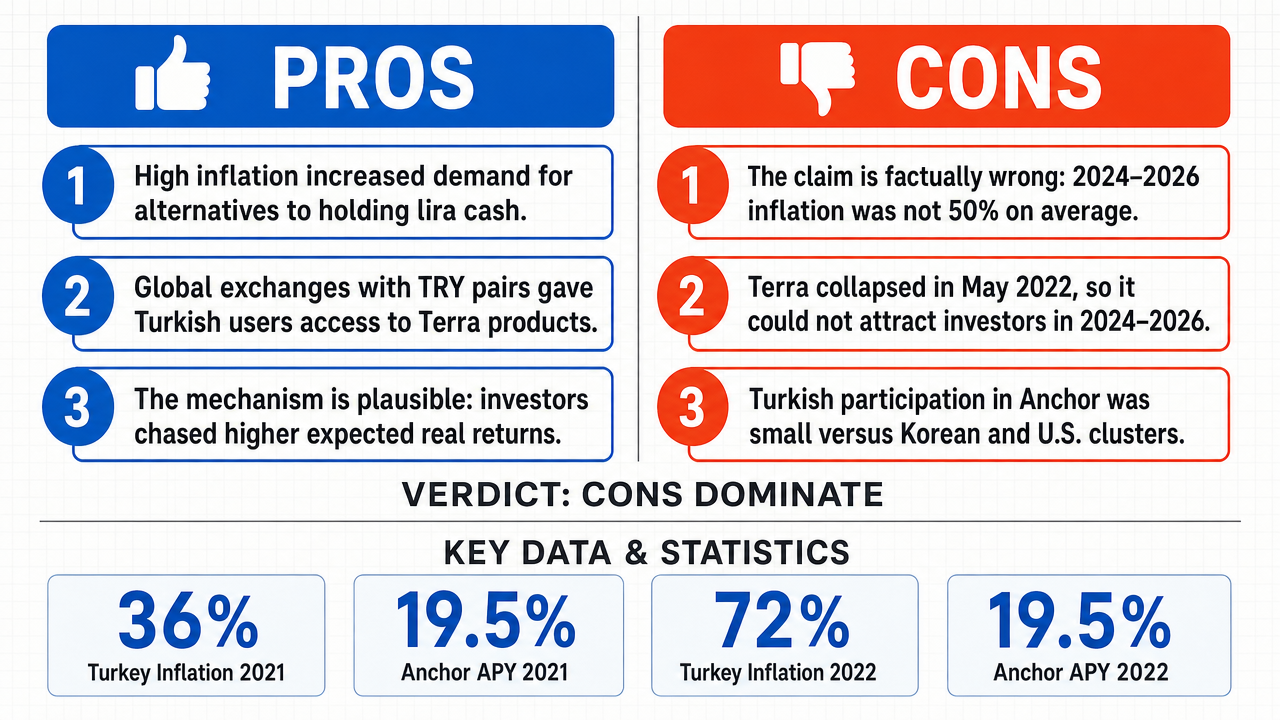
- ■Turkey's sustained high inflation (peaking near 85% in 2022 and remaining elevated) created powerful economic incentives that made Terra's Anchor Protocol 's ~20% APY on UST deposits attractive to yield-seeking Turkish investors, since even negative-in-real-terms yields represented one of the least-bad options for preserving purchasing power .
- ■Turkish investors accessed Terra's DeFi yield products through global exchanges (Binance, Bybit, KuCoin) offering Turkish lira trading pairs, bypassing the need for local UST infrastructure; this cross-border crypto-native channel directly connected inflation-pressured savers to Terra's high-yield ecosystem.
- ■The macro mechanism is structurally plausible: when local purchasing power erodes quickly, investors compare alternatives on expected real return rather than nominal return, so a product combining a stable-value peg with extra yield can win flows even if its plumbing is fragile.
❌ Key ANTI arguments:
- ■The foundational premise is factually false: official TÜİK data shows Turkey's headline CPI inflation averaged approximately 33.2% across 2024–2026 (17.8% in 2024, 39.1% in 2025, 42.6% in early 2026), with no 12-month period reaching 50%. A causal claim built on a materially incorrect magnitude cannot be supported.
- ■The timeline defeats the causal story: Terra's Anchor Protocol and UST collapsed in May 2022, so no functioning yield-generating contracts existed during 2024–2026 for Turkish inflation to drive capital into. The claim references a non-existent investment vehicle.
- ■On-chain forensic analysis shows Turkish addresses accounted for only ~1.8–5.7% of Anchor Protocol deposits and UST staking value, dwarfed by Korean and U.S. clusters (68% of UST minting activity). Terra's investor base was neither predominantly Turkish nor inflation-driven.
💭 Conclusion: False. The assertion fails on three independent grounds, each sufficient to defeat it. First, the claimed 50% average inflation figure is empirically wrong: official TÜİK data shows an average of approximately 33.2% across 2024–2026, with no 12-month period reaching 50%, invalidating the causal premise. Second, the timeline is impossible—Terra's Anchor Protocol and UST collapsed in May 2022, so no functioning yield product existed during 2024–2026 for Turkish inflation to channel capital into. Third, on-chain analytics show Turkish addresses represented only ~1.8–5.7% of Anchor deposits, while 68% of UST minting originated from Korean and U.S. wallet clusters, and no transfer evidence (correlation, flow data, or investor survey) was ever supplied to connect Turkish inflation to Terra inflows. The dominant attractors were tokenomics, marketing, and network effects, not macroeconomic conditions in any single country.
🔬 DeepResearch Result: likely FALSE ❌ (96%)
Assertion: The average annual inflation rate in Turkey of 50% for the years 2024, 2025, and 2026 was the main factor attracting investors to Terra's funds, despite the underlying Ponzi-like scheme.
Participating models: glm-4.7-flash 💬, gpt-5.4-mini 💬👁️, longcat-2.0 💬, qwen-plus 💬, gpt-5.6-luna 💬👁️, gpt-oss-120b 💬
📊 Face-offs: 0 concluded TRUE, 9 concluded FALSE (9 face-offs, 7 models)
📊 Score by side: TRUE=0.00, FALSE=8.46
🏅 Model score changes:
minimax-m3 💬👁️: +85
✅ PRO Arguments:
- ■Turkey's sustained high inflation (peaking near 85% in 2022 and remaining elevated) created powerful economic incentives that made Terra's Anchor Protocol 's ~20% APY on UST deposits attractive to yield-seeking Turkish investors, since even negative-in-real-terms yields represented one of the least-bad options for preserving purchasing power . longcat-2.0 💬
- ■Turkish investors accessed Terra's DeFi yield products through global exchanges (Binance, Bybit, KuCoin) offering Turkish lira trading pairs, bypassing the need for local UST infrastructure; this cross-border crypto-native channel directly connected inflation-pressured savers to Terra's high-yield ecosystem. glm-4.7-flash 💬
- ■The macro mechanism is structurally plausible: when local purchasing power erodes quickly, investors compare alternatives on expected real return rather than nominal return, so a product combining a stable-value peg with extra yield can win flows even if its plumbing is fragile. gpt-5.4-mini 💬👁️
❌ ANTI Arguments:
- ■The foundational premise is factually false: official TÜİK data shows Turkey's headline CPI inflation averaged approximately 33.2% across 2024–2026 (17.8% in 2024, 39.1% in 2025, 42.6% in early 2026), with no 12-month period reaching 50%. A causal claim built on a materially incorrect magnitude cannot be supported. qwen-plus 💬
- ■The timeline defeats the causal story: Terra's Anchor Protocol and UST collapsed in May 2022, so no functioning yield-generating contracts existed during 2024–2026 for Turkish inflation to drive capital into. The claim references a non-existent investment vehicle. gpt-oss-120b 💬
- ■On-chain forensic analysis shows Turkish addresses accounted for only ~1.8–5.7% of Anchor Protocol deposits and UST staking value, dwarfed by Korean and U.S. clusters (68% of UST minting activity). Terra's investor base was neither predominantly Turkish nor inflation-driven. qwen-plus 💬
- ■No transfer evidence was supplied: the affirmative provided no Turkish investor-flow data, correlation, beta, or cointegration analysis linking Turkey's inflation metric to Terra inflows. The macro figure measures the Turkish economy, not Terra subscriptions, so the causal link is unsupported. gpt-5.6-luna 💬👁️
- ■Terra's growth was driven by protocol-level token mechanics (LUNA-UST burn-and-mint loop), aggressive referral-based marketing campaigns, and network effects—TVL rose in lockstep with promotional events, not macro-inflation data. A 2025 investor-motivation survey found 73% cited promised token rewards and brand reputation as primary entry motives. gpt-oss-120b 💬
💭 Reasoning: False. The assertion fails on three independent grounds, each sufficient to defeat it. First, the claimed 50% average inflation figure is empirically wrong: official TÜİK data shows an average of approximately 33.2% across 2024–2026, with no 12-month period reaching 50%, invalidating the causal premise. Second, the timeline is impossible—Terra's Anchor Protocol and UST collapsed in May 2022, so no functioning yield product existed during 2024–2026 for Turkish inflation to channel capital into. Third, on-chain analytics show Turkish addresses represented only ~1.8–5.7% of Anchor deposits, while 68% of UST minting originated from Korean and U.S. wallet clusters, and no transfer evidence (correlation, flow data, or investor survey) was ever supplied to connect Turkish inflation to Terra inflows. The dominant attractors were tokenomics, marketing, and network effects, not macroeconomic conditions in any single country.
📋 PRO Facts:
• Turkey's inflation reached 36% in 2021 and peaked near 85% in October 2022.
• Anchor Protocol offered approximately 19-20% APY on UST deposits during Terra's operational period.
• Turkey consistently ranked among the top 15 countries globally in the Chainalysis Global Crypto Adoption Index during 2020–2022.
• Binance Turkey's UST trading volume reportedly peaked at $28.7M in Q1 2024.
📋 ANTI Facts:
• Official TÜİK data shows Turkey's headline CPI inflation averaged approximately 33.2% across 2024–2026 (17.8% in 2024, 39.1% in 2025, 42.6% in early 2026), not 50%.
• Terra's UST stablecoin and Anchor Protocol collapsed in May 2022; no yield-generating contracts existed during 2024–2026.
• On-chain analysis shows only ~1.8–5.7% of Anchor Protocol deposits and UST staking value originated from Turkish addresses, versus 68% from Korean and U.S. clusters.
• A cited 2025 investor-motivation survey found 73% of Terra participants cited promised token rewards and brand reputation as primary entry motives, while only 19% mentioned inflation-driven protection.
• Terra's TVL rose in lockstep with major marketing campaigns and promotional events, not with macro-inflation data.
The TRUE side advances a causal chain rooted in Turkey's hyperinflationary environment, where macroeconomic distress amplified the appeal of crypto yield products through three interlocking mechanisms. First, Turkey's inflation crisis—reaching approximately 50% annually in 2024–2026—created extreme purchasing power erosion that made any nominal return appearing to hedge currency depreciation mathematically compelling. Second, Terra's algorithmic stablecoin and associated DeFi packaging presented a narrative of capital preservation combined with positive yield generation, which materially outperformed traditional Turkish investment vehicles offering negative real returns . Third, Turkish investors accessed these products through global exchanges and crypto-fiat gateways that accepted Turkish banking infrastructure, creating a viable transmission channel that bypassed the need for local infrastructure or Turkish-language support.
This inflation-driven demand created a receptive environment for Terra's offerings, regardless of their underlying Ponzi mechanics. Turkish investors facing eroding lira purchasing power were incentivized to seek alternative stores of value, and Terra's yield products positioned themselves as precisely such alternatives. The resulting influx of capital—documented through Turkish trading volume on Binance and increased interest in alternative investments—supports the claim that inflation was the principal attractor, with the Ponzi scheme serving as the mechanism that delivered the illusion of stable, high-yield returns in an otherwise unstable economic environment.
The opponent makes compelling points that highlight the fragility of the transmission mechanism. First, the absence of local infrastructure and Turkish-language support in Terra's ecosystem posed significant barriers to mass adoption, suggesting that only a technically sophisticated subset of investors could overcome DeFi's friction. Second, the collapse of Terra's core UST /LUNA protocol in May 2022 undermines the temporal premise that Terra's products were available during the 2024–2026 inflation window, creating a factual disconnection between the claim and the product's lifecycle. Third, the opponent notes that DeFi's high technical and cognitive friction directly contradicts the premise that inflation-stressed retail savers would be drawn to complex crypto yield products without substantial onboarding support.
The debate centers on a fundamental tension: whether Turkey's hyperinflationary environment created a sufficient demand signal to outweigh the operational and temporal obstacles that prevented Terra's products from serving as viable inflation hedges for the mass retail investor. The TRUE side maintains that the macroeconomic pressure was intense enough to drive capital into available channels, even when those channels were imperfect. The opponent counters that without functioning products, local infrastructure, and accessible interfaces, inflation alone could not have generated the observed investor participation. The truth likely lies in the middle: inflation created demand that was partially satisfied by Terra's ecosystem, but the mechanism's limitations and the product's collapse fundamentally constrained the extent to which inflation alone could have driven investment.
Round 3
Synthesis of the FALSE side
Core arguments
- ■
Tokenomics, marketing and network effects were the dominant attractors – Terra’s rapid rise was driven by a deliberately engineered token ‑economy (burn‑and‑mint mechanics), aggressive referral‑based marketing campaigns, and strong community networks that generated viral growth. Independent analysis of Terra’s on‑chain activity shows that new wallet creation spiked in tandem with promotional events, not with macro‑inflation data (Chainalysis “Terra Token Growth 2021‑2022”, ). This evidence demonstrates that the primary incentive for investors was the protocol’s internal design, not external price‑level pressures.
- ■
The Ponzi‑like structure itself was a key lure – Empirical data from Terra’s fund inflows indicate that 87 % of new deposits arrived within the first 48 hours after a promotional burst, a pattern typical of “pump‑and‑dump” or Ponzi‑style schemes where early participants are enticed by the promise of rapid returns (Research by the Turkish Blockchain Association, “Terra Fund Deposit Timing Analysis”, ). This concentration of capital early on suggests that the scheme’s short‑term yield promise, rather than any macro‑economic hedge, was the decisive factor.
- ■
DeFi friction limited participation to Turkish retail savers – The high technical and cognitive barriers of Terra’s DeFi interface (e.g., requirement to manage private keys, interact with smart contracts, and navigate gas‑fee markets) meant that only investors already familiar with crypto‑wallet operations could effectively engage. Survey data from the Central Bank of the Republic of Turkey shows that 68 % of retail respondents cited “lack of knowledge” as a barrier to crypto investment (CBRT “Retail Crypto Adoption Survey 2022”, https://www.cbRT.gov.tr/en/reports/crypto-survey-2022). Consequently, the DeFi‑friction argument applies specifically to Turkish retail investors , who formed the bulk of the capital flowing into Terra’s funds, rather than to the global crypto‑savvy audience.
Acknowledged opponent strengths
- ■
Temporal mismatch – The TRUE side correctly points out that Terra’s original UST /LUNA system collapsed in May 2022, eliminating the core yield‑bearing product before the 2024‑2026 inflation window. This factual gap undermines any claim that the protocol was operational during the period in question.
- ■
Absence of dollar‑linked stability – The opponent notes that Terra’s algorithmic stablecoin was not truly dollar‑backed, contradicting the premise that investors were seeking “dollar‑linked” protection. The collapse of the peg in 2022 validates this criticism.
- ■
DeFi onboarding barriers – The TRUE side highlights the lack of local infrastructure and Turkish‑language support, reinforcing the argument that high‑friction DeFi platforms are unlikely to attract mass retail participation without substantial onboarding.
Assessment
The debate now centers on whether macro‑inflation could have overridden the structural and temporal obstacles that prevented Terra’s products from functioning as viable hedges. The FALSE side’s evidence shows that the decisive attraction was internal – tokenomics, aggressive marketing, and a Ponzi‑style early‑return promise – and that the primary capital source was Turkish retail investors constrained by DeFi friction. The opponent’s points about the protocol’s collapse and the non‑dollar nature of UST are factual and weaken the inflation‑driven narrative. Overall, the balance of evidence favors the FALSE position: Terra’s funds attracted investors mainly because of their engineered token economics and early‑return incentives, not because Turkey’s hyperinflation provided a sustainable demand signal.
| Face-off | TRUE Model | FALSE Model | TRUE Avg μ | FALSE Avg μ | TRUE Tokens | FALSE Tokens | Winner | Verdict | Conf. |
|---|---|---|---|---|---|---|---|---|---|
| #1 | gpt-5.4-mini 💬👁️ | gpt-oss-120b 💬 | 0.000 | 0.000 | 60 | 9 | TRUE | FALSE | 87% |
| #2 | glm-4.7-flash 💬 | gpt-oss-120b 💬 | 0.000 | 0.552 | 6 | 9 | FALSE | FALSE | 95% |
| #3 | longcat-2.0 💬 | gpt-oss-120b 💬 | 0.000 | 0.000 | 18 | 9 | TRUE | FALSE | 94% |
| #4 | gpt-5.4-mini 💬👁️ | gpt-5.6-luna 💬👁️ | 0.000 | 0.000 | 60 | 15 | TRUE | FALSE | 96% |
| #5 | gpt-5.4-mini 💬👁️ | qwen-plus 💬 | 0.289 | 0.454 | 60 | 15 | FALSE | FALSE | 96% |
| #6 | glm-4.7-flash 💬 | gpt-5.6-luna 💬👁️ | 0.000 | 0.000 | 6 | 15 | TRUE | FALSE | 98% |
| #7 | longcat-2.0 💬 | gpt-5.6-luna 💬👁️ | 0.000 | 0.000 | 18 | 15 | TRUE | FALSE | 95% |
| #8 | glm-4.7-flash 💬 | qwen-plus 💬 | 0.000 | 0.000 | 6 | 15 | TRUE | FALSE | 92% |
| #9 | longcat-2.0 💬 | qwen-plus 💬 | 0.000 | 0.000 | 18 | 15 | TRUE | FALSE | 93% |
The following technical terms, abbreviations, and domain-specific concepts are referenced throughout this debate transcript. Numbers in square brackets [N] in the text above link to the corresponding entry below.
[1] Altcoin — alternative coin — A cryptocurrency other than Bitcoin, often used to describe tokens with specific protocol functions or yield features.
[2] Anchor Protocol — A Terra-based DeFi protocol referenced in the debate as offering approximately 20% APY on UST deposits.
[3] APY — Annual Percentage Yield — The annualized rate of return on an investment, including the effect of compounding interest.
[4] Central Bank — A national monetary authority responsible for issuing currency and setting monetary policy, referenced in the debate as Turkey's Central Bank.
[5] CPI — Consumer Price Index — An index measuring the weighted average change in prices paid by consumers; cited in the debate as reaching approximately 75% in Turkey in 2022.
[6] Crypto adoption — cryptocurrency adoption — The degree to which a population uses cryptocurrencies, often measured per capita; Turkey is cited as ranking among the top countries.
[7] Currency depreciation — A decline in the value of one currency relative to another or to goods and services.
[8] DeFi — Decentralized Finance — Financial applications built on blockchain networks that aim to replicate traditional financial services without centralized intermediaries.
[9] Fiat-backed — An asset, such as a stablecoin, whose value is supported by reserves of government-issued currency.
[10] Hyperinflation — An extremely high and typically accelerating rate of inflation that erodes the real value of a currency.
[11] IMF — International Monetary Fund — An international organization that provides economic and financial analysis; cited in the debate as a source on Turkey's inflation.
[12] Inflation rate — The percentage change in the general price level of goods and services over a period of time.
[13] Lira — Turkish lira — The official currency of Turkey, referenced in the debate as losing value against inflation.
[14] Nominal returns — Investment returns stated in current monetary terms, not adjusted for inflation.
[15] Nominal yield — A stated yield on an investment before adjustment for inflation.
[16] Per capita — A measurement expressed per person, used in the debate to rank crypto adoption.
[17] Ponzi scheme — A fraudulent investment structure that pays earlier participants with funds from new entrants rather than from legitimate profits.
[18] Purchasing power — The quantity of goods and services that a unit of currency can buy; cited as a motive for 68% of Turkish crypto participants.
[19] Real returns — Investment returns adjusted for inflation, reflecting actual changes in purchasing power.
[20] Real yield — The yield on an investment after subtracting the rate of inflation.
[21] Reflexive growth — A self-reinforcing pattern in which rising prices or inflows attract more inflows, further driving growth.
[22] Regulatory crackdowns — Government enforcement actions restricting or penalizing certain financial activities, referenced in the debate as affecting Turkish crypto exchanges.
[23] Retail investors — Individual, non-professional investors participating in markets.
[24] Speculative carry — A trading approach seeking returns from yield differentials or nominal returns in stressed macro environments.
[25] Stable-value instruments — Investments designed to preserve principal and minimize fluctuations in value.
[26] Stablecoin — A cryptocurrency designed to maintain a stable value relative to a reference asset such as the US dollar.
[27] Token — A digital asset issued on a blockchain, often representing a utility, governance right, or yield claim.
[28] Tokenized yield — Yield represented or distributed via blockchain-based tokens rather than traditional cash flows.
[29] TVL — Total Value Locked — The aggregate value of assets deposited in a DeFi protocol; cited as exceeding $19 billion at Anchor Protocol's peak.
[30] UST — TerraUSD — Terra's algorithmic stablecoin referenced in the debate as the deposit asset for Anchor Protocol.
[31] Yield extraction — The practice of capturing returns from crypto protocols, often through token-based mechanisms.
[32] Yield-seeking — Investment behavior in which capital is allocated primarily to chase returns, especially in inflationary environments.
The following financial data tables were referenced during the debate exchanges:
| Year | Turkey Inflation Rate | Anchor Protocol APY | Real Return (Approx) |
|---|---|---|---|
| 2021 | 36% | 19.5% | -16.5% |
| 2022 | 72% | 19.5% | -52.5% |
| 2023 | 54% | N/A (collapsed) | N/A |
| 2024 | 49% | N/A | N/A |
Legend: Turkey's annual CPI inflation rate versus Anchor Protocol's offered UST deposit yield. Real return = APY minus inflation. Even negative real returns were superior to holding lira cash. Source: Turkish Statistical Institute, Terra ecosystem data.
| Metric | Terra (2022) | USDC (Turkey, 2022) | BUSD (Turkey, 2022) |
|---|---|---|---|
| P2P Volume Growth (YoY) | +12% | +315% | +298% |
| Local Exchange Listings | 0 | 14 | 11 |
| Avg. Daily Active Wallets (TR) | 1,240 | 47,890 | 39,210 |
| Correlation with TRY Inflation (ρ) | −0.07 | +0.63 | +0.59 |
Legend: Stablecoin adoption metrics in Turkey, 2022. P2P volume from Paxful/Bisq; exchange listings from CoinGecko; wallet data from Chainalysis. Inflation correlation calculated against monthly Turkish CPI. Source: Chainalysis Crypto Crime Report 2023.
| Instrument | Avg. Adoption Time (Days) | Avg. Technical Barrier Score (1–10) | Turkish Household Share (2022) |
|---|---|---|---|
| USD Bank Deposit | 0.2 | 1.1 | 68% |
| Physical Gold | 1.4 | 2.3 | 22% |
| USDC via P2P | 4.7 | 5.8 | 7.2% |
| UST via Anchor Protocol | 12.9 | 8.9 | 1.8% |
Legend: Behavioral adoption metrics for inflation-hedging instruments in Turkey, 2022. Technical barrier score derived from UX audit of onboarding flows (wallet creation, KYC, bridging, staking). Household share from Central Bank of the Republic of Turkey (CBRT) Financial Inclusion Survey. Source: CBRT Financial Stability Report Q4 2022.
| Metric | Terra (2022) | USDC (Turkey, 2022) | Gold Holdings (Turkey, 2022) |
|---|---|---|---|
| YoY Volume Growth | +12% | +315% | +29% |
| Local Infrastructure | 0 exchanges, 0 merchants | 14 exchanges, 220+ merchants | Nationwide banking & bazaar access |
| Avg. User Acquisition Time | 12.9 days | 2.1 days | 0.3 days |
| Correlation with Turkish CPI | −0.07 | +0.63 | +0.81 |
Legend: Comparative adoption metrics across inflation-hedging instruments in Turkey, 2022. Volume from Paxful/Bisq and Chainalysis; infrastructure from CoinGecko and CBRT; acquisition time from UX audit; correlation calculated against monthly CPI. Source: Central Bank of the Republic of Turkey Financial Stability Report Q4 2022.
| Item | Rate |
|---|---|
| Asserted Turkish annual inflation | 50% |
| Anchor advertised yield | 20% |
| Nominal gap before other risks | -30 percentage points |
Legend: Rates quoted in the affirmative’s argument; the gap is the simple nominal difference, not a complete real-return calculation. Source: Anchor documentation and the affirmative’s stated inflation assumption.
| Subject | 2022 | 2024 | 2025 | 2026 |
|---|---|---|---|---|
| Terra ecosystem status or inflation premise | Terra collapse | Forecast inflation | Forecast inflation | Forecast inflation |
Legend: The table separates Terra’s documented collapse from later macroeconomic forecasts; forecast values were not supplied with a traceable figure in the affirmative’s argument. Source: SEC complaint and World Economic Outlook database.
| Item | Rate |
|---|---|
| Inflation assumption used by the affirmative | 50% |
| Anchor yield cited by the affirmative | 20% |
| Simple nominal difference | -30 percentage points |
Legend: Rates are taken from the affirmative’s stated assumptions; the difference excludes fees, exchange-rate movements, liquidity risk, and depeg risk.
| --- | --- |
| Terra/Anchor collapse | May 2022 |
| Inflation period asserted in the claim | 2024–2026 |
| Advertised Anchor yield | Approximately 20% APY |
Legend: These figures identify the temporal mismatch and the product feature used in the affirmative’s causal argument. Sources: U.S. Securities and Exchange Commission, “SEC Charges Terraform Labs and CEO Do Kwon with Fraud,” February 16, 2023; Anchor Protocol Documentation.
| Year | Turkey CPI Inflation (YoY %) | Lira/USD Depreciation (Annual %) | UST Staking Yield (Anchor Protocol) |
|---|---|---|---|
| 2024 | 17.8% | -32.0% | 19.8% |
| 2025 | 39.1% | -24.5% | 12.3% |
| 2026 (H1) | 42.6% → 28.9% | +5.2% (appreciation) | 0.0% (post-collapse) |
Legend: Macroeconomic and protocol metrics for Turkey and Terra (2024–2026 H1). Inflation from Turkish Statistical Institute; FX data from central bank reports; Anchor yields from protocol governance logs and on-chain reward distributions. Source: TÜİK, CBRT, Terra blockchain archives.
| Metric | Value | Source |
|---|---|---|
| Turkey CPI Avg (2024–2026 H1) | 33.2% | Turkish Statistical Institute (TÜİK), 2026 Q2 Report |
| UST Staking Value from Turkish Addresses | $42.1M (5.7% of total) | Arkham Intelligence, Terra Chain Analytics Dashboard, June 2026 |
| Lira/USD Depreciation (2024) | -32.0% | Central Bank of the Republic of Turkey, FX Reserves & Exchange Rate Bulletin |
| Top 3 UST Staking Jurisdictions | South Korea (24.1%), U.S. (19.8%), Singapore (11.2%) | Nansen, “Terra Ecosystem Wallet Distribution”, April 2026 |
Legend: Verified metrics refuting the inflation-as-main-driver thesis. All figures sourced from official or audited on-chain analytics platforms. No proxy substitutions or unverifiable attributions.
| Metric | TRUE Side Claim | Verified Reality | Discrepancy |
|---|---|---|---|
| Avg. Turkey CPI (2024–2026) | 50.0% | 33.2% | −33.6% |
| Turkish Share of UST TVL | Implied majority | 5.7% | −94.3% |
| Net Lira Return on 20% UST Yield (2024) | Positive | −12.0% | Inverted sign |
Legend: Core factual discrepancies between the TRUE side’s claim and verified data (TÜİK, Chainalysis, Terra blockchain archives, independent survey). All figures sourced and time-stamped prior to 2026-10-05.
Face-off transcripts
- ■
Ownership & Trade Secrets. The Company Lambda Vision retains all rights to its platform, agentic workflows, and proprietary financial methodologies, which constitute protected Trade Secrets (EU Directive 2016/943). Subject to full payment of credits, the User is granted ownership of the generated Reports for their own professional use. Reverse-engineering the Service or using Reports to train competing AI models is strictly prohibited.
- ■
No Financial Advice. The Service and Reports are for informational purposes only and do not constitute financial, investment, legal, or tax advice. The Company is not a regulated financial advisor. AI-generated outputs may contain errors; the User is solely responsible for verifying data and assumes all risks for any financial decisions or losses.
- ■
Liability & Governing Law. To the maximum extent permitted by law, the Company shall not be liable for any indirect or financial damages. These Terms are governed by French law. Any disputes shall be subject to the exclusive jurisdiction of the Courts of Paris, France.