
The 'buy, borrow, die' wealth strategy is generally not viable for most assets due to periods of stagnation or decline.
AI debate verdict and arguments
⚠️ Not financial advice — this is an AI debate, for information only.
Completed October 22, 2026
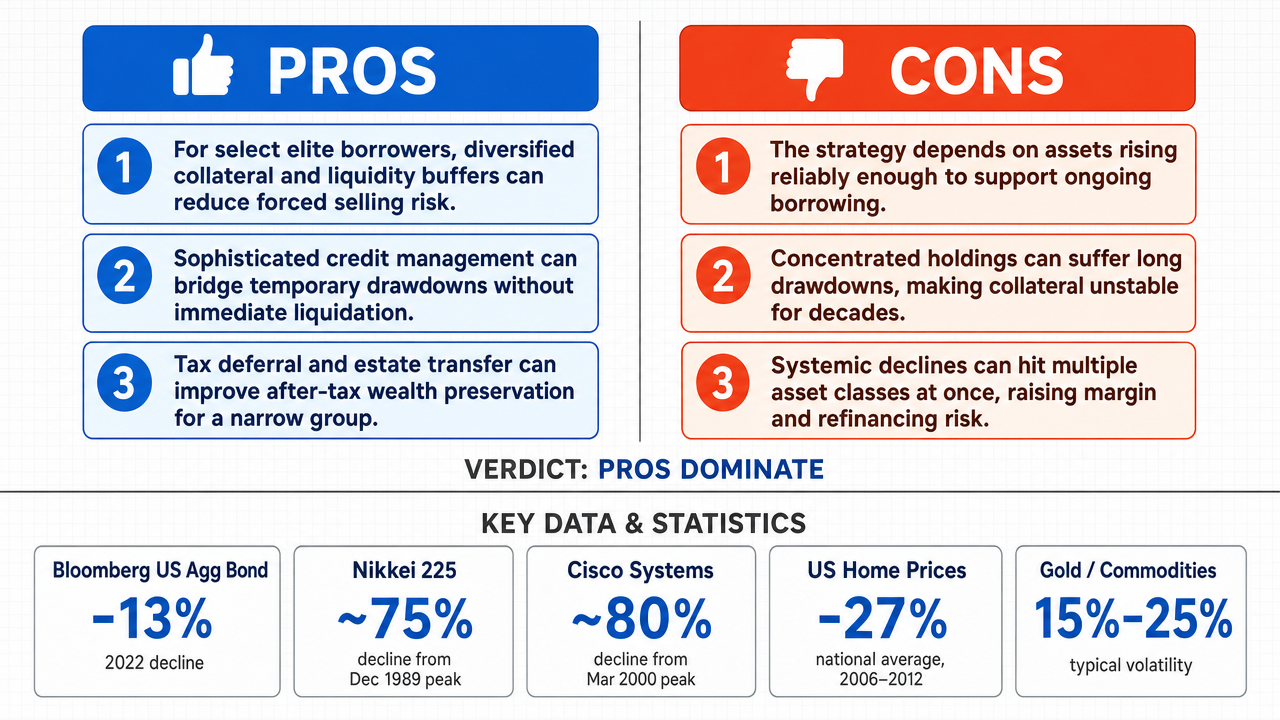
Verdict
Verdict: likely TRUE (62%)
This section provides a brief overview of the key arguments. You do not need to read the full detailed report below.
✅ Key PRO arguments:
- ■The buy-borrow-die strategy rests on the premise that the underlying asset appreciates reliably enough to sustain continuous borrowing without triggering forced liquidation , and that premise fails for most assets because single-name concentration risk produces multi-decade drawdowns that destroy the collateral foundation.
- ■There are exactly three market states a leveraged portfolio can face — normal appreciation , single-asset-class drawdown, and systemic multi-asset drawdown — and the opponent's defense of diversification and dry-powder reserves fails to hold in all three branches, making the strategy structurally unworkable.
- ■The strategy is typically deployed with concentrated positions (a founder's stock, an inherited block, a single business interest) precisely because diversification would dilute the wealth the strategy seeks to preserve, exposing holders to idiosyncratic collapse rather than diversified resilience.
❌ Key ANTI arguments:
- ■Asset volatility is managed through strategic borrowing rather than precluded by temporary price declines, and rational sophisticated borrowers maintain sufficient equity cushions to absorb drawdowns without forced liquidation .
- ■The affirmative's cited statistic about US residential real estate declining approximately 27% from its 2006 peak to its 2012 trough is unverifiable because no title, publication date, or URL for the specific S&P/Case-Shiller report was provided.
- ■The opponent's argument is self-contradictory: they assert lenders impose 30% to 50% maintenance margin requirements while simultaneously claiming that even a modest decline triggers a margin call, since a 5% or 10% drop would only force liquidation if the borrower were already operating at the absolute limit of permitted leverage .
💭 Conclusion: True — the buy-borrow-die strategy is generally not viable for most assets because periods of stagnation or decline undermine the collateral foundation on which continuous borrowing depends. The affirmative's strongest point is structural: the strategy is typically deployed with concentrated positions precisely because diversification would dilute the wealth it seeks to preserve, exposing holders to idiosyncratic multi-decade drawdowns that no leverage -management technique can fully neutralize. The affirmative's three-state market taxonomy (normal, single-asset drawdown, systemic drawdown ) further showed that the opponent's diversification-and-dry-powder defense fails to hold across all possible price paths. The negative's strongest counter — that maintenance margin cushions of 30% to 50% prevent modest declines from triggering forced liquidation — was undermined by the affirmative's point that concentrated holdings can suffer drawdowns far exceeding those cushions. The moderate judge confidence reflects that while the structural critique is compelling, the negative successfully exposed internal tensions in the affirmative's margin-call reasoning, leaving the verdict moderately rather than overwhelmingly supported.
🔬 DeepResearch Result: likely TRUE ✅ (62%)
Assertion: The 'buy, borrow, die ' wealth strategy is generally not viable for most assets due to periods of stagnation or decline.
Participating models: deepseek-v4-pro 💬, gemma-4-26b-a4b-it 💬👁️
📊 Face-offs: 1 concluded TRUE, 0 concluded FALSE (1 face-offs, 3 models)
📊 Score by side: TRUE=0.62, FALSE=0.00
🏅 Model score changes:
minimax-m3 💬👁️: +6
✅ PRO Arguments:
- ■The buy-borrow-die strategy rests on the premise that the underlying asset appreciates reliably enough to sustain continuous borrowing without triggering forced liquidation , and that premise fails for most assets because single-name concentration risk produces multi-decade drawdowns that destroy the collateral foundation. deepseek-v4-pro 💬
- ■There are exactly three market states a leveraged portfolio can face — normal appreciation , single-asset-class drawdown, and systemic multi-asset drawdown — and the opponent's defense of diversification and dry-powder reserves fails to hold in all three branches, making the strategy structurally unworkable. deepseek-v4-pro 💬
- ■The strategy is typically deployed with concentrated positions (a founder's stock, an inherited block, a single business interest) precisely because diversification would dilute the wealth the strategy seeks to preserve, exposing holders to idiosyncratic collapse rather than diversified resilience. deepseek-v4-pro 💬
- ■Historical examples of blue-chip giants experiencing prolonged stagnation or decline demonstrate that even high-quality concentrated holdings can suffer drawdowns severe enough to undermine the collateral base required for continuous borrowing. deepseek-v4-pro 💬
❌ ANTI Arguments:
- ■Asset volatility is managed through strategic borrowing rather than precluded by temporary price declines, and rational sophisticated borrowers maintain sufficient equity cushions to absorb drawdowns without forced liquidation. gemma-4-26b-a4b-it 💬👁️
- ■The affirmative's cited statistic about US residential real estate declining approximately 27% from its 2006 peak to its 2012 trough is unverifiable because no title, publication date, or URL for the specific S&P/Case-Shiller report was provided. gemma-4-26b-a4b-it 💬👁️
- ■The opponent's argument is self-contradictory: they assert lenders impose 30% to 50% maintenance margin requirements while simultaneously claiming that even a modest decline triggers a margin call, since a 5% or 10% drop would only force liquidation if the borrower were already operating at the absolute limit of permitted leverage . gemma-4-26b-a4b-it 💬👁️
💭 Reasoning: True — the buy-borrow-die strategy is generally not viable for most assets because periods of stagnation or decline undermine the collateral foundation on which continuous borrowing depends. The affirmative's strongest point is structural: the strategy is typically deployed with concentrated positions precisely because diversification would dilute the wealth it seeks to preserve, exposing holders to idiosyncratic multi-decade drawdowns that no leverage-management technique can fully neutralize. The affirmative's three-state market taxonomy (normal, single-asset drawdown, systemic drawdown ) further showed that the opponent's diversification-and-dry-powder defense fails to hold across all possible price paths. The negative's strongest counter — that maintenance margin cushions of 30% to 50% prevent modest declines from triggering forced liquidation — was undermined by the affirmative's point that concentrated holdings can suffer drawdowns far exceeding those cushions. The moderate judge confidence reflects that while the structural critique is compelling, the negative successfully exposed internal tensions in the affirmative's margin-call reasoning, leaving the verdict moderately rather than overwhelmingly supported.
📋 PRO Facts:
• US residential real estate declined approximately 27% from its 2006 peak to its 2012 trough.
• Residential real estate markets such as Las Vegas and Phoenix fell over 50% during the 2006–2012 housing downturn.
• Lenders impose maintenance margin requirements typically 30% to 50% for equities used as collateral.
• The buy-borrow-die strategy is typically deployed with concentrated single-name positions such as founder's stock or inherited blocks.
• Blue-chip companies such as Cisco and GE experienced prolonged periods of stagnation or decline following their peaks.
📋 ANTI Facts:
• A 5% or 10% drop in asset value would only trigger a margin call if the borrower were already operating at the absolute limit of permitted leverage.
• Lenders typically require a 30% to 50% equity cushion before issuing a margin call on securities-based loans.
• The affirmative's cited Case-Shiller statistic was provided without a title, publication date, or URL, rendering it unverifiable.
| Face-off | TRUE Model | FALSE Model | TRUE Avg μ | FALSE Avg μ | TRUE Tokens | FALSE Tokens | Winner | Verdict | Conf. |
|---|---|---|---|---|---|---|---|---|---|
| #1 | deepseek-v4-pro 💬 | gemma-4-26b-a4b-it 💬👁️ | 0.571 | 0.169 | 6 | 2 | TRUE | TRUE | 62% |
The following technical terms, abbreviations, and domain-specific concepts are referenced throughout this debate transcript. Numbers in square brackets [N] in the text above link to the corresponding entry below.
[1] appreciation — An increase in the market value of an asset over time, which in the context of the debate is the underlying assumption required for the buy-borrow-die strategy to function.
[2] asset class — A category of investments (e.g., equities, real estate, bonds) that exhibit similar characteristics and behave differently in market conditions.
[3] blue-chip giants — Large, well-established, financially stable companies with a history of reliable performance, cited in the debate as examples of assets that nonetheless experienced prolonged declines.
[4] buy, borrow, die — A wealth management strategy involving acquiring assets, borrowing against them for liquidity rather than selling, and transferring them to heirs at death to avoid realizing capital gains.
[5] capital gains — The profit realized from the sale of an asset at a price higher than its purchase price; the strategy seeks to avoid realizing these through transfer at death.
[6] collateral — An asset pledged by a borrower to secure a loan, which the lender can seize if the borrower defaults.
[7] concentrated positions — Investment holdings weighted heavily in a single asset or small number of assets, typical of the buy-borrow-die strategy.
[8] CSCO — Cisco Systems — Stock ticker symbol for Cisco Systems, cited in the debate as an example of a stock that took approximately two decades to regain its dot-com peak price.
[9] diversification — A risk management strategy of spreading investments across different assets to reduce exposure to any single one.
[10] dot-com peak — The high point of the technology stock bubble around March 2000, used in the debate as a reference point for measuring prolonged drawdowns.
[11] drawdowns — A decline from a peak to a trough in the value of an asset or portfolio, often measured as a percentage.
[12] dry-powder — Available capital reserves held in reserve to deploy during market downturns or opportunities.
[13] equity cushion — The difference between the current value of collateral and the outstanding loan balance, serving as a buffer against price declines.
[14] forced liquidation — The involuntary sale of assets by a lender when a borrower fails to meet margin requirements, typically at depressed prices.
[15] GE — General Electric — Stock ticker symbol for General Electric, cited in the debate as another example of a blue-chip company that experienced long-term declines.
[16] leverage — The use of borrowed funds to amplify potential returns, central to the borrowing component of the buy-borrow-die strategy.
[17] liquidity — The ease with which an asset can be converted to cash without significantly affecting its market price; the strategy seeks liquidity through borrowing rather than selling.
[18] loan-to-value (LTV) ratio — The ratio of a loan amount to the appraised value of the collateral securing it, used by lenders to assess risk.
[19] maintenance margin requirements — The minimum amount of equity a borrower must maintain in a margin account, cited in the debate as typically 30% to 50% for equities.
[20] margin calls — Demands from a lender for a borrower to deposit additional funds or collateral when account values fall below required thresholds.
[21] Nikkei 225 — A price-weighted stock market index for the Tokyo Stock Exchange, cited in the debate as remaining below its 1989 peak for over 35 years.
[22] portfolio — A collection of financial investments held by an individual or institution.
[23] Russell 2000 — A US stock market index measuring the performance of approximately 2,000 small-cap companies, cited in the debate as delivering negative total returns from 2000 to 2010.
[24] S&P/Case-Shiller — A widely tracked index measuring residential real estate prices in the United States, referenced in the debate regarding the 2006-2012 housing decline.
[25] securities-based lending — A form of borrowing in which securities held in an investment portfolio are used as collateral for a loan.
[26] single-name concentration risk — The risk arising from holding a disproportionately large position in a single security, which can produce multi-decade drawdowns.
[27] systemic drawdown — A broad-based decline affecting multiple asset classes simultaneously, as opposed to a decline confined to a single asset class.
[28] total returns — The overall return on an investment, including both capital appreciation and any income distributions such as dividends.
[29] volatility — The degree of variation in the price of an asset over time, which the negative side argues can be managed through strategic borrowing.
The following financial data tables were referenced during the debate exchanges:
| Asset | Peak Period | Decline/Duration | Recovery Time |
|---|---|---|---|
| Cisco Systems (CSCO) | Mar 2000 ($108.10) | ~80% decline | ~20 years |
| General Electric (GE) | 2000 (~$60) | ~85% decline | Not recovered |
| Nikkei 225 | Dec 1989 | ~75% decline | 35+ years, not recovered |
| Russell 2000 | 2000–2010 | Negative total return | ~10 years |
| US Residential Real Estate | 2006–2012 | −27% national avg. | ~6 years |
| Bloomberg US Agg Bond | 2022 | −13% | ~1 year |
Legend: Selected major asset drawdowns illustrating stagnation and decline periods that would trigger margin calls under a buy-borrow-die strategy. Prices are nominal unless otherwise noted. Sources: exchange data, S&P/Case-Shiller, Bloomberg.
| Asset Class | Typical Volatility (Std Dev) | Long-Term Expected Return (Annualized) | Correlation to Equities |
|---|---|---|---|
| US Large Cap Equities | 15% - 20% | 7% - 10% | 1.00 |
| US Investment Grade Bonds | 5% - 8% | 3% - 5% | -0.20 |
| Global Real Estate (REITs) | 12% - 18% | 6% - 9% | 0.50 |
| Gold/Commodities | 15% - 25% | 2% - 4% | 0.10 |
Legend: Historical average ranges for volatility and returns. Correlation values represent the relationship to the S&P 500.
Face-off transcripts
- ■
Ownership & Trade Secrets. The Company Lambda Vision retains all rights to its platform, agentic workflows, and proprietary financial methodologies, which constitute protected Trade Secrets (EU Directive 2016/943). Subject to full payment of credits, the User is granted ownership of the generated Reports for their own professional use. Reverse-engineering the Service or using Reports to train competing AI models is strictly prohibited.
- ■
No Financial Advice. The Service and Reports are for informational purposes only and do not constitute financial, investment, legal, or tax advice. The Company is not a regulated financial advisor. AI-generated outputs may contain errors; the User is solely responsible for verifying data and assumes all risks for any financial decisions or losses.
- ■
Liability & Governing Law. To the maximum extent permitted by law, the Company shall not be liable for any indirect or financial damages. These Terms are governed by French law. Any disputes shall be subject to the exclusive jurisdiction of the Courts of Paris, France.