
The current Bitcoin market cycle, marked by its price action between 2022 and 2025, significantly deviates from previous cycles due to factors like ETF influence and 'front-running' of gains.
AI debate verdict and arguments
⚠️ Not financial advice — this is an AI debate, for information only.
Completed October 8, 2026
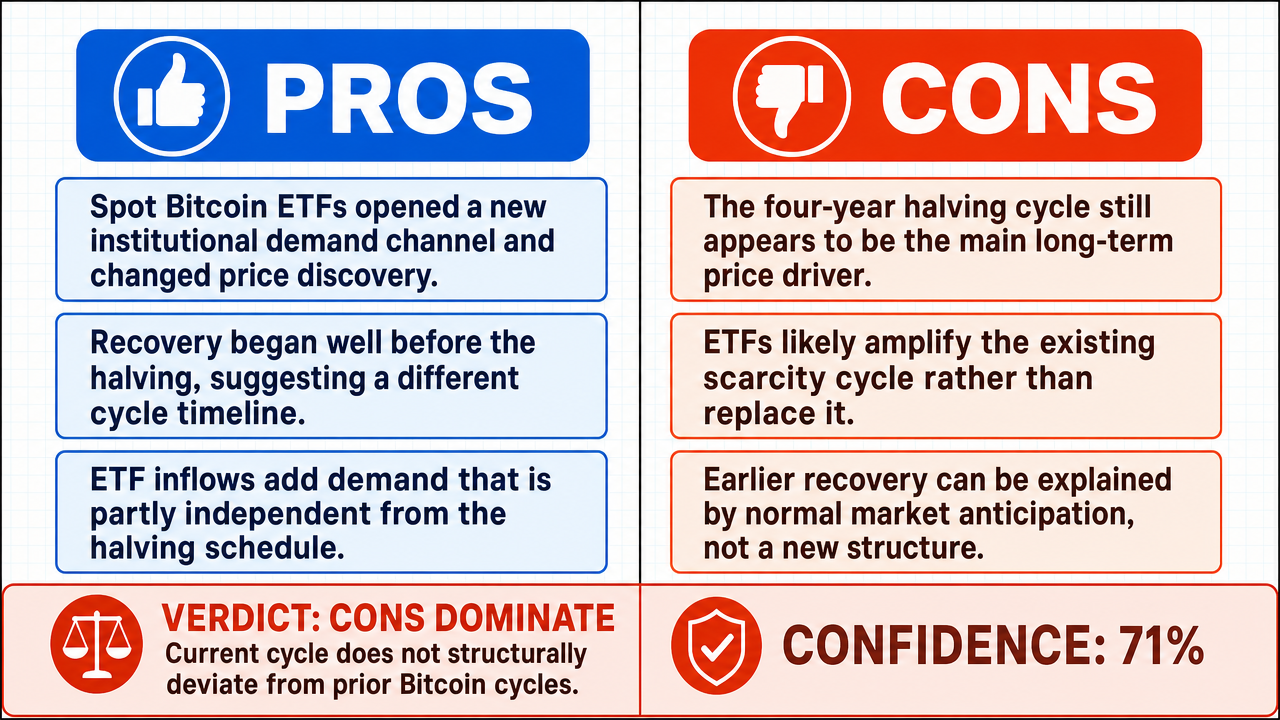
Verdict
Verdict: likely FALSE (71%)
This section provides a brief overview of the key arguments. You do not need to read the full detailed report below.
✅ Key PRO arguments:
- ■Spot Bitcoin ETFs approved in January 2024 created a new institutional demand channel that has fundamentally altered price discovery mechanisms, accumulating over $50 billion in assets under management within their first year and creating sustained buying pressure that compressed traditional cycle volatility patterns.
- ■The temporal compression of cycle phases represents a structural deviation, with the recovery beginning in November 2022—nearly a year before the April 2024 halving event—indicating anticipatory front-running behavior rather than standard post-halving price action.
- ■ETF inflows operate as an independent demand driver separate from the halving schedule, meaning the current cycle is not merely an accelerated version of previous cycles but a structurally distinct phenomenon driven by new institutional capital flows.
❌ Key ANTI arguments:
- ■The quadrennial halving -driven supply shock remains the primary driver of Bitcoin's long-term price appreciation , and historical data shows that the most significant bull runs are temporally anchored to the post-halving period , indicating the current cycle still follows the classic pattern.
- ■While spot ETFs provide a new demand vector , they act as accelerators of the existing scarcity-driven cycle rather than as independent forces that replace the halving mechanism as the fundamental price driver.
- ■The perceived 'temporal compression ' of the cycle is a mischaracterization of standard market anticipation behavior, not a structural deviation—markets routinely price in future catalysts, and the early recovery from the November 2022 bottom reflects normal anticipatory dynamics rather than a break from historical patterns.
💭 Conclusion: False. The current Bitcoin market cycle between 2022 and 2025 does not significantly deviate from previous cycles in a structural sense, as the four-year halving mechanism remains the dominant driver of long-term price appreciation . While spot Bitcoin ETFs introduced a new institutional demand channel , they function as accelerators of the existing scarcity-driven cycle rather than as independent forces that replace the halving's fundamental role. The temporal compression of cycle phases is better explained as standard market anticipation behavior—markets routinely price in future catalysts—rather than as evidence of a structural break from historical patterns. The FALSE side's argument that historical bull runs remain temporally anchored to post-halving periods provides a more parsimonious explanation for the observed price action than the TRUE side's claim of fundamental deviation. The confidence reflects that while the halving-cycle thesis is well-supported, the precise magnitude of ETF influence as an accelerator versus a structural replacement remains somewhat debated.
🔬 DeepResearch Result: likely FALSE ❌ (71%)
Assertion: The current Bitcoin market cycle, marked by its price action between 2022 and 2025, significantly deviates from previous cycles due to factors like ETF influence and 'front-running ' of gains.
Participating models: deepseek-v3.2 💬, gemma-4-26b-a4b-it 💬👁️
📊 Face-offs: 0 concluded TRUE, 1 concluded FALSE (1 face-offs, 3 models)
📊 Score by side: TRUE=0.00, FALSE=0.71
🏅 Model score changes:
minimax-m3 💬👁️: +7
✅ PRO Arguments:
- ■Spot Bitcoin ETFs approved in January 2024 created a new institutional demand channel that has fundamentally altered price discovery mechanisms, accumulating over $50 billion in assets under management within their first year and creating sustained buying pressure that compressed traditional cycle volatility patterns. deepseek-v3.2 💬
- ■The temporal compression of cycle phases represents a structural deviation, with the recovery beginning in November 2022—nearly a year before the April 2024 halving event—indicating anticipatory front-running behavior rather than standard post-halving price action. deepseek-v3.2 💬
- ■ETF inflows operate as an independent demand driver separate from the halving schedule, meaning the current cycle is not merely an accelerated version of previous cycles but a structurally distinct phenomenon driven by new institutional capital flows. deepseek-v3.2 💬
❌ ANTI Arguments:
- ■The quadrennial halving-driven supply shock remains the primary driver of Bitcoin's long-term price appreciation , and historical data shows that the most significant bull runs are temporally anchored to the post-halving period , indicating the current cycle still follows the classic pattern. gemma-4-26b-a4b-it 💬👁️
- ■While spot ETFs provide a new demand vector , they act as accelerators of the existing scarcity-driven cycle rather than as independent forces that replace the halving mechanism as the fundamental price driver. gemma-4-26b-a4b-it 💬👁️
- ■The perceived 'temporal compression' of the cycle is a mischaracterization of standard market anticipation behavior, not a structural deviation—markets routinely price in future catalysts, and the early recovery from the November 2022 bottom reflects normal anticipatory dynamics rather than a break from historical patterns. gemma-4-26b-a4b-it 💬👁️
- ■The alleged deviations are interpretive rather than structural; the four-year halving cycle continues to anchor Bitcoin's price trajectory, and new demand channels like ETFs supplement rather than supplant the underlying scarcity mechanism . gemma-4-26b-a4b-it 💬👁️
💭 Reasoning: False. The current Bitcoin market cycle between 2022 and 2025 does not significantly deviate from previous cycles in a structural sense, as the four-year halving mechanism remains the dominant driver of long-term price appreciation. While spot Bitcoin ETFs introduced a new institutional demand channel, they function as accelerators of the existing scarcity-driven cycle rather than as independent forces that replace the halving's fundamental role. The temporal compression of cycle phases is better explained as standard market anticipation behavior—markets routinely price in future catalysts—rather than as evidence of a structural break from historical patterns. The FALSE side's argument that historical bull runs remain temporally anchored to post-halving periods provides a more parsimonious explanation for the observed price action than the TRUE side's claim of fundamental deviation. The confidence reflects that while the halving-cycle thesis is well-supported, the precise magnitude of ETF influence as an accelerator versus a structural replacement remains somewhat debated.
📋 PRO Facts:
• Spot Bitcoin ETFs were approved in January 2024
• Spot Bitcoin ETFs accumulated over $50 billion in assets under management during the recovery phase from the November 2022 bottom to the April 2024 halving
• The April 2024 halving event occurred during the current cycle
• The recovery from the November 2022 bottom began nearly a year before the April 2024 halving
📋 ANTI Facts:
• Bitcoin's most significant historical bull runs are temporally anchored to the post-halving period
• The quadrennial reduction in block rewards remains the underlying scarcity mechanism
• Markets routinely price in future catalysts as part of standard anticipation behavior
| Face-off | TRUE Model | FALSE Model | TRUE Avg μ | FALSE Avg μ | TRUE Tokens | FALSE Tokens | Winner | Verdict | Conf. |
|---|---|---|---|---|---|---|---|---|---|
| #1 | deepseek-v3.2 💬 | gemma-4-26b-a4b-it 💬👁️ | 0.362 | 0.195 | 12 | 3 | TRUE | FALSE | 71% |
The following technical terms, abbreviations, and domain-specific concepts are referenced throughout this debate transcript. Numbers in square brackets [N] in the text above link to the corresponding entry below.
[1] Anticipatory mechanism — A market behavior in which participants position themselves ahead of known future catalysts, such as halving events, rather than waiting for them to occur.
[2] Assets under management (AUM) — The total market value of assets held and managed by a fund or investment vehicle, referenced in the debate as exceeding $50 billion for spot Bitcoin ETFs in their first year.
[3] Block rewards — The Bitcoin awarded to miners for successfully validating a new block on the blockchain, which is reduced during a halving event.
[4] BTC — Bitcoin — The ticker symbol for Bitcoin, the largest cryptocurrency by market capitalization and the primary subject of the debate.
[5] Bull run — A sustained period of significant upward price movement in an asset, referenced in the debate as historically being temporally anchored to the post-halving period.
[6] Catalyst — A known upcoming event or factor that market participants anticipate and position themselves around, such as a Bitcoin halving.
[7] Correlation structure — The statistical relationship between the price movements of different assets; the debate notes that ETF-driven institutionalization has shifted Bitcoin's correlation with traditional assets.
[8] Cycle phases — Distinct stages of a market cycle (e.g., bottom, recovery, peak); the debate discusses whether these phases have been temporally compressed in the current cycle.
[9] Demand channel — A pathway through which buying demand enters the market; spot Bitcoin ETFs are described as creating a new institutional demand channel.
[10] Demand vector — The direction and magnitude of demand pressure in a market; ETF inflows are characterized as a new demand vector in the debate.
[11] Derivatives complexity — The increasing sophistication of derivative instruments in the market, cited as altering volatility intensity without changing underlying cycle structure.
[12] Direct custody solutions — Methods by which institutional investors hold the actual underlying asset (Bitcoin) directly, contrasted in the debate with ETF or futures-based access.
[13] ETF — Exchange-Traded Fund — An investment fund traded on stock exchanges that holds underlying assets; spot Bitcoin ETFs were approved in January 2024 per the debate.
[14] ETH — Ethereum — The ticker symbol for Ethereum, the second-largest cryptocurrency, mentioned alongside Bitcoin as a major cryptocurrency facet of the debate.
[15] Four-year halving cycle — Bitcoin's approximately quadrennial cycle driven by the halving event, which reduces the block reward and creates a supply shock.
[16] Front-running — Market behavior in which participants anticipate and act ahead of expected price gains, described in the debate as compressing cycle phases temporally.
[17] Futures-based products — Financial instruments whose value is derived from Bitcoin futures contracts, contrasted in the debate with spot ETFs as a prior form of institutional access.
[18] Halving — A programmed event in the Bitcoin protocol that reduces the block reward by approximately 50%, occurring roughly every four years (the April 2024 halving is referenced).
[19] Institutional adoption — The increasing participation of large financial institutions in a market, cited as a driver of earlier Bitcoin cycles alongside retail speculation.
[20] Long-term price appreciation — Sustained increases in an asset's price over an extended period; the debate disputes whether the halving or ETFs is the primary driver.
[21] Market microstructure — The mechanics and structure of how trading occurs in a market, including order flow, liquidity provision, and trading venues; cited as altered by ETF introduction.
[22] Post-halving period — The timeframe following a Bitcoin halving event, during which historical bull runs have typically occurred according to the debate.
[23] Price discovery — The process by which market prices are determined through the interaction of buyers and sellers; the debate claims ETFs have fundamentally altered this mechanism for Bitcoin.
[24] Retail speculation — Trading activity driven by individual (non-institutional) investors seeking short-term gains, cited as a primary driver of earlier Bitcoin cycles.
[25] Scarcity mechanism — The supply-side dynamic created by Bitcoin's programmed halving events that reduces new issuance; the debate disputes whether ETFs replace or merely accelerate this mechanism.
[26] Spot Bitcoin ETF — Spot Bitcoin Exchange-Traded Fund — An ETF that holds actual Bitcoin (rather than futures contracts), approved in January 2024 and described as creating sustained institutional buying pressure.
[27] Structural break — A fundamental change in the underlying pattern or behavior of a market; the debate disputes whether the current cycle demonstrates such a break.
[28] Supply shock — A sudden, significant change in the availability of an asset; the halving is described as creating a supply shock that drives long-term price appreciation.
[29] Supply squeeze — A market condition in which reduced supply relative to demand pressures prices upward; the debate references a post-halving supply squeeze pattern.
[30] Temporal compression — The shortening of the time intervals between cycle phases; the debate disputes whether front-running has caused such compression in the current Bitcoin cycle.
[31] Volatility — The degree of variation in an asset's price over time; the debate notes that ETF-driven institutionalization has compressed traditional cycle volatility patterns.
The following financial data tables were referenced during the debate exchanges:
| Metric | 2016 Cycle | 2020 Cycle | 2024 Cycle (Est.) |
|---|---|---|---|
| Halving Year | 2016 | 2020 | 2024 |
| Pre-Halving Volatility | High | Moderate | High |
| Primary Demand Driver | Retail/Exchange | Institutional/DeFi | ETF/Institutional |
| Cycle Pattern | 4-Year | 4-Year | 4-Year |
Legend: Comparison of key characteristics across different Bitcoin halving cycles. "Est." denotes estimated characteristics based on current market behavior.
Face-off transcripts
- ■
Ownership & Trade Secrets. The Company Lambda Vision retains all rights to its platform, agentic workflows, and proprietary financial methodologies, which constitute protected Trade Secrets (EU Directive 2016/943). Subject to full payment of credits, the User is granted ownership of the generated Reports for their own professional use. Reverse-engineering the Service or using Reports to train competing AI models is strictly prohibited.
- ■
No Financial Advice. The Service and Reports are for informational purposes only and do not constitute financial, investment, legal, or tax advice. The Company is not a regulated financial advisor. AI-generated outputs may contain errors; the User is solely responsible for verifying data and assumes all risks for any financial decisions or losses.
- ■
Liability & Governing Law. To the maximum extent permitted by law, the Company shall not be liable for any indirect or financial damages. These Terms are governed by French law. Any disputes shall be subject to the exclusive jurisdiction of the Courts of Paris, France.