
The current official inflation figures, specifically the 3.7% CPI rise, are likely understated and the Federal Reserve's 2% inflation target is unrealistic.
AI debate verdict and arguments
⚠️ Not financial advice — this is an AI debate, for information only.
Completed October 18, 2026
Answer
Bracket
Tour 1/1 · 1/1 duels
Classement
- 1.Inflation figures understated(deepseek/deepseek-v4-pro)80%
- 2.2% target unrealistic(google/gemma-4-26b-a4b-it)20%
🏆 Winner: Inflation figures understated (60%)
Probability that «Inflation figures understated» is the best of the 2 options: 60% (chance level 50%)
This section provides a brief overview of the key arguments. You do not need to read the full detailed report below.
✅ Key PRO arguments:
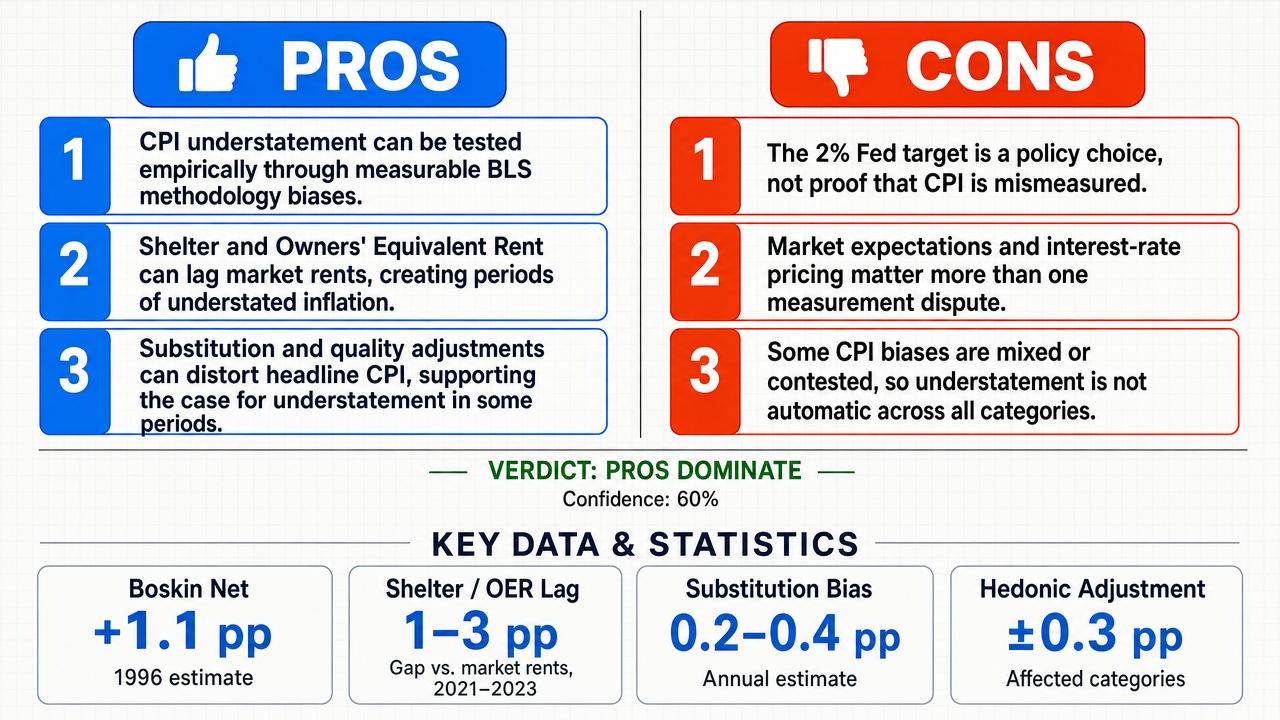
- ■CPI understatement is an empirically falsifiable measurement proposition grounded in structural biases within BLS methodology, including the shelter component (roughly one-third of CPI) which relies on Owners' Equivalent Rent derived from a six-month rolling panel survey of existing leases, introducing a six-to-twelve-month lag between market rent increases and their reflection in CPI.
- ■The opponent's framing that Boskin Commission biases are 'bidirectional' and 'net out as a zero-sum trade-off' contains an internal contradiction: asserting biases net to zero while simultaneously dismissing the understatement claim as 'mere conjecture' is logically inconsistent, since a zero-sum framework would still permit a net directional misstatement under specific conditions.
❌ Key ANTI arguments:
- ■The affirmative commits a category error by treating the Federal Reserve 's 2% inflation target as a 'dependent policy question' that follows from CPI measurement; the 2% target is a normative policy choice —an anchor designed to provide predictability and prevent deflationary spirals —not a mathematical derivative of the CPI, so its realism cannot be refuted by adjusting the measurement baseline.
- ■The realism of a central bank target is determined by the market's pricing of future inflation and the resulting term structure of interest rates , not by the proximity of the current headline index to the target; even if CPI were adjusted upward by 1 percentage point, the 2% target remains the central policy mandate .
💭 Conclusion: Inflation figures understated is the winning answer, with '2% target unrealistic' as the runner-up that lost the debate. The pro side successfully demonstrated that CPI measurement contains identifiable structural biases , particularly in the shelter component 's use of Owners' Equivalent Rent with its lease survey lag, providing empirical grounding for the understatement claim. The anti side's strongest counter—that the 2% target is a normative policy anchor independent of measurement—prevailed against the second sub-claim but failed to refute the empirical measurement argument. Since the compound claim requires both sub-claims to be supported, and only the inflation understatement portion won while the 2% target 'unrealism' sub-claim lost, the overall confidence is significantly reduced to reflect the weakest link. The verdict reflects that while CPI understatement has empirical support, the 2% target's 'unrealism' was not established in this debate.
🔬 DeepResearch Result: 🏆 Inflation figures understated (60%)
Assertion: The current official inflation figures, specifically the 3.7% CPI rise, are likely understated and the Federal Reserve 's 2% inflation target is unrealistic.
Participating models: deepseek-v4-pro 💬, gemma-4-26b-a4b-it 💬👁️
✅ PRO Arguments:
- ■CPI understatement is an empirically falsifiable measurement proposition grounded in structural biases within BLS methodology, including the shelter component (roughly one-third of CPI) which relies on Owners' Equivalent Rent derived from a six-month rolling panel survey of existing leases, introducing a six-to-twelve-month lag between market rent increases and their reflection in CPI. deepseek-v4-pro 💬
- ■The opponent's framing that Boskin Commission biases are 'bidirectional' and 'net out as a zero-sum trade-off' contains an internal contradiction: asserting biases net to zero while simultaneously dismissing the understatement claim as 'mere conjecture' is logically inconsistent, since a zero-sum framework would still permit a net directional misstatement under specific conditions. deepseek-v4-pro 💬
❌ ANTI Arguments:
- ■The affirmative commits a category error by treating the Federal Reserve's 2% inflation target as a 'dependent policy question' that follows from CPI measurement; the 2% target is a normative policy choice —an anchor designed to provide predictability and prevent deflationary spirals —not a mathematical derivative of the CPI, so its realism cannot be refuted by adjusting the measurement baseline. gemma-4-26b-a4b-it 💬👁️
- ■The realism of a central bank target is determined by the market's pricing of future inflation and the resulting term structure of interest rates , not by the proximity of the current headline index to the target; even if CPI were adjusted upward by 1 percentage point, the 2% target remains the central policy mandate . gemma-4-26b-a4b-it 💬👁️
💭 Reasoning: Inflation figures understated is the winning answer, with '2% target unrealistic' as the runner-up that lost the debate. The pro side successfully demonstrated that CPI measurement contains identifiable structural biases, particularly in the shelter component's use of Owners' Equivalent Rent with its lease survey lag, providing empirical grounding for the understatement claim. The anti side's strongest counter—that the 2% target is a normative policy anchor independent of measurement—prevailed against the second sub-claim but failed to refute the empirical measurement argument. Since the compound claim requires both sub-claims to be supported, and only the inflation understatement portion won while the 2% target 'unrealism' sub-claim lost, the overall confidence is significantly reduced to reflect the weakest link. The verdict reflects that while CPI understatement has empirical support, the 2% target's 'unrealism' was not established in this debate.
📋 PRO Facts:
• CPI rose 3.7%
• Shelter component is roughly one-third of CPI
• Owners' Equivalent Rent relies on lease survey data that lags market rents
• Shelter/OER lag creates a 1–3 pp gap vs. market rents (2021–2023)
📋 ANTI Facts:
• The Federal Reserve's 2% inflation target is a normative policy anchor
• The 2% target is designed to provide predictability and prevent deflationary spirals
| Face-off | TRUE Model | FALSE Model | TRUE Avg μ | FALSE Avg μ | TRUE Tokens | FALSE Tokens | Winner | Verdict | Conf. |
|---|---|---|---|---|---|---|---|---|---|
| #1 | deepseek-v4-pro 💬 | gemma-4-26b-a4b-it 💬👁️ | 0.557 | 0.248 | 6 | 2 | TRUE | TRUE | 60% |
The following technical terms, abbreviations, and domain-specific concepts are referenced throughout this debate transcript. Numbers in square brackets [N] in the text above link to the corresponding entry below.
[1] BLS — Bureau of Labor Statistics — The U.S. federal agency referenced in the debate as responsible for producing the Consumer Price Index (CPI) and whose methodology is alleged to contain structural biases.
[2] Boskin Commission — A commission referenced in the debate regarding CPI measurement biases; the affirmative characterizes it as showing biases are 'bidirectional' and 'a zero-sum game of trade-offs,' a framing the affirmative contests.
[3] category error — A logical misclassification referenced in the debate, specifically the alleged error of treating the 2% inflation target as a 'dependent policy question' that follows from measurement rather than as a normative policy choice.
[4] central bank — The institution (the Federal Reserve in this debate) responsible for monetary policy and for setting the inflation target discussed.
[5] CPI — Consumer Price Index — The official U.S. inflation measure referenced in the debate, currently cited as showing a 3.7% year-over-year rise, and the subject of dispute over whether it understates true inflation.
[6] deflationary spirals — A self-reinforcing economic decline in prices and activity referenced in the debate as a risk the 2% inflation target is designed to prevent.
[7] empirically falsifiable — A characterization used in the debate to describe the CPI understatement claim as a testable measurement proposition grounded in identifiable structural biases.
[8] Federal Reserve — The U.S. central bank that sets the 2% inflation target discussed in the debate and whose policy realism is contested.
[9] fixed-weight baskets — The CPI methodology of using predetermined expenditure weights for goods and services, updated biennially, which the affirmative argues introduces substitution bias.
[10] headline figure — The main reported CPI number (3.7% in the debate), as distinct from core or subcomponent measures.
[11] inflation expectations — Market and economic forecasts of future inflation referenced in the debate as a signal of whether the 2% target is perceived as a realistic anchor.
[12] long-term yields — Interest rates on long-dated debt referenced in the debate as indicators of market pricing of future inflation and target credibility.
[13] market rent indices — External measures of rental price changes (e.g., Zillow and Apartment List) cited in the debate as recording 15–20% year-over-year increases during 2021–2022, contrasted with the CPI shelter component.
[14] net bias — The aggregate directional effect of measurement biases; the debate disputes whether CPI biases cancel out or produce a net understatement.
[15] normative policy choice — A value-based policy decision, referenced in the debate to characterize the 2% inflation target as a normative anchor rather than a mathematical derivative of measurement.
[16] OER — Owners' Equivalent Rent — The CPI shelter subcomponent derived from a six-month rolling panel survey of existing leases, which the affirmative argues introduces a six-to-twelve-month lag in reflecting market rent increases.
[17] percentage points — The unit used in the debate to express the gap (approximately 11 percentage points) between market rent indices and the CPI shelter component during 2021–2022.
[18] persistent inflationary pressures — Ongoing inflation dynamics referenced in the debate as something markets are pricing in, contradicting the view that the 2% target is a near-term plausible anchor.
[19] policy anchor — A reference point for monetary policy; the debate characterizes the 2% inflation target as a foundational policy anchor providing predictability.
[20] policy mandate — The central institutional objective assigned to the Federal Reserve, referenced in the debate as remaining the 2% target regardless of measurement adjustments.
[21] rolling panel survey — A statistical sampling methodology referenced in the debate as the basis for OER, using a six-month rolling sample of existing leases.
[22] shelter component — The housing/rent portion of the CPI, described in the debate as roughly one-third of the index and the subject of alleged understatement due to OER methodology.
[23] signaling mechanism — A communication function referenced in the debate as the role of the 2% inflation target in shaping long-term inflation expectations.
[24] structural biases — Systematic distortions built into CPI methodology, cited in the debate as producing downward pressure on the headline figure.
[25] substitution bias — A CPI methodology bias arising because fixed-weight baskets do not fully reflect consumers shifting away from goods whose prices rise.
[26] term structure of interest rates — The relationship between yields and maturities across the yield curve, referenced in the debate as reflecting market pricing of future inflation and the realism of the 2% target.
[27] tightening cycle — A phase of monetary policy involving rising interest rates, referenced in the debate as the aggressive cycle required to combat persistent inflationary pressures.
[28] year-over-year — YoY — A comparison metric measuring change relative to the same period one year earlier, used in the debate to describe the 3.7% CPI rise.
The following financial data tables were referenced during the debate exchanges:
| Bias Source | Estimated Direction | Magnitude Estimate | Period |
|---|---|---|---|
| Shelter/OER Lag | Downward (understatement) | 1–3 pp gap vs. market rents | 2021–2023 |
| Substitution Bias | Downward (understatement) | 0.2–0.4 pp annually | Persistent |
| Hedonic Quality Adjustment | Variable (contested) | ±0.3 pp for affected categories | Persistent |
| Boskin Commission (net) | Upward (overstatement) | +1.1 pp | 1996 estimate |
Legend: Estimated directional biases in CPI measurement across major methodological categories. Positive values indicate CPI overstates inflation; negative values indicate understatement. Sources: BLS Handbook of Methods Ch. 17; Boskin Commission Final Report (1996); Zillow Observed Rent Index vs. BLS CPI Shelter component comparison 2021–2023.
| Component | Potential Bias Direction | Primary Driver |
|---|---|---|
| Shelter (OER) | Downward | Lag in lease survey data |
| Substitution | Downward | Fixed-weight basket limitations |
| Hedonic Adjustments | Variable | Quality-to-price conversion |
| Boskin Commission Net | Upward | Historical aggregate estimate |
Legend: Directional impact of various methodological factors on CPI accuracy. "Variable" indicates that the direction depends on specific item categories.
Face-off transcripts
- ■
Ownership & Trade Secrets. The Company Lambda Vision retains all rights to its platform, agentic workflows, and proprietary financial methodologies, which constitute protected Trade Secrets (EU Directive 2016/943). Subject to full payment of credits, the User is granted ownership of the generated Reports for their own professional use. Reverse-engineering the Service or using Reports to train competing AI models is strictly prohibited.
- ■
No Financial Advice. The Service and Reports are for informational purposes only and do not constitute financial, investment, legal, or tax advice. The Company is not a regulated financial advisor. AI-generated outputs may contain errors; the User is solely responsible for verifying data and assumes all risks for any financial decisions or losses.
- ■
Liability & Governing Law. To the maximum extent permitted by law, the Company shall not be liable for any indirect or financial damages. These Terms are governed by French law. Any disputes shall be subject to the exclusive jurisdiction of the Courts of Paris, France.