
The current S&P 500 market is a 'fake bull market' because a significant portion of its constituents are in decline, despite record index highs
AI debate verdict and arguments
⚠️ Not financial advice — this is an AI debate, for information only.
Completed October 11, 2026
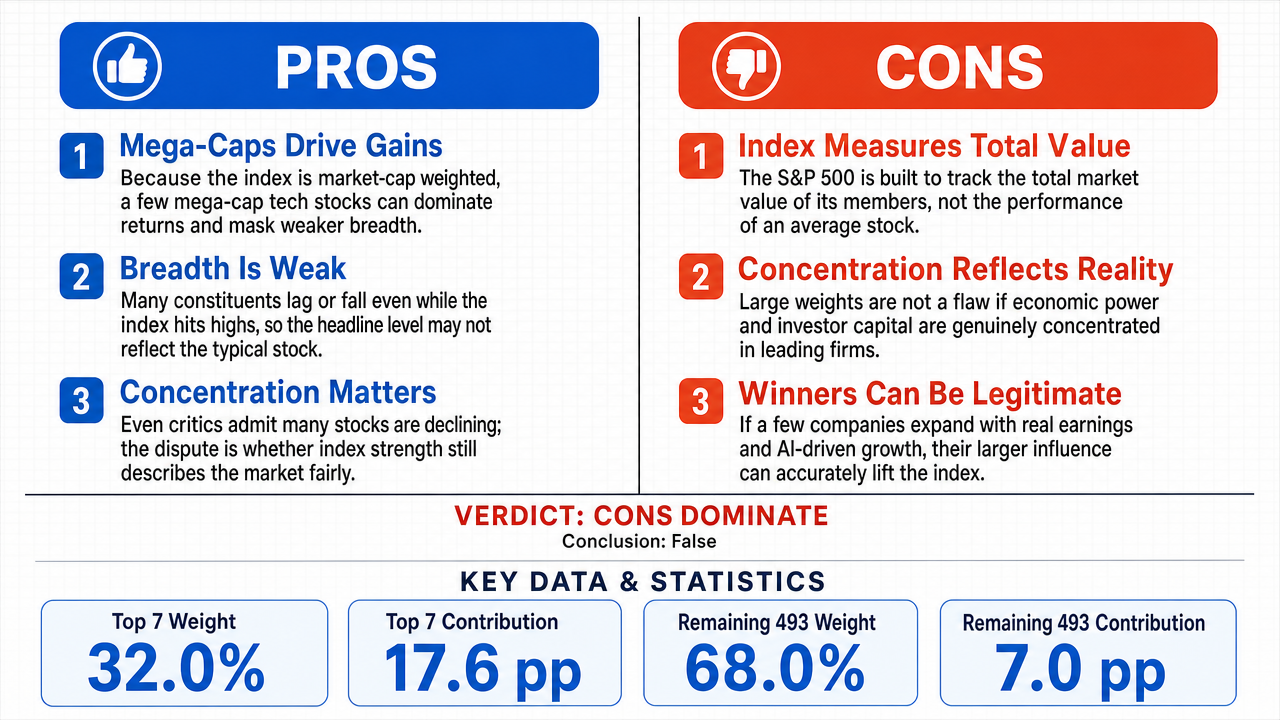
Verdict
Verdict: likely FALSE (66%)
This section provides a brief overview of the key arguments. You do not need to read the full detailed report below.
✅ Key PRO arguments:
- ■The S&P 500 is market-capitalization-weighted, so mega-cap technology stocks disproportionately drive index returns, creating a stark divergence between headline index performance and the experience of typical constituents .
- ■A majority of S&P 500 constituents have underperformed or declined while the index reaches new highs, making the headline index level an increasingly poor representation of the typical large-cap stock's experience and validating the 'fake' or narrow bull market characterization.
- ■The opponent's argument that 'total S&P 500 wealth must rise by definition' concedes the factual premise that many constituents are declining while pivoting to index mechanics; a conceded premise is not a rebutted one.
❌ Key ANTI arguments:
- ■The affirmative commits a fundamental category error by substituting the behavior of an index for the behavior of the entire market; the S&P 500 is designed to track total market capitalization, not the 'typical' stock, so concentration in mega-caps is not a flaw but a feature.
- ■Treating the concentration of market value as a structural flaw rather than a reflection of the actual distribution of economic power and capital misunderstands the fundamental nature of a market-cap-weighted index .
- ■If a handful of companies genuinely grow to represent a larger portion of the global economy—as seen with massive expansions in AI-related sectors—the index correctly reflects this real economic shift, making the bull market genuine rather than fake.
💭 Conclusion: False. The S&P 500 is a market-capitalization-weighted index designed specifically to track the total market value of its constituent universe, not to measure the performance of a 'typical' stock. The affirmative's argument commits a category error by treating index concentration in mega-cap stocks as evidence of a 'fake' bull market , when in fact this concentration reflects the genuine distribution of economic value and capital across the market. While it is true that a significant portion of constituents may underperform the headline index, this is an inherent feature of cap-weighted indices and does not invalidate the bull market characterization. The index is performing exactly as designed, and its record highs represent real aggregate wealth creation driven by the largest, most economically significant companies.
🔬 DeepResearch Result: likely FALSE ❌ (66%)
Assertion: The current S&P 500 market is a 'fake bull market ' because a significant portion of its constituents are in decline, despite record index highs
Participating models: deepseek-v3.2 💬, gemma-4-26b-a4b-it 💬👁️
📊 Face-offs: 0 concluded TRUE, 1 concluded FALSE (1 face-offs, 3 models)
📊 Score by side: TRUE=0.00, FALSE=0.66
🏅 Model score changes:
minimax-m3 💬👁️: +7
✅ PRO Arguments:
- ■The S&P 500 is market-capitalization-weighted, so mega-cap technology stocks disproportionately drive index returns, creating a stark divergence between headline index performance and the experience of typical constituents. deepseek-v3.2 💬
- ■A majority of S&P 500 constituents have underperformed or declined while the index reaches new highs, making the headline index level an increasingly poor representation of the typical large-cap stock's experience and validating the 'fake' or narrow bull market characterization. deepseek-v3.2 💬
- ■The opponent's argument that 'total S&P 500 wealth must rise by definition' concedes the factual premise that many constituents are declining while pivoting to index mechanics; a conceded premise is not a rebutted one. deepseek-v3.2 💬
❌ ANTI Arguments:
- ■The affirmative commits a fundamental category error by substituting the behavior of an index for the behavior of the entire market; the S&P 500 is designed to track total market capitalization, not the 'typical' stock, so concentration in mega-caps is not a flaw but a feature. gemma-4-26b-a4b-it 💬👁️
- ■Treating the concentration of market value as a structural flaw rather than a reflection of the actual distribution of economic power and capital misunderstands the fundamental nature of a market-cap-weighted index. gemma-4-26b-a4b-it 💬👁️
- ■If a handful of companies genuinely grow to represent a larger portion of the global economy—as seen with massive expansions in AI-related sectors—the index correctly reflects this real economic shift, making the bull market genuine rather than fake. gemma-4-26b-a4b-it 💬👁️
- ■The S&P 500's record highs reflect genuine aggregate economic strength and value creation; calling it a 'fake bull market' because individual constituents underperform misapplies the concept of market breadth to an index that was never designed to measure breadth. gemma-4-26b-a4b-it 💬👁️
💭 Reasoning: False. The S&P 500 is a market-capitalization-weighted index designed specifically to track the total market value of its constituent universe, not to measure the performance of a 'typical' stock. The affirmative's argument commits a category error by treating index concentration in mega-cap stocks as evidence of a 'fake' bull market, when in fact this concentration reflects the genuine distribution of economic value and capital across the market. While it is true that a significant portion of constituents may underperform the headline index, this is an inherent feature of cap-weighted indices and does not invalidate the bull market characterization. The index is performing exactly as designed, and its record highs represent real aggregate wealth creation driven by the largest, most economically significant companies.
📋 PRO Facts:
• The S&P 500 is a market-capitalization-weighted index where the largest constituents disproportionately drive returns.
• A majority of S&P 500 constituents have underperformed the index while it reached new highs.
📋 ANTI Facts:
• The S&P 500 is designed to track total market capitalization, not the performance of a typical constituent stock.
• Concentration in mega-cap stocks reflects the actual distribution of economic power and capital in the broader economy.
• Market-cap-weighted indices inherently overweight larger companies by design, not by flaw.
| Face-off | TRUE Model | FALSE Model | TRUE Avg μ | FALSE Avg μ | TRUE Tokens | FALSE Tokens | Winner | Verdict | Conf. |
|---|---|---|---|---|---|---|---|---|---|
| #1 | deepseek-v3.2 💬 | gemma-4-26b-a4b-it 💬👁️ | 0.295 | 0.208 | 8 | 2 | TRUE | FALSE | 66% |
The following technical terms, abbreviations, and domain-specific concepts are referenced throughout this debate transcript. Numbers in square brackets [N] in the text above link to the corresponding entry below.
[1] 200-day moving average — 200-day MA — A long-term technical indicator that smooths price data over the prior 200 trading sessions, commonly used to gauge the broader trend of a stock or index.
[2] aggregate — In this context, the combined or total value of a group of securities or the market as a whole, as opposed to the behavior of individual components.
[3] bull market — A market environment characterized by rising prices and broad investor optimism, typically defined by sustained upward movement in major indices.
[4] cap-weighting — market-capitalization weighting — An index construction method in which each constituent's weight is proportional to its total market capitalization, so larger companies exert greater influence on the index value.
[5] capital inflows — The movement of investment capital into a particular asset, sector, or market, often associated with rising prices and investor demand.
[6] cloud computing — A technology sector delivering on-demand computing services (storage, processing, software) over the internet, cited in the debate as a driver of mega-cap valuations.
[7] concentration risk — The risk arising from excessive exposure to a small number of holdings or sectors; in the debate, framed as the danger of a few mega-caps disproportionately driving index returns.
[8] constituents — The individual securities that make up an index such as the S&P 500.
[9] divergence — In technical analysis, a situation in which an index's price action moves in the opposite direction of a related indicator (such as breadth), often interpreted as a warning signal.
[10] earnings — A company's net profits, often reported quarterly; cited in the debate as evidence that mega-cap valuations reflect real economic performance.
[11] equity value — The total market value of a company's outstanding shares, used in the debate to describe the share of global equity wealth commanded by mega-cap firms.
[12] fake bull market — A term used in the debate to describe a bull market in which the headline index reaches record highs while a significant portion of its constituent stocks are in decline.
[13] free cash flow — FCF — The cash a company generates after accounting for capital expenditures, cited in the debate as a justification for the valuations of mega-cap technology stocks.
[14] global equity value — The combined market capitalization of publicly traded equities worldwide, referenced in the debate as the aggregate the S&P 500 is said to track.
[15] index — A statistical measure tracking the performance of a group of assets; in the debate, the S&P 500 is described as an instrument designed to track aggregate market capitalization.
[16] large-cap — large capitalization — A designation for companies with large market capitalizations, typically the biggest constituents of major indices such as the S&P 500.
[17] Magnificent Seven — Mag 7 — An informal market term for a group of seven dominant U.S. technology-related mega-cap stocks cited in the debate as drivers of recent index gains.
[18] market breadth — A technical indicator measuring how broadly a market move is participated in by individual stocks, often expressed as the percentage of stocks above a key moving average.
[19] market-capitalization-weighted index — An index in which each component's weight equals its share of total market capitalization, so the largest companies dominate the index's movement.
[20] mega-cap — mega-capitalization — A designation for the very largest publicly traded companies by market capitalization, cited in the debate as the handful of stocks disproportionately driving the S&P 500.
[21] moving average — MA — A technical indicator that averages price data over a specified number of periods to smooth short-term fluctuations and identify the underlying trend.
[22] narrow bull market — A bull market driven by a small subset of stocks rather than broad participation across the index, used in the debate to characterize the current S&P 500 advance.
[23] price level — The current quoted price of an asset or index, distinguished in the debate from the performance of the underlying constituent population.
[24] rally — A sustained upward movement in the price of an asset, index, or market over a period of time.
[25] record highs — All-time peak prices reached by an index or security, referenced in the debate as the surface signal of the current bull market.
[26] S&P 500 — Standard & Poor's 500 — A U.S. equity index tracking 500 large-cap companies, weighted by market capitalization, used as a benchmark for U.S. stock market performance.
[27] semiconductor sector — The industry segment comprising companies that design and manufacture chips, cited in the debate as a driver of mega-cap concentration in the index.
[28] top 10 holdings — The ten largest positions in an index or portfolio by weight; in the debate, their combined share is cited as evidence of index concentration.
[29] underlying — In this context, the individual constituent stocks whose collective performance the index is intended to summarize.
[30] weighted average — An average in which each component contributes in proportion to an assigned weight; the S&P 500's value is constructed as a market-cap-weighted average of its constituents.
The following financial data tables were referenced during the debate exchanges:
| Entity Type | Role in S&P 500 | Value Driver | Market Impact |
|---|---|---|---|
| Mega-Cap Tech | Primary Driver | Earnings Growth | High |
| Mid-Cap Constituents | Secondary Support | Sector Rotation | Moderate |
| Small-Cap Constituents | Tertiary Component | Cyclicality | Low |
Legend: Qualitative breakdown of S&P 500 constituent influence based on market-cap weighting logic.
| Cohort | Index weight (%) | Return contribution (pp) | Share of total return (%) |
|---|---|---|---|
| Seven most valuable constituents | 32.0 | 17.6 | 71.5 |
| Remaining 493 constituents | 68.0 | 7.0 | 28.5 |
Legend: Decomposition of the S&P 500's calendar-2023 price gain of +24.56 pp. Weights approximate; contribution and share of return per Dow Jones Market Data as reported in The Wall Street Journal, 30 Dec 2023. All columns expressed in percent or percentage points.
Face-off transcripts
- ■
Ownership & Trade Secrets. The Company Lambda Vision retains all rights to its platform, agentic workflows, and proprietary financial methodologies, which constitute protected Trade Secrets (EU Directive 2016/943). Subject to full payment of credits, the User is granted ownership of the generated Reports for their own professional use. Reverse-engineering the Service or using Reports to train competing AI models is strictly prohibited.
- ■
No Financial Advice. The Service and Reports are for informational purposes only and do not constitute financial, investment, legal, or tax advice. The Company is not a regulated financial advisor. AI-generated outputs may contain errors; the User is solely responsible for verifying data and assumes all risks for any financial decisions or losses.
- ■
Liability & Governing Law. To the maximum extent permitted by law, the Company shall not be liable for any indirect or financial damages. These Terms are governed by French law. Any disputes shall be subject to the exclusive jurisdiction of the Courts of Paris, France.