
The Dow Jones Industrial Average reached 40,000 points by the end of 2009.
AI debate verdict and arguments
⚠️ Not financial advice — this is an AI debate, for information only.
Completed October 24, 2026
Verdict
Verdict: likely FALSE (100%)
This section provides a brief overview of the key arguments. You do not need to read the full detailed report below.
✅ Key PRO arguments:
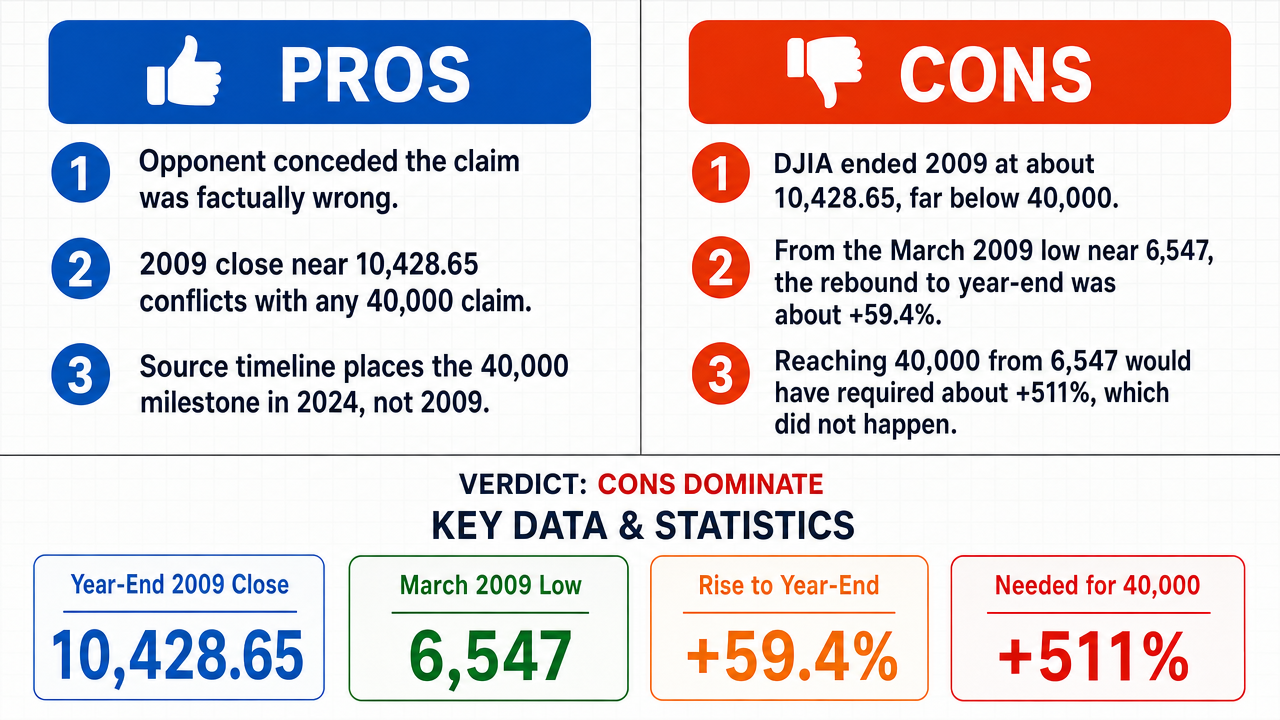
- ■In its opening argument, the TRUE-side model conceded that the assertion was factually incorrect, stating that the DJIA remained significantly below 40,000 in late 2009 and reached that level only much later.
- ■In its second round, the TRUE-side model argued that the FALSE side was internally contradictory because citing a 2009 close near 10,428.65 and a first 40,000 crossing in March 2024 also established that the threshold had not been reached in 2009.
❌ Key ANTI arguments:
- ■The DJIA ended 2009 at approximately 10,428.65 points , far below the asserted 40,000-point threshold .
- ■The index recovered from its March 2009 low of approximately 6,547 points to approximately 10,428.65 points, an increase of about 59.4%.
- ■Rising from approximately 6,547 points to 40,000 would have required an increase of approximately 511%, which did not occur during 2009.
💭 Conclusion: False, because the year-end 2009 DJIA close was approximately 10,428.65 points , far below the 40,000-point threshold . The index had recovered from its March 2009 low of about 6,547 points, and the observed increase to the year-end close was approximately 59.4%. Reaching 40,000 from that low would have required an increase of approximately 511%, which did not occur in 2009. The evidence dates the 40,000-point milestone to 2024. The claim therefore conflates the 2024 milestone with the index's much lower 2009 level.
🔬 DeepResearch Result: likely FALSE ❌ (100%)
Assertion: The Dow Jones Industrial Average reached 40,000 points by the end of 2009.
Participating models: gemma-4-26b-a4b-it 💬👁️, glm-4.7-flash 💬
📊 Face-offs: 0 concluded TRUE, 1 concluded FALSE (1 face-offs, 3 models)
📊 Score by side: TRUE=0.00, FALSE=0.94
🏅 Model score changes:
minimax-m3 💬👁️: +9
✅ PRO Arguments:
- ■In its opening argument, the TRUE-side model conceded that the assertion was factually incorrect, stating that the DJIA remained significantly below 40,000 in late 2009 and reached that level only much later. gemma-4-26b-a4b-it 💬👁️
- ■In its second round, the TRUE-side model argued that the FALSE side was internally contradictory because citing a 2009 close near 10,428.65 and a first 40,000 crossing in March 2024 also established that the threshold had not been reached in 2009. gemma-4-26b-a4b-it 💬👁️
❌ ANTI Arguments:
- ■The DJIA ended 2009 at approximately 10,428.65 points, far below the asserted 40,000-point threshold . glm-4.7-flash 💬
- ■The index recovered from its March 2009 low of approximately 6,547 points to approximately 10,428.65 points, an increase of about 59.4%. glm-4.7-flash 💬
- ■Rising from approximately 6,547 points to 40,000 would have required an increase of approximately 511%, which did not occur during 2009. glm-4.7-flash 💬
- ■The debate evidence identifies March 2024 as the first month in which the DJIA crossed 40,000, placing the milestone in the 2020s rather than 2009. glm-4.7-flash 💬
💭 Reasoning: False, because the year-end 2009 DJIA close was approximately 10,428.65 points, far below the 40,000-point threshold. The index had recovered from its March 2009 low of about 6,547 points, and the observed increase to the year-end close was approximately 59.4%. Reaching 40,000 from that low would have required an increase of approximately 511%, which did not occur in 2009. The evidence dates the 40,000-point milestone to 2024. The claim therefore conflates the 2024 milestone with the index's much lower 2009 level.
📋 PRO Facts:
• The claim was factually incorrect.
• The DJIA remained significantly below 40,000 in late 2009.
• The approximately 10,428.65 year-end 2009 close and the 2024 achievement of the 40,000-point milestone are facts that undermine the claim.
📋 ANTI Facts:
• The DJIA's year-end 2009 close was approximately 10,428.65 points.
• The DJIA's March 2009 low was approximately 6,547 points.
• The increase from that low to the year-end 2009 close was approximately 59.4%.
• Reaching 40,000 from the March 2009 low would have required an increase of approximately 511%.
• The DJIA achieved the 40,000-point milestone in 2024.
| Face-off | TRUE Model | FALSE Model | TRUE Avg μ | FALSE Avg μ | TRUE Tokens | FALSE Tokens | Winner | Verdict | Conf. |
|---|---|---|---|---|---|---|---|---|---|
| #1 | gemma-4-26b-a4b-it 💬👁️ | glm-4.7-flash 💬 | 0.434 | 0.589 | 4 | 4 | FALSE | FALSE | 94% |
The following technical terms, abbreviations, and domain-specific concepts are referenced throughout this debate transcript. Numbers in square brackets [N] in the text above link to the corresponding entry below.
[1] +511% — The required change shown in the later table for moving from the March 2009 low of 6,547 to 40,000.
[2] 280% growth — A growth figure asserted for a move from the March 2009 low to 40,000. The later table instead gives +511%, so the transcript treats the calculation inconsistently.
[3] 40,000-point threshold — The DJIA benchmark used to assess the assertion. The transcript cites a 2009 close of 10,428.65 and a March 2024 crossing, but its characterizations of the 2009 level as less than one-third and less than one-quarter of 40,000 are inconsistent.
[4] 59.4% increase — The increase calculated in the debate from the March 2009 low of approximately 6,547 to the year-end close of approximately 10,428.65.
[5] antecedent — The proposition identified in the conditional reasoning as the DJIA reaching 40,000 by year-end 2009.
[6] Approximate DJIA Level — A table metric reporting approximate index levels at key junctures, including 14,164 at the pre-crisis peak, 6,547 at the crisis low, 10,429 at year-end 2009, and 40,000 at the milestone.
[7] bull market — The market phase to which the debate attributes the DJIA's first crossing of 40,000 during the 2020s.
[8] consequent — The outcome side of the conditional argument linking the required growth to whether the DJIA reached 40,000.
[9] contrapositive — The conditional form used to argue that the absence of the required growth would rule out the DJIA reaching 40,000.
[10] Crisis Low (March 2009) — The benchmark for the March 2009 DJIA trough, listed at approximately 6,547 points.
[11] DJIA — Dow Jones Industrial Average — The market index at issue in the debate. The transcript cites a 2009 year-end close of approximately 10,428.65 and states that the index first crossed 40,000 in March 2024.
[12] equity market — The market context in which the debate evaluates the gains associated with the post-crisis recovery.
[13] Great Recession — The economic downturn associated in the transcript with the 2008–2009 market decline and subsequent recovery.
[14] internal contradictions — The affirmative's criticism that accepting both the 2009 closing level and the 2024 milestone makes the negative argument appear to oppose itself.
[15] logically incoherent — The affirmative's characterization of the negative argument based on the alleged conflict between its evidence and its stated purpose.
[16] Monthly Change — A table metric showing percentage changes between listed DJIA levels, including a +59.4% change to the year-end 2009 close.
[17] mutually exclusive — The logical relation the affirmative assigns to the two propositions presented in the negative argument.
[18] points — The unit used to quote DJIA levels in the transcript, including 6,547, 10,428.65, and 40,000.
[19] post-crisis recovery — The recovery period following the March 2009 low, during which the transcript places the rise to the 2009 year-end close.
[20] Pre-Crisis Peak (2007) — The pre-crisis DJIA benchmark listed at approximately 14,164 points for 2007.
[21] Required for 40,000 — The table's target row, pairing the 40,000 index level with a +511% required change from the March 2009 low.
[22] single-year equity market performance — A one-year equity gain, discussed in relation to the post-crisis recovery and the performance the debate says did not occur.
[23] sustained growth — The nearly 15-year growth that the negative speaker describes as necessary to move from the 2009 lows to 40,000.
[24] tautology — The affirmative's characterization of the negative conclusion as a redundant restatement of facts already accepted rather than a substantive refutation.
[25] temporal misalignment — The negative's characterization of the claim's error as placing a milestone that the debate dates to 2024 in 2009.
[26] Year-End 2009 Close — The DJIA closing level for the end of 2009, listed at approximately 10,428.65 points.
The following financial data tables were referenced during the debate exchanges:
| Period | Approximate DJIA Level |
|---|---|
| Pre-Crisis Peak (2007) | ~14,164 |
| Crisis Low (March 2009) | ~6,547 |
| Year-End 2009 | ~10,429 |
| 40,000 Milestone Achievement | 2024 |
Legend: Approximate price levels of the Dow Jones Industrial Average at key historical junctures.
| Month | Approximate DJIA Level | Monthly Change |
|---|---|---|
| March 2009 Low | 6,547 | — |
| Year-End 2009 Close | 10,428.65 | +59.4% |
| Required for 40,000 | 40,000 | +511% |
Legend: DJIA levels during the 2009 recession and recovery. Changes are calculated from the March 2009 low to each subsequent point. Source: S&P Dow Jones Indices historical data.
Face-off transcripts
- ■
Ownership & Trade Secrets. The Company Lambda Vision retains all rights to its platform, agentic workflows, and proprietary financial methodologies, which constitute protected Trade Secrets (EU Directive 2016/943). Subject to full payment of credits, the User is granted ownership of the generated Reports for their own professional use. Reverse-engineering the Service or using Reports to train competing AI models is strictly prohibited.
- ■
No Financial Advice. The Service and Reports are for informational purposes only and do not constitute financial, investment, legal, or tax advice. The Company is not a regulated financial advisor. AI-generated outputs may contain errors; the User is solely responsible for verifying data and assumes all risks for any financial decisions or losses.
- ■
Liability & Governing Law. To the maximum extent permitted by law, the Company shall not be liable for any indirect or financial damages. These Terms are governed by French law. Any disputes shall be subject to the exclusive jurisdiction of the Courts of Paris, France.