
The Federal Reserve will implement at least one interest rate hike by the end of October 2026.
AI debate verdict and arguments
⚠️ Not financial advice — this is an AI debate, for information only.
Completed October 18, 2026
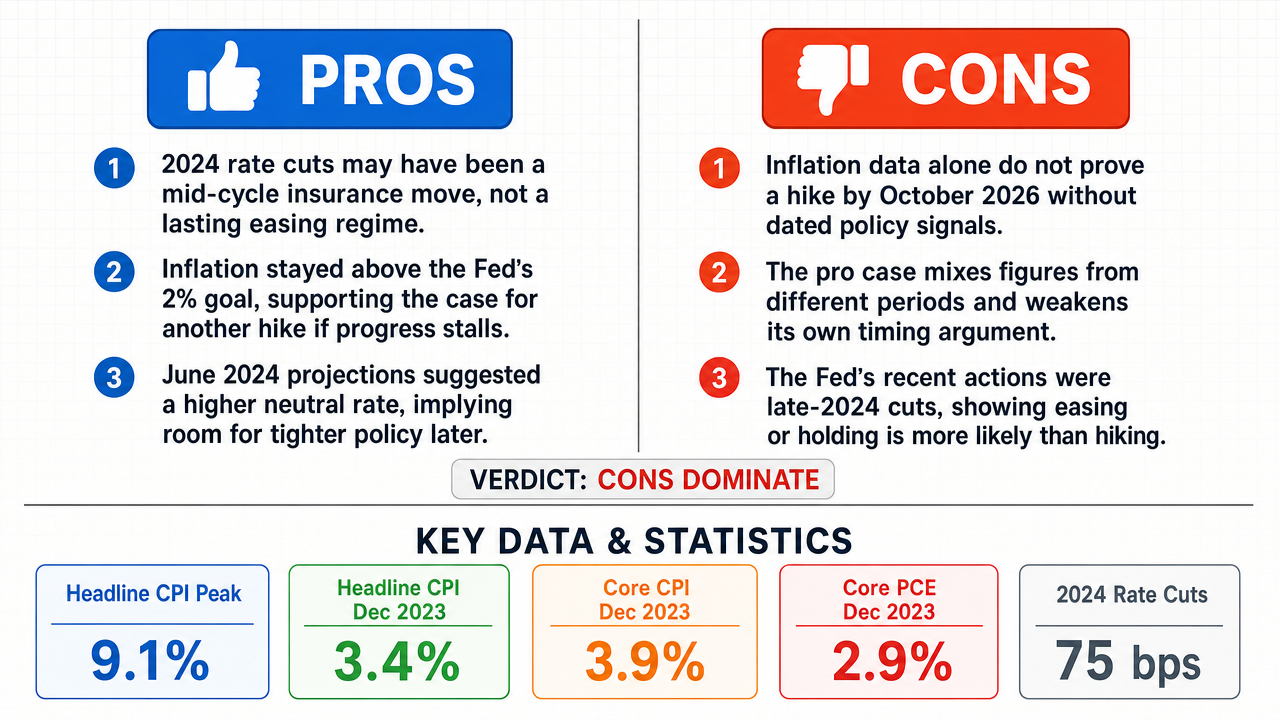
Verdict
Verdict: likely FALSE (58%)
This section provides a brief overview of the key arguments. You do not need to read the full detailed report below.
✅ Key PRO arguments:
- ■The 2024 cuts (three consecutive 25bp easings from September through December 2024 lowering the target range to 4.25–4.50%) should be read as a mid-cycle 'insurance' pause of the kind that historically reverses, implying a hike is likely by October 2026.
- ■Inflation persistence above the 2% target — with headline CPI having peaked at 9.1% YoY in June 2022 and remaining elevated — supports the case that the Fed will need to resume tightening .
- ■The June 2024 Summary of Economic Projections on federalreserve.gov documents an upward revision in the neutral rate , indicating a structural shift that materially supports a 2026 hike.
❌ Key ANTI arguments:
- ■The affirmative relies on CPI and PCE — lagging indicators of aggregate activity — but fails to provide any transfer operator or statistical coefficient linking those price-level measures to the immediate future path of the federal funds rate .
- ■The affirmative's own figures are internally contradictory: they note headline CPI peaked at 9.1% in June 2022 yet 'remained' at 2.9% by December 2024, while simultaneously claiming inflation is 'stuck near 3%' — a trajectory inconsistent with the urgency of a near-term hike.
- ■The Fed's actual recent behavior — three cuts in late 2024 — demonstrates a clear preference for easing or holding, not hiking, and there is no concrete policy signal in the record pointing to a reversal toward tightening by October 2026.
💭 Conclusion: The negative side exposed gaps in the affirmative's case. The affirmative relied on price-level indicators (CPI, PCE ) without supplying dated, specific policy signals supporting a hike by October 2026. The negative also correctly noted that the Fed's demonstrated recent behavior — three consecutive cuts in late 2024 — points toward holding or further easing rather than hiking. While the affirmative raised plausible structural arguments about neutral-rate revisions and historical 'insurance pause ' reversals, these remained speculative. The confidence level reflects that the negative's case, while stronger, did not foreclose all possibility of a future policy reversal .
🔬 DeepResearch Result: likely FALSE ❌ (58%)
Assertion: The Federal Reserve will implement at least one interest rate hike by the end of October 2026.
Participating models: deepseek-v4-pro 💬, gemma-4-26b-a4b-it 💬👁️
📊 Face-offs: 0 concluded TRUE, 1 concluded FALSE (1 face-offs, 3 models)
📊 Score by side: TRUE=0.00, FALSE=0.58
🏅 Model score changes:
minimax-m3 💬👁️: +6
✅ PRO Arguments:
- ■The 2024 cuts (three consecutive 25bp easings from September through December 2024 lowering the target range to 4.25–4.50%) should be read as a mid-cycle 'insurance' pause of the kind that historically reverses, implying a hike is likely by October 2026. deepseek-v4-pro 💬
- ■Inflation persistence above the 2% target — with headline CPI having peaked at 9.1% YoY in June 2022 and remaining elevated — supports the case that the Fed will need to resume tightening . deepseek-v4-pro 💬
- ■The June 2024 Summary of Economic Projections on federalreserve.gov documents an upward revision in the neutral rate , indicating a structural shift that materially supports a 2026 hike. deepseek-v4-pro 💬
❌ ANTI Arguments:
- ■The affirmative relies on CPI and PCE — lagging indicators of aggregate activity — but fails to provide any transfer operator or statistical coefficient linking those price-level measures to the immediate future path of the federal funds rate . gemma-4-26b-a4b-it 💬👁️
- ■The affirmative's own figures are internally contradictory: they note headline CPI peaked at 9.1% in June 2022 yet 'remained' at 2.9% by December 2024, while simultaneously claiming inflation is 'stuck near 3%' — a trajectory inconsistent with the urgency of a near-term hike. gemma-4-26b-a4b-it 💬👁️
- ■The Fed's actual recent behavior — three cuts in late 2024 — demonstrates a clear preference for easing or holding, not hiking, and there is no concrete policy signal in the record pointing to a reversal toward tightening by October 2026. gemma-4-26b-a4b-it 💬👁️
💭 Reasoning: The negative side exposed gaps in the affirmative's case. The affirmative relied on price-level indicators (CPI, PCE) without supplying dated, specific policy signals supporting a hike by October 2026. The negative also correctly noted that the Fed's demonstrated recent behavior — three consecutive cuts in late 2024 — points toward holding or further easing rather than hiking. While the affirmative raised plausible structural arguments about neutral-rate revisions and historical 'insurance pause ' reversals, these remained speculative. The confidence level reflects that the negative's case, while stronger, did not foreclose all possibility of a future policy reversal .
📋 PRO Facts:
• The Federal Reserve executed three consecutive 25-basis-point rate cuts from September through December 2024.
• The target federal funds rate range was lowered to 4.25–4.50% by the end of 2024.
• Headline CPI peaked at 9.1% year-over-year in June 2022.
• A Summary of Economic Projections was published on federalreserve.gov in June 2024.
📋 ANTI Facts:
• Headline CPI was reported at 2.9% by December 2024, well below its June 2022 peak of 9.1%.
• The Fed's late-2024 actions consisted entirely of rate cuts.
| Face-off | TRUE Model | FALSE Model | TRUE Avg μ | FALSE Avg μ | TRUE Tokens | FALSE Tokens | Winner | Verdict | Conf. |
|---|---|---|---|---|---|---|---|---|---|
| #1 | deepseek-v4-pro 💬 | gemma-4-26b-a4b-it 💬👁️ | 0.567 | 0.189 | 6 | 2 | TRUE | FALSE | 58% |
The following technical terms, abbreviations, and domain-specific concepts are referenced throughout this debate transcript. Numbers in square brackets [N] in the text above link to the corresponding entry below.
[1] aggregate economic activity — Total economic output or activity across an economy. In the debate, the negative argues that CPI and PCE are lagging indicators of this activity and therefore do not dictate the immediate future path of the federal funds rate.
[2] basis points — bps — A unit equal to 1/100th of a percentage point (0.01%), commonly used to express changes in interest rates and yields. The debate references '425 basis points of tightening' and '25-basis-point easings.'
[3] Consumer Price Index — CPI — A measure of the average change over time in prices paid by urban consumers for a market basket of consumer goods and services. The debate cites a peak of 9.1% year-over-year in June 2022 and 2.9% by December 2024.
[4] core CPI — The Consumer Price Index excluding the volatile food and energy components, used to better signal durable inflation trends. The debate cites core CPI at 3.2% in December 2024.
[5] core PCE — The Personal Consumption Expenditures price index excluding food and energy components, identified in the debate as the Federal Reserve's own preferred inflation gauge. The debate cites core PCE at 2.8% over the referenced period.
[6] delta — Used in the debate to refer to the difference or gap between two values, specifically the 'massive delta between the 2022 peak and the 2024 level' of the Consumer Price Index.
[7] disinflation — A slowdown in the rate of inflation, distinct from deflation. The debate disputes whether the disinflation observed since 2022 has been successful or has stalled.
[8] federal funds rate — The interest rate at which depository institutions lend reserve balances to each other overnight, serving as the primary tool of U.S. monetary policy. The debate references a target range lowered to 4.25–4.50%.
[9] FOMC — Federal Open Market Committee — The branch of the Federal Reserve System that sets monetary policy, including the federal funds rate target. The debate references specific FOMC meeting dates such as June 12, 2024 and December 18, 2024.
[10] headline Consumer Price Index — headline CPI — The full Consumer Price Index including all major spending categories, including volatile food and energy components, as opposed to core CPI.
[11] insurance pause — A temporary pause in monetary policy changes intended to insure against economic risks. The affirmative characterizes the 2024 rate cuts as a mid-cycle 'insurance' pause of the kind that history shows frequently reverses.
[12] lagging indicators — Economic metrics that change after broader economic trends have already shifted. The negative characterizes CPI and PCE as lagging indicators of aggregate economic activity relative to Fed policy decisions.
[13] mid-cycle — A phase in the monetary policy cycle between the initial tightening or easing and the terminal rate. The affirmative describes the 2024 cuts as a 'mid-cycle' pause rather than a terminal destination.
[14] neutral rate — The theoretical interest rate at which monetary policy is neither expansionary nor contractionary, also known as r-star. The debate references an upward revision in the neutral rate documented in the Summary of Economic Projections.
[15] PCE — Personal Consumption Expenditures price index — A measure of inflation based on changes in prices paid for goods and services consumed, broader than the CPI. The debate cites PCE figures as evidence of inflation persistence.
[16] policy reversal — A change in the direction of monetary policy, such as shifting from rate cuts to rate hikes. The affirmative argues that the 2024 easing cycle will undergo a policy reversal by October 2026.
[17] rate hike — An increase in the central bank's policy interest rate. The debate's central question is whether the Federal Reserve will implement at least one rate hike by the end of October 2026.
[18] stickiness — The tendency of inflation or prices to remain elevated and resist falling. The negative argues the affirmative fails to show a specific threshold of 'stickiness' that triggers a policy reversal.
[19] Summary of Economic Projections — SEP — A quarterly publication containing FOMC members' economic forecasts, including projections for the neutral rate. The debate references the June 2024 Summary of Economic Projections as a source for the neutral-rate revision.
[20] target range — The specified range for the federal funds rate set by the FOMC at its meetings. The debate references the target range being lowered to 4.25–4.50% following three consecutive 25-basis-point easings.
[21] tightening — Monetary policy that raises interest rates or reduces monetary stimulus to combat inflation. The debate references '425 basis points of tightening' prior to the 2024 easing cycle.
[22] transfer operator — A mathematical concept from functional analysis invoked metaphorically in the debate to describe a statistical link or coefficient that would connect price-level measures to the Federal Reserve's policy decisions.
[23] year-over-year — YoY — A comparison of a metric in one period to the same period one year earlier. The debate cites the headline Consumer Price Index peaking at 9.1% year-over-year in June 2022.
The following financial data tables were referenced during the debate exchanges:
| Indicator | 2022 peak | Dec 2023 | Dec 2024 | Distance above 2% |
|---|---|---|---|---|
| Headline CPI (YoY) | 9.1% | 3.4% | 2.9% | +0.9pp |
| Core CPI (YoY) | 6.6% | 3.9% | 3.2% | +1.2pp |
| Core PCE (YoY) | 5.6% | 2.9% | 2.8% | +0.8pp |
Legend: Year-over-year U.S. inflation measures at their 2022 peak versus December 2023 and December 2024, showing how far each remains above the Federal Reserve's 2.0% objective. Source: Bureau of Labor Statistics (CPI) and Bureau of Economic Analysis (PCE), December 2024 releases.
| Cycle reversal episode | Easing before pivot | Tightening after pivot | Peak after reversal |
|---|---|---|---|
| Greenspan, 1998–2000 | -75 bps | +175 bps | 6.50% |
| Volcker, 1980–1981 | eased, then re-tightened | resumed aggressive hikes | ~19–20% |
Legend: Documented episodes in which the Federal Reserve eased and subsequently reversed course with new hikes, measured in basis points and the resulting peak federal funds rate. Source: FOMC meeting histories, 1979–2000.
| Economic Variable | Affirmative Assertion | Required Verification |
|---|---|---|
| Neutral Rate (r*) | Upwardly revised/Higher | Specific FOMC Meeting/Date |
| Inflation Trigger | Core CPI/PCE stickiness | Correlation coefficient to Fed Action |
| Policy Reversal | Historical precedence (Greenspan/Volcker) | Scale invariance proof |
Legend: Comparison of the affirmative's qualitative claims against the evidentiary requirements for formal validation.
| SEP release date | Median longer-run fed funds rate |
|---|---|
| Dec 2023 | 2.5% |
| Mar 2024 | 2.6% |
| Jun 2024 | 2.8% |
| Sep 2024 | 2.9% |
| Dec 2024 | 3.0% |
Legend: Median projection of the longer-run federal funds rate across the five most recent Summary of Economic Projections releases, showing a cumulative 50-basis-point upward revision over 2024. Source: Federal Reserve FOMC projection materials, December 2024 (federalreserve.gov).
Face-off transcripts
- ■
Ownership & Trade Secrets. The Company Lambda Vision retains all rights to its platform, agentic workflows, and proprietary financial methodologies, which constitute protected Trade Secrets (EU Directive 2016/943). Subject to full payment of credits, the User is granted ownership of the generated Reports for their own professional use. Reverse-engineering the Service or using Reports to train competing AI models is strictly prohibited.
- ■
No Financial Advice. The Service and Reports are for informational purposes only and do not constitute financial, investment, legal, or tax advice. The Company is not a regulated financial advisor. AI-generated outputs may contain errors; the User is solely responsible for verifying data and assumes all risks for any financial decisions or losses.
- ■
Liability & Governing Law. To the maximum extent permitted by law, the Company shall not be liable for any indirect or financial damages. These Terms are governed by French law. Any disputes shall be subject to the exclusive jurisdiction of the Courts of Paris, France.