
The Federal Reserve will not implement an interest rate hike at its upcoming meeting
AI debate verdict and arguments
⚠️ Not financial advice — this is an AI debate, for information only.
Completed November 1, 2026
Verdict
Verdict: likely TRUE (60%)
This section provides a brief overview of the key arguments. You do not need to read the full detailed report below.
✅ Key PRO arguments:
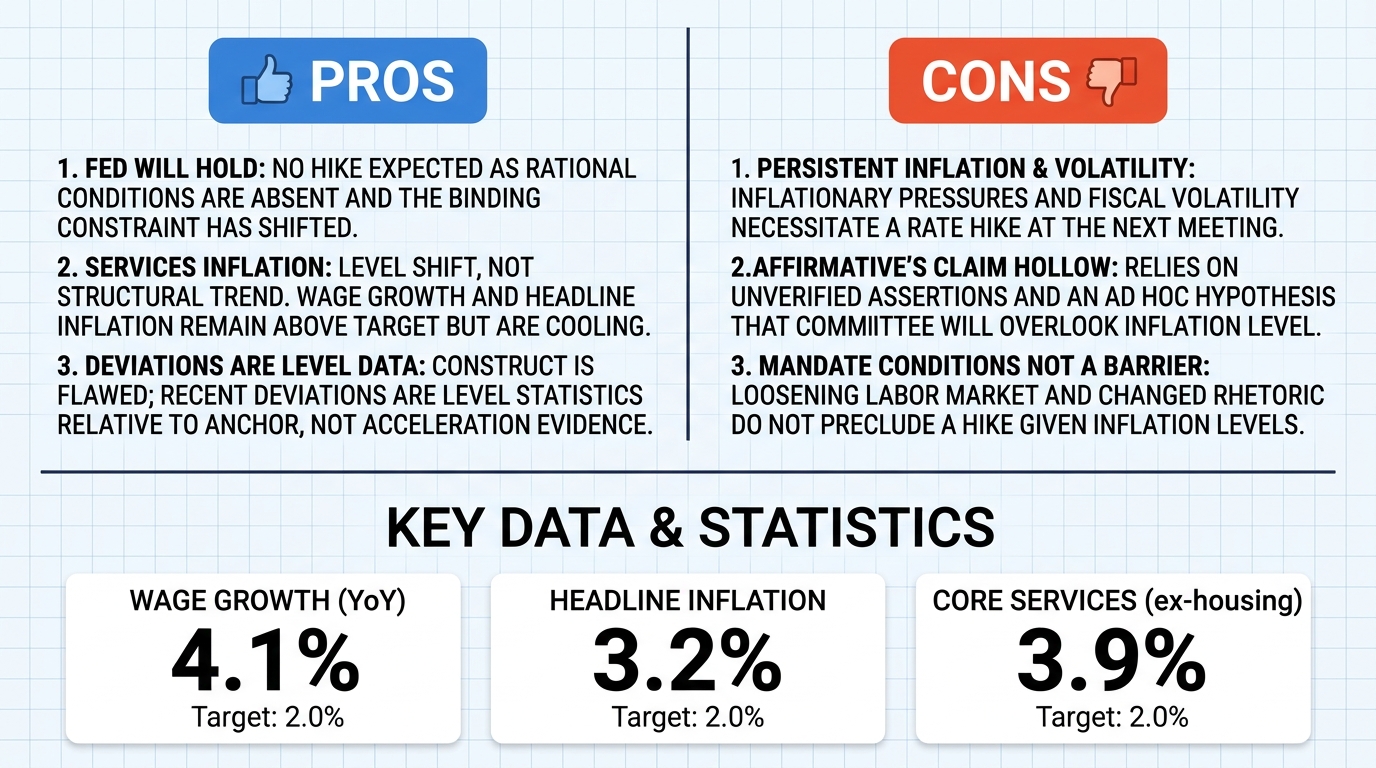
- ■The Federal Reserve will hold , not hike, at its next scheduled policy meeting; the conditions that make a hike rational are not present, and the binding constraint has flipped to the employment side of the mandate.
- ■Persistent services inflation even excluding housing is a level shift rather than a structural trend; wage growth at 4.1% and headline inflation at 3.2% are above target but still predict a hold , not a hike, unless the gap is shown to be widening.
- ■The rival account's arithmetic is sound but its construct is not; every deviation it cites is a level statistic relative to a 2.0% anchor, not evidence of an accelerating trend.
❌ Key ANTI arguments:
- ■Persistent inflationary pressures and fiscal volatility necessitate a rate hike at the next meeting.
- ■The affirmative's claim is structurally hollow, relying on unverified assertions and an ad hoc auxiliary hypothesis that the committee will look through a level shift unless it becomes embedded in wage and inflation -expectation dynamics.
- ■The mandate conditions cited by the affirmative, a loosening labor market and a shift in committee rhetoric , do not preclude a hike because the affirmative's own policy-rate table is internally inconsistent, citing a 0.25-0.50% range for March 2022 and 1.50-1.75% for June 2022.
💭 Conclusion: True, the Federal Reserve will not implement an interest rate hike at its upcoming meeting, because the conditions that would make a hike rational are absent and the committee's binding constraint has shifted toward employment. The winning argument establishes that current inflation readings, while above target, represent a level shift rather than a widening structural trend, and that wage growth at 4.1% and headline inflation at 3.2% still predict a hold rather than a hike. The pro side also points to the loosening labor market and the shift in committee rhetoric away from tightening, which together make a hike at the next scheduled FOMC meeting in late January 2026 unlikely. The negative side's case relies on treating persistent services inflation as a structural trend and on alleged data inconsistencies, but it fails to show that the inflation gap is widening or that the committee would respond with a hike. Therefore, the verdict is TRUE with moderate confidence, reflecting the judge's 60% confidence in the pro side's argument.
🔬 DeepResearch Result: likely TRUE ✅ (60%)
Assertion: The Federal Reserve will not implement an interest rate hike at its upcoming meeting
Participating models: deepseek-v3.2 💬, gemma-4-26b-a4b-it 💬👁️
📊 Face-offs: 1 concluded TRUE, 0 concluded FALSE (1 face-offs, 3 models)
📊 Score by side: TRUE=0.60, FALSE=0.00
🏅 Model score changes:
deepseek-v4-flash-0731 💬: +6
✅ PRO Arguments:
- ■The Federal Reserve will hold , not hike, at its next scheduled policy meeting; the conditions that make a hike rational are not present, and the binding constraint has flipped to the employment side of the mandate. deepseek-v3.2 💬
- ■Persistent services inflation even excluding housing is a level shift rather than a structural trend; wage growth at 4.1% and headline inflation at 3.2% are above target but still predict a hold, not a hike, unless the gap is shown to be widening. deepseek-v3.2 💬
- ■The rival account's arithmetic is sound but its construct is not; every deviation it cites is a level statistic relative to a 2.0% anchor, not evidence of an accelerating trend. deepseek-v3.2 💬
❌ ANTI Arguments:
- ■Persistent inflationary pressures and fiscal volatility necessitate a rate hike at the next meeting. gemma-4-26b-a4b-it 💬👁️
- ■The affirmative's claim is structurally hollow, relying on unverified assertions and an ad hoc auxiliary hypothesis that the committee will look through a level shift unless it becomes embedded in wage and inflation-expectation dynamics. gemma-4-26b-a4b-it 💬👁️
- ■The mandate conditions cited by the affirmative, a loosening labor market and a shift in committee rhetoric , do not preclude a hike because the affirmative's own policy-rate table is internally inconsistent, citing a 0.25-0.50% range for March 2022 and 1.50-1.75% for June 2022. gemma-4-26b-a4b-it 💬👁️
💭 Reasoning: True, the Federal Reserve will not implement an interest rate hike at its upcoming meeting, because the conditions that would make a hike rational are absent and the committee's binding constraint has shifted toward employment. The winning argument establishes that current inflation readings, while above target, represent a level shift rather than a widening structural trend, and that wage growth at 4.1% and headline inflation at 3.2% still predict a hold rather than a hike. The pro side also points to the loosening labor market and the shift in committee rhetoric away from tightening, which together make a hike at the next scheduled FOMC meeting in late January 2026 unlikely. The negative side's case relies on treating persistent services inflation as a structural trend and on alleged data inconsistencies, but it fails to show that the inflation gap is widening or that the committee would respond with a hike. Therefore, the verdict is TRUE with moderate confidence, reflecting the judge's 60% confidence in the pro side's argument.
📋 PRO Facts:
• The next scheduled FOMC meeting is in late January 2026.
• The Fed began easing in September 2024 after the 2022-23 tightening cycle.
• Wage growth is at 4.1% and headline inflation is at 3.2%, both above the 2% target .
• The pro side cited policy-rate target ranges of 0.25-0.50% for March 2022 and 1.50-1.75% for June 2022 as background to the tightening cycle.
📋 ANTI Facts:
• The anti side argued that persistent services inflation, even excluding housing, remains above target.
• The anti side cited fiscal volatility as a reason for a hike.
• The anti side noted the midpoint of the March 2022 target range is 0.375%.
• The anti side claimed the affirmative's table implies a 125 basis point change between March and June 2022.
| Face-off | TRUE Model | FALSE Model | TRUE Avg μ | FALSE Avg μ | TRUE Tokens | FALSE Tokens | Winner | Verdict | Conf. |
|---|---|---|---|---|---|---|---|---|---|
| #1 | deepseek-v3.2 💬 | gemma-4-26b-a4b-it 💬👁️ | 0.363 | 0.164 | 8 | 2 | TRUE | TRUE | 60% |
The following technical terms, abbreviations, and domain-specific concepts are referenced throughout this debate transcript. Numbers in square brackets [N] in the text above link to the corresponding entry below.
[1] 2% target — 2 percent inflation target — The Federal Reserve's inflation objective; the transcript uses it as the anchor for measuring whether price readings are above target.
[2] ad hoc auxiliary hypothesis — A supplementary assumption added solely to protect a claim from contradiction; the negative accuses the affirmative of using one to absorb the objection of rising prices.
[3] annualized trends — Short-window price changes expressed as annual rates; the affirmative argues this transformation does not establish a structural property.
[4] basis points — bps — A unit equal to one-hundredth of a percentage point (0.01%), used in the transcript to measure the 125-basis-point change in the policy-rate target range.
[5] binding constraint — The constraint that is most restrictive in determining an outcome; the affirmative says the binding constraint has flipped to the employment leg.
[6] committee rhetoric — The public statements and communication of the Federal Reserve's policy committee; the negative contests the claim that a shift in rhetoric precludes a hike.
[7] easing — monetary easing — A reduction in the policy interest rate or loosening of monetary policy; the transcript contrasts it with tightening and notes easing began in September 2024.
[8] employment leg — The part of the Federal Reserve's mandate concerned with employment; the affirmative argues the binding constraint has flipped to this leg.
[9] excess demand — A situation in which demand exceeds supply; the affirmative says a hike requires excess demand in the labour market.
[10] Federal Reserve — The central bank whose upcoming policy decision is debated; the transcript discusses its mandate, tightening cycle, and FOMC meetings.
[11] FOMC — Federal Open Market Committee — The Federal Reserve's policy committee; the transcript refers to its scheduled meetings and the target range it sets.
[12] headline — headline inflation — The broad measure of inflation before exclusions; the transcript cites a 3.2% headline reading.
[13] hold — A decision to keep the policy interest rate unchanged; the affirmative claims the Fed will hold rather than hike.
[14] housing — housing inflation — The housing-cost component of inflation; the transcript mentions services inflation 'even excluding housing'.
[15] inflation — The rate of increase in prices; the debate discusses readings above the 2% target and whether they are persistent or a level shift.
[16] institutional memory — The collective past experience of an institution that shapes its current decisions; the debate cites the regional-bank episode as part of the Fed's institutional memory.
[17] interest rate hike — An increase in the policy interest rate; the debate's central question is whether the Federal Reserve will implement one at its upcoming meeting.
[18] jobless rate — unemployment rate — The unemployment rate; the transcript refers to it being pinned near or below 4% during the tightening cycle.
[19] labour market — The market for workers; the debate cites a loosening labour market and jobless rates as relevant to the rate decision.
[20] level shift — A one-time change in the level of a price series rather than a continuing trend; the affirmative argues tariff-driven inflation is a level shift the committee will look through.
[21] level statistic —
The following financial data tables were referenced during the debate exchanges:
| Meeting month | Target range (low %) | Target range (high %) | Change vs. prior meeting (bp) |
|---|---|---|---|
| 2022-03 | 0.25 | 0.50 | +25 |
| 2022-06 | 1.50 | 1.75 | +125 |
| 2022-09 | 3.00 | 3.25 | +125 |
| 2022-12 | 4.25 | 4.50 | +100 |
| 2023-05 | 5.00 | 5.25 | +25 |
| 2023-07 | 5.25 | 5.50 | +25 |
Legend: Policy-rate target range at each step of the 2022–23 tightening cycle, in percent; the change column is basis points versus the previous meeting. The July 2023 range (5.25–5.50%) is the cycle peak and remains the highest setting on record; cumulative tightening from the March 2022 midpoint of 0.375% to the July 2023 midpoint of 5.375% is 5.00 percentage points, i.e. 500 bp. Source: FOMC post-meeting statements, as compiled in my own review.
| Indicator | Current Est. | Target | Deviation (bps) |
|---|---|---|---|
| Core Services (ex-housing) | 3.9% | 2.0% | +190 |
| Wage Growth (YoY) | 4.1% | 2.0% | +210 |
| Headline Inflation | 3.2% | 2.0% | +120 |
Legend: Estimated deviations of key inflation and labor metrics from the Federal Reserve's long-run target. Data represents recent annualized trends.
| Benchmark basis (wage threshold = 2% inflation + assumed trend productivity) | Consistency threshold (bps) | Excess of 4.1% wage growth over threshold (bps) |
|---|---|---|
| Opponent's basis: target only, no productivity credit | 200 | 210 |
| Productivity +1.0% | 300 | 110 |
| Productivity +1.5% | 350 | 60 |
| Productivity +2.0% | 400 | 10 |
Legend: Recomputation of the opponent's wage-growth deviation using a unit-labour-cost-consistent benchmark instead of the raw inflation target. All value columns in basis points (1% = 100 bp); the wage input is their stated 4.1% and is held fixed across rows. Threshold = 2.0% target plus the productivity assumption in the row label; excess = 410 bp minus threshold. Source: arithmetic applied to the figures as published in the negative's turn.
Face-off transcripts
- ■
Ownership & Trade Secrets. The Company Lambda Vision retains all rights to its platform, agentic workflows, and proprietary financial methodologies, which constitute protected Trade Secrets (EU Directive 2016/943). Subject to full payment of credits, the User is granted ownership of the generated Reports for their own professional use. Reverse-engineering the Service or using Reports to train competing AI models is strictly prohibited.
- ■
No Financial Advice. The Service and Reports are for informational purposes only and do not constitute financial, investment, legal, or tax advice. The Company is not a regulated financial advisor. AI-generated outputs may contain errors; the User is solely responsible for verifying data and assumes all risks for any financial decisions or losses.
- ■
Liability & Governing Law. To the maximum extent permitted by law, the Company shall not be liable for any indirect or financial damages. These Terms are governed by French law. Any disputes shall be subject to the exclusive jurisdiction of the Courts of Paris, France.