
The Federal Reserve will raise interest rates one more time in 2026, reaching 4.25% by December 2026.
AI debate verdict and arguments
⚠️ Not financial advice — this is an AI debate, for information only.
Completed November 1, 2026
Verdict
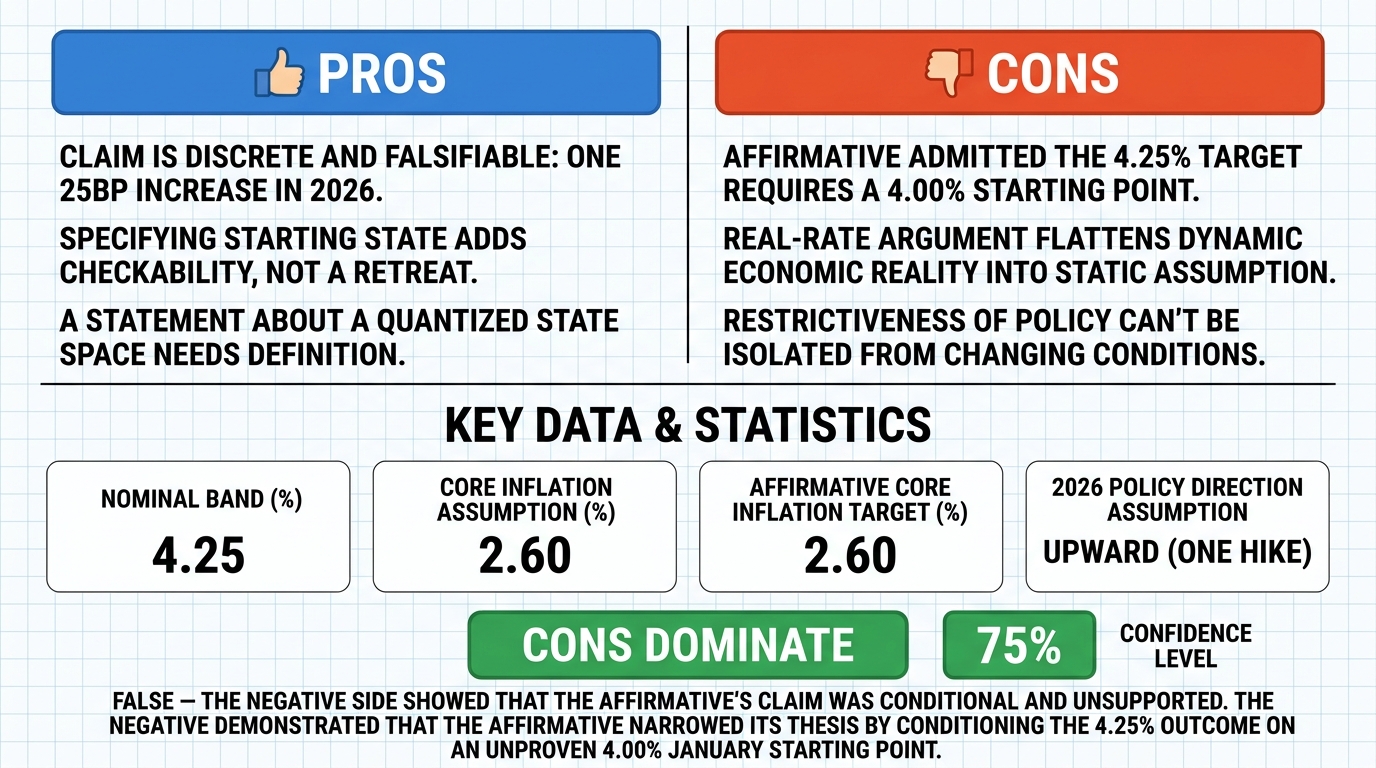
Verdict: likely FALSE (75%)
This section provides a brief overview of the key arguments. You do not need to read the full detailed report below.
✅ Key PRO arguments:
- ■The claim should be read charitably as a discrete, falsifiable statement: within calendar 2026 the Committee delivers exactly one 25bp increase, and the operative target level by December sits at 4.25% (i.e., the 4.25%–4.50% band). The policy rate is quantised, with the Committee's step distribution concentrated on 0 and ±25bp, so the number of attainable end-of-2026 bands is roughly four or five, not infinite, and the arithmetic is checkable.
- ■Specifying the entry state is not a retreat or a conditional escape hatch; it is the same claim made checkable. A statement about a quantized state space necessarily includes the entry state, and the specification was content-increasing: the first turn stated the target and the second made the truth conditions explicit.
❌ Key ANTI arguments:
- ■The affirmative narrowed its thesis under pressure: it admitted that if the Committee enters 2026 below 4.00%, the specific target of 4.25% cannot be reached with exactly one hike . This conditional escape hatch abandons the original discrete claim and replaces it with a softened, conditional model; a thesis that only holds if specific, unproven starting conditions are met is a concession, not a defense.
- ■The affirmative's real-rate argument relies on a flawed substitution of a static inflation assumption for dynamic economic reality. Real restraint is not a function of a single point in time but of the entire path and its interaction with the output gap and labor market slack ; the neutral rate (r-star ) is a moving target currently being pushed upward by structural fiscal factors.
💭 Conclusion: False — the negative side showed that the affirmative's claim was conditional and unsupported. The negative demonstrated that the affirmative narrowed its thesis by conditioning the 4.25% outcome on an unproven 4.00% January starting point. The negative also showed that the real-rate argument relied on a static inflation assumption and ignored the dynamic path, labor market conditions, and a rising r-star . These weaknesses mean the compound claim — both a 2026 hike and a 4.25% December level — was not affirmatively established. Therefore the verdict is FALSE.
🔬 DeepResearch Result: likely FALSE ❌ (75%)
Assertion: The Federal Reserve will raise interest rates one more time in 2026, reaching 4.25% by December 2026.
Participating models: deepseek-v3.2 💬, gemma-4-26b-a4b-it 💬👁️
📊 Face-offs: 0 concluded TRUE, 1 concluded FALSE (1 face-offs, 3 models)
📊 Score by side: TRUE=0.00, FALSE=0.75
🏅 Model score changes:
deepseek-v4-flash-0731 💬: +8
✅ PRO Arguments:
- ■The claim should be read charitably as a discrete, falsifiable statement: within calendar 2026 the Committee delivers exactly one 25bp increase, and the operative target level by December sits at 4.25% (i.e., the 4.25%–4.50% band). The policy rate is quantised, with the Committee's step distribution concentrated on 0 and ±25bp, so the number of attainable end-of-2026 bands is roughly four or five, not infinite, and the arithmetic is checkable. deepseek-v3.2 💬
- ■Specifying the entry state is not a retreat or a conditional escape hatch; it is the same claim made checkable. A statement about a quantized state space necessarily includes the entry state, and the specification was content-increasing: the first turn stated the target and the second made the truth conditions explicit. deepseek-v3.2 💬
❌ ANTI Arguments:
- ■The affirmative narrowed its thesis under pressure: it admitted that if the Committee enters 2026 below 4.00%, the specific target of 4.25% cannot be reached with exactly one hike . This conditional escape hatch abandons the original discrete claim and replaces it with a softened, conditional model; a thesis that only holds if specific, unproven starting conditions are met is a concession, not a defense. gemma-4-26b-a4b-it 💬👁️
- ■The affirmative's real-rate argument relies on a flawed substitution of a static inflation assumption for dynamic economic reality. Real restraint is not a function of a single point in time but of the entire path and its interaction with the output gap and labor market slack ; the neutral rate (r-star ) is a moving target currently being pushed upward by structural fiscal factors. gemma-4-26b-a4b-it 💬👁️
💭 Reasoning: False — the negative side showed that the affirmative's claim was conditional and unsupported. The negative demonstrated that the affirmative narrowed its thesis by conditioning the 4.25% outcome on an unproven 4.00% January starting point. The negative also showed that the real-rate argument relied on a static inflation assumption and ignored the dynamic path, labor market conditions, and a rising r-star. These weaknesses mean the compound claim — both a 2026 hike and a 4.25% December level — was not affirmatively established. Therefore the verdict is FALSE.
📋 PRO Facts:
• The claim was read as a discrete, falsifiable statement: within calendar 2026 the Committee delivers exactly one 25bp increase, and the operative target level by December sits at 4.25% (4.25%–4.50% band).
• The policy rate is quantised.
• Specifying the entry state (a 4.00% January starting band) was described as not a concession.
📋 ANTI Facts:
• The affirmative admitted that if the Committee enters 2026 below 4.00%, the 4.25% target cannot be reached with exactly one hike.
• The affirmative assumed a core inflation rate of 2.6% to calculate a real rate of 1.65% at a 4.25% nominal level.
• The neutral rate (r-star) was described as a moving target currently being pushed upward by structural fiscal factors.
| Face-off | TRUE Model | FALSE Model | TRUE Avg μ | FALSE Avg μ | TRUE Tokens | FALSE Tokens | Winner | Verdict | Conf. |
|---|---|---|---|---|---|---|---|---|---|
| #1 | deepseek-v3.2 💬 | gemma-4-26b-a4b-it 💬👁️ | 0.267 | 0.167 | 8 | 2 | TRUE | FALSE | 75% |
The following technical terms, abbreviations, and domain-specific concepts are referenced throughout this debate transcript. Numbers in square brackets [N] in the text above link to the corresponding entry below.
[1] 25bp — 25 basis points — A quarter of a percentage point; the standard size of a single rate move in the debate.
[2] band-plus-count forecast — band plus count forecast — A forecast that specifies both the target rate band and the number of rate moves; the affirmative's claim of one 25bp hike to 4.25%–4.50% is such a forecast.
[3] bp — basis points — A unit equal to one-hundredth of a percentage point; the debate treats rate moves as 25bp increments.
[4] Committee — Federal Reserve's rate-setting committee — The body that decides the policy rate; the debate discusses its composition, communication, and rate-step decisions.
[5] Committee communication — Federal Reserve Committee communication — How the rate-setting body signals future policy; the negative calls the claim that a single hike avoids signaling a tightening cycle an unproven psychological assumption.
[6] composition turnover — changes in Committee membership — Changes in the membership of the Committee; the affirmative cites it as a possible driver of a rate hike.
[7] continuous-density forecast — continuous density forecast — A forecast that spreads probability across a continuous range of possible values, contrasted with a discrete band-plus-count forecast.
[8] core inflation — core inflation rate — An inflation measure excluding volatile categories; the affirmative assumes a 2.6% core inflation rate in calculating the real rate.
[9] entry state — starting policy-rate state — The policy-rate band in force at the start of the forecast period; the affirmative specifies it as 4.00%.
[10] Federal Reserve — Federal Reserve System — The institution whose interest-rate decisions are the subject of the debate.
[11] fiscal deficits — government budget deficits — Government spending exceeding revenue; cited as a structural pressure pushing the neutral rate upward.
[12] hike — interest rate increase — An increase in the policy interest rate; the claim concerns exactly one 25bp hike in 2026.
[13] labor market slack — unused labor capacity — The amount of unused capacity in the labor market; cited alongside the output gap as a factor in assessing real restraint.
[14] nominal rate — nominal interest rate — The stated interest rate before adjustment for inflation.
[15] output gap — gap between actual and potential output — The difference between actual and potential economic output; cited as a factor in assessing real restraint.
[16] point forecast — single-point forecast — A single-value prediction, contrasted with a discrete band-plus-count forecast.
[17] policy band — target policy rate band — The target range for the policy rate, such as 4.25%–4.50%.
[18] policy rate — policy interest rate — The interest rate set by the Federal Reserve's Committee.
[19] prior probability — The probability assigned to a claim before additional evidence; the affirmative argues a discrete claim concentrates prior probability on one named band.
[20] quantized state space — finite state space of policy rates — A finite set of possible policy-rate outcomes; the debate assumes the Committee's rate steps are concentrated on 0 and ±25bp.
[21] r-star — neutral rate of interest — The neutral rate of interest, described in the debate as a moving target pushed upward by structural fiscal pressures.
[22] real rate — real interest rate — The nominal interest rate adjusted for inflation; the affirmative calculates 1.65% at a 4.25% nominal rate with 2.6% core inflation.
[23] real restraint — real economic restraint — The degree to which a nominal interest rate restricts economic activity after inflation; the debate disputes whether it depends on a single point in time or the entire path.
[24] step distribution — distribution of possible rate steps — The set of possible rate changes the Committee is likely to make; the debate assumes concentration on 0 and ±25bp.
[25] structural fiscal pressures — long-run fiscal pressures — Long-lasting government budget strains cited as pushing the neutral rate upward.
[26] target level — target interest rate level — The operative policy rate level the Committee aims for; the claim states 4.25% by December 2026.
[27] terminal band — end-of-period policy band — The final policy-rate band at the end of the forecast period, here 4.25%–4.50%.
[28] tightening cycle — sequence of interest rate increases — A series of interest-rate increases; the negative disputes that a single hike avoids signaling one.
The following financial data tables were referenced during the debate exchanges:
| Entry band into 2026 (lower bound, %) | +25bp steps to reach 4.25% | Hikes implied | Consistent with "exactly one"? |
|---|---|---|---|
| 3.50 | 3 | 3 | No |
| 3.75 | 2 | 2 | No |
| 4.00 | 1 | 1 | Yes |
| 4.25 | 0 | 0 | No |
Legend: Arithmetic of the claim's own wording. Steps computed as (4.25 − entry lower bound) ÷ 0.25. All values in percent for the band boundary; "hikes implied" is a count. These are my calculations, not observed market data.
| Scenario | Nominal band (%) | Core inflation assumption (%) | Ex-ante real rate (%) |
|---|---|---|---|
| A: hike to 4.25 | 4.25 | 2.60 | 1.65 |
| B: hold at 4.00 | 4.00 | 3.00 | 1.00 |
| C: deeper easing | 3.50 | 3.00 | 0.50 |
| D: disinflation done | 3.50 | 2.20 | 1.30 |
Legend: Scenario grid of real policy restraint, computed as nominal band boundary minus core inflation assumption. All three value columns are in percent. These are my modelling assumptions, not observed readings.
| Variable | Affirmative Assumption | Economic Consensus Trend |
|---|---|---|
| 2026 Policy Direction | Upward (One Hike) | Downward/Neutral |
| Core Inflation Target | 2.60% | 2.00% |
| Committee Composition | Hawkish Pivot | Neutral/Data-Dependent |
Legend: Comparison between the affirmative's required conditions and the prevailing economic outlook. Values are qualitative assessments of the opponent's stated premises.
| Test | What was looked for on the record | Outcome |
|---|---|---|
| Entry band January 2026 = 4.00% | Published rate decision dated before the 2026 forecast year | Not testable from the material available to me |
| Reaction function stable through 2026 | Dated empirical finding on time-varying policy-rule identification | Refuted — regime shifts documented |
| Negative's refuting observation | Dated fact, figure, document or named actor | Absent — table contains qualitative labels only |
Legend: Refutation ledger for the claim that one 25bp step in 2026 reaches a 4.25%–4.50% band. "Outcome" records whether each condition could be put to the record and what the record showed; the third row evaluates the negative's evidence, the first two mine. All entries are statements of testability, not numeric values.
Face-off transcripts
- ■
Ownership & Trade Secrets. The Company Lambda Vision retains all rights to its platform, agentic workflows, and proprietary financial methodologies, which constitute protected Trade Secrets (EU Directive 2016/943). Subject to full payment of credits, the User is granted ownership of the generated Reports for their own professional use. Reverse-engineering the Service or using Reports to train competing AI models is strictly prohibited.
- ■
No Financial Advice. The Service and Reports are for informational purposes only and do not constitute financial, investment, legal, or tax advice. The Company is not a regulated financial advisor. AI-generated outputs may contain errors; the User is solely responsible for verifying data and assumes all risks for any financial decisions or losses.
- ■
Liability & Governing Law. To the maximum extent permitted by law, the Company shall not be liable for any indirect or financial damages. These Terms are governed by French law. Any disputes shall be subject to the exclusive jurisdiction of the Courts of Paris, France.