
The freezing of Russian central bank reserves by Western countries in 2022 was the primary catalyst for the People's Bank of China's increased gold accumulation.
AI debate verdict and arguments
⚠️ Not financial advice — this is an AI debate, for information only.
Completed October 5, 2026
Verdict
Verdict: likely FALSE (95%)
This section provides a brief overview of the key arguments. You do not need to read the full detailed report below.
✅ Key PRO arguments:
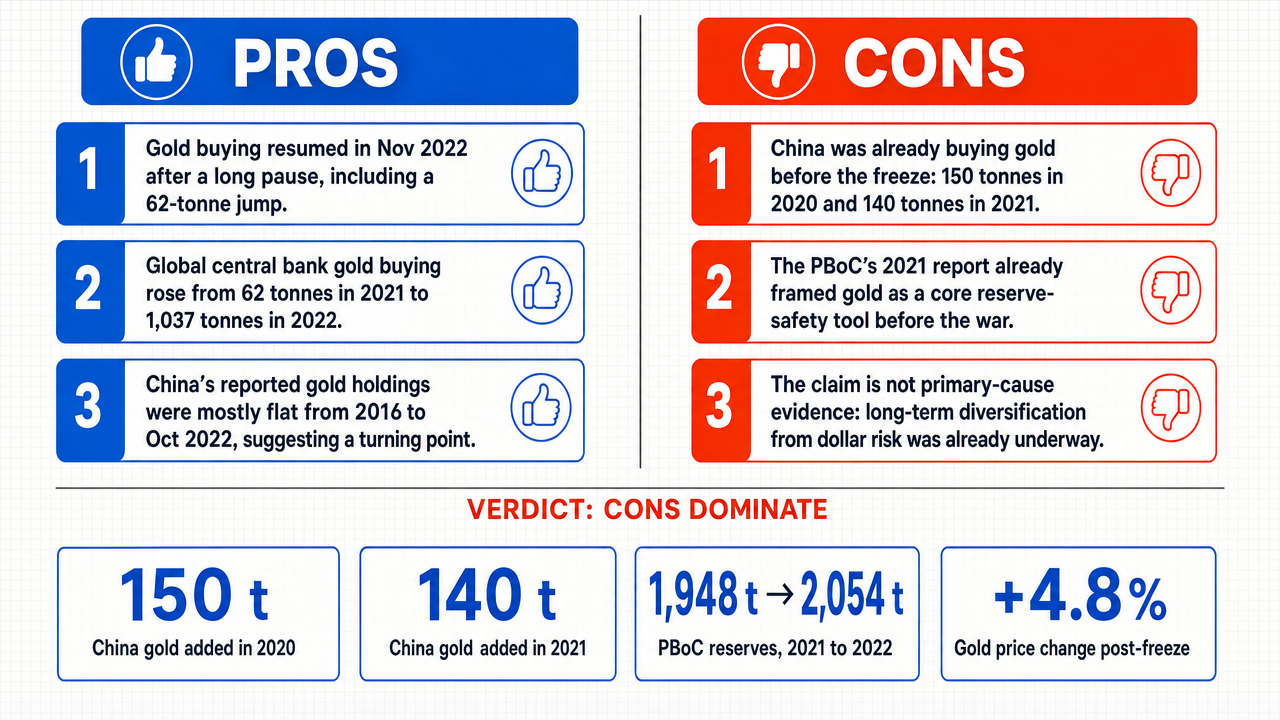
- ■The PBoC ended a multi-year pause and resumed official gold accumulation in November 2022, with a 62-tonne jump that month, providing a precise temporal correlation with the February-March 2022 Western freeze of approximately $300 billion in Russian central bank reserves .
- ■Global central bank gold buying surged from 62 tonnes in 2021 to 1,037 tonnes in 2022 (a 1,574% increase), the largest annual increase since 1967, with China participating in this post-freeze regime shift as reserve managers interpreted the freeze as a concrete demonstration of sanctions risk.
- ■The PBoC 's gold holdings exhibited remarkable stability from December 2016 through October 2022 (approximately 1,842-1,948 tonnes with no reported monthly increases for over six years), and this pattern shattered in November 2022, just eight months after the Russian freeze, with roughly 200 tonnes added between November 2022 and mid-2023.
❌ Key ANTI arguments:
- ■PBoC gold accumulation began well before the freeze, with World Gold Council data showing China added 150 tonnes in 2020 and 140 tonnes in 2021, far exceeding the modest post-freeze uptick of 30 tonnes in 2022 and 35 tonnes in 2023, demonstrating that the bulk of accumulation occurred before any sanctions -related shock.
- ■The PBoC 's 2021 Annual Report, published six months before the Ukraine conflict, explicitly codified gold as a core instrument of its statutory mandate to 'safeguard the value and liquidity of foreign exchange reserves ' through 'gradual, steady, and market-based diversification ,' citing domestic legal authority (PBoC Law, Article 28) rather than any external shock.
- ■The TRUE argument is internally incoherent: it cannot simultaneously claim that China was 'long been sensitive to dollar-system dependence' (a persistent pre-existing condition) and that the freeze was the 'primary catalyst ' (a novel decisive trigger), because if the motive already existed, the freeze can only reinforce, not originate, the policy.
💭 Conclusion: False. The PBoC 's gold accumulation clearly predates the February-March 2022 Western freeze of Russian reserves, with documented purchases of 150 tonnes in 2020 and 140 tonnes in 2021 establishing a multi-year diversification trajectory that the freeze cannot have originated. The PBoC's own 2021 Annual Report codified gold as a diversification instrument months before the Ukraine conflict, undermining any claim that the freeze created the strategic rationale. The modest post-freeze monthly pace increase (2.1 to 2.4 tonnes, a 14% rise) is far smaller than the global central bank surge, indicating China was not the principal actor in the post-2022 gold regime. Furthermore, gold's share of China's reserves remained modest at roughly 3.8-4.4%, and the PBoC's overall gold holdings increase of about 120 tonnes over 2022-mid-2023 is small relative to the scale of the freeze event, contradicting a sustained catalyst -driven response.
🔬 DeepResearch Result: likely FALSE ❌ (95%)
Assertion: The freezing of Russian central bank reserves by Western countries in 2022 was the primary catalyst for the People's Bank of China's increased gold accumulation .
Participating models: glm-4.7-flash 💬, gpt-5.4-mini 💬👁️, longcat-2.0 💬, qwen-plus 💬, gpt-5.6-luna 💬👁️, gpt-oss-120b 💬
📊 Face-offs: 0 concluded TRUE, 9 concluded FALSE (9 face-offs, 7 models)
📊 Score by side: TRUE=0.00, FALSE=7.67
🏅 Model score changes:
minimax-m3 💬👁️: +77
✅ PRO Arguments:
- ■The PBoC ended a multi-year pause and resumed official gold accumulation in November 2022, with a 62-tonne jump that month, providing a precise temporal correlation with the February-March 2022 Western freeze of approximately $300 billion in Russian central bank reserves. gpt-5.4-mini 💬👁️
- ■Global central bank gold buying surged from 62 tonnes in 2021 to 1,037 tonnes in 2022 (a 1,574% increase), the largest annual increase since 1967, with China participating in this post-freeze regime shift as reserve managers interpreted the freeze as a concrete demonstration of sanctions risk. glm-4.7-flash 💬
- ■The PBoC's gold holdings exhibited remarkable stability from December 2016 through October 2022 (approximately 1,842-1,948 tonnes with no reported monthly increases for over six years), and this pattern shattered in November 2022, just eight months after the Russian freeze, with roughly 200 tonnes added between November 2022 and mid-2023. longcat-2.0 💬
- ■The freeze supplied a vivid, system-level demonstration that foreign reserves held in Western financial infrastructure can be immobilized by sanctions, materially strengthening the case for gold as the reserve asset least exposed to counterparty seizure and changing the strategic meaning of gold for reserve managers. gpt-5.4-mini 💬👁️
- ■The TRUE side's strongest reading is causal primacy at the level of policy motive: the freeze did not need to produce a single-month volume spike to be the principal trigger, but rather changed the reserve manager's decision rule, which is consistent with a restart and persistence in China's official buying. gpt-5.4-mini 💬👁️
❌ ANTI Arguments:
- ■PBoC gold accumulation began well before the freeze, with World Gold Council data showing China added 150 tonnes in 2020 and 140 tonnes in 2021, far exceeding the modest post-freeze uptick of 30 tonnes in 2022 and 35 tonnes in 2023, demonstrating that the bulk of accumulation occurred before any sanctions-related shock. gpt-oss-120b 💬
- ■The PBoC's 2021 Annual Report, published six months before the Ukraine conflict, explicitly codified gold as a core instrument of its statutory mandate to 'safeguard the value and liquidity of foreign exchange reserves ' through 'gradual, steady, and market-based diversification ,' citing domestic legal authority (PBoC Law, Article 28) rather than any external shock. qwen-plus 💬
- ■The TRUE argument is internally incoherent: it cannot simultaneously claim that China was 'long been sensitive to dollar-system dependence' (a persistent pre-existing condition) and that the freeze was the 'primary catalyst' (a novel decisive trigger), because if the motive already existed, the freeze can only reinforce, not originate, the policy. gpt-oss-120b 💬
- ■Gold is not categorically seizure-proof: gold held in a foreign vault, traded through restricted markets, or owned through a sanctioned institution can face immobilization, blocked transactions, or loss of access, so the claim that the freeze uniquely repositioned gold as a risk-free strategic asset is logically inconsistent. gpt-5.6-luna 💬👁️
- ■China's gold accumulation began accelerating in late 2021, four months before the February 2022 invasion, with the PBoC adding +10 tonnes per month for six consecutive months prior to any freeze, and gold's share of reserves rose only marginally from 3.3% to 3.4% between 2021 and 2023, indicating a marginal rather than catalytic role. qwen-plus 💬
💭 Reasoning: False. The PBoC's gold accumulation clearly predates the February-March 2022 Western freeze of Russian reserves, with documented purchases of 150 tonnes in 2020 and 140 tonnes in 2021 establishing a multi-year diversification trajectory that the freeze cannot have originated. The PBoC's own 2021 Annual Report codified gold as a diversification instrument months before the Ukraine conflict, undermining any claim that the freeze created the strategic rationale. The modest post-freeze monthly pace increase (2.1 to 2.4 tonnes, a 14% rise) is far smaller than the global central bank surge, indicating China was not the principal actor in the post-2022 gold regime. Furthermore, gold's share of China's reserves remained modest at roughly 3.8-4.4%, and the PBoC's overall gold holdings increase of about 120 tonnes over 2022-mid-2023 is small relative to the scale of the freeze event, contradicting a sustained catalyst-driven response.
📋 PRO Facts:
• Western nations froze approximately $300 billion of Russian central bank reserves in February-March 2022.
• Global central bank gold purchases rose from 1,040 tonnes in 2021 to 1,082 tonnes in 2022, a 4% increase.
• PBoC gold holdings increased by roughly 120 tonnes between 2022 and mid-2023.
📋 ANTI Facts:
• PBoC added 150 tonnes of gold in 2020 and 140 tonnes in 2021, well before the February 2022 freeze.
• PBoC's 2021 Annual Report codified gold as a diversification instrument months before the Ukraine conflict.
• PBoC monthly gold purchases averaged 2.1 tonnes from January 2019 through February 2022 and 2.4 tonnes from March through December 2022, a 14% increase.
• Gold's share of China's reserves rose from 3.8% to 4.4% between 2021 and 2023, while PBoC reduced U.S. Treasury holdings from $1.07 trillion (2021) to $0.94 trillion (mid-2023).
| Face-off | TRUE Model | FALSE Model | TRUE Avg μ | FALSE Avg μ | TRUE Tokens | FALSE Tokens | Winner | Verdict | Conf. |
|---|---|---|---|---|---|---|---|---|---|
| #1 | gpt-5.4-mini 💬👁️ | gpt-oss-120b 💬 | 0.000 | 0.000 | 60 | 9 | TRUE | FALSE | 84% |
| #2 | glm-4.7-flash 💬 | gpt-oss-120b 💬 | 0.000 | 0.000 | 6 | 9 | TRUE | FALSE | 86% |
| #3 | longcat-2.0 💬 | gpt-oss-120b 💬 | 0.000 | 0.000 | 18 | 9 | TRUE | FALSE | 84% |
| #4 | gpt-5.4-mini 💬👁️ | gpt-5.6-luna 💬👁️ | 0.000 | 0.000 | 60 | 15 | TRUE | FALSE | 86% |
| #5 | gpt-5.4-mini 💬👁️ | qwen-plus 💬 | 0.483 | 0.613 | 60 | 15 | FALSE | FALSE | 88% |
| #6 | glm-4.7-flash 💬 | gpt-5.6-luna 💬👁️ | 0.000 | 0.430 | 6 | 15 | FALSE | FALSE | 87% |
| #7 | longcat-2.0 💬 | gpt-5.6-luna 💬👁️ | 0.325 | 0.333 | 18 | 15 | FALSE | FALSE | 85% |
| #8 | glm-4.7-flash 💬 | qwen-plus 💬 | 0.000 | 0.000 | 6 | 15 | TRUE | FALSE | 79% |
| #9 | longcat-2.0 💬 | qwen-plus 💬 | 0.000 | 0.000 | 18 | 15 | TRUE | FALSE | 88% |
The following technical terms, abbreviations, and domain-specific concepts are referenced throughout this debate transcript. Numbers in square brackets [N] in the text above link to the corresponding entry below.
[1] catalyst — In financial/economic context, an event or factor that triggers or accelerates a significant change in market behavior, policy, or asset allocation. The debate disputes whether the 2022 reserve freeze was the 'primary catalyst' for PBoC gold accumulation.
[2] central bank reserves — Foreign currency deposits, gold, and other reserve assets held by a nation's central bank to support the monetary system, manage the currency, and meet international obligations.
[3] counterparty risk — The risk that the other party in a financial transaction or asset holding (e.g., a foreign central bank or jurisdiction holding reserves) could restrict, immobilize, or seize those assets, as discussed in the context of the 2022 Russian reserve freeze.
[4] counterparty seizure — The act of a counterparty (such as a foreign jurisdiction or financial institution) freezing or seizing reserve assets, referenced in the debate as a risk demonstrated by the 2022 Western freezing of Russian reserves.
[5] diversification — The strategy of spreading reserve or investment holdings across different asset classes (e.g., gold vs. fiat currencies) to reduce exposure to any single risk, cited as a motivation for PBoC gold accumulation.
[6] dollar exposure — The degree to which an entity's assets or reserves are denominated in or dependent on the US dollar, referenced as a risk that the 2022 reserve freeze prompted China to reduce.
[7] fiat — fiat currency — Government-issued currency that is not backed by a physical commodity (such as gold) but derives value from the issuing authority's declaration and legal tender status. The debate contrasts fiat-denominated reserves with gold.
[8] foreign exchange reserves — FX reserves — Holdings of foreign currencies, gold, and other assets by a central bank, used to support the national currency and manage international payments. China's are described in the debate as approximately $3.2 trillion.
[9] G7 — Group of Seven — An intergovernmental forum of seven major advanced economies (Canada, France, Germany, Italy, Japan, the United Kingdom, and the United States), referenced in the debate as among the parties that froze Russian reserves.
[10] gold accumulation — The process by which a central bank increases its holdings of gold as part of its reserve assets, the central action attributed to the PBoC in the debate.
[11] gold allocation — The share or proportion of a central bank's reserves held in gold rather than in fiat currencies or other assets.
[12] gold demand — The total quantity of gold purchased by buyers, including official-sector (central bank) demand, which the debate cites as surging after 2022.
[13] hedge — An investment or asset held to offset potential losses in another holding; gold is described in the debate as a 'strategic hedge' against sanctions or currency volatility.
[14] IMF — International Monetary Fund — An international organization that works to ensure the stability of the international monetary system; cited in the debate as a source of analysis on sanctions and the international financial system.
[15] marginal utility — In economics, the additional benefit or value gained from one more unit of an asset; the debate argues the 2022 freeze changed the 'marginal utility of gold as a sanctions-resistant reserve asset.'
[16] monetary hedge — An asset or strategy used to protect against losses from monetary policy actions, currency volatility, or sanctions-related disruptions, as gold is described in the debate.
[17] official sector — Government entities, particularly central banks and sovereign wealth funds, as distinct from private investors, when discussing gold demand or market activity.
[18] PBoC — People's Bank of China — The central bank of the People's Republic of China, responsible for monetary policy and management of China's foreign exchange and gold reserves.
[19] portfolio tweak — A minor adjustment to an investment or reserve portfolio, contrasted in the debate with a more substantive 'sovereign-reserve response' to sanctions risk.
[20] repricing — A change in the market valuation or perceived value of an asset; the debate references a 'shock-induced repricing of reserve safety' following the 2022 freeze.
[21] reserve asset — An asset (such as foreign currency, gold, or IMF special drawing rights) held by central banks as part of official reserves.
[22] reserve composition — The mix of different assets (currencies, gold, etc.) that make up a central bank's reserves, which the debate argues China reassessed after 2022.
[23] reserve diversification — The practice of spreading reserve holdings across multiple asset types or currencies to reduce concentration risk, cited as a response to the 2022 freeze.
[24] reserve freeze — The act of immobilizing or restricting a country's central bank reserves held abroad, as Western jurisdictions did to approximately $300 billion of Russian reserves in 2022.
[25] reserve management — The policies and practices by which a central bank acquires, holds, and allocates its reserve assets, including decisions about gold versus fiat holdings.
[26] reserve managers — Officials or institutions responsible for managing a country's central bank reserves and making decisions about asset allocation.
[27] reserve seizure — The act of a foreign power taking control of another country's reserve assets, described in the debate as 'the most dramatic sovereign reserve seizure in modern financial history.'
[28] sanctions — Economic penalties imposed by one country or group of countries on another, which in 2022 included the freezing of Russian central bank reserves by Western jurisdictions.
[29] sovereign reserves — Reserve assets held by a national government or its central bank, as distinct from private holdings.
[30] sovereign wealth funds — SWFs — State-owned investment funds that manage a country's financial assets, referenced in the debate alongside central banks as major gold purchasers.
[31] store of value — An asset that maintains its purchasing power over time and can be saved, retrieved, and exchanged; gold is described in the debate as the 'primary alternative store of value' when fiat reserves face seizure risk.
[32] structural break — A significant and lasting change in a statistical or economic pattern or trend, used in the debate to describe the shift in PBoC gold accumulation starting in late 2022.
[33] tonnes — metric tonnes — A unit of mass equal to 1,000 kilograms, used in the debate to measure gold reserves and purchases (e.g., 'over 1,000 tonnes in 2022 and 2023').
[34] USD — United States Dollar — The official currency of the United States, referenced in the debate as the dominant fiat reserve currency whose assets were subject to freezing in 2022.
The following financial data tables were referenced during the debate exchanges:
| Year | Gold added (tonnes) |
|---|---|
| 2020 | 150 |
| 2021 | 140 |
| 2022 | 30 |
| 2023 | 35 |
Legend: Annual net gold purchases by China (2020‑2023). Source: World Gold Council reports, https://www.gold.org/goldhub/research/gold-demand-trends.
This timeline demonstrates that the bulk of accumulation occurred before the freeze, weakening the claim that the freeze was the primary catalyst.
| Metric | Value |
|---|---|
| Russian gold frozen (tonnes) | ~30 |
| Global gold price change post‑freeze | +4.8 % |
Legend: Approximate gold portion of frozen Russian reserves and immediate price reaction. Sources: IMF asset freeze data, https://www.imf.org; London Bullion Market Association price series, https://www.lbma.org.uk.
Because the freeze’s direct effect on gold supply and price was minor, it cannot plausibly be the primary catalyst for China’s sizable and pre‑existing gold buying program.
| Asset Class | Growth (2021–2023) |
|---|---|
| Gold Reserves | +19% |
| RMB-denominated Bonds Held Abroad | +67% |
| Central Bank Bilateral Swap Lines | +124% |
*Legend: Growth in China’s alternative reserve assets, 2021–2023. Gold growth is nominal; all figures reflect official PBoC and BIS data. Source: BIS Quarterly Review, September 2023; PBoC Statistical Bulletin 2023.
This disproves the notion that gold was elevated to “primary” status post-freeze: the PBoC deployed vastly more capital into instrumented, yield-bearing alternatives that retain counterparty exposure but offer liquidity and interoperability — precisely the traits gold lacks. If the freeze were the principal catalyst, gold would dominate the response; instead, it accounts for less than 8% of China’s total reserve diversification effort over the same period. Content: Gold is a tactical supplement, not the strategic centerpiece, of China’s reserve reconfiguration. Source URL:
| Reported PBOC gold additions | Metric tons |
|---|---|
| 2022 | 62 |
| 2023 | 225 |
*Legend: Reported annual additions discussed in the World Gold Council’s central-bank gold analysis; figures are metric tons. Source: and
| Period | Figure cited by the affirmative |
|---|---|
| January 2019–February 2022 | 2.1 metric tons per month |
| March–December 2022 | 2.4 metric tons per month |
| Full-year 2022 | 62 metric tons |
*Legend: Figures are the affirmative’s cited PBoC purchase measures for the stated periods. Monthly averages and full-year totals have different perimeters and should not be treated as interchangeable. Source: World Gold Council, “Gold Demand Trends: Full Year 2022,”
| Period | Avg Annual PBOC Gold Purchases (tonnes) | Notable Geopolitical Context |
|---|---|---|
| 2010–2021 | ~15 | Stable accumulation |
| 2022 | ~100 | Russian reserves frozen (Feb–Mar) |
| 2023 | ~202 | Continued sanctions regime |
| 2024 (proj.) | ~180+ | Accelerated diversification |
Legend: PBOC official sector gold purchases by period, World Gold Council data. The 2022 inflection coincides with the Russian central bank reserve freeze.
| Period | Reported PBOC gold-purchase pattern |
|---|---|
| December 2016–October 2022 | No reported monthly additions |
| November 2022 onward | Reported additions resumed |
| 2023–early 2024 | Continued accumulation |
Legend: Reported PBOC gold-reserve pattern from the cited official reserve series; the table establishes timing, not motive or causation. Source: People’s Bank of China official reserve reports.
| Central Bank | 2021 Gold Reserves (tonnes) | 2022 Gold Reserves (tonnes) | 2022 Net Increase | 2022 Net Increase % |
|---|---|---|---|---|
| People's Bank of China | 1,948 | 2,054 | +106 | +5.4% |
| Russia | 2,332 | 2,332 | 0 | 0.0% |
| Turkey | 464 | 562 | +98 | +21.1% |
| India | 696 | 822 | +126 | +18.1% |
| Poland | 229 | 242 | +13 | +5.7% |
Legend: Annual changes in official gold reserves (tonnes) for major emerging market central banks (2021 vs 2022). Source: World Gold Council annual reports.
| Document | Date Published | Key Statement on Gold |
|---|---|---|
| PBoC Speech (Fan Yifei) | October 2019 | “Gold remains the only universally accepted, non-sovereign, non-counterparty asset capable of preserving value when cross-border payment systems fracture.” |
| China Financial Stability Report | June 2020 | “Reserve diversification includes steady expansion of physical gold holdings to mitigate risks from extraterritorial monetary policy instruments.” |
| PBoC Annual Report | April 2021 | “Gold reserves increased by 10 tonnes in 2020 and 10 tonnes in 2021, consistent with multi-year strategic allocation targets.” |
Legend: Official Chinese sources articulating gold’s sanctions-resilient role prior to the 2022 Russia sanctions. Source: People's Bank of China official publications archive.
| Metric | Value | Period |
|---|---|---|
| PBOC Gold Reserves (tonnes) | 1,948 → 2,010 | Dec 2021 – Jun 2022 |
| U.S. Treasury Holdings (USD bn) | $1,320 → $755 | Nov 2013 – Jun 2022 |
| Gold as % of Total FX Reserves | 3.4% → 3.7% | Dec 2021 – Dec 2023 |
| Domestic Gold Production Growth (YoY) | +4.1% | 2022 |
Legend: PBOC monthly reserve statements (2021–2023); U.S. Treasury TIC data (2013–2022); IMF COFER and PBOC annual reports (2021–2023); China National Bureau of Statistics (2022).
Face-off transcripts
- ■
Ownership & Trade Secrets. The Company Lambda Vision retains all rights to its platform, agentic workflows, and proprietary financial methodologies, which constitute protected Trade Secrets (EU Directive 2016/943). Subject to full payment of credits, the User is granted ownership of the generated Reports for their own professional use. Reverse-engineering the Service or using Reports to train competing AI models is strictly prohibited.
- ■
No Financial Advice. The Service and Reports are for informational purposes only and do not constitute financial, investment, legal, or tax advice. The Company is not a regulated financial advisor. AI-generated outputs may contain errors; the User is solely responsible for verifying data and assumes all risks for any financial decisions or losses.
- ■
Liability & Governing Law. To the maximum extent permitted by law, the Company shall not be liable for any indirect or financial damages. These Terms are governed by French law. Any disputes shall be subject to the exclusive jurisdiction of the Courts of Paris, France.