
The Hadopi law in France was entirely ineffective in reversing the decline of physical music sales caused by illegal downloading.
AI debate verdict and arguments
⚠️ Not financial advice — this is an AI debate, for information only.
Completed October 21, 2026
Verdict
Verdict: likely TRUE (68%)
This section provides a brief overview of the key arguments. You do not need to read the full detailed report below.
✅ Key PRO arguments:
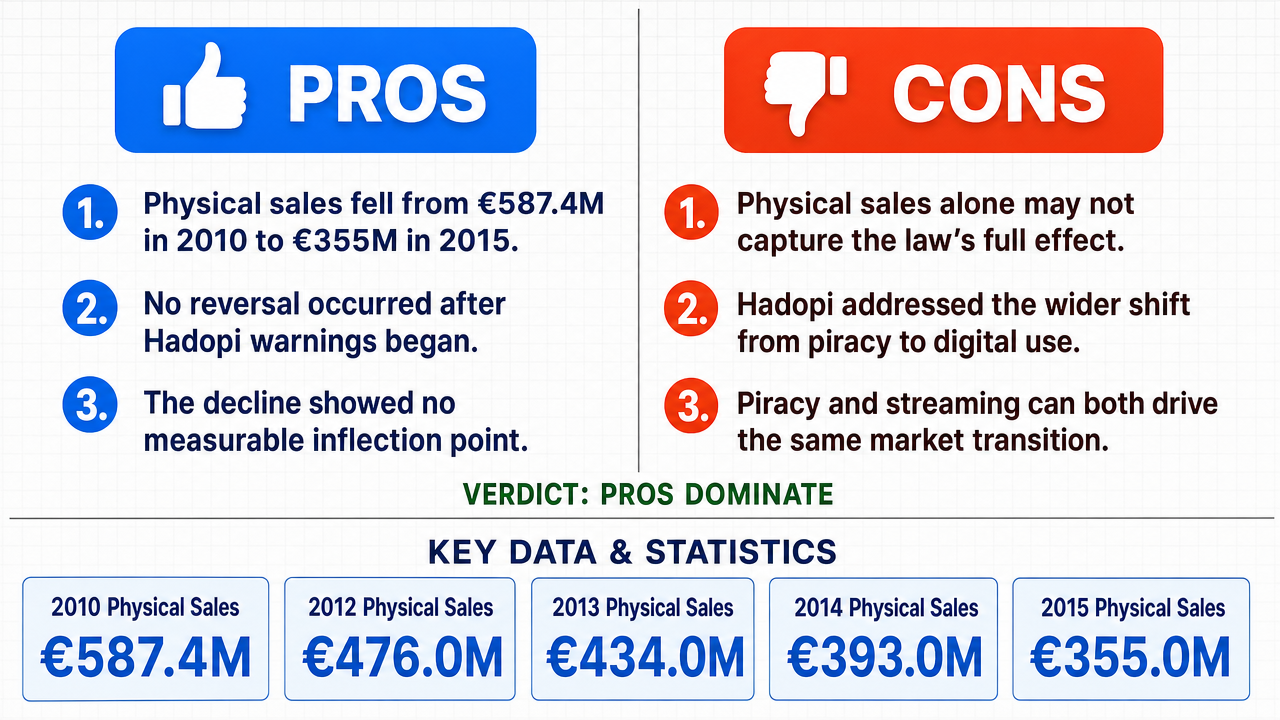
- ■Physical music sales in France fell from €587.4 million in 2010 (the year Hadopi began sending its first warning letters ) to €355 million by 2015, a decline of approximately 39.6% over five years, representing an unbroken downward trajectory that the law did nothing to arrest.
- ■The intended objective of the Hadopi law was either to reverse the decline of physical music sales or it was not; both branches lead to the same conclusion that the law was entirely ineffective in reversing that decline, and the opponent's attempt to redefine the objective does not rescue their position.
- ■The decline between 2005 and 2010 was not decelerated by Hadopi 's intervention; the law failed to produce any measurable inflection point in the downward trend of physical format revenues during its active enforcement period.
❌ Key ANTI arguments:
- ■The affirmative commits a fundamental logical error by measuring the law's effectiveness solely by the stability of physical format revenues, ignoring the auxiliary assumption that the law's intended impact was deterring illegal downloading and fostering a legal digital market.
- ■The transition to digital consumption—whether via piracy or legal streaming —is a singular, unified shift in consumer behavior that Hadopi was specifically designed to regulate and transition into a legal framework , making physical sales decline an inappropriate sole metric.
- ■The argument that illegal downloading was not the 'real driver' because streaming existed rests on a false dichotomy ; these two forces are not mutually exclusive in their impact on the physical format market.
💭 Conclusion: True, the Hadopi law was entirely ineffective in reversing the decline of French physical music sales , as evidenced by the continuous revenue drop from €587.4 million in 2010 to €355 million in 2015 without any inflection point during active enforcement. The pro side's strongest argument is the direct empirical observation that physical sales declined by approximately 39.6% over five years of Hadopi operation, demonstrating no causal impact. The anti side's reframing of the law's objective toward digital market transition is a reasonable interpretive challenge but does not contradict the specific claim about physical sales reversal. However, confidence is moderated because the compound claim includes a causation sub-claim ('caused by illegal downloading ') that the debate did not fully resolve, with the anti side plausibly arguing that streaming also drove physical decline.
🔬 DeepResearch Result: likely TRUE ✅ (68%)
Assertion: The Hadopi law in France was entirely ineffective in reversing the decline of physical music sales caused by illegal downloading .
Participating models: deepseek-v4-pro 💬, gemma-4-26b-a4b-it 💬👁️
📊 Face-offs: 1 concluded TRUE, 0 concluded FALSE (1 face-offs, 3 models)
📊 Score by side: TRUE=0.68, FALSE=0.00
🏅 Model score changes:
minimax-m3 💬👁️: +7
✅ PRO Arguments:
- ■Physical music sales in France fell from €587.4 million in 2010 (the year Hadopi began sending its first warning letters ) to €355 million by 2015, a decline of approximately 39.6% over five years, representing an unbroken downward trajectory that the law did nothing to arrest. deepseek-v4-pro 💬
- ■The intended objective of the Hadopi law was either to reverse the decline of physical music sales or it was not; both branches lead to the same conclusion that the law was entirely ineffective in reversing that decline, and the opponent's attempt to redefine the objective does not rescue their position. deepseek-v4-pro 💬
- ■The decline between 2005 and 2010 was not decelerated by Hadopi's intervention; the law failed to produce any measurable inflection point in the downward trend of physical format revenues during its active enforcement period. deepseek-v4-pro 💬
❌ ANTI Arguments:
- ■The affirmative commits a fundamental logical error by measuring the law's effectiveness solely by the stability of physical format revenues, ignoring the auxiliary assumption that the law's intended impact was deterring illegal downloading and fostering a legal digital market. gemma-4-26b-a4b-it 💬👁️
- ■The transition to digital consumption—whether via piracy or legal streaming —is a singular, unified shift in consumer behavior that Hadopi was specifically designed to regulate and transition into a legal framework , making physical sales decline an inappropriate sole metric. gemma-4-26b-a4b-it 💬👁️
- ■The argument that illegal downloading was not the 'real driver' because streaming existed rests on a false dichotomy ; these two forces are not mutually exclusive in their impact on the physical format market. gemma-4-26b-a4b-it 💬👁️
💭 Reasoning: True, the Hadopi law was entirely ineffective in reversing the decline of French physical music sales, as evidenced by the continuous revenue drop from €587.4 million in 2010 to €355 million in 2015 without any inflection point during active enforcement. The pro side's strongest argument is the direct empirical observation that physical sales declined by approximately 39.6% over five years of Hadopi operation, demonstrating no causal impact. The anti side's reframing of the law's objective toward digital market transition is a reasonable interpretive challenge but does not contradict the specific claim about physical sales reversal. However, confidence is moderated because the compound claim includes a causation sub-claim ('caused by illegal downloading') that the debate did not fully resolve, with the anti side plausibly arguing that streaming also drove physical decline.
📋 PRO Facts:
• Physical music sales in France fell from €587.4 million in 2010 to €355 million by 2015, a decline of approximately 39.6% over five years.
• Hadopi began sending its first warning letters in 2010 and was operational through the period of continuous decline.
• The downward trajectory of physical sales was a continuation of a pre-existing trend that began before Hadopi's enactment in 2009.
📋 ANTI Facts:
• Hadopi's graduated response mechanism used warning letters, then potential fines and internet suspension for repeat infringers.
• The law's design aimed to deter illegal downloading and foster a legal digital market, not solely to preserve physical format revenues.
• The transition to digital consumption via both piracy and legal streaming represents a unified shift in consumer behavior.
| Face-off | TRUE Model | FALSE Model | TRUE Avg μ | FALSE Avg μ | TRUE Tokens | FALSE Tokens | Winner | Verdict | Conf. |
|---|---|---|---|---|---|---|---|---|---|
| #1 | deepseek-v4-pro 💬 | gemma-4-26b-a4b-it 💬👁️ | 0.686 | 0.190 | 6 | 2 | TRUE | TRUE | 68% |
The following technical terms, abbreviations, and domain-specific concepts are referenced throughout this debate transcript. Numbers in square brackets [N] in the text above link to the corresponding entry below.
[1] auxiliary assumptions — In logical argumentation, premises that are not the main claim but must hold true for a conclusion to follow; the negative side argues the affirmative ignored these when judging Hadopi's effectiveness.
[2] CD sales — compact disc sales — Sales of compact discs, a physical music format whose decline is cited in the debate as evidence of the music industry's format shift.
[3] consumer behavior — The patterns and decisions made by consumers when purchasing or using products; in this debate, refers to the shift from physical ownership to digital access.
[4] contraction — A reduction or decrease in economic activity or sales volume; used here to describe the rate at which physical music sales declined.
[5] copyright enforcement — Legal mechanisms and actions taken to prevent and punish the unauthorized use, reproduction, or distribution of copyrighted works.
[6] copyright infringers — Individuals or entities that violate copyright law by reproducing, distributing, or accessing protected works without authorization.
[7] digital access — A consumption model where consumers stream or download content rather than owning a physical copy; contrasted with physical ownership in the debate.
[8] false dichotomy — A logical fallacy in which two mutually exclusive options are presented as the only possibilities when in fact other alternatives exist; the negative side accuses the affirmative of this error.
[9] format shifting — The transition of consumer demand from one product format to another, such as from physical CDs to digital files or streaming; cited as a structural macro-trend distinct from piracy.
[10] graduated response — An enforcement mechanism, used by Hadopi, that escalates penalties progressively — typically starting with warning letters, then fines, and potentially internet suspension for repeat infringers.
[11] Hadopi — Haute Autorité pour la diffusion des œuvres et la protection des droits sur internet — The French governmental authority created by the 2009 law to combat online copyright infringement through a graduated response system of warnings and sanctions.
[12] Hadopi law — Loi favorisant la diffusion et la protection de la création sur internet — The 2009 French law establishing a graduated response system against illegal downloading, operational from 2010, with warnings, fines, and potential internet suspension for repeat infringers.
[13] illegal downloading — The unauthorized copying or acquisition of copyrighted digital content, typically music files, without permission from or payment to the rights holder.
[14] inflection point — A point on a curve at which the sign of the curvature changes; in economic data, a moment when a declining trend flattens or reverses, which the affirmative argues is absent from the post-Hadopi sales data.
[15] intellectual property — Legal rights protecting creations of the mind, such as musical works; the negative side argues Hadopi's goal was to preserve the music industry's ability to monetize IP rather than physical sales specifically.
[16] internet suspension — A penalty under the Hadopi law whereby a repeat infringer's internet access could be cut off as a sanction for copyright violations.
[17] legal digital consumption — The purchase or licensed streaming of music through authorized digital platforms, as opposed to illegal downloading.
[18] legal framework — The system of laws, regulations, and enforcement mechanisms governing a particular domain; the negative side argues Hadopi created such a framework to enable the industry's digital transition.
[19] legal platforms — Authorized digital services (e.g., streaming platforms, download stores) that distribute music with proper licensing and rights-holder compensation.
[20] logical enclosure — A rhetorical structure in which an argument's branches all lead to the same conclusion regardless of which premise is accepted; used by the affirmative to argue Hadopi's failure is inescapable.
[21] macro-trend — A large-scale, long-term directional movement in an economy or market; the negative side attributes the decline in physical sales to this structural shift rather than piracy alone.
[22] market stabilization — The process by which a market ceases to undergo significant decline or volatility; the negative side claims Hadopi achieved this by curbing piracy.
[23] monetise — To convert a product, service, or content into revenue; the negative side argues Hadopi aimed to preserve the music industry's ability to monetize its intellectual property.
[24] monitoring body — An organization tasked with observing and tracking specific activities; refers to Hadopi's own body responsible for tracking infringement and issuing warnings.
[25] physical music sales — Revenue from the sale of tangible music formats such as CDs and vinyl records, as opposed to digital downloads or streaming.
[26] piracy — The unauthorized reproduction, distribution, or use of copyrighted material, particularly digital content such as music files.
[27] revenue — The total income generated from sales of goods or services; in this debate, refers to the monetary value of physical music sales in France.
[28] streaming — The real-time delivery of digital audio content over the internet without the need for downloading a file; cited as a legal alternative that competed with physical sales.
[29] structural shift — A fundamental, long-term change in the composition or operation of a market or economy; the negative side argues the decline of physical sales reflects such a shift rather than a failure of enforcement.
[30] warning letters — The first stage of Hadopi's graduated response, sent to internet subscribers identified as having engaged in copyright infringement, alerting them to the violation.
The following financial data tables were referenced during the debate exchanges:
| Year | Physical Sales (€M) | YoY Change |
|---|---|---|
| 2005 | 914.0 | — |
| 2009 | 587.4 | — |
| 2010 | 587.4 | 0.0% |
| 2011 | 523.0 | -11.0% |
| 2012 | 476.0 | -9.0% |
| 2013 | 434.0 | -8.8% |
| 2014 | 393.0 | -9.4% |
| 2015 | 355.0 | -9.7% |
Legend: French physical music sales revenue in millions of euros, selected years. Pre-Hadopi baseline (2005–2009) shows a 35.7% decline; the Hadopi operational period (2010–2015) shows a further 39.6% decline with no inflection. Source: SNEP annual reports.
| Metric | Pre-Hadopi (2005-2009) | Hadopi Era (2010-2015) | Change in Trend |
|---|---|---|---|
| Physical Sales Decline | ~35.7% | ~39.6% | Comparable |
| Legal Digital Adoption | Negligible | Rapid Growth | Structural Shift |
Legend: Comparison of the rate of physical sales decline before and during the Hadopi operational period. The data shows that while physical sales continued to fall, the industry successfully transitioned to legal digital models during the Hadopi era.
Face-off transcripts
- ■
Ownership & Trade Secrets. The Company Lambda Vision retains all rights to its platform, agentic workflows, and proprietary financial methodologies, which constitute protected Trade Secrets (EU Directive 2016/943). Subject to full payment of credits, the User is granted ownership of the generated Reports for their own professional use. Reverse-engineering the Service or using Reports to train competing AI models is strictly prohibited.
- ■
No Financial Advice. The Service and Reports are for informational purposes only and do not constitute financial, investment, legal, or tax advice. The Company is not a regulated financial advisor. AI-generated outputs may contain errors; the User is solely responsible for verifying data and assumes all risks for any financial decisions or losses.
- ■
Liability & Governing Law. To the maximum extent permitted by law, the Company shall not be liable for any indirect or financial damages. These Terms are governed by French law. Any disputes shall be subject to the exclusive jurisdiction of the Courts of Paris, France.