
The iPhone Duo will be a major new product category for Apple, significantly restarting the iPhone renewal cycle.
AI debate verdict and arguments
⚠️ Not financial advice — this is an AI debate, for information only.
Completed October 8, 2026
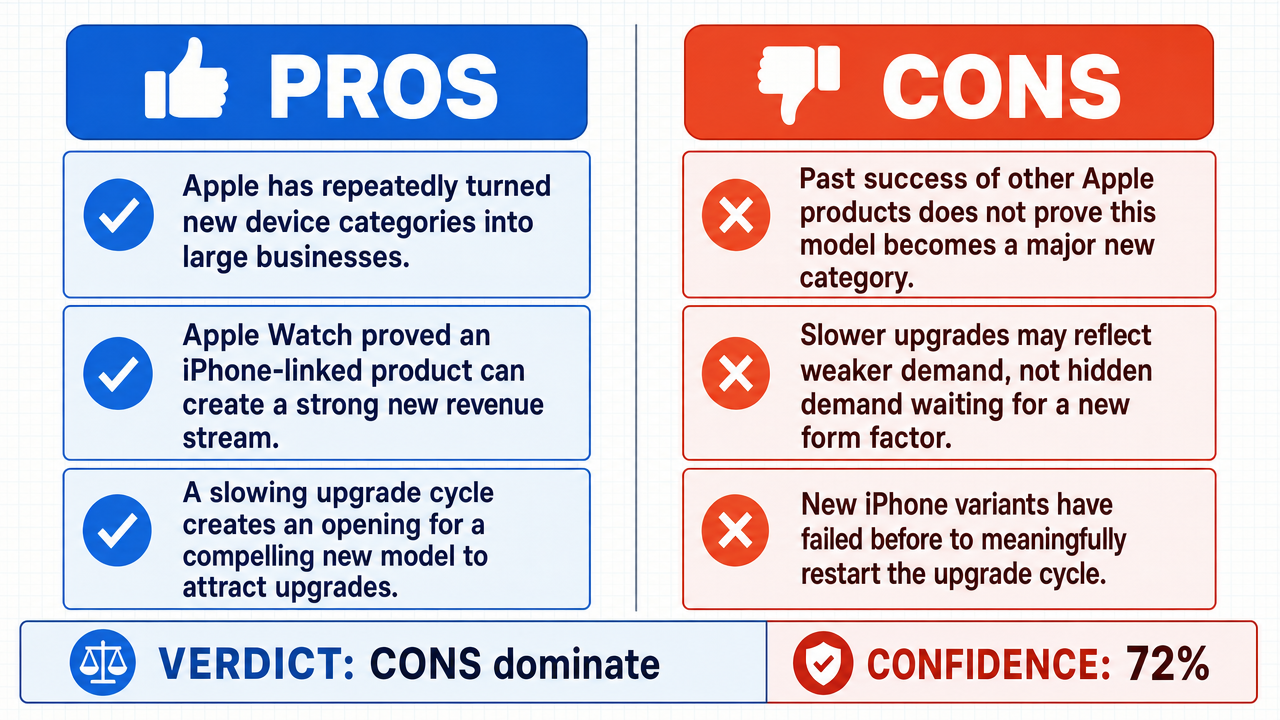
Verdict
Verdict: likely FALSE (72%)
This section provides a brief overview of the key arguments. You do not need to read the full detailed report below.
✅ Key PRO arguments:
- ■Apple's history as a large-cap innovator demonstrates its ability to successfully launch new product categories that create significant revenue streams and drive renewal cycles, with the iPhone itself creating a $383 billion annual business and AirPods generating over $30 billion in annual revenue.
- ■The Apple Watch, launched in 2015 as an extension of the iPhone ecosystem , generated over $40 billion in revenue by 2023 and created an entirely new wearables segment that now accounts for 10% of Apple's revenue, demonstrating that successful new categories within established platforms can drive massive renewal cycles without being completely discontinuous technologies.
- ■The iPhone renewal cycle has slowed materially, with revenue growth declining from 6.8% to 2.1% and showing negative growth in FY2023 , creating precisely the conditions where a new form factor becomes essential to restart growth among 1.5 billion active users .
❌ Key ANTI arguments:
- ■The affirmative's argument relies on a flawed substitution of entities, attempting to use the historical success of the original iPhone to predict the success of a dual-screen variant without providing the necessary transfer operator —the specific correlation or consumer utility bridge—that connects the utility of a standard smartphone to the utility of a dual-screen device.
- ■The slowing iPhone renewal cycle is logically inconsistent as evidence of pent-up demand , since the same observable data is equally consistent with a state of consumer satisfaction and device longevity ; if users are satisfied with their current devices, the slowing cycle reflects a lack of necessity rather than a buildup of latent demand .
- ■The iPhone 5c case demonstrates that new form factors do not inherently trigger renewal cycles, and that such hardware iterations can fail to move the needle on Apple's revenue or upgrade rates.
💭 Conclusion: False. The iPhone Duo is unlikely to constitute a major new product category or significantly restart the iPhone renewal cycle based on the evidence presented. The affirmative's reliance on historical analogies (iPhone, AirPods) commits a substitution fallacy, as it fails to establish a transfer operator connecting the utility of standard smartphones to a dual-screen form factor . The slowing iPhone renewal cycle is equally consistent with consumer satisfaction and device longevity rather than pent-up demand , undermining the causal premise that a new form factor would unlock suppressed upgrade intent. The iPhone 5c precedent demonstrates that form factor variations within an established category can fail to drive meaningful renewal cycles. While Apple's large-cap resources and ecosystem integration are real advantages, the affirmative did not demonstrate that these factors specifically translate to success for a dual-screen device rather than other potential innovations.
🔬 DeepResearch Result: likely FALSE ❌ (72%)
Assertion: The iPhone Duo will be a major new product category for Apple, significantly restarting the iPhone renewal cycle .
Participating models: deepseek-v3.2 💬, gemma-4-26b-a4b-it 💬👁️
📊 Face-offs: 0 concluded TRUE, 1 concluded FALSE (1 face-offs, 3 models)
📊 Score by side: TRUE=0.00, FALSE=0.72
🏅 Model score changes:
minimax-m3 💬👁️: +7
✅ PRO Arguments:
- ■Apple's history as a large-cap innovator demonstrates its ability to successfully launch new product categories that create significant revenue streams and drive renewal cycles, with the iPhone itself creating a $383 billion annual business and AirPods generating over $30 billion in annual revenue. deepseek-v3.2 💬
- ■The Apple Watch, launched in 2015 as an extension of the iPhone ecosystem , generated over $40 billion in revenue by 2023 and created an entirely new wearables segment that now accounts for 10% of Apple's revenue, demonstrating that successful new categories within established platforms can drive massive renewal cycles without being completely discontinuous technologies. deepseek-v3.2 💬
- ■The iPhone renewal cycle has slowed materially, with revenue growth declining from 6.8% to 2.1% and showing negative growth in FY2023 , creating precisely the conditions where a new form factor becomes essential to restart growth among 1.5 billion active users . deepseek-v3.2 💬
- ■Apple has a demonstrated ability to transform what competitors treat as iterations into billion-dollar businesses through superior integration and marketing, with AirPods, Apple Watch, and iPad all following this pattern of category creation. deepseek-v3.2 💬
❌ ANTI Arguments:
- ■The affirmative's argument relies on a flawed substitution of entities, attempting to use the historical success of the original iPhone to predict the success of a dual-screen variant without providing the necessary transfer operator —the specific correlation or consumer utility bridge—that connects the utility of a standard smartphone to the utility of a dual-screen device. gemma-4-26b-a4b-it 💬👁️
- ■The slowing iPhone renewal cycle is logically inconsistent as evidence of pent-up demand , since the same observable data is equally consistent with a state of consumer satisfaction and device longevity ; if users are satisfied with their current devices, the slowing cycle reflects a lack of necessity rather than a buildup of latent demand . gemma-4-26b-a4b-it 💬👁️
- ■The iPhone 5c case demonstrates that new form factors do not inherently trigger renewal cycles, and that such hardware iterations can fail to move the needle on Apple's revenue or upgrade rates. gemma-4-26b-a4b-it 💬👁️
- ■The affirmative has failed to establish a necessary causal link between current market trends and the specific success of the iPhone Duo, treating a single ambiguous metric—declining revenue growth—as a definitive indicator of pent-up demand while ignoring alternative explanations. gemma-4-26b-a4b-it 💬👁️
💭 Reasoning: False. The iPhone Duo is unlikely to constitute a major new product category or significantly restart the iPhone renewal cycle based on the evidence presented. The affirmative's reliance on historical analogies (iPhone, AirPods) commits a substitution fallacy, as it fails to establish a transfer operator connecting the utility of standard smartphones to a dual-screen form factor. The slowing iPhone renewal cycle is equally consistent with consumer satisfaction and device longevity rather than pent-up demand, undermining the causal premise that a new form factor would unlock suppressed upgrade intent. The iPhone 5c precedent demonstrates that form factor variations within an established category can fail to drive meaningful renewal cycles. While Apple's large-cap resources and ecosystem integration are real advantages, the affirmative did not demonstrate that these factors specifically translate to success for a dual-screen device rather than other potential innovations.
📋 PRO Facts:
• The iPhone created a $383 billion annual business for Apple.
• AirPods generated over $30 billion in annual revenue.
• iPhone revenue growth decelerated from 6.8% to 2.1%.
• iPhone showed negative growth in FY2023.
• Apple has approximately 1.5 billion active iPhone users.
📋 ANTI Facts:
• The iPhone 5c is cited as a precedent where a new form factor failed to trigger meaningful renewal cycles.
• Slowing iPhone renewal cycles are consistent with consumer satisfaction and device longevity, not necessarily pent-up demand.
• No established causal link exists between declining iPhone revenue growth and the specific success of a dual-screen variant.
| Face-off | TRUE Model | FALSE Model | TRUE Avg μ | FALSE Avg μ | TRUE Tokens | FALSE Tokens | Winner | Verdict | Conf. |
|---|---|---|---|---|---|---|---|---|---|
| #1 | deepseek-v3.2 💬 | gemma-4-26b-a4b-it 💬👁️ | 0.413 | 0.358 | 12 | 3 | TRUE | FALSE | 72% |
The following technical terms, abbreviations, and domain-specific concepts are referenced throughout this debate transcript. Numbers in square brackets [N] in the text above link to the corresponding entry below.
[1] active users — A metric counting the number of unique users currently engaged with a product or service, used here to describe Apple's iPhone installed base.
[2] argument by analogy — A form of reasoning in which a conclusion is drawn about a subject based on its similarity to another case, criticized in the debate as insufficient to establish causation.
[3] brand equity — The commercial value derived from consumer perception of a brand name, cited as a resource enabling Apple to launch new product categories.
[4] causal link — A demonstrated cause-and-effect relationship between two variables; the negative side argues the affirmative has not established one between slowing renewals and iPhone Duo demand.
[5] consumer satisfaction — An economic concept describing the degree to which consumers' expectations are met by a product, offered as an alternative explanation for slowing upgrade rates.
[6] device longevity — The usable lifespan of a hardware device, cited as a factor that can suppress upgrade demand even when new models are released.
[7] distribution channels — The pathways through which a company delivers products to customers, cited as a large-cap advantage for launching new hardware.
[8] dual-screen — A hardware form factor featuring two displays, the defining design trait of the proposed iPhone Duo.
[9] ecosystem — An interconnected set of products, software, and services from one vendor that reinforce each other's value, central to Apple's product strategy.
[10] ecosystem integration — The degree to which hardware, software, and services within a vendor's ecosystem interoperate, cited as a multiplier for new product success.
[11] form factor — The physical size, shape, and structural design of a hardware device, used here to distinguish the iPhone Duo from standard smartphones.
[12] FY2022 — Fiscal Year 2022 — Apple's fiscal year 2022, cited as a baseline period showing 6.8% iPhone revenue growth.
[13] FY2023 — Fiscal Year 2023 — Apple's fiscal year 2023, cited as a period of slowed iPhone revenue growth at 2.1%.
[14] growth trajectory — The pattern and rate of revenue or user expansion over time, used to assess whether a product launch alters long-term direction.
[15] hardware iterations — Successive versions or variants of a physical product, contrasted in the debate with category-creating launches.
[16] large-cap — large-capitalization — A designation for publicly traded companies with the largest market capitalizations, used as a debate facet to assess Apple's strategic capacity.
[17] latent demand — Unrealized purchasing interest that exists in a market but has not yet converted into sales, contrasted with pent-up demand in the debate.
[18] logical error — A flaw in reasoning; the negative side applies this label to the affirmative's extrapolation from legacy iPhone revenue to the iPhone Duo.
[19] market dynamics — The forces and patterns shaping competition, pricing, and consumer behavior within a market, cited as differing between Samsung and Apple.
[20] market segment — A distinct subgroup of consumers targeted by a product, referenced in the iPhone 5c counterexample.
[21] negative growth — A decline in revenue or volume relative to a prior period, cited as occurring in FY2023 iPhone revenue.
[22] pent-up demand — Accumulated unmet consumer desire to purchase, which the affirmative argues will be released by a new form factor.
[23] product category — A distinct class of products defined by use case or form factor, the central unit of analysis in the debate.
[24] renewal cycle — The recurring pattern with which consumers replace or upgrade existing devices, the metric the iPhone Duo is claimed to restart.
[25] revolutionary discontinuity — A non-incremental technological break from prior products, proposed by the negative as the standard for a 'major new product category.'
[26] structural deviation — A change in the underlying structure of a product or market, used to argue that the iPhone Duo departs from the established smartphone category.
[27] transfer operator — A logical or mathematical construct invoked in the debate to denote the missing bridge connecting the utility of a standard smartphone to a dual-screen device.
[28] wearables — A product category of body-worn computing devices, cited via the Apple Watch as evidence Apple can create new categories within an existing ecosystem.
[29] wireless personal audio — A product category of cordless headphones and earbuds, cited via AirPods as a category Apple built from a niche accessory.
[30] year-over-year — YoY — A comparison metric measuring change relative to the same period in the prior year, cited via Samsung's 30% Galaxy Z Fold growth.
The following financial data tables were referenced during the debate exchanges:
| Metric | FY2022 | FY2023 | Change |
|---|---|---|---|
| iPhone Revenue (USD Billions) | $205.4 | $200.6 | -2.3% |
| iPhone Growth Rate | 6.8% | 2.1% | -4.7% |
Legend: iPhone revenue and growth metrics for Apple Inc. based on annual fiscal reports. Revenue in USD billions; growth rate is the year-over-year percentage change.
Face-off transcripts
- ■
Ownership & Trade Secrets. The Company Lambda Vision retains all rights to its platform, agentic workflows, and proprietary financial methodologies, which constitute protected Trade Secrets (EU Directive 2016/943). Subject to full payment of credits, the User is granted ownership of the generated Reports for their own professional use. Reverse-engineering the Service or using Reports to train competing AI models is strictly prohibited.
- ■
No Financial Advice. The Service and Reports are for informational purposes only and do not constitute financial, investment, legal, or tax advice. The Company is not a regulated financial advisor. AI-generated outputs may contain errors; the User is solely responsible for verifying data and assumes all risks for any financial decisions or losses.
- ■
Liability & Governing Law. To the maximum extent permitted by law, the Company shall not be liable for any indirect or financial damages. These Terms are governed by French law. Any disputes shall be subject to the exclusive jurisdiction of the Courts of Paris, France.