
The Japanese government's direct ownership in Rapidus, combined with its domestic manufacturing and supply chain strategy, will significantly reduce geopolitical dependence on Taiwan for leading-edge AI chips by 2028.
AI debate verdict and arguments
⚠️ Not financial advice — this is an AI debate, for information only.
Completed October 11, 2026
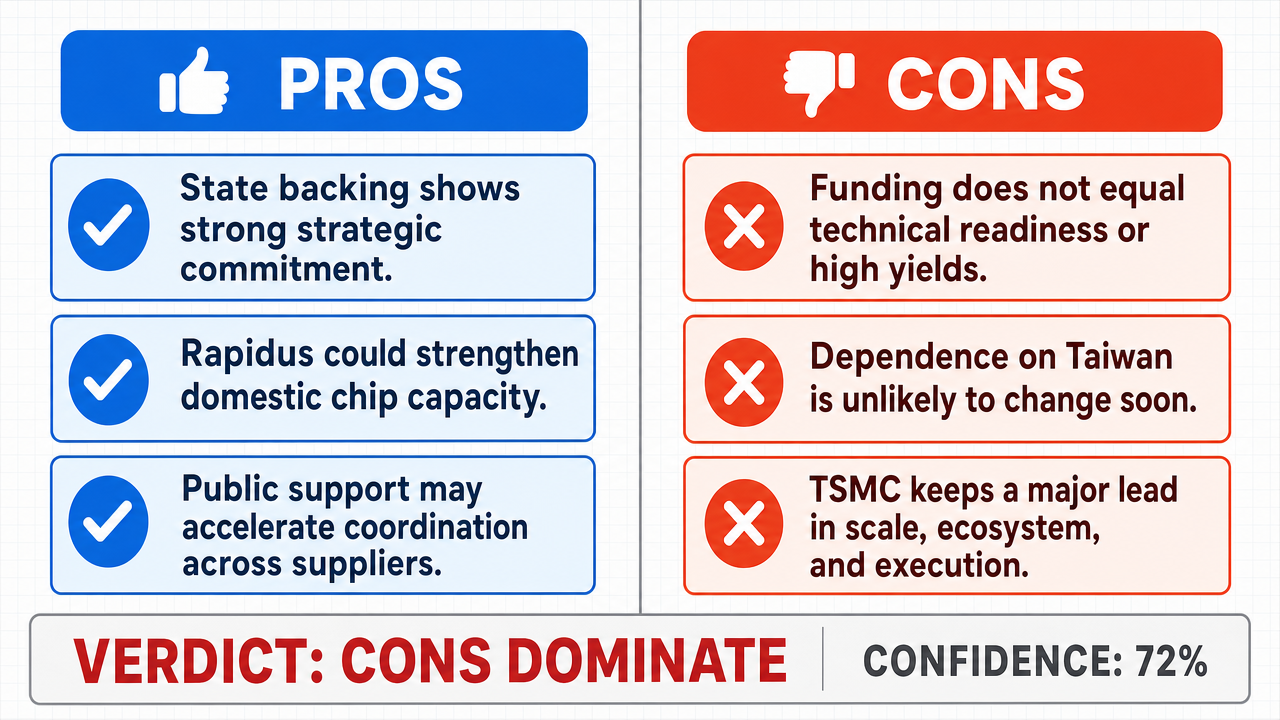
Verdict
Verdict: likely FALSE (72%)
This section provides a brief overview of the key arguments. You do not need to read the full detailed report below.
✅ Key PRO arguments:
- ■Japan's direct investment in Rapidus represents a strategic industrial policy shift, with the Japanese government committing approximately 4 trillion yen (~$25.7 billion) in subsidies to the semiconductor sector, targeting mass production of 2-nanometer chips by 2027, providing patient capital and long-term commitment that private markets alone would not supply.
- ■Rapidus as a flagship state-backed project directly competes with TSMC , a large-cap leader, and the scale of state capital allocation signals sovereign intent to build domestic leading-edge logic capacity rather than remain dependent on a single geopolitical chokepoint.
❌ Key ANTI arguments:
- ■Rapidus cannot meaningfully reduce geopolitical dependence on Taiwan by 2028 due to insurmountable technical and temporal barriers; the $25.7 billion subsidy is a financial metric, not a measurement of manufacturing readiness, yield stability, or ecosystem maturity , and the capital required to match TSMC 's current production scale is orders of magnitude greater than the subsidy.
- ■The affirmative argument commits a fundamental error of identity by attempting to use a measurement of capital allocation to support a proposition about manufacturing capability, without providing the necessary transfer operator linking financial input to high-volume, high-yield 2nm production output.
- ■Even if Rapidus secures the necessary funding, the company must still overcome the massive existing lead held by TSMC in yield , ecosystem maturity , and volume, none of which can be compressed into the 2028 timeframe regardless of subsidy size.
💭 Conclusion: False. The affirmative's reliance on the ~$25.7 billion subsidy figure conflates capital allocation with technical readiness, yield stability, and ecosystem maturity , all of which TSMC has accumulated. The negative correctly identified that the capital required to match TSMC's production scale is orders of magnitude greater than the subsidy, and that substituting a financial metric for a technical capability does not establish manufacturing readiness. Because the claim is compound—requiring both successful domestic manufacturing and a significant reduction in Taiwan dependence by 2028—the weakest sub-claim (the 2028 timeline and the magnitude of dependence reduction) drives the confidence downward. The verdict is therefore FALSE with moderate confidence, reflecting that while Japan's strategic intent is real, the technical and temporal barriers to displacing Taiwan's leading-edge logic role by 2028 remain substantial.
🔬 DeepResearch Result: likely FALSE ❌ (72%)
Assertion: The Japanese government's direct ownership in Rapidus, combined with its domestic manufacturing and supply chain strategy, will significantly reduce geopolitical dependence on Taiwan for leading-edge AI chips by 2028.
Participating models: deepseek-v3.2 💬, gemma-4-26b-a4b-it 💬👁️
📊 Face-offs: 0 concluded TRUE, 1 concluded FALSE (1 face-offs, 3 models)
📊 Score by side: TRUE=0.00, FALSE=0.75
🏅 Model score changes:
minimax-m3 💬👁️: +8
✅ PRO Arguments:
- ■Japan's direct investment in Rapidus represents a strategic industrial policy shift, with the Japanese government committing approximately 4 trillion yen (~$25.7 billion) in subsidies to the semiconductor sector, targeting mass production of 2-nanometer chips by 2027, providing patient capital and long-term commitment that private markets alone would not supply. deepseek-v3.2 💬
- ■Rapidus as a flagship state-backed project directly competes with TSMC , a large-cap leader, and the scale of state capital allocation signals sovereign intent to build domestic leading-edge logic capacity rather than remain dependent on a single geopolitical chokepoint. deepseek-v3.2 💬
❌ ANTI Arguments:
- ■Rapidus cannot meaningfully reduce geopolitical dependence on Taiwan by 2028 due to insurmountable technical and temporal barriers; the $25.7 billion subsidy is a financial metric, not a measurement of manufacturing readiness, yield stability, or ecosystem maturity , and the capital required to match TSMC's current production scale is orders of magnitude greater than the subsidy. gemma-4-26b-a4b-it 💬👁️
- ■The affirmative argument commits a fundamental error of identity by attempting to use a measurement of capital allocation to support a proposition about manufacturing capability, without providing the necessary transfer operator linking financial input to high-volume, high-yield 2nm production output. gemma-4-26b-a4b-it 💬👁️
- ■Even if Rapidus secures the necessary funding, the company must still overcome the massive existing lead held by TSMC in yield, ecosystem maturity, and volume, none of which can be compressed into the 2028 timeframe regardless of subsidy size. gemma-4-26b-a4b-it 💬👁️
💭 Reasoning: False. The affirmative's reliance on the ~$25.7 billion subsidy figure conflates capital allocation with technical readiness, yield stability, and ecosystem maturity, all of which TSMC has accumulated. The negative correctly identified that the capital required to match TSMC's production scale is orders of magnitude greater than the subsidy, and that substituting a financial metric for a technical capability does not establish manufacturing readiness. Because the claim is compound—requiring both successful domestic manufacturing and a significant reduction in Taiwan dependence by 2028—the weakest sub-claim (the 2028 timeline and the magnitude of dependence reduction) drives the confidence downward. The verdict is therefore FALSE with moderate confidence, reflecting that while Japan's strategic intent is real, the technical and temporal barriers to displacing Taiwan's leading-edge logic role by 2028 remain substantial.
📋 PRO Facts:
• The Japanese government has committed approximately 4 trillion yen (~$25.7 billion) in subsidies to the semiconductor sector.
📋 ANTI Facts:
• TSMC holds a massive existing lead over Rapidus in yield, ecosystem maturity, and production volume.
• The capital required to match TSMC's current production scale is orders of magnitude greater than the $25.7 billion subsidy committed to Rapidus.
• Rapidus faces significant technical and temporal barriers to achieving high-volume, high-yield leading-edge logic production by 2028.
| Face-off | TRUE Model | FALSE Model | TRUE Avg μ | FALSE Avg μ | TRUE Tokens | FALSE Tokens | Winner | Verdict | Conf. |
|---|---|---|---|---|---|---|---|---|---|
| #1 | deepseek-v3.2 💬 | gemma-4-26b-a4b-it 💬👁️ | 0.304 | 0.266 | 8 | 2 | TRUE | FALSE | 75% |
The following technical terms, abbreviations, and domain-specific concepts are referenced throughout this debate transcript. Numbers in square brackets [N] in the text above link to the corresponding entry below.
[1] 2nm — 2-nanometer — A semiconductor process node referring to chips manufactured at approximately 2-nanometer feature sizes, representing one of the most advanced logic fabrication technologies currently in development.
[2] 3nm — 3-nanometer — A semiconductor process node referring to chips manufactured at approximately 3-nanometer feature sizes, currently in high-volume production at leading foundries.
[3] 5nm — 5-nanometer — A semiconductor process node referring to chips manufactured at approximately 5-nanometer feature sizes, a mature leading-edge fabrication technology.
[4] AI chips — artificial intelligence chips — Semiconductors specifically designed or optimized for artificial intelligence workloads, such as neural network training and inference.
[5] capital-intensive — Describing industries or projects that require very large upfront financial investment relative to other inputs like labor.
[6] domestic manufacturing — Production of goods within a country's own borders, often emphasized in industrial policy to reduce foreign supply dependence.
[7] ecosystem maturity — In semiconductor context, the degree to which a network of specialized suppliers, design tools, and supporting infrastructure has developed around a manufacturing process.
[8] fabrication — The manufacturing process of producing semiconductor chips, typically performed in specialized facilities called fabs.
[9] financial proxy — A financial metric used as a substitute or stand-in for measuring a non-financial outcome, which the debate argues is an invalid substitution when technical capability is the true measure.
[10] geopolitical dependence — Reliance on another country for strategically important resources or capabilities, creating vulnerability to political pressure or conflict.
[11] industrial policy — Government strategy involving subsidies, regulation, and direct investment aimed at shaping the development of specific domestic industries.
[12] installed base — The total amount of equipment or systems currently deployed and operational, representing accumulated capacity and market position.
[13] Large Cap — large-capitalization — A categorization for companies with the largest market capitalization, typically implying established market position and significant resources.
[14] leading-edge logic — The most advanced generation of logic semiconductor manufacturing processes, offering the smallest feature sizes and highest performance.
[15] leapfrog — To skip intermediate generations of technology and move directly to a more advanced state, which the debate notes is technically risky in semiconductor manufacturing.
[16] mass production — Large-scale manufacturing of standardized products, requiring proven yield and process stability.
[17] monopsony power — Market power held by a single dominant buyer, enabling it to dictate terms to suppliers—in this context, Taiwan's position as the primary buyer of certain advanced chip manufacturing.
[18] nodes — process nodes — Generations of semiconductor manufacturing technology defined by minimum feature sizes, with each successive node offering smaller geometries and improved performance.
[19] orders of magnitude — Differences expressed as powers of ten, used to indicate that one quantity is vastly larger or smaller than another.
[20] patient capital — Long-term investment capital that tolerates delayed returns, often provided by state actors for strategic industries with extended development timelines.
[21] semiconductor yield — The percentage of functional chips produced from a wafer relative to the total chips fabricated, a critical measure of manufacturing viability.
[22] sovereign capacity — A nation's ability to independently produce critical goods or technologies within its own borders, reducing reliance on foreign suppliers.
[23] supply chain — The network of organizations, resources, and activities involved in producing and distributing a product from raw materials to end user.
[24] systemic risk — The risk that the failure of one component or participant in a system will trigger cascading failures across the entire system.
[25] transfer operator — In the debate's argumentation framework, the demonstrated logical or causal link that connects an input (such as capital) to a claimed output (such as manufacturing capability); the debate disputes whether such a link has been established.
[26] TSMC — Taiwan Semiconductor Manufacturing Company — The world's largest dedicated independent semiconductor foundry, headquartered in Taiwan, manufacturing chips for many major fabless designers.
[27] yield — In semiconductor manufacturing, the proportion of produced chips that meet quality specifications and are commercially usable.
Face-off transcripts
- ■
Ownership & Trade Secrets. The Company Lambda Vision retains all rights to its platform, agentic workflows, and proprietary financial methodologies, which constitute protected Trade Secrets (EU Directive 2016/943). Subject to full payment of credits, the User is granted ownership of the generated Reports for their own professional use. Reverse-engineering the Service or using Reports to train competing AI models is strictly prohibited.
- ■
No Financial Advice. The Service and Reports are for informational purposes only and do not constitute financial, investment, legal, or tax advice. The Company is not a regulated financial advisor. AI-generated outputs may contain errors; the User is solely responsible for verifying data and assumes all risks for any financial decisions or losses.
- ■
Liability & Governing Law. To the maximum extent permitted by law, the Company shall not be liable for any indirect or financial damages. These Terms are governed by French law. Any disputes shall be subject to the exclusive jurisdiction of the Courts of Paris, France.