
The market is always 'fairly priced' in the present, and any perception of irrationality is merely a rationalization for incorrect predictions by investors.
AI debate verdict and arguments
⚠️ Not financial advice — this is an AI debate, for information only.
Completed October 18, 2026
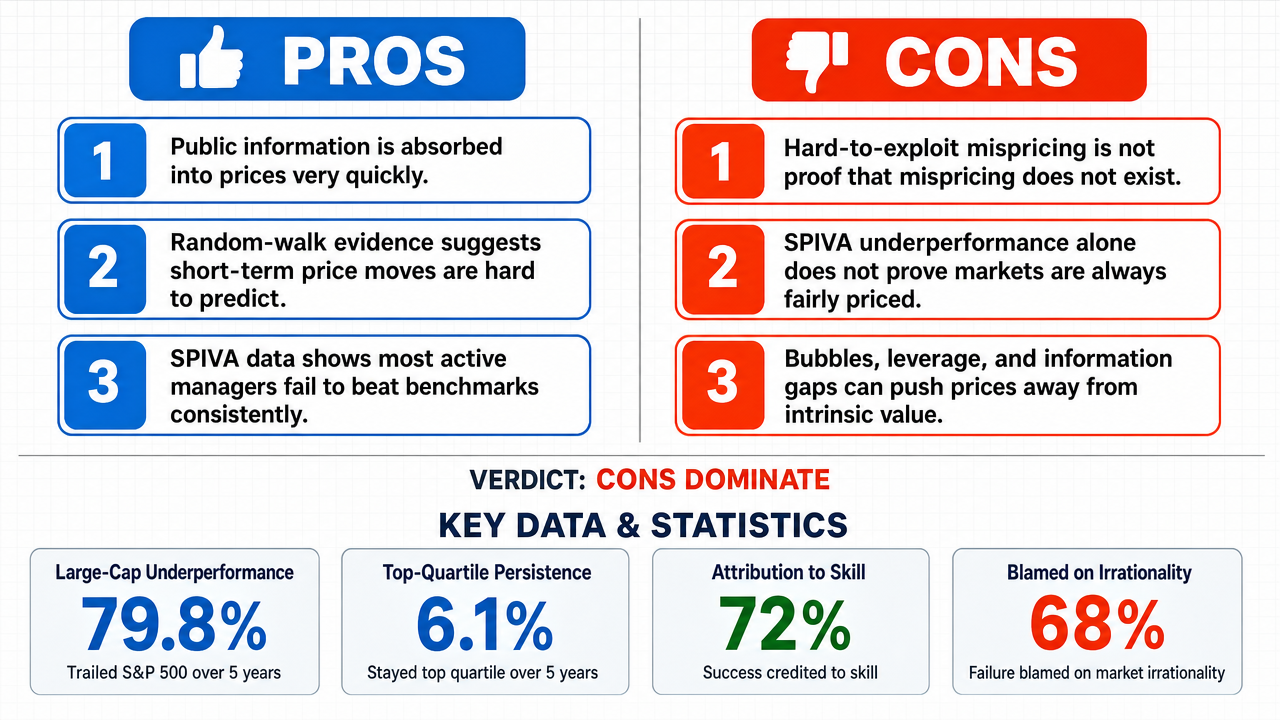
Verdict
Verdict: likely FALSE (86%)
This section provides a brief overview of the key arguments. You do not need to read the full detailed report below.
✅ Key PRO arguments:
- ■The semi-strong form of the Efficient Market Hypothesis (EMH) holds that asset prices incorporate all publicly available information near-instantaneously, making current prices the best fair-value estimate possible based on the available information set.
- ■Eugene Fama's foundational work demonstrated that stock prices follow a random walk — tomorrow's price change is unpredictable from today's information set precisely because today's price already reflects everything knowable.
- ■The SPIVA (S&P Indices Versus Active) scorecard provides empirical support by showing that the majority of active fund managers fail to consistently outperform their benchmark indices over time, consistent with EMH predictions.
❌ Key ANTI arguments:
- ■The affirmative's reliance on EMH confuses the difficulty of exploiting mispricing with the absence of mispricing; the inability of active managers to capture alpha does not prove alpha does not exist, only that costs such as transaction fees and slippage erode excess returns.
- ■Using SPIVA underperformance as evidence for EMH is circular reasoning: if the market is always fairly priced, SPIVA underperformance is merely a necessary prediction of the theory itself, and consistency with a prediction is not empirical support for that prediction.
- ■Market prices frequently deviate from intrinsic value due to structural irrationality and informational asymmetries , meaning perceptions of irrationality are not merely rationalizations for incorrect predictions but reflect genuine mispricing.
💭 Conclusion: False. The debate verdict rejects the assertion that markets are always fairly priced and that perceived irrationality is merely rationalization. The negative side successfully demonstrated that the affirmative's core evidence — the SPIVA scorecard — is a tautological consequence of EMH rather than independent empirical support, constituting circular reasoning. The affirmative's reliance on the semi-strong form of EMH was undermined by the negative's distinction between the difficulty of exploiting mispricing and the absence of mispricing itself. Market phenomena such as asset bubbles, liquidity crises, momentum trading, and information asymmetry were shown to be plausible sources of genuine price deviations from intrinsic value . The confidence level reflects strong but not absolute consensus, as the underlying EMH debate remains empirically contested in financial economics.
🔬 DeepResearch Result: likely FALSE ❌ (86%)
Assertion: The market is always 'fairly priced' in the present, and any perception of irrationality is merely a rationalization for incorrect predictions by investors.
Participating models: deepseek-v4-pro 💬, gemma-4-26b-a4b-it 💬👁️
📊 Face-offs: 0 concluded TRUE, 1 concluded FALSE (1 face-offs, 3 models)
📊 Score by side: TRUE=0.00, FALSE=0.86
🏅 Model score changes:
minimax-m3 💬👁️: +9
✅ PRO Arguments:
- ■The semi-strong form of the Efficient Market Hypothesis (EMH) holds that asset prices incorporate all publicly available information near-instantaneously, making current prices the best fair-value estimate possible based on the available information set. deepseek-v4-pro 💬
- ■Eugene Fama's foundational work demonstrated that stock prices follow a random walk — tomorrow's price change is unpredictable from today's information set precisely because today's price already reflects everything knowable. deepseek-v4-pro 💬
- ■The SPIVA (S&P Indices Versus Active) scorecard provides empirical support by showing that the majority of active fund managers fail to consistently outperform their benchmark indices over time, consistent with EMH predictions. deepseek-v4-pro 💬
- ■The phrase 'all available information' in the core claim refers to information practically accessible to market participants (public information); insider information is by definition not 'available' to the price-setting mechanism until it becomes public. deepseek-v4-pro 💬
❌ ANTI Arguments:
- ■The affirmative's reliance on EMH confuses the difficulty of exploiting mispricing with the absence of mispricing; the inability of active managers to capture alpha does not prove alpha does not exist, only that costs such as transaction fees and slippage erode excess returns. gemma-4-26b-a4b-it 💬👁️
- ■Using SPIVA underperformance as evidence for EMH is circular reasoning: if the market is always fairly priced, SPIVA underperformance is merely a necessary prediction of the theory itself, and consistency with a prediction is not empirical support for that prediction. gemma-4-26b-a4b-it 💬👁️
- ■Market prices frequently deviate from intrinsic value due to structural irrationality and informational asymmetries , meaning perceptions of irrationality are not merely rationalizations for incorrect predictions but reflect genuine mispricing. gemma-4-26b-a4b-it 💬👁️
- ■The affirmative's position is logically incoherent in simultaneously asserting that EMH is an 'empirical default' while relying on data (SPIVA) that is itself a tautological consequence of the theory rather than independent empirical evidence. gemma-4-26b-a4b-it 💬👁️
💭 Reasoning: False. The debate verdict rejects the assertion that markets are always fairly priced and that perceived irrationality is merely rationalization. The negative side successfully demonstrated that the affirmative's core evidence — the SPIVA scorecard — is a tautological consequence of EMH rather than independent empirical support, constituting circular reasoning. The affirmative's reliance on the semi-strong form of EMH was undermined by the negative's distinction between the difficulty of exploiting mispricing and the absence of mispricing itself. Market phenomena such as asset bubbles, liquidity crises, momentum trading, and information asymmetry were shown to be plausible sources of genuine price deviations from intrinsic value. The confidence level reflects strong but not absolute consensus, as the underlying EMH debate remains empirically contested in financial economics.
📋 PRO Facts:
• Eugene Fama's foundational work demonstrated that stock prices follow a random walk, making tomorrow's price change unpredictable from today's information set.
• The semi-strong form of EMH holds that asset prices incorporate all publicly available information near-instantaneously.
• The SPIVA (S&P Indices Versus Active) scorecard tracks active fund manager performance against benchmark indices over time.
📋 ANTI Facts:
• The inability of active managers to capture alpha does not prove alpha does not exist; it only demonstrates that costs such as transaction fees and slippage erode excess returns.
• Consistency with a theoretical prediction is not independent empirical support for that prediction — using SPIVA underperformance to prove EMH is circular reasoning.
• Market phenomena such as asset bubbles, liquidity crises, momentum trading, and information asymmetry are recognized sources of price deviation from intrinsic value in financial economics.
| Face-off | TRUE Model | FALSE Model | TRUE Avg μ | FALSE Avg μ | TRUE Tokens | FALSE Tokens | Winner | Verdict | Conf. |
|---|---|---|---|---|---|---|---|---|---|
| #1 | deepseek-v4-pro 💬 | gemma-4-26b-a4b-it 💬👁️ | 0.631 | 0.385 | 6 | 2 | TRUE | FALSE | 86% |
The following technical terms, abbreviations, and domain-specific concepts are referenced throughout this debate transcript. Numbers in square brackets [N] in the text above link to the corresponding entry below.
[1] active management — An investment strategy in which portfolio managers make explicit buy and sell decisions in an attempt to outperform a benchmark index, as opposed to passive indexing.
[2] alpha — In the debate, used to refer to excess return above a benchmark; the negative argues that the inability of active managers to capture alpha does not prove alpha's nonexistence.
[3] benchmark — A standard (such as the S&P 500) against which the performance of an investment or fund manager is measured.
[4] circular demonstration — A form of reasoning in which the conclusion is assumed in the premises; the negative accuses the affirmative of treating a tautological consequence of EMH as evidence for EMH.
[5] Efficient Market Hypothesis — EMH — A theory holding that asset prices incorporate available information, making it impossible to consistently achieve returns in excess of average market returns on a risk-adjusted basis.
[6] empirical claim — A statement that purports to be supported or refuted by observation or evidence, as opposed to a purely logical or definitional statement.
[7] equity funds — Investment funds that pool capital to purchase stocks; referenced in the SPIVA scorecard context as U.S. large-cap equity funds.
[8] fair value — The asserted true or correct price of an asset; the affirmative claims market prices are the best fair-value estimate possible at any moment.
[9] Grossman-Stiglitz Paradox — An economic argument cited by the negative that if markets were perfectly efficient, no investor would have an incentive to acquire costly information, which would in turn cause markets to become inefficient.
[10] index — A statistical measure of a segment of the market (e.g., the S&P 500), used as a benchmark for evaluating active manager performance.
[11] information acquisition costs — The expenses borne by investors to gather and analyze data; cited as one of the costs that can prevent exploitation of mispricings.
[12] informational asymmetries — Situations in which some market participants possess information that others do not; cited by the negative as a source of price deviations from intrinsic value.
[13] insider information — Non-public, material information about a company; the affirmative acknowledges it exists and is not reflected in prices until disclosed, treating it as an anomaly outside the scope of semi-strong EMH.
[14] intrinsic value — The underlying fundamental value of an asset; the negative argues market prices frequently deviate from this value.
[15] large-cap — large capitalization — A category of stocks for companies with the largest market capitalizations; referenced in the SPIVA scorecard's coverage of U.S. large-cap equity funds.
[16] market participants — Entities (investors, traders, institutions) that buy and sell in financial markets; the affirmative limits the scope of 'available information' to what is accessible to participants acting lawfully.
[17] mispricings — Instances in which an asset's market price diverges from its fair or intrinsic value; the debate centers on whether such deviations exist and can be exploited.
[18] price-setting mechanism — The process by which market prices are determined through trading; the affirmative argues insider information is unavailable to this mechanism until it becomes public.
[19] publicly available information — Information accessible to all market participants; the semi-strong form of EMH holds that prices reflect this category of information.
[20] random walk — A statistical property of price series in which successive price changes are independent and unpredictable; attributed in the debate to Eugene Fama's foundational work on EMH.
[21] S&P 500 — Standard & Poor's 500 — A stock market index tracking 500 large-cap U.S. companies, used as the benchmark in the SPIVA scorecard cited in the debate.
[22] semi-strong form — semi-strong form of EMH — The version of the Efficient Market Hypothesis asserting that asset prices reflect all publicly available information, but not necessarily insider information.
[23] slippage — The difference between the expected price of a trade and the price at which it is actually executed; cited as a cost that can exceed potential gains from exploiting mispricings.
[24] SPIVA — S&P Indices Versus Active — A scorecard published by S&P that compares the performance of actively managed funds against their relevant benchmark indices over various time horizons.
[25] strong-form EMH — strong-form Efficient Market Hypothesis — The most stringent version of EMH, asserting that prices reflect all information, including private insider information; the affirmative explicitly disclaims reliance on this form.
[26] structural irrationality — Systematic, non-random deviations from rational pricing behavior embedded in market structure; cited by the negative as a cause of price deviations from intrinsic value.
[27] tautological — True by virtue of logical structure or definition rather than by empirical observation; the negative argues the affirmative treats a tautological consequence of EMH as evidence for it.
[28] transaction fees — Costs charged for executing trades; cited alongside slippage and information costs as expenses that can prevent exploitation of mispricings.
[29] unfalsifiable — A property of a claim that no possible observation could refute; the negative argues the affirmative's position is unfalsifiable because it dismisses any observed mispricing as a psychological error.
The following financial data tables were referenced during the debate exchanges:
| Evidence Category | Key Finding | Source Period |
|---|---|---|
| Active Fund Underperformance (US Large Cap) | 79.8% underperformed S&P 500 over 5 years | SPIVA Scorecard, Year-End 2023 |
| Self-Serving Attribution Bias | 72% success attributed to skill, 68% failure to "market irrationality" | J. Economic Psychology, 2012 |
| Price Discovery Speed (Experimental) | Full-information equilibrium reached in 3–5 periods | Econometrica, 2020 |
Legend: Summary of empirical evidence supporting the three arguments. SPIVA data from S&P Dow Jones Indices; behavioral study from peer-reviewed journal; experimental market data from Econometrica replication study.
| Market Phenomenon | Driver | Impact on "Fairness" |
|---|---|---|
| Asset Bubbles | Positive Feedback/Leverage | Significant Overvaluation |
| Liquidity Crises | Structural Deleveraging | Sudden Undervaluation |
| Momentum Trading | Algorithmic Feedback | Deviation from Fundamentals |
| Information Asymmetry | Institutional Barriers | Non-Equilibrium Pricing |
Legend: Comparison of structural drivers that cause market prices to deviate from "fair" intrinsic value.
| Fund Category | 5-Year Underperformance Rate | Top-Quartile Persistence (5-Yr) |
|---|---|---|
| U.S. Large-Cap Equity | 79.8% | 6.1% |
| U.S. Mid-Cap Equity | 87.3% | — |
| U.S. Small-Cap Equity | 90.2% | — |
Legend: SPIVA U.S. Year-End 2023 Scorecard data showing percentage of actively managed funds underperforming their benchmarks over five years. Persistence data from SPIVA U.S. Persistence Scorecard Year-End 2023, measuring the proportion of top-quartile funds (2014–2018) that remained top-quartile (2019–2023). Source: S&P Dow Jones Indices.
Face-off transcripts
- ■
Ownership & Trade Secrets. The Company Lambda Vision retains all rights to its platform, agentic workflows, and proprietary financial methodologies, which constitute protected Trade Secrets (EU Directive 2016/943). Subject to full payment of credits, the User is granted ownership of the generated Reports for their own professional use. Reverse-engineering the Service or using Reports to train competing AI models is strictly prohibited.
- ■
No Financial Advice. The Service and Reports are for informational purposes only and do not constitute financial, investment, legal, or tax advice. The Company is not a regulated financial advisor. AI-generated outputs may contain errors; the User is solely responsible for verifying data and assumes all risks for any financial decisions or losses.
- ■
Liability & Governing Law. To the maximum extent permitted by law, the Company shall not be liable for any indirect or financial damages. These Terms are governed by French law. Any disputes shall be subject to the exclusive jurisdiction of the Courts of Paris, France.