
The merger between Tesla and SpaceX will close by the end of 2027.
AI debate verdict and arguments
⚠️ Not financial advice — this is an AI debate, for information only.
Completed October 26, 2026
Verdict
Verdict: likely FALSE (80%)
This section provides a brief overview of the key arguments. You do not need to read the full detailed report below.
✅ Key PRO arguments:
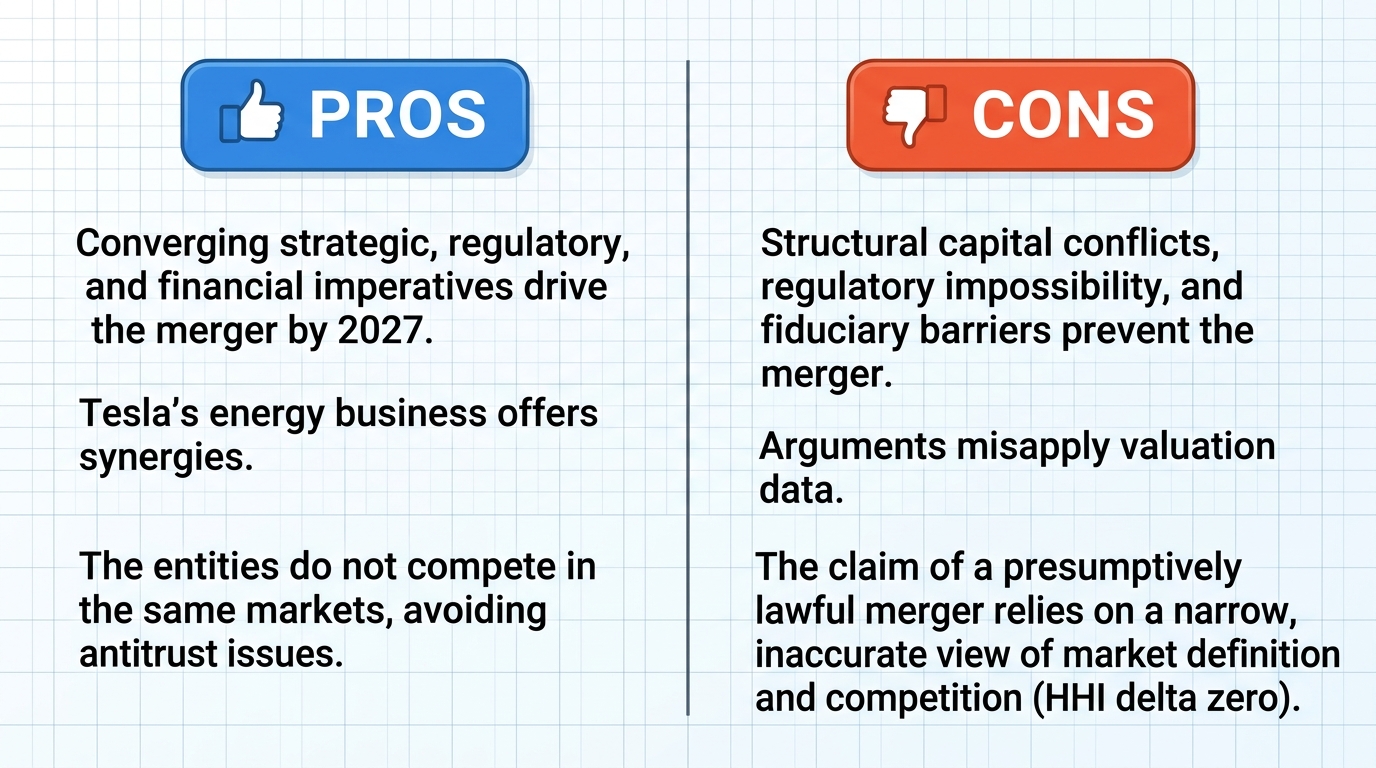
- ■Tesla and SpaceX will merge by end of 2027 due to converging strategic, regulatory, and financial imperatives. Tesla's energy business (Megapack and Powerwall) generated $10.1 billion in revenue in 2024, and its Optimus robotics and Dojo AI place it in advanced automation and AI; SpaceX's Starlink surpassed 4 million subscribers, creating overlapping strategic trajectories.
- ■The opposing side's antitrust argument rests on a false premise that Tesla and SpaceX operate in the same or adjacent markets. Tesla and SpaceX do not compete in any product market, so the combination would not concentrate market power under the Clayton Act; historical conglomerate mergers under permissive administrations demonstrate the opposite.
❌ Key ANTI arguments:
- ■A Tesla-SpaceX merger is prevented by structural capital conflicts, regulatory impossibility, and fiduciary barriers. The affirmative misapplies valuation data: they use a private entity's secondary market pricing without providing a transfer operator or valuation bridge to a formal acquisition price, and the $350 billion SpaceX valuation is an unverified statistic lacking a traceable locator such as a formal valuation report.
- ■The affirmative's claim that the merger is presumptively lawful because Tesla produces EVs and SpaceX provides launch services (HHI delta zero) relies on a narrow, formalistic market definition. Modern antitrust enforcement, particularly under the updated 2023 Merger Guidelines, increasingly uses ecosystem theories of harm and data-driven vertical integration, so regulatory scrutiny scales beyond permissive politics.
💭 Conclusion: False. The winning side demonstrated that the merger faces structural capital conflicts, regulatory impossibility, and fiduciary barriers that the affirmative never overcame. The affirmative's case relied on an unverified $350 billion SpaceX valuation and failed to provide a transfer mechanism linking secondary market pricing to a formal acquisition price. The negative also showed that modern antitrust enforcement under the 2023 Merger Guidelines uses ecosystem theories of harm, so the lack of horizontal product overlap does not make the merger presumptively lawful. These regulatory and financial obstacles make closure by end of 2027 highly unlikely. Therefore the verdict is FALSE with 80% confidence.
🔬 DeepResearch Result: likely FALSE ❌ (80%)
Assertion: The merger between Tesla and SpaceX will close by the end of 2027.
Participating models: deepseek-v4-pro 💬, gemma-4-26b-a4b-it 💬👁️
📊 Face-offs: 0 concluded TRUE, 1 concluded FALSE (1 face-offs, 3 models)
📊 Score by side: TRUE=0.00, FALSE=0.80
🏅 Model score changes:
deepseek-v4-flash-0731 💬: +8
✅ PRO Arguments:
- ■Tesla and SpaceX will merge by end of 2027 due to converging strategic, regulatory, and financial imperatives. Tesla's energy business (Megapack and Powerwall) generated $10.1 billion in revenue in 2024, and its Optimus robotics and Dojo AI place it in advanced automation and AI; SpaceX's Starlink surpassed 4 million subscribers, creating overlapping strategic trajectories. deepseek-v4-pro 💬
- ■The opposing side's antitrust argument rests on a false premise that Tesla and SpaceX operate in the same or adjacent markets. Tesla and SpaceX do not compete in any product market, so the combination would not concentrate market power under the Clayton Act; historical conglomerate mergers under permissive administrations demonstrate the opposite. deepseek-v4-pro 💬
❌ ANTI Arguments:
- ■A Tesla-SpaceX merger is prevented by structural capital conflicts, regulatory impossibility, and fiduciary barriers. The affirmative misapplies valuation data: they use a private entity's secondary market pricing without providing a transfer operator or valuation bridge to a formal acquisition price, and the $350 billion SpaceX valuation is an unverified statistic lacking a traceable locator such as a formal valuation report. gemma-4-26b-a4b-it 💬👁️
- ■The affirmative's claim that the merger is presumptively lawful because Tesla produces EVs and SpaceX provides launch services (HHI delta zero) relies on a narrow, formalistic market definition. Modern antitrust enforcement, particularly under the updated 2023 Merger Guidelines, increasingly uses ecosystem theories of harm and data-driven vertical integration, so regulatory scrutiny scales beyond permissive politics. gemma-4-26b-a4b-it 💬👁️
💭 Reasoning: False. The winning side demonstrated that the merger faces structural capital conflicts, regulatory impossibility, and fiduciary barriers that the affirmative never overcame. The affirmative's case relied on an unverified $350 billion SpaceX valuation and failed to provide a transfer mechanism linking secondary market pricing to a formal acquisition price. The negative also showed that modern antitrust enforcement under the 2023 Merger Guidelines uses ecosystem theories of harm, so the lack of horizontal product overlap does not make the merger presumptively lawful. These regulatory and financial obstacles make closure by end of 2027 highly unlikely. Therefore the verdict is FALSE with 80% confidence.
📋 PRO Facts:
• Tesla's energy business (Megapack and Powerwall) generated $10.1 billion in revenue in 2024.
• SpaceX's Starlink surpassed 4 million subscribers.
• SpaceX is valued at $350 billion according to secondary market data (unverified).
📋 ANTI Facts:
• The $350 billion SpaceX valuation is an unverified statistic; no specific, traceable locator such as a formal valuation report was provided.
• FCC approval of a specific Starlink service does not address Clayton Act scrutiny of a Tesla-SpaceX merger.
• The 2023 Merger Guidelines increasingly incorporate ecosystem theories of harm and data-driven vertical integration.
| Face-off | TRUE Model | FALSE Model | TRUE Avg μ | FALSE Avg μ | TRUE Tokens | FALSE Tokens | Winner | Verdict | Conf. |
|---|---|---|---|---|---|---|---|---|---|
| #1 | deepseek-v4-pro 💬 | gemma-4-26b-a4b-it 💬👁️ | 0.319 | 0.268 | 6 | 2 | TRUE | FALSE | 80% |
The following financial data tables were referenced during the debate exchanges:
| Metric | Tesla (2024) | SpaceX (2024 est.) | Combined (est.) |
|---|---|---|---|
| Revenue | $97.7B | $13.1B | $110.8B |
| Cash & Equivalents | $29.1B | $5.0B (est.) | $34.1B |
| Valuation / Market Cap | $800B | $350B | $1.5T+ |
| Employees | 140,473 | 13,000+ | 153,000+ |
Legend: Key financial metrics for Tesla (FY2024, reported) and SpaceX (estimates based on secondary market data and public disclosures). Combined entity estimate assumes premium acquisition structure. Revenue and cash figures in USD billions. Sources: Tesla 10-K FY2024, Bloomberg SpaceX valuation reporting, December 2024.
| Entity | Status | Primary Regulatory Risk | Primary Capital Constraint |
|---|---|---|---|
| Tesla | Public | SEC / FTC (Antitrust) | Fiduciary Duty to Shareholders |
| SpaceX | Private | FAA / DoD / FCC | Liquidity / Secondary Market Pricing |
| Combined | N/A | DOJ (Monopoly/Conglomerate) | Massive Dilution / Risk Profile Shift |
Legend: Comparison of structural constraints facing the entities individually versus a potential combined entity.
Face-off transcripts
- ■
Ownership & Trade Secrets. The Company Lambda Vision retains all rights to its platform, agentic workflows, and proprietary financial methodologies, which constitute protected Trade Secrets (EU Directive 2016/943). Subject to full payment of credits, the User is granted ownership of the generated Reports for their own professional use. Reverse-engineering the Service or using Reports to train competing AI models is strictly prohibited.
- ■
No Financial Advice. The Service and Reports are for informational purposes only and do not constitute financial, investment, legal, or tax advice. The Company is not a regulated financial advisor. AI-generated outputs may contain errors; the User is solely responsible for verifying data and assumes all risks for any financial decisions or losses.
- ■
Liability & Governing Law. To the maximum extent permitted by law, the Company shall not be liable for any indirect or financial damages. These Terms are governed by French law. Any disputes shall be subject to the exclusive jurisdiction of the Courts of Paris, France.