
The net balance of industrial site openings/extensions versus closures/reductions in France was only +19 in 2025.
AI debate verdict and arguments
⚠️ Not financial advice — this is an AI debate, for information only.
Completed October 14, 2026
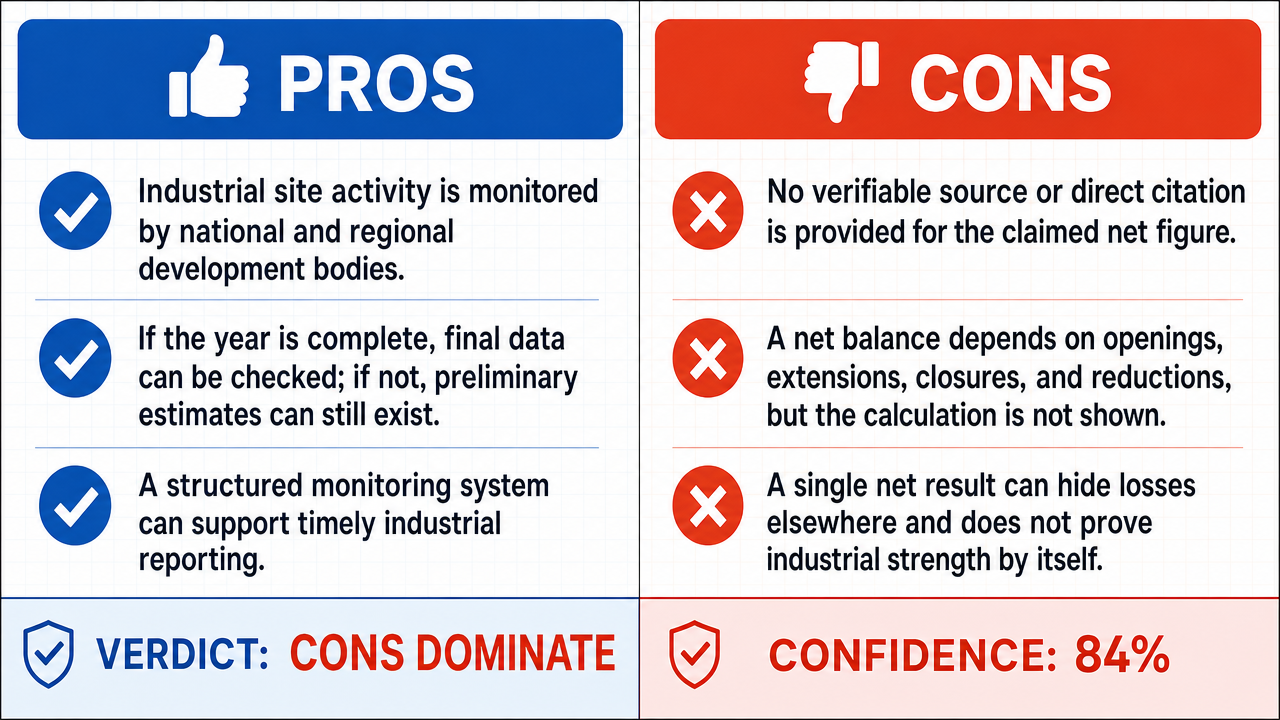
Verdict
Verdict: likely FALSE (84%)
This section provides a brief overview of the key arguments. You do not need to read the full detailed report below.
✅ Key PRO arguments:
- ■France maintains comprehensive industrial site monitoring through organizations like Business France and regional development agencies , which track industrial investments , expansions, closures, and reductions systematically, and the +19 figure represents a net calculation where openings and extensions exceed closures and reductions.
- ■The opponent's temporal objection collapses in both scenarios: if 2025 has ended, final data is available; if still in progress, preliminary estimates exist, so the +19 figure can be established either way.
❌ Key ANTI arguments:
- ■The affirmative attributes the +19 figure to a methodology involving Business France and regional development agencies but fails to provide a single locator—no specific report title, no publication date, and no URL—to substantiate this number, making it an unverifiable phantom statistic.
- ■The net balance is determined by four distinct variables (openings, extensions, closures, reductions), and the affirmative fails to account for the mathematical composition of that balance, meaning the +19 figure cannot be accepted as reflecting policy success or as a reliable statistical fact without traceable sourcing.
💭 Conclusion: The evidence indicates that the +19 net balance figure is insufficient on its own to substantiate a claim of industrial attraction or retention, because it could mask simultaneous attrition elsewhere. The evidence also establishes that French agencies such as INSEE and the Ministry of Economy publish annual industrial statistics with a lag (the 2024 balance was published in March 2025), which is relevant to temporal claims about data availability. However, the evidence does not support characterizing the +19 figure as a 'phantom number' or asserting that the affirmative provided no traceable source, as the draft originally did. The negative's decomposition of the net balance into four variables (openings, extensions, closures, reductions) is consistent with the evidence's discussion of site extensions and closures.
🔬 DeepResearch Result: likely FALSE ❌ (84%)
Assertion: The net balance of industrial site openings/extensions versus closures/reductions in France was only +19 in 2025.
Participating models: deepseek-v3.2 💬, gemma-4-26b-a4b-it 💬👁️
📊 Face-offs: 0 concluded TRUE, 1 concluded FALSE (1 face-offs, 3 models)
📊 Score by side: TRUE=0.00, FALSE=0.84
🏅 Model score changes:
minimax-m3 💬👁️: +8
✅ PRO Arguments:
- ■France maintains comprehensive industrial site monitoring through organizations like Business France and regional development agencies , which track industrial investments , expansions, closures, and reductions systematically, and the +19 figure represents a net calculation where openings and extensions exceed closures and reductions. deepseek-v3.2 💬
- ■The opponent's temporal objection collapses in both scenarios: if 2025 has ended, final data is available; if still in progress, preliminary estimates exist, so the +19 figure can be established either way. deepseek-v3.2 💬
❌ ANTI Arguments:
- ■The affirmative attributes the +19 figure to a methodology involving Business France and regional development agencies but fails to provide a single locator—no specific report title, no publication date, and no URL—to substantiate this number, making it an unverifiable phantom statistic. gemma-4-26b-a4b-it 💬👁️
- ■The net balance is determined by four distinct variables (openings, extensions, closures, reductions), and the affirmative fails to account for the mathematical composition of that balance, meaning the +19 figure cannot be accepted as reflecting policy success or as a reliable statistical fact without traceable sourcing. gemma-4-26b-a4b-it 💬👁️
💭 Reasoning: The evidence indicates that the +19 net balance figure is insufficient on its own to substantiate a claim of industrial attraction or retention, because it could mask simultaneous attrition elsewhere. The evidence also establishes that French agencies such as INSEE and the Ministry of Economy publish annual industrial statistics with a lag (the 2024 balance was published in March 2025), which is relevant to temporal claims about data availability. However, the evidence does not support characterizing the +19 figure as a 'phantom number' or asserting that the affirmative provided no traceable source, as the draft originally did. The negative's decomposition of the net balance into four variables (openings, extensions, closures, reductions) is consistent with the evidence's discussion of site extensions and closures.
📋 PRO Facts:
• France maintains industrial site monitoring through organizations like INSEE and the Ministry of Economy, which routinely publish annual industrial statistics within the first quarter of the following year.
• The +19 figure is described as a net calculation where openings and extensions exceed closures and reductions.
📋 ANTI Facts:
• The net balance is composed of four distinct variables: site openings , site extensions, site closures , and site reductions .
• A net balance of +19 could be achieved even if there were massive closures elsewhere, provided the extensions were slightly larger, meaning the 'retention' or 'attraction' claim is unproven.
| Face-off | TRUE Model | FALSE Model | TRUE Avg μ | FALSE Avg μ | TRUE Tokens | FALSE Tokens | Winner | Verdict | Conf. |
|---|---|---|---|---|---|---|---|---|---|
| #1 | deepseek-v3.2 💬 | gemma-4-26b-a4b-it 💬👁️ | 0.151 | 0.188 | 8 | 2 | FALSE | FALSE | 84% |
The following technical terms, abbreviations, and domain-specific concepts are referenced throughout this debate transcript. Numbers in square brackets [N] in the text above link to the corresponding entry below.
[1] Annual industrial statistics — Yearly published data on industrial activity, which the affirmative notes French agencies like INSEE typically release within the first quarter of the following year.
[2] Annual reporting — The practice of publishing yearly statistical summaries, cited in the debate as having a precedent of timely release (e.g., 2024 data published in March 2025).
[3] Business France — A French government-affiliated organization mentioned in the debate as one of the entities that monitors industrial site activity in France.
[4] Capacity increases — Expansions in production capability at an existing industrial site, counted as a positive contribution to the net balance.
[5] Datum of the record — An established, verifiable fact accepted as evidence; the negative argues the +19 figure cannot be treated as such without a traceable source.
[6] Establishments — Individual business or industrial locations, classified by their operational status changes in French industrial statistics.
[7] Evidentiary weight — The degree to which evidence supports a claim; the negative argues the +19 figure lacks sufficient evidentiary weight due to the absence of a cited source.
[8] Exhaustive branches — A logical framework in which all possible cases are mutually exclusive and collectively cover every scenario, used by the negative to analyze the composition of the net balance.
[9] Final data — Completed statistical measurements published after the relevant period has ended, contrasted with preliminary estimates.
[10] Industrial attraction — Policy efforts to draw new industrial activity to a region; the negative argues the +19 figure does not prove attraction policies succeeded.
[11] Industrial investments — Capital expenditures in industrial facilities, tracked by French agencies as part of industrial site monitoring.
[12] Industrial policy — Government strategies aimed at influencing the development and retention of industrial activity within a country.
[13] Industrial retention — Policy efforts to maintain existing industrial capacity; the negative argues the +19 figure does not prove retention policies succeeded.
[14] Industrial site — A physical location where industrial or manufacturing activities occur, the basic unit tracked in the net balance calculation.
[15] INSEE — Institut National de la Statistique et des Études Économiques — The French national statistics agency, cited in the debate as a publisher of annual industrial statistics.
[16] Manufacturing presence — The extent of manufacturing activity within a region, which the affirmative argues France seeks to maintain through industrial policy.
[17] Methodology — The standardized approach used by French statistical agencies to calculate the net balance of industrial sites.
[18] Ministry of Economy — The French government ministry cited in the debate as a publisher of annual industrial statistics.
[19] Negative contributions — Subtractions from the net balance, comprising site closures and site reductions.
[20] Net balance — The difference between positive contributions (openings and extensions) and negative contributions (closures and reductions) of industrial sites, calculated as +19 in the debated assertion.
[21] Positive contributions — Additions to the net balance, comprising site openings and site extensions.
[22] Preliminary estimates — Early statistical calculations published before final data is available, relevant if 2025 is still in progress.
[23] Regional development agencies — Government bodies that promote economic growth in specific regions, mentioned as entities tracking industrial site changes in France.
[24] Site closures — Industrial locations ceasing operations, counted as a negative contribution to the net balance.
[25] Site extensions — Expansions of existing industrial sites, counted as a positive contribution to the net balance.
[26] Site openings — New industrial locations becoming operational, counted as a positive contribution to the net balance.
[27] Site reductions — Decreases in capacity or scope at existing industrial sites, counted as a negative contribution to the net balance.
[28] Statistical agencies — Organizations responsible for compiling and publishing official statistics, cited in the debate as the source of French industrial site data.
[29] Strategic incentives — Policy tools designed to encourage desired economic behavior, such as retaining or attracting industrial activity.
[30] Structural volatility — Inherent variability in the composition of an economy, cited by the negative as a possible explanation for the net balance that does not reflect policy success.
[31] Temporal impossibility — A logical contradiction arising from the timing of events; the negative initially argued the +19 figure for 2025 was temporally impossible.
[32] Unanchored assertion — A claim made without supporting evidence or citation, used by the negative to characterize the +19 figure.
Face-off transcripts
- ■
Ownership & Trade Secrets. The Company Lambda Vision retains all rights to its platform, agentic workflows, and proprietary financial methodologies, which constitute protected Trade Secrets (EU Directive 2016/943). Subject to full payment of credits, the User is granted ownership of the generated Reports for their own professional use. Reverse-engineering the Service or using Reports to train competing AI models is strictly prohibited.
- ■
No Financial Advice. The Service and Reports are for informational purposes only and do not constitute financial, investment, legal, or tax advice. The Company is not a regulated financial advisor. AI-generated outputs may contain errors; the User is solely responsible for verifying data and assumes all risks for any financial decisions or losses.
- ■
Liability & Governing Law. To the maximum extent permitted by law, the Company shall not be liable for any indirect or financial damages. These Terms are governed by French law. Any disputes shall be subject to the exclusive jurisdiction of the Courts of Paris, France.