
The primary purpose of experiencing financial losses in trading is to uncover foundational weaknesses in a trader's approach.
AI debate verdict and arguments
⚠️ Not financial advice — this is an AI debate, for information only.
Completed October 11, 2026
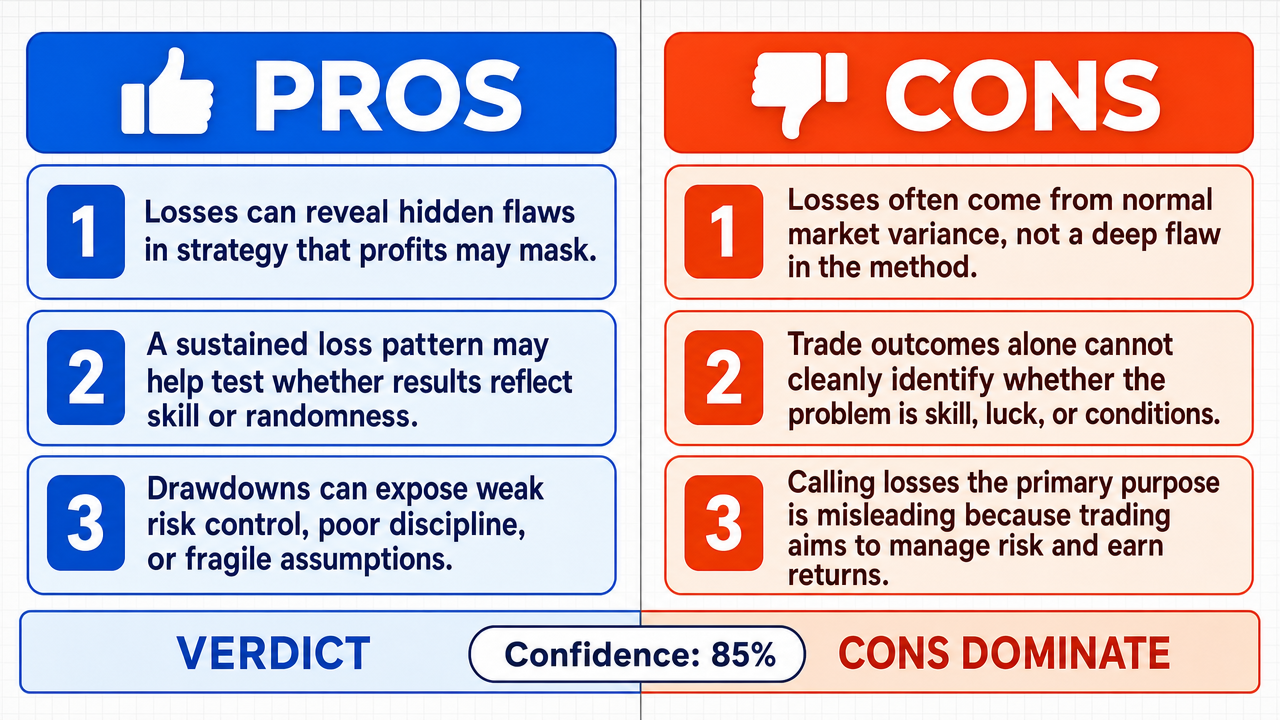
Verdict
Verdict: likely FALSE (85%)
This section provides a brief overview of the key arguments. You do not need to read the full detailed report below.
✅ Key PRO arguments:
- ■Financial losses expose structural flaws in trading methodology that profit cannot reveal, serving as the primary diagnostic tool for distinguishing skill from luck. Consistent losses force rigorous examination of selection criteria , timing decisions , and risk management frameworks that profitable outcomes often mask, since profits can be attributed to favorable market conditions or random chance.
- ■The transfer operator between loss and skill exists in the form of the Sharpe ratio 's statistical significance test . A loss sequence's deviation from random expectations provides the necessary correlation between outcome and process quality, and deflated Sharpe ratios demonstrate that when a strategy's losses exceed what would be expected from a randomized benchmark with similar constraints, this directly identifies methodological weaknesses rather than mere random variance.
❌ Key ANTI arguments:
- ■The affirmative's reliance on loss patterns as a primary diagnostic tool suffers from a fundamental error of identity: they attempt to use the outcome of a trade (the loss) to measure the quality of the process (the skill), but they fail to provide the necessary transfer operator —the statistical correlation or cointegration —that links a specific loss to a specific methodological failure. In many market regimes , a loss is merely the realization of a statistical probability within a sound strategy, so claiming it reveals foundational gaps mistakes the symptom of market volatility for a flaw in process.
- ■The affirmative's argument about derivatives losses is logically incoherent because it asserts two mutually exclusive propositions: that derivatives losses directly illuminate structural weaknesses in position sizing , volatility management , and Greek exposures , while simultaneously asserting that theoretical models cannot predict those same structural weaknesses. If the very models designed to manage these exposures are incapable of predicting the weaknesses they are meant to mitigate, then a loss cannot directly illuminate a structural flaw in those models.
💭 Conclusion: False. The assertion that the primary purpose of financial losses is to uncover foundational weaknesses in a trader's approach is not supported because losses frequently arise from random variance, statistical probability realizations, or market regime shifts rather than from identifiable methodological flaws. The negative side successfully identified a fundamental error of identity in the affirmative's reasoning: using a trade outcome (loss) to measure process quality (skill) requires a transfer operator linking specific losses to specific methodological failures, which the affirmative failed to establish. Furthermore, the affirmative's framework contained an internal contradiction regarding derivatives losses and theoretical models, undermining the claim that losses serve as a reliable diagnostic tool. While the affirmative offered statistical frameworks like the Sharpe ratio as potential transfer operators, the negative demonstrated that these tools measure aggregate performance rather than pinpointing specific structural weaknesses, leaving the primary-purpose claim unsubstantiated.
🔬 DeepResearch Result: likely FALSE ❌ (85%)
Assertion: The primary purpose of experiencing financial losses in trading is to uncover foundational weaknesses in a trader's approach.
Participating models: deepseek-v3.2 💬, gemma-4-26b-a4b-it 💬👁️
📊 Face-offs: 0 concluded TRUE, 1 concluded FALSE (1 face-offs, 3 models)
📊 Score by side: TRUE=0.00, FALSE=0.85
🏅 Model score changes:
minimax-m3 💬👁️: +8
✅ PRO Arguments:
- ■Financial losses expose structural flaws in trading methodology that profit cannot reveal, serving as the primary diagnostic tool for distinguishing skill from luck. Consistent losses force rigorous examination of selection criteria , timing decisions , and risk management frameworks that profitable outcomes often mask, since profits can be attributed to favorable market conditions or random chance. deepseek-v3.2 💬
- ■The transfer operator between loss and skill exists in the form of the Sharpe ratio 's statistical significance test . A loss sequence's deviation from random expectations provides the necessary correlation between outcome and process quality, and deflated Sharpe ratios demonstrate that when a strategy's losses exceed what would be expected from a randomized benchmark with similar constraints, this directly identifies methodological weaknesses rather than mere random variance. deepseek-v3.2 💬
❌ ANTI Arguments:
- ■The affirmative's reliance on loss patterns as a primary diagnostic tool suffers from a fundamental error of identity: they attempt to use the outcome of a trade (the loss) to measure the quality of the process (the skill), but they fail to provide the necessary transfer operator—the statistical correlation or cointegration —that links a specific loss to a specific methodological failure. In many market regimes , a loss is merely the realization of a statistical probability within a sound strategy, so claiming it reveals foundational gaps mistakes the symptom of market volatility for a flaw in process. gemma-4-26b-a4b-it 💬👁️
- ■The affirmative's argument about derivatives losses is logically incoherent because it asserts two mutually exclusive propositions: that derivatives losses directly illuminate structural weaknesses in position sizing , volatility management , and Greek exposures , while simultaneously asserting that theoretical models cannot predict those same structural weaknesses. If the very models designed to manage these exposures are incapable of predicting the weaknesses they are meant to mitigate, then a loss cannot directly illuminate a structural flaw in those models. gemma-4-26b-a4b-it 💬👁️
💭 Reasoning: False. The assertion that the primary purpose of financial losses is to uncover foundational weaknesses in a trader's approach is not supported because losses frequently arise from random variance, statistical probability realizations, or market regime shifts rather than from identifiable methodological flaws. The negative side successfully identified a fundamental error of identity in the affirmative's reasoning: using a trade outcome (loss) to measure process quality (skill) requires a transfer operator linking specific losses to specific methodological failures, which the affirmative failed to establish. Furthermore, the affirmative's framework contained an internal contradiction regarding derivatives losses and theoretical models, undermining the claim that losses serve as a reliable diagnostic tool. While the affirmative offered statistical frameworks like the Sharpe ratio as potential transfer operators, the negative demonstrated that these tools measure aggregate performance rather than pinpointing specific structural weaknesses, leaving the primary-purpose claim unsubstantiated.
📋 PRO Facts:
• Deflated Sharpe ratios can identify when a strategy's losses exceed what would be expected from a randomized benchmark with similar constraints.
• Venture capital research compares realized portfolio returns against randomized benchmarks to distinguish skill from luck.
• Profitable outcomes can be attributed to favorable market conditions or random chance rather than methodological soundness.
📋 ANTI Facts:
• In many market regimes, a loss is merely the realization of a statistical probability within a sound strategy.
• Using a trade outcome to measure process quality requires a transfer operator—the statistical correlation or cointegration—linking specific losses to specific methodological failures.
• Theoretical models designed to manage position sizing, volatility, and Greek exposures may be incapable of predicting the structural weaknesses they are meant to mitigate.
| Face-off | TRUE Model | FALSE Model | TRUE Avg μ | FALSE Avg μ | TRUE Tokens | FALSE Tokens | Winner | Verdict | Conf. |
|---|---|---|---|---|---|---|---|---|---|
| #1 | deepseek-v3.2 💬 | gemma-4-26b-a4b-it 💬👁️ | 0.338 | 0.303 | 8 | 2 | TRUE | FALSE | 85% |
The following technical terms, abbreviations, and domain-specific concepts are referenced throughout this debate transcript. Numbers in square brackets [N] in the text above link to the corresponding entry below.
[1] causal link — A connection that establishes a cause-and-effect relationship between two variables or events. In the debate, the negative argues that a loss alone does not provide the causal link needed to distinguish a model's failure from a market movement exceeding the model's intended probabilistic bounds.
[2] cointegration — A statistical property of two or more time series that move together over the long term despite short-term deviations. In the debate, it is cited alongside statistical correlation as a potential transfer operator linking a loss to a methodological failure.
[3] constrained random benchmarking — A methodology referenced in the affirmative's argument that uses loss patterns to identify which aspects of an investment approach fail under stress, revealing foundational gaps in analysis.
[4] deflated Sharpe ratios — An adjustment to the Sharpe ratio that accounts for the probability that a reported result is due to chance rather than skill. In the debate, the affirmative cites research showing that when a strategy's losses exceed what would be expected from a randomized benchmark with similar constraints, this identifies methodological weaknesses rather than random variance.
[5] delta hedging — An options strategy that reduces or eliminates the directional risk associated with changes in the price of an underlying asset. The negative mentions it as an example of a specific error that derivatives losses allegedly pinpoint.
[6] derivatives — Financial instruments whose value is derived from an underlying asset, index, or rate. In the debate, derivatives trading is cited as a context where losses illuminate structural weaknesses in position sizing, volatility management, and Greek exposures.
[7] gamma risk — The risk associated with the rate of change of an option's delta as the underlying asset price moves. The negative cites gamma risk miscalculations as an example of a specific error that derivatives losses allegedly pinpoint.
[8] Greek exposures — The sensitivities of a derivatives position to various market factors, commonly measured using the 'Greeks' (delta, gamma, vega, theta). In the debate, Greek exposures are cited as one of the structural areas where derivatives losses reveal weaknesses.
[9] loss patterns — The recurring characteristics or sequences of losing trades. The affirmative relies on loss patterns as a 'primary diagnostic tool' for distinguishing skill from luck in trading.
[10] market regimes — Distinct periods or states of market behavior characterized by particular trends, volatility levels, or correlations. The negative argues that in many market regimes, a loss is merely the realization of a statistical probability within a sound strategy.
[11] market volatility — The degree of variation in trading prices over time. The negative argues that mistaking the symptom of market volatility for the disease of poor methodology is a fundamental error.
[12] position sizing — The determination of how much capital to allocate to a particular trade or investment. In the debate, position sizing is cited as one of the structural areas where derivatives losses reveal weaknesses.
[13] probabilistic bounds — The statistical limits within which a model's outcomes are expected to fall. The negative argues that a market movement exceeding a model's intended probabilistic bounds cannot be distinguished from a model failure by a loss alone.
[14] quantitative model — A mathematical or computational representation used to analyze financial instruments or markets. The negative contests the argument that derivatives losses serve as a direct diagnostic for quantitative model errors.
[15] randomized benchmarks — Comparison standards generated through random sampling or simulation to evaluate the performance of an investment strategy. The affirmative cites research comparing realized portfolio returns against randomized benchmarks to show that losses provide clearer signals about systematic weaknesses.
[16] realized portfolio returns — The actual returns earned on a portfolio over a specified period. The affirmative cites research comparing realized portfolio returns against randomized benchmarks to assess whether outcomes reflect skill or luck.
[17] risk management — The process of identifying, assessing, and prioritizing risks followed by coordinated application of resources to minimize or control them. The affirmative argues that losses force rigorous examination of risk management frameworks that profitable outcomes often mask.
[18] selection criteria — The standards or rules used to choose investments or trades. The affirmative argues that consistent losses force rigorous examination of selection criteria that profitable outcomes often mask.
[19] Sharpe ratio — A measure of risk-adjusted return calculated as the excess return per unit of volatility. In the debate, the affirmative cites the Sharpe ratio's statistical significance test as the transfer operator linking loss sequences to process quality, giving an example where a Sharpe ratio of 0.55 yields a luck probability of approximately 30.25% (0.55 × 0.55).
[20] statistical correlation — A measure of the degree to which two variables move in relation to each other. In the debate, it is cited alongside cointegration as a potential transfer operator linking a specific loss to a specific methodological failure.
[21] statistical significance test — A procedure used to determine whether an observed effect is likely due to chance. The affirmative cites the Sharpe ratio's statistical significance test as the mechanism that provides the necessary correlation between outcome and process quality.
[22] stop-loss — An order placed to sell a security when it reaches a specified price, designed to limit an investor's loss. The negative distinguishes a 'good loss' (a trade that followed all rules but hit a stop-loss due to randomness) from a 'bad loss' (a trade that failed due to flawed logic).
[23] timing decisions — Choices about when to enter or exit a trade or investment. The affirmative argues that consistent losses force rigorous examination of timing decisions that profitable outcomes often mask.
[24] transfer operator — In the debate, a conceptual mechanism—described as a statistical correlation or cointegration—that links a specific loss to a specific methodological failure. The negative argues the affirmative fails to provide this necessary operator.
[25] venture capital — A form of private equity financing provided to early-stage companies with high growth potential. The affirmative cites empirical evidence from venture capital research to support the claim that losses serve as a diagnostic tool for distinguishing skill from luck.
[26] volatility management — Strategies and techniques used to monitor and control exposure to price fluctuations. In the debate, volatility management is cited as one of the structural areas where derivatives losses reveal weaknesses.
Face-off transcripts
- ■
Ownership & Trade Secrets. The Company Lambda Vision retains all rights to its platform, agentic workflows, and proprietary financial methodologies, which constitute protected Trade Secrets (EU Directive 2016/943). Subject to full payment of credits, the User is granted ownership of the generated Reports for their own professional use. Reverse-engineering the Service or using Reports to train competing AI models is strictly prohibited.
- ■
No Financial Advice. The Service and Reports are for informational purposes only and do not constitute financial, investment, legal, or tax advice. The Company is not a regulated financial advisor. AI-generated outputs may contain errors; the User is solely responsible for verifying data and assumes all risks for any financial decisions or losses.
- ■
Liability & Governing Law. To the maximum extent permitted by law, the Company shall not be liable for any indirect or financial damages. These Terms are governed by French law. Any disputes shall be subject to the exclusive jurisdiction of the Courts of Paris, France.