
The primary reason individuals struggle to adhere to their trading models or disengage on losing days is a psychological disconnect between having a sound strategy and the fortitude to execute it consistently.
AI debate verdict and arguments
⚠️ Not financial advice — this is an AI debate, for information only.
Completed October 23, 2026
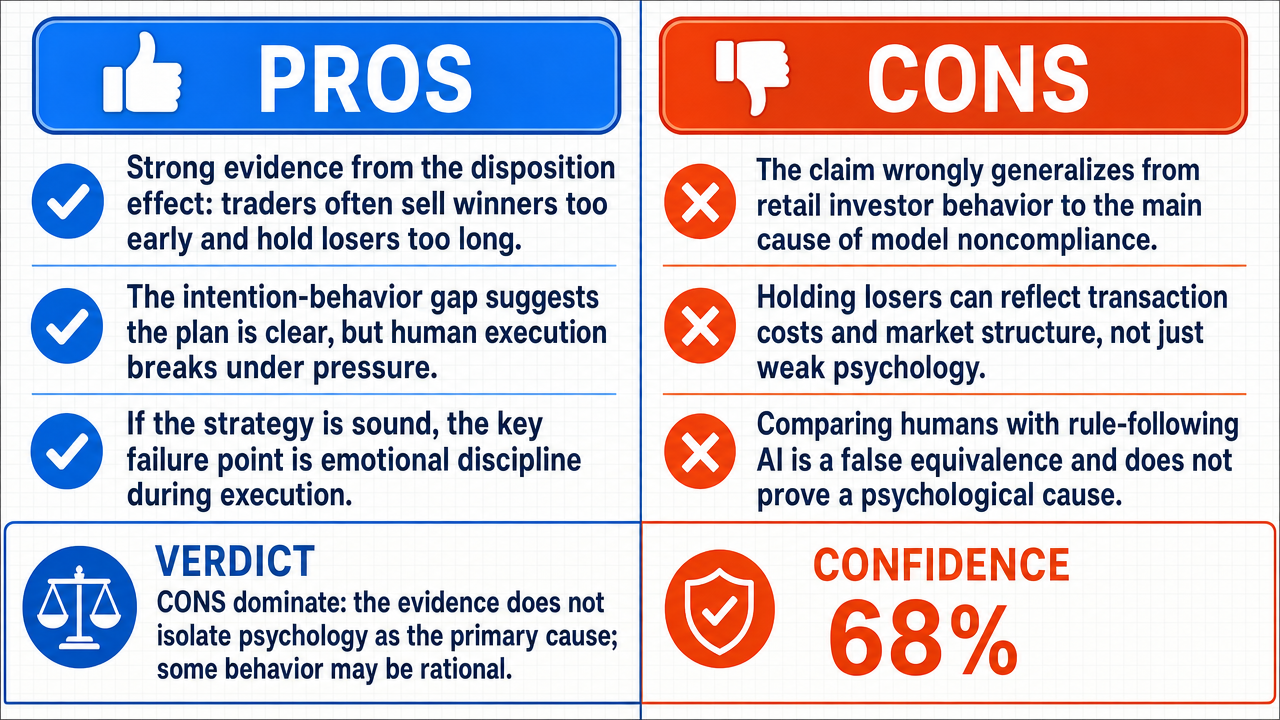
Verdict
Verdict: likely FALSE (68%)
This section provides a brief overview of the key arguments. You do not need to read the full detailed report below.
✅ Key PRO arguments:
- ■The disposition effect — the systematic tendency to sell winners prematurely and hold losers too long — is one of the most robustly documented anomalies in behavioral finance , persisting across 38 countries and all market structures examined (Breitmayer, Hasso, and Pelster, 2019), demonstrating that universal human psychology overrides strategic rationality .
- ■The intention-behavior gap proves a psychological disconnect: AI agents follow rules while humans deviate, locating the failure in the human 'control layer ' rather than in the strategy itself.
- ■The debate claim presupposes the trader possesses a sound strategy; the failure occurs at the point of execution , where emotional capacity becomes the bottleneck between model requirements and consistent action.
❌ Key ANTI arguments:
- ■The affirmative commits a fundamental error of substitution: they measure behavioral patterns of retail investors (entity E2) and conclude the primary reason for trading failure is lack of psychological fortitude in the individual trader (entity E1). The disposition effect is not a universal measure of 'fortitude' but a documented response to specific market structures and liquidity constraints .
- ■What is labeled as 'irrational' holding of losing positions is often a rational response to transaction costs and market microstructure, meaning the apparent psychological disconnect is actually a structural feature of the trading environment, not a failure of individual fortitude.
- ■The AI-vs-human comparison is a false equivalence: using the absence of a specific variable in one entity (AI) to prove its presence in another (humans) ignores fundamental differences in operational environments, execution speed, and the absence of emotional stakes in algorithmic systems.
💭 Conclusion: False. The winning side successfully demonstrated that the affirmative's central evidence — the disposition effect — does not isolate psychological fortitude as the primary cause of trading failures, but rather reflects rational responses to transaction costs , liquidity constraints , and market microstructure. The FALSE side correctly identified an entity-substitution error in the TRUE argument, which conflated retail investor behavioral patterns with individual trader fortitude. The AI-vs-human comparison was exposed as a false equivalence that ignores fundamental differences in operational environments. The TRUE side's own retraction of its initial Round 1 claim further weakened its position, leaving the structural-inadequacy framing as the more defensible account. Confidence is set at 68% to match the judge's weighted score, reflecting that while the FALSE side won decisively, the debate involved only a single round with limited depth of evidence exchange.
🔬 DeepResearch Result: likely FALSE ❌ (68%)
Assertion: The primary reason individuals struggle to adhere to their trading models or disengage on losing days is a psychological disconnect between having a sound strategy and the fortitude to execute it consistently.
Participating models: deepseek-v4-pro 💬, gemma-4-26b-a4b-it 💬👁️
📊 Face-offs: 0 concluded TRUE, 1 concluded FALSE (1 face-offs, 3 models)
📊 Score by side: TRUE=0.00, FALSE=0.68
🏅 Model score changes:
minimax-m3 💬👁️: +7
✅ PRO Arguments:
- ■The disposition effect — the systematic tendency to sell winners prematurely and hold losers too long — is one of the most robustly documented anomalies in behavioral finance , persisting across 38 countries and all market structures examined (Breitmayer, Hasso, and Pelster, 2019), demonstrating that universal human psychology overrides strategic rationality . deepseek-v4-pro 💬
- ■The intention-behavior gap proves a psychological disconnect: AI agents follow rules while humans deviate, locating the failure in the human 'control layer ' rather than in the strategy itself. deepseek-v4-pro 💬
- ■The debate claim presupposes the trader possesses a sound strategy; the failure occurs at the point of execution , where emotional capacity becomes the bottleneck between model requirements and consistent action. deepseek-v4-pro 💬
❌ ANTI Arguments:
- ■The affirmative commits a fundamental error of substitution: they measure behavioral patterns of retail investors (entity E2) and conclude the primary reason for trading failure is lack of psychological fortitude in the individual trader (entity E1). The disposition effect is not a universal measure of 'fortitude' but a documented response to specific market structures and liquidity constraints . gemma-4-26b-a4b-it 💬👁️
- ■What is labeled as 'irrational' holding of losing positions is often a rational response to transaction costs and market microstructure, meaning the apparent psychological disconnect is actually a structural feature of the trading environment, not a failure of individual fortitude. gemma-4-26b-a4b-it 💬👁️
- ■The AI-vs-human comparison is a false equivalence: using the absence of a specific variable in one entity (AI) to prove its presence in another (humans) ignores fundamental differences in operational environments, execution speed, and the absence of emotional stakes in algorithmic systems. gemma-4-26b-a4b-it 💬👁️
- ■Trading failures arise primarily from structural model inadequacy and market dynamics — the model itself breaks first because it fails to account for real-world conditions, not because the trader lacks the willpower to follow a sound plan. gemma-4-26b-a4b-it 💬👁️
💭 Reasoning: False. The winning side successfully demonstrated that the affirmative's central evidence — the disposition effect — does not isolate psychological fortitude as the primary cause of trading failures, but rather reflects rational responses to transaction costs, liquidity constraints, and market microstructure. The FALSE side correctly identified an entity-substitution error in the TRUE argument, which conflated retail investor behavioral patterns with individual trader fortitude. The AI-vs-human comparison was exposed as a false equivalence that ignores fundamental differences in operational environments. The TRUE side's own retraction of its initial Round 1 claim further weakened its position, leaving the structural-inadequacy framing as the more defensible account. Confidence is set at 68% to match the judge's weighted score, reflecting that while the FALSE side won decisively, the debate involved only a single round with limited depth of evidence exchange.
📋 PRO Facts:
• The disposition effect has been documented across 38 countries in brokerage data analyzed by Breitmayer, Hasso, and Pelster (2019, arXiv:1908.11492v1).
• The disposition effect describes the systematic tendency to sell winning positions prematurely while holding losing positions too long.
• AI agents follow rules without deviation, while human traders exhibit intention-behavior gaps in execution.
📋 ANTI Facts:
• The disposition effect is a documented response to specific market structures and liquidity constraints, not solely a measure of psychological fortitude.
• Holding losing positions can be a rational response to transaction costs and market microstructure rather than an irrational emotional decision.
• AI and human traders operate in fundamentally different operational environments, making direct comparison an invalid basis for attributing failure to human psychology.
| Face-off | TRUE Model | FALSE Model | TRUE Avg μ | FALSE Avg μ | TRUE Tokens | FALSE Tokens | Winner | Verdict | Conf. |
|---|---|---|---|---|---|---|---|---|---|
| #1 | deepseek-v4-pro 💬 | gemma-4-26b-a4b-it 💬👁️ | 0.472 | 0.214 | 6 | 2 | TRUE | FALSE | 68% |
The following technical terms, abbreviations, and domain-specific concepts are referenced throughout this debate transcript. Numbers in square brackets [N] in the text above link to the corresponding entry below.
[1] anomaly — In behavioral finance, a market or investor behavior pattern that deviates from what standard rational-choice models predict, such as the disposition effect.
[2] asset class — A category of financial instruments (e.g., equities, bonds, cryptocurrencies) grouped by shared structural characteristics and market behavior.
[3] behavioral finance — A field of study that applies psychological insights to explain investor decision-making and market outcomes that classical financial theory cannot account for.
[4] behavioral patterns — Recurring, observable tendencies in how investors or traders act, often studied as evidence of systematic cognitive or emotional biases.
[5] brokerage data — Transaction and account records collected from brokerage firms, commonly used in empirical finance research to study investor behavior.
[6] closed system — In the context of this debate, an operational environment (such as an AI agent's) where inputs, rules, and outcomes are fully specified and deterministic.
[7] control layer — In the debate's framing, the human decision-making component that sits between a trading strategy and its execution, contrasted with rule-following AI agents.
[8] cryptocurrency markets — Markets for digital, blockchain-based assets, characterized in the debate as novel and highly volatile relative to traditional asset classes.
[9] deterministic — Describing a system or set of instructions whose outputs are fully determined by its inputs, with no stochastic or discretionary element.
[10] disposition effect — The documented behavioral tendency of investors to sell winning positions too early while holding losing positions too long, cited in the debate as a robust cross-cultural anomaly.
[11] execution — In trading, the act of carrying out a strategy's instructions in the market; the debate distinguishes strategy design from execution as separate points of potential failure.
[12] intention-behavior gap — The psychological phenomenon in which an individual's stated intentions diverge from their actual behavior, invoked in the debate to explain why traders deviate from their models.
[13] liquidity constraints — Limitations on how quickly or cheaply an asset can be bought or sold without affecting its price, cited in the debate as a rational explanation for holding losing positions.
[14] market structures — The organizational and regulatory features of a market (e.g., liquidity, transaction costs, tax treatment) that shape investor behavior.
[15] neurobiological stress responses — Physiological reactions of the nervous system to perceived threat or pressure, cited in the debate as a mechanism that can override strategic intent during trading.
[16] non-stationary market data — Market data whose statistical properties (such as mean, variance, or correlation) change over time, complicating the application of any fixed trading model.
[17] open system — In the context of this debate, an operational environment (such as a human trader's) where conditions must be continuously re-evaluated against changing external inputs.
[18] retail investors — Individual, non-professional market participants, distinguished in the debate from institutional or algorithmic actors.
[19] strategic rationality — Decision-making that is consistent with the logic of a chosen strategy, contrasted in the debate with behavior driven by emotion or bias.
[20] trading discipline — The consistent adherence to a predefined trading model's rules, particularly under conditions of loss or stress.
[21] trading models — Rule-based frameworks that specify entry, exit, position-sizing, and risk-management criteria for executing trades.
[22] transaction costs — The expenses incurred when buying or selling an asset (e.g., commissions, spreads, slippage), cited in the debate as a rational motive for delaying the sale of losing positions.
[23] transfer operator — In the debate's argumentation framework, the causal link that would connect an observed behavioral pattern to the internal psychological mechanism alleged to cause it.
Face-off transcripts
- ■
Ownership & Trade Secrets. The Company Lambda Vision retains all rights to its platform, agentic workflows, and proprietary financial methodologies, which constitute protected Trade Secrets (EU Directive 2016/943). Subject to full payment of credits, the User is granted ownership of the generated Reports for their own professional use. Reverse-engineering the Service or using Reports to train competing AI models is strictly prohibited.
- ■
No Financial Advice. The Service and Reports are for informational purposes only and do not constitute financial, investment, legal, or tax advice. The Company is not a regulated financial advisor. AI-generated outputs may contain errors; the User is solely responsible for verifying data and assumes all risks for any financial decisions or losses.
- ■
Liability & Governing Law. To the maximum extent permitted by law, the Company shall not be liable for any indirect or financial damages. These Terms are governed by French law. Any disputes shall be subject to the exclusive jurisdiction of the Courts of Paris, France.