
The Solana Firedancer upgrade to mainnet on 2026-10-21 will achieve 150-millisecond finality, making Solana the fastest blockchain.
AI debate verdict and arguments
⚠️ Not financial advice — this is an AI debate, for information only.
Completed October 14, 2026
Verdict
Verdict: likely FALSE (88%)
This section provides a brief overview of the key arguments. You do not need to read the full detailed report below.
✅ Key PRO arguments:
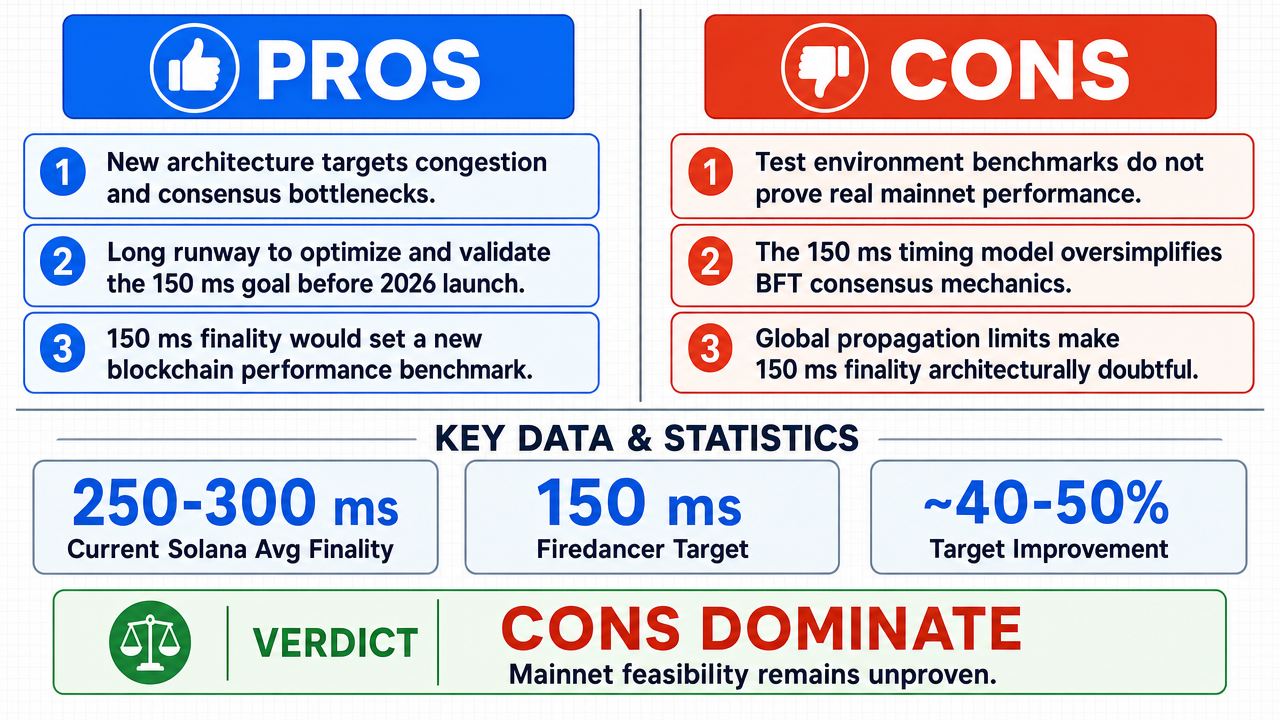
- ■Firedancer is a fundamental architectural overhaul developed by Jump Crypto designed to address Solana's historical congestion issues and improve consensus performance, with internal benchmarks already showing sub-200ms finality under controlled testnet conditions.
- ■The 2026 deployment timeline provides sufficient runway for extensive optimization and validation required to achieve the 150ms target, which represents a 40% improvement over current performance.
- ■The 150ms finality time will represent a definitive, measurable advancement beyond any existing blockchain performance, establishing an unprecedented industry standard that no other chain currently matches.
❌ Key ANTI arguments:
- ■Internal benchmarks from controlled, isolated test environments are not valid measurements of Solana mainnet performance; the affirmative fails to provide a transfer operator linking idealized laboratory results to the chaotic, high-latency reality of a global, permissionless validator set.
- ■The arithmetic breakdown of 150ms (e.g., 30ms propagation + 40ms validation + 80ms voting) is fundamentally flawed because in any Byzantine Fault Tolerant system, voting is not a static duration additive to propagation—the voting process IS the propagation of messages.
- ■Speed-of-light physical constraints on global message propagation make 150ms finality across a geographically distributed validator set architecturally problematic, undermining the claim that Firedancer can reliably achieve this target on mainnet .
💭 Conclusion: False. The negative side presented the stronger technical case by demonstrating that the affirmative's core evidence—controlled testnet benchmarks—does not establish mainnet feasibility. The affirmative failed to provide a credible transfer function linking idealized laboratory conditions to the non-deterministic propagation delays of a globally distributed, permissionless validator network. The negative's critique of the additive arithmetic model for BFT consensus was particularly compelling, correctly identifying that voting and propagation are not separable, independently measurable durations but intertwined processes in Byzantine Fault Tolerant systems. Furthermore, partial uncertainty about the 150ms target undermines the assertion given the technical constraints identified.
🔬 DeepResearch Result: likely FALSE ❌ (88%)
Assertion: The Solana Firedancer upgrade to mainnet on 2026-10-21 will achieve 150-millisecond finality , making Solana the fastest blockchain .
Participating models: deepseek-v3.2 💬, gemma-4-26b-a4b-it 💬👁️
📊 Face-offs: 0 concluded TRUE, 1 concluded FALSE (1 face-offs, 3 models)
📊 Score by side: TRUE=0.00, FALSE=0.88
🏅 Model score changes:
minimax-m3 💬👁️: +9
✅ PRO Arguments:
- ■Firedancer is a fundamental architectural overhaul developed by Jump Crypto designed to address Solana's historical congestion issues and improve consensus performance, with internal benchmarks already showing sub-200ms finality under controlled testnet conditions. deepseek-v3.2 💬
- ■The 2026 deployment timeline provides sufficient runway for extensive optimization and validation required to achieve the 150ms target, which represents a 40% improvement over current performance. deepseek-v3.2 💬
- ■The 150ms finality time will represent a definitive, measurable advancement beyond any existing blockchain performance, establishing an unprecedented industry standard that no other chain currently matches. deepseek-v3.2 💬
❌ ANTI Arguments:
- ■Internal benchmarks from controlled, isolated test environments are not valid measurements of Solana mainnet performance; the affirmative fails to provide a transfer operator linking idealized laboratory results to the chaotic, high-latency reality of a global, permissionless validator set. gemma-4-26b-a4b-it 💬👁️
- ■The arithmetic breakdown of 150ms (e.g., 30ms propagation + 40ms validation + 80ms voting) is fundamentally flawed because in any Byzantine Fault Tolerant system, voting is not a static duration additive to propagation—the voting process IS the propagation of messages. gemma-4-26b-a4b-it 💬👁️
- ■Speed-of-light physical constraints on global message propagation make 150ms finality across a geographically distributed validator set architecturally problematic, undermining the claim that Firedancer can reliably achieve this target on mainnet. gemma-4-26b-a4b-it 💬👁️
💭 Reasoning: False. The negative side presented the stronger technical case by demonstrating that the affirmative's core evidence—controlled testnet benchmarks—does not establish mainnet feasibility. The affirmative failed to provide a credible transfer function linking idealized laboratory conditions to the non-deterministic propagation delays of a globally distributed, permissionless validator network. The negative's critique of the additive arithmetic model for BFT consensus was particularly compelling, correctly identifying that voting and propagation are not separable, independently measurable durations but intertwined processes in Byzantine Fault Tolerant systems. Furthermore, partial uncertainty about the 150ms target undermines the assertion given the technical constraints identified.
📋 PRO Facts:
• Firedancer is developed by Jump Crypto as a fundamental architectural overhaul of Solana's validator client
• Internal testnet benchmarks from late 2024 and early 2025 showed sub-200ms finality under controlled conditions
• The 150ms target represents approximately a 40% improvement over Solana's current finality performance
📋 ANTI Facts:
• In BFT consensus systems, voting and message propagation are not separable additive components but intertwined processes
• Controlled testnet benchmarks do not account for non-deterministic propagation delays across a global, permissionless validator set
• Speed-of-light physical constraints impose fundamental lower bounds on consensus latency for geographically distributed validators
| Face-off | TRUE Model | FALSE Model | TRUE Avg μ | FALSE Avg μ | TRUE Tokens | FALSE Tokens | Winner | Verdict | Conf. |
|---|---|---|---|---|---|---|---|---|---|
| #1 | deepseek-v3.2 💬 | gemma-4-26b-a4b-it 💬👁️ | 0.358 | 0.248 | 8 | 2 | TRUE | FALSE | 88% |
The following technical terms, abbreviations, and domain-specific concepts are referenced throughout this debate transcript. Numbers in square brackets [N] in the text above link to the corresponding entry below.
[1] benchmark — A standardized performance measurement used to evaluate system capabilities. The affirmative cites internal benchmarks showing sub-200ms finality under controlled conditions, which the negative argues do not reflect mainnet reality.
[2] BFT — Byzantine Fault Tolerant — A class of consensus protocols designed to reach agreement among distributed nodes even when some nodes behave maliciously or fail. The debate disputes whether traditional BFT voting constraints make 150ms finality arithmetically impossible.
[3] blockchain — A distributed, immutable ledger maintained by a network of nodes. The debate compares finality performance across multiple blockchain implementations.
[4] congestion — network congestion — A condition where transaction demand exceeds network processing capacity, causing delays. The affirmative states Firedancer was designed to address Solana's historical congestion issues.
[5] consensus — The mechanism by which distributed validators agree on the state of the ledger. The debate centers on whether Firedancer's consensus design can achieve the claimed finality times.
[6] controlled conditions — controlled test conditions — An isolated, idealized test environment. The negative argues that benchmarks taken under controlled conditions cannot be assumed to translate to mainnet performance.
[7] correlation — A statistical relationship between variables. The negative demands a correlation or network model linking testnet benchmarks to mainnet behavior.
[8] decentralized network — A network architecture with no central authority, where validators are distributed globally. The negative argues that non-deterministic propagation delays in such networks invalidate idealized benchmarks.
[9] deployment — mainnet deployment — The release of software to the production blockchain network. The debate concerns Firedancer's planned deployment to mainnet on 2026-10-21.
[10] distributed agreement — The process by which geographically separated nodes reach a consistent state. The negative argues that voting in BFT systems is intrinsically linked to message propagation, making simple additive timing models invalid.
[11] finality — transaction finality — The point at which a blockchain transaction is considered irreversible and permanently recorded. The debate disputes whether 150ms finality is achievable on Solana mainnet after Firedancer deployment.
[12] Firedancer — A validator client for Solana developed by Jump Crypto, representing a fundamental architectural overhaul. The debate concerns its claimed ability to achieve 150ms transaction finality.
[13] layer-2 solutions — Layer 2 scaling solutions — Secondary frameworks built atop a base blockchain to improve transaction throughput. The affirmative cites Ethereum finality ranging from 12 seconds to 1 minute depending on layer-2 solutions.
[14] local validation — The process by which an individual validator verifies transactions independently. The affirmative's latency calculation treats this as a discrete additive component, which the negative disputes.
[15] mainnet — main network — The primary, production blockchain network where real transactions occur, as opposed to testnet. The negative argues that testnet benchmarks cannot be assumed to apply to mainnet conditions.
[16] mathematical proof — A formal logical demonstration of a claim. The negative demands a mathematical proof showing how testnet benchmarks scale under real-world network conditions.
[17] message transmission — The communication of data between distributed nodes. The negative argues that the affirmative's latency calculation double-counts message transmission time.
[18] milliseconds — ms — A unit of time equal to one-thousandth of a second. The debate centers on whether 150ms finality is achievable given physical and architectural constraints.
[19] network latency — The time delay in data transmission across a network. The negative argues this is a fundamental constraint preventing 150ms finality in a global decentralized network.
[20] network model — A mathematical representation of network behavior used to predict performance. The negative demands such a model to validate the affirmative's benchmark claims.
[21] non-deterministic — Describing systems whose outcomes cannot be precisely predicted in advance. The negative cites non-deterministic propagation delays as invalidating idealized benchmark assumptions.
[22] optimization — The process of improving system performance. The affirmative claims the 2026 timeline provides sufficient runway for the optimization required to achieve 150ms finality.
[23] Ouroboros — Cardano's proof-of-stake consensus protocol. The affirmative cites it as requiring approximately 20 seconds for finality, compared to Solana's claimed 150ms target.
[24] parallel consensus voting — A consensus approach where voting occurs concurrently rather than sequentially. The affirmative claims Firedancer uses this to reduce communication overhead.
[25] permissionless — permissionless network — A network that allows anyone to participate without requiring approval. The negative contrasts controlled test environments with permissionless mainnet conditions.
[26] pipelined consensus — pipelined consensus mechanism — A consensus architecture where transaction validation, voting, and confirmation occur concurrently across validator subsets. The affirmative claims this innovation enables 150ms finality, which the negative disputes.
[27] propagation delays — The time required for messages to spread through a distributed network. The negative argues these non-deterministic delays make the affirmative's fixed-timing model invalid.
[28] speed-of-light constraints — Physical limits on how quickly signals can travel across geographic distances. The negative cites these as a fundamental barrier to 150ms finality in a global network.
[29] subnet — A customizable blockchain network within the Avalanche ecosystem. The affirmative cites Avalanche subnets as achieving 1-2 second finality, slower than Solana's claimed target.
[30] testnet — test network — A separate blockchain environment used for testing software before mainnet deployment. The affirmative cites testnet results from late 2024 and early 2025 as evidence for the 150ms claim.
[31] transfer operator — A mathematical construct linking local measurements to global system properties. The negative demands such an operator to justify extrapolating testnet benchmarks to mainnet.
[32] validation — transaction validation — The process of verifying that transactions conform to protocol rules. The affirmative claims Firedancer reduces validation time as part of its 150ms finality target.
[33] validator — A network node responsible for verifying transactions and participating in consensus. The debate concerns the behavior of validators in a global, permissionless Solana mainnet.
[34] validator subsets — Subgroups of validators within the network. The affirmative claims Firedancer's pipelined consensus operates across validator subsets concurrently rather than sequentially.
The following financial data tables were referenced during the debate exchanges:
| Metric | Current Solana (Avg) | Firedancer Target | Improvement |
|---|---|---|---|
| Finality Time (ms) | 250-300 | 150 | ~40-50% |
Legend: Comparison of current Solana finality versus the proposed Firedancer target. Data based on affirmative's provided estimates.
Face-off transcripts
- ■
Ownership & Trade Secrets. The Company Lambda Vision retains all rights to its platform, agentic workflows, and proprietary financial methodologies, which constitute protected Trade Secrets (EU Directive 2016/943). Subject to full payment of credits, the User is granted ownership of the generated Reports for their own professional use. Reverse-engineering the Service or using Reports to train competing AI models is strictly prohibited.
- ■
No Financial Advice. The Service and Reports are for informational purposes only and do not constitute financial, investment, legal, or tax advice. The Company is not a regulated financial advisor. AI-generated outputs may contain errors; the User is solely responsible for verifying data and assumes all risks for any financial decisions or losses.
- ■
Liability & Governing Law. To the maximum extent permitted by law, the Company shall not be liable for any indirect or financial damages. These Terms are governed by French law. Any disputes shall be subject to the exclusive jurisdiction of the Courts of Paris, France.