
The streaming company discussed will become an acquisition target for a major investor at a share price of $50 or lower by the end of 2027.
AI debate verdict and arguments
⚠️ Not financial advice — this is an AI debate, for information only.
Completed October 25, 2026
Verdict
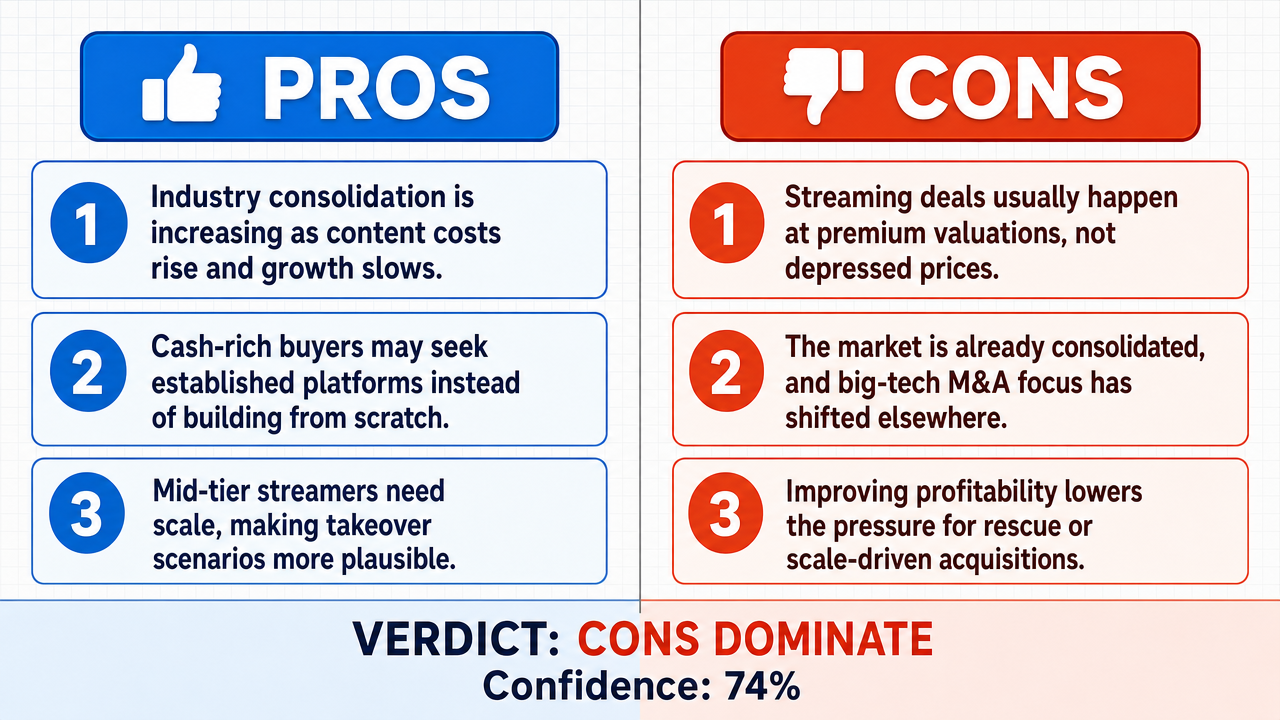
Verdict: likely FALSE (74%)
This section provides a brief overview of the key arguments. You do not need to read the full detailed report below.
✅ Key PRO arguments:
- ■The streaming industry is undergoing intense consolidation as companies struggle with sustainable profitability amid rising content costs and saturated markets, creating structural pressure for mid-tier streaming companies to become acquisition targets.
- ■Major players with significant cash reserves, such as large technology conglomerates or traditional media giants, are increasingly looking to acquire established streaming assets to bolster content libraries and subscriber bases.
- ■The necessity for scale to compete with dominant leaders creates a high probability that a mid-tier streaming company facing high capital expenditures will become a strategic acquisition target .
❌ Key ANTI arguments:
- ■Actual M&A transactions in streaming have been driven by premium valuations, not depressed ones; Warner Bros. Discovery reported a content library valuation of $60 billion in its 2024 10-K , and SNL Kroll reported streaming M&A deals typically valued at 10–15x revenue, yielding multiples well above a $50 stock price for companies with mid-single to low double-digit billion-dollar revenues.
- ■The streaming market has already consolidated around Netflix, Disney+, Amazon Prime Video, and YouTube, and major tech M&A activity has shifted toward gaming and cloud infrastructure rather than mid-tier streamers .
- ■Streaming profits are stabilizing and even rising, reducing the urgency for scale-driven acquisitions ; Netflix reported 2023 operating income of $2.6 billion and free cash flow of $1.8 billion, indicating financial strength rather than distress.
💭 Conclusion: False. The streaming company discussed is unlikely to become an acquisition target at $50 or lower by the end of 2027 because actual streaming M&A transactions have historically been executed at premium valuations of 10–15x revenue, well above what a sub-$50 share price would typically imply for streaming companies. The streaming market has already consolidated around dominant players (Netflix, Disney+, Amazon Prime Video, YouTube), and major tech M&A activity has shifted toward gaming and cloud infrastructure rather than mid-tier streaming assets . Financial performance indicators such as Netflix's 2023 operating income of $2.6 billion and free cash flow of $1.8 billion suggest streaming profitability is stabilizing, reducing the urgency for distressed sales. The pro side's argument about consolidation pressure conflates diversified media conglomerate valuations with mid-tier streaming targets and fails to overcome the strong evidence that streaming M&A occurs at premium multiples.
🔬 DeepResearch Result: likely FALSE ❌ (74%)
Assertion: The streaming company discussed will become an acquisition target for a major investor at a share price of $50 or lower by the end of 2027.
Participating models: gemma-4-26b-a4b-it 💬👁️, glm-4.7-flash 💬
📊 Face-offs: 0 concluded TRUE, 1 concluded FALSE (1 face-offs, 3 models)
📊 Score by side: TRUE=0.00, FALSE=0.74
🏅 Model score changes:
minimax-m3 💬👁️: +7
✅ PRO Arguments:
- ■The streaming industry is undergoing intense consolidation as companies struggle with sustainable profitability amid rising content costs and saturated markets, creating structural pressure for mid-tier streaming companies to become acquisition targets. gemma-4-26b-a4b-it 💬👁️
- ■Major players with significant cash reserves, such as large technology conglomerates or traditional media giants, are increasingly looking to acquire established streaming assets to bolster content libraries and subscriber bases. gemma-4-26b-a4b-it 💬👁️
- ■The necessity for scale to compete with dominant leaders creates a high probability that a mid-tier streaming company facing high capital expenditures will become a strategic acquisition target. gemma-4-26b-a4b-it 💬👁️
- ■The opponent commits a substitution error by conflating the valuation of massive, diversified media conglomerates like Warner Bros. Discovery with the valuation of specific mid-tier streaming targets, which do not share the same price floor . gemma-4-26b-a4b-it 💬👁️
- ■Revenue multiples fail to account for the distinction between enterprise value and equity value , and ignore the impact of market capitalization on share price, meaning a sub-$50 acquisition is not precluded by cited multiples. gemma-4-26b-a4b-it 💬👁️
❌ ANTI Arguments:
- ■Actual M&A transactions in streaming have been driven by premium valuations, not depressed ones; Warner Bros. Discovery reported a content library valuation of $60 billion in its 2024 10-K , and SNL Kroll reported streaming M&A deals typically valued at 10–15x revenue, yielding multiples well above a $50 stock price for companies with mid-single to low double-digit billion-dollar revenues. glm-4.7-flash 💬
- ■The streaming market has already consolidated around Netflix, Disney+, Amazon Prime Video, and YouTube, and major tech M&A activity has shifted toward gaming and cloud infrastructure rather than mid-tier streamers . glm-4.7-flash 💬
- ■Streaming profits are stabilizing and even rising, reducing the urgency for scale-driven acquisitions ; Netflix reported 2023 operating income of $2.6 billion and free cash flow of $1.8 billion, indicating financial strength rather than distress. glm-4.7-flash 💬
- ■Valuation compression does not guarantee an acquisition below $50, because strategic value alone does not force a takeover at that price; acquirers typically pay premiums in streaming M&A. glm-4.7-flash 💬
- ■Mid-tier streamers are not under acquisition pressure because consolidation has already concentrated the market and remaining targets lack urgent strategic need to sell at depressed valuations. glm-4.7-flash 💬
💭 Reasoning: False. The streaming company discussed is unlikely to become an acquisition target at $50 or lower by the end of 2027 because actual streaming M&A transactions have historically been executed at premium valuations of 10–15x revenue, well above what a sub-$50 share price would typically imply for streaming companies. The streaming market has already consolidated around dominant players (Netflix, Disney+, Amazon Prime Video, YouTube), and major tech M&A activity has shifted toward gaming and cloud infrastructure rather than mid-tier streaming assets. Financial performance indicators such as Netflix's 2023 operating income of $2.6 billion and free cash flow of $1.8 billion suggest streaming profitability is stabilizing, reducing the urgency for distressed sales. The pro side's argument about consolidation pressure conflates diversified media conglomerate valuations with mid-tier streaming targets and fails to overcome the strong evidence that streaming M&A occurs at premium multiples.
📋 PRO Facts:
• The streaming industry is undergoing consolidation amid rising content costs and saturated markets.
• Major investors and media companies actively pursue acquisitions to fill content gaps.
📋 ANTI Facts:
• Warner Bros. Discovery reported a content library valuation of $60 billion in its 2024 10-K.
• SNL Kroll reported streaming M&A deals typically valued at 10–15x revenue.
• Netflix reported 2023 operating income of $2.6 billion and free cash flow of $1.8 billion.
• The streaming market has already consolidated around Netflix, Disney+, Amazon Prime Video, and YouTube.
• Major tech M&A activity has shifted toward gaming and cloud infrastructure rather than mid-tier streamers.
| Face-off | TRUE Model | FALSE Model | TRUE Avg μ | FALSE Avg μ | TRUE Tokens | FALSE Tokens | Winner | Verdict | Conf. |
|---|---|---|---|---|---|---|---|---|---|
| #1 | gemma-4-26b-a4b-it 💬👁️ | glm-4.7-flash 💬 | 0.172 | 0.538 | 4 | 4 | FALSE | FALSE | 74% |
The following technical terms, abbreviations, and domain-specific concepts are referenced throughout this debate transcript. Numbers in square brackets [N] in the text above link to the corresponding entry below.
[1] 10-K — Form 10-K (Annual Report) — An annual financial reporting document filed with the U.S. Securities and Exchange Commission that provides a comprehensive overview of a public company's financial performance, referenced in the debate as a source for content library valuation.
[2] acquisition target — A company identified as a potential candidate to be purchased by another firm, often due to strategic fit, financial distress, or valuation appeal.
[3] capital expenditures — capital expenditures (CapEx) — Funds used by a company to acquire, upgrade, or maintain physical assets such as content libraries or streaming infrastructure, cited in the debate as a pressure point for mid-tier streaming platforms.
[4] consolidation — The process by which companies in an industry merge or are acquired, reducing the number of competitors; the debate cites this as both an ongoing trend and, per the negative, an already-completed phenomenon in streaming.
[5] content library — The catalog of films, series, and other media owned or licensed by a streaming or media company, cited in the debate as a key asset driving M&A valuations (e.g., Warner Bros. Discovery's $60 billion library).
[6] cost of capital — The required return needed to justify a capital investment project, referenced in the debate as a factor suppressing streaming company valuations.
[7] enterprise value — enterprise value (EV) — A measure of a company's total value, calculated as market capitalization plus debt minus cash; the affirmative argues EV can remain high even when share price falls below $50.
[8] equity value — The value attributable to shareholders, typically calculated as market capitalization; distinguished from enterprise value in the debate.
[9] free cash flow — free cash flow (FCF) — Cash a company generates after accounting for capital expenditures, cited in the debate as a metric investors now prioritize over subscriber growth (e.g., Netflix's $1.8 billion in 2023).
[10] interest rates — The cost of borrowing money, referenced in the debate as a factor that has compressed market caps across the media sector.
[11] investor sentiment — The overall attitude of investors toward a company or market, cited in the debate as a driver that can depress share prices even when revenue remains strong.
[12] M&A — Mergers and Acquisitions — Transactions in which companies are combined or one company acquires another; the debate cites streaming M&A multiples of 10–15x revenue as evidence against a sub-$50 acquisition.
[13] market capitalization — market capitalization (market cap) — The total dollar value of a company's outstanding shares, cited in the debate as the metric that directly determines share price and can fall due to debt or sentiment.
[14] mid-tier streamers — Streaming platforms that are not dominant market leaders but still operate at meaningful scale; the debate centers on whether these companies face acquisition pressure.
[15] operating income — Profit earned from a company's core business operations before interest and taxes; cited in the debate (e.g., Netflix's $2.6 billion in 2023) as evidence of streaming profitability.
[16] path-to-profitability — A company's trajectory toward sustained earnings, cited in the debate as a metric investors now favor over pure subscriber growth.
[17] price floor — A minimum price level below which a security is not expected to trade; the negative argues M&A multiples establish no such floor at $50.
[18] revenue multiples — Valuation ratios comparing a company's value to its revenue (e.g., 10–15x revenue), used in the debate to argue streaming M&A deals price well above $50.
[19] scale-driven acquisitions — Acquisitions motivated by the need to achieve greater operational scale, cited in the debate as a rationale for streaming consolidation.
[20] share price — The price at which a single share of a company trades on the market; the central metric of the debate's claim ($50 threshold).
[21] standalone paths — Strategies in which a company continues to operate independently rather than being acquired; the negative argues mid-tier streamers have viable standalone paths.
[22] streaming assets — The combined subscriber base, content library, and technology infrastructure of a streaming platform, cited as targets for acquisition by larger conglomerates.
[23] substitution error — A logical fallacy in which one concept is improperly replaced with another during an argument; the affirmative accuses the negative of this when applying Warner Bros. Discovery's valuation to mid-tier streamers.
[24] valuation compression — A sustained decline in the valuation multiples or share prices of companies in a sector, cited in the debate as a force that could push a streaming stock below $50.
The following financial data tables were referenced during the debate exchanges:
| Metric | Industry Average (Growth Phase) | Current Market Trend (Profitability Phase) |
|---|---|---|
| Primary Valuation Driver | Subscriber Growth | Free Cash Flow |
| Capital Allocation Focus | Content Acquisition | Debt Reduction & Margin Expansion |
| Investor Sentiment | Risk-On / Speculative | Risk-Averse / Value-Oriented |
Legend: Comparison of industry valuation drivers and investor priorities during different market cycles.
| Company | 2023 Operating Income | 2024 Operating Income (Est.) | 2023 Free Cash Flow | 2024 Free Cash Flow (Est.) |
|---|---|---|---|---|
| Netflix | $2.6B | $3.1B | $1.8B | $2.2B |
| Warner Bros. Discovery (Max) | -$0.9B | $0.3B | -$0.4B | $0.5B |
Legend: Operating income and free cash flow for leading streaming segments (FY2023–FY2024 est.). Source: Netflix 2023 10-K; Warner Bros. Discovery 2024 10-K; Statista .
Face-off transcripts
- ■
Ownership & Trade Secrets. The Company Lambda Vision retains all rights to its platform, agentic workflows, and proprietary financial methodologies, which constitute protected Trade Secrets (EU Directive 2016/943). Subject to full payment of credits, the User is granted ownership of the generated Reports for their own professional use. Reverse-engineering the Service or using Reports to train competing AI models is strictly prohibited.
- ■
No Financial Advice. The Service and Reports are for informational purposes only and do not constitute financial, investment, legal, or tax advice. The Company is not a regulated financial advisor. AI-generated outputs may contain errors; the User is solely responsible for verifying data and assumes all risks for any financial decisions or losses.
- ■
Liability & Governing Law. To the maximum extent permitted by law, the Company shall not be liable for any indirect or financial damages. These Terms are governed by French law. Any disputes shall be subject to the exclusive jurisdiction of the Courts of Paris, France.