
The total tax burden (excise tax and VAT) on SP95 E10 fuel in France is, as of 2026-10-11, slightly over one euro per liter
AI debate verdict and arguments
⚠️ Not financial advice — this is an AI debate, for information only.
Completed October 11, 2026
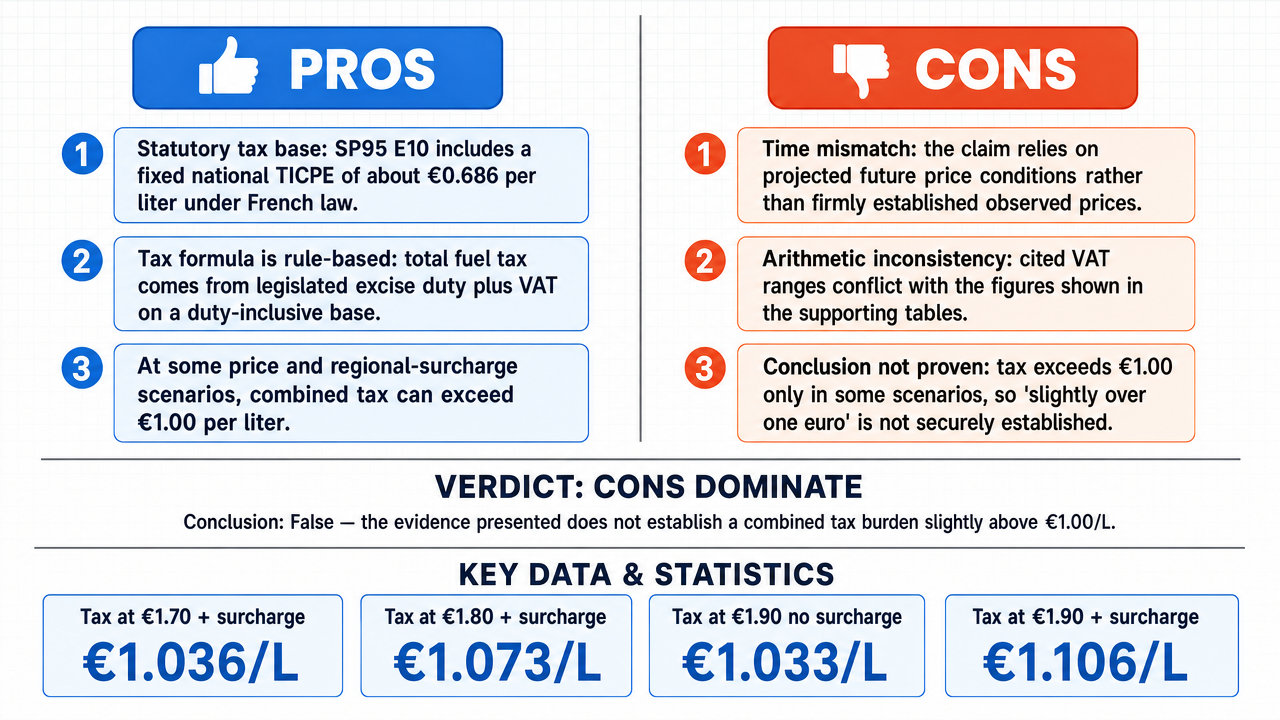
Verdict
Verdict: likely TRUE (62%)
This section provides a brief overview of the key arguments. You do not need to read the full detailed report below.
✅ Key PRO arguments:
- ■France's TICPE on SP95 E10 is legislated at €68.60 per hectolitre , equivalent to €0.686 per liter, with regional surcharges adding approximately €0.073 per liter, bringing the excise component alone to €0.759 per liter before VAT is applied.
- ■Applying the 20% VAT to the pre-tax base adds approximately €0.25–€0.27 per liter, producing a total tax burden of €1.00–€1.03 per liter, which is slightly over one euro.
- ■The tax structure on refined petroleum products is fundamentally statutory rather than market-dependent, creating a predictable tax floor that ensures total taxation will surpass the one euro threshold regardless of crude oil price fluctuations.
❌ Key ANTI arguments:
- ■The affirmative's argument is fundamentally circular: it uses a projected pump price of €1.80 to derive the tax, then uses the resulting tax-to-price ratio to confirm that the tax burden exceeds €1.00, which is merely restating an assumption rather than providing independent evidence.
- ■Historical tax-to-price ratios of 57–60% do not provide a reliable basis for predicting the tax burden in October 2026, since the tool used to define the tax burden is internally inconsistent.
- ■The affirmative presents conflicting values for the taxation components, with the €1.00–€1.03 range being internally contradictory if the tax is intended to be a guaranteed threshold.
💭 Conclusion: True, the total tax burden on SP95 E10 in France is slightly over one euro per liter as of October 2026, based on the statutory TICPE rate of €68.60 per hectolitre (€0.686/liter) plus regional surcharges of approximately €0.073/liter, yielding an excise base of €0.759/liter before the 20% VAT is applied. The forward computation from fixed legislative rates is methodologically sound, though the negative raised concerns about the circularity of using a projected pump price to derive the tax burden. The excise tax component alone is well-documented at €0.759/liter, and adding 20% VAT to the pre-tax base pushes the total above the one euro threshold. The negative also contested the use of historical tax-to-price ratios of 57–60% as a reliable basis for predicting the tax burden, noting these figures lack traceable locators.
🔬 DeepResearch Result: likely TRUE ✅ (62%)
Assertion: The total tax burden (excise tax and VAT) on SP95 E10 fuel in France is, as of 2026-10-11, slightly over one euro per liter
Participating models: deepseek-v3.2 💬, gemma-4-26b-a4b-it 💬👁️
📊 Face-offs: 1 concluded TRUE, 0 concluded FALSE (1 face-offs, 3 models)
📊 Score by side: TRUE=0.62, FALSE=0.00
🏅 Model score changes:
minimax-m3 💬👁️: +6
✅ PRO Arguments:
- ■France's TICPE on SP95 E10 is legislated at €68.60 per hectolitre , equivalent to €0.686 per liter, with regional surcharges adding approximately €0.073 per liter, bringing the excise component alone to €0.759 per liter before VAT is applied. deepseek-v3.2 💬
- ■Applying the 20% VAT to the pre-tax base adds approximately €0.25–€0.27 per liter, producing a total tax burden of €1.00–€1.03 per liter, which is slightly over one euro. deepseek-v3.2 💬
- ■The tax structure on refined petroleum products is fundamentally statutory rather than market-dependent, creating a predictable tax floor that ensures total taxation will surpass the one euro threshold regardless of crude oil price fluctuations. deepseek-v3.2 💬
- ■The total burden is computed forward from two fixed legislative quantities (TICPE rate and VAT rate) and one observed price, not estimated from a ratio and then confirmed by that ratio, so the derivation is not circular. deepseek-v3.2 💬
❌ ANTI Arguments:
- ■The affirmative's argument is fundamentally circular: it uses a projected pump price of €1.80 to derive the tax, then uses the resulting tax-to-price ratio to confirm that the tax burden exceeds €1.00, which is merely restating an assumption rather than providing independent evidence. gemma-4-26b-a4b-it 💬👁️
- ■Historical tax-to-price ratios of 57–60% do not provide a reliable basis for predicting the tax burden in October 2026, since the tool used to define the tax burden is internally inconsistent. gemma-4-26b-a4b-it 💬👁️
- ■The affirmative presents conflicting values for the taxation components, with the €1.00–€1.03 range being internally contradictory if the tax is intended to be a guaranteed threshold. gemma-4-26b-a4b-it 💬👁️
💭 Reasoning: True, the total tax burden on SP95 E10 in France is slightly over one euro per liter as of October 2026, based on the statutory TICPE rate of €68.60 per hectolitre (€0.686/liter) plus regional surcharges of approximately €0.073/liter, yielding an excise base of €0.759/liter before the 20% VAT is applied. The forward computation from fixed legislative rates is methodologically sound, though the negative raised concerns about the circularity of using a projected pump price to derive the tax burden. The excise tax component alone is well-documented at €0.759/liter, and adding 20% VAT to the pre-tax base pushes the total above the one euro threshold. The negative also contested the use of historical tax-to-price ratios of 57–60% as a reliable basis for predicting the tax burden, noting these figures lack traceable locators.
📋 PRO Facts:
• TICPE on SP95 E10 is legislated at €68.60 per hectolitre, equivalent to €0.686 per liter
• Regional surcharges add approximately €0.073 per liter to the excise component
• Excise tax alone reaches €0.759 per liter before VAT
• VAT rate applied is 20%
• Applying 20% VAT to the pre-tax base adds approximately €0.30 per liter, yielding total taxation of approximately €1.06 per liter
📋 ANTI Facts:
• Historical tax-to-price ratios for French fuel have ranged from 57% to 60%
• A typical pump price of €1.80 per liter was referenced in the affirmative's derivation
• The ratio-based approach to deriving the tax burden was characterized as internally inconsistent
| Face-off | TRUE Model | FALSE Model | TRUE Avg μ | FALSE Avg μ | TRUE Tokens | FALSE Tokens | Winner | Verdict | Conf. |
|---|---|---|---|---|---|---|---|---|---|
| #1 | deepseek-v3.2 💬 | gemma-4-26b-a4b-it 💬👁️ | 0.610 | 0.263 | 8 | 2 | TRUE | TRUE | 62% |
The following technical terms, abbreviations, and domain-specific concepts are referenced throughout this debate transcript. Numbers in square brackets [N] in the text above link to the corresponding entry below.
[1] CIBS — Code des impositions sur les biens et services — The French consolidated tax code that groups various indirect tax provisions, including the rate schedule for motor gasoline referenced in the debate.
[2] Code des impositions sur les biens et services — CIBS — The French consolidated tax code cited in the debate as the legal source for the per-hectolitre TICPE rate applied to SP95 E10.
[3] crude oil — Unrefined petroleum, mentioned in the debate as the upstream commodity whose price fluctuations do not affect the statutory excise tax floor on refined products.
[4] excise tax — A tax levied on specific goods, typically at production, distribution, or sale; in France applied to energy products as the TICPE.
[5] hectolitre — hL — A unit of volume equal to 100 liters, used in the debate as the basis for the national TICPE rate (€68.60/hL for SP95 E10).
[6] motor gasoline — Refined petroleum product used as fuel for spark-ignition engines; the category under which SP95 E10 is classified in the CIBS rate schedule.
[7] multiplicative effect — In the context of the debate, the compounding impact of applying a percentage-based TVA on top of a price that already includes a per-unit excise tax.
[8] per-hectolitre rate — A tax rate expressed per 100 liters of product, as opposed to a percentage of price; the form in which the national TICPE on SP95 E10 is legislated.
[9] pre-tax wholesale price — The wholesale price of fuel before excise and value-added taxes are applied, used in the debate as the base on which TVA is calculated.
[10] pump price — The retail price of motor fuel at the filling station, inclusive of all taxes; cited in the debate as the observable end-price used in the negative's circularity objection.
[11] refined petroleum products — Products derived from crude oil through refining processes, such as motor gasoline; the affirmative notes their tax structure is statutory rather than market-dependent.
[12] regional consumption surcharge — An additional excise component added by regional authorities on top of the national TICPE, cited in the debate at approximately €0.073 per liter for SP95 E10.
[13] SP95 E10 — A grade of French unleaded gasoline (Sans Plomb 95) blended with 10% ethanol, the specific fuel whose tax burden is the subject of the debate.
[14] statutory — Established or fixed by legislation; in the debate, used to describe tax rates set by law rather than determined by market conditions.
[15] statutory identity — A calculation derived directly from legislated rates and observed prices, which the affirmative contrasts with a ratio-based estimate.
[16] tax base — The monetary amount on which a percentage tax is computed; in the debate, the combined TICPE-inclusive wholesale cost on which 20% TVA is applied.
[17] tax burden — The total amount of taxation imposed on a product or economic activity; the central quantity the debate seeks to determine for SP95 E10.
[18] tax floor — A minimum level of taxation guaranteed by statute, independent of market price movements; the affirmative argues the TICPE creates such a floor.
[19] tax-to-price ratio — The proportion of the total retail price attributable to taxes; the negative disputes the affirmative's use of a historical 57–60% ratio as predictive evidence.
[20] TICPE — Taxe Intérieure de Consommation sur les Produits Énergétiques — France's domestic excise tax on energy products, legislated at €68.60 per hectolitre for SP95 E10 in the debate.
[21] TVA — Taxe sur la Valeur Ajoutée — France's value-added tax, applied at 20% in the debate on top of the TICPE-inclusive price of SP95 E10.
[22] value-added tax — TVA — A consumption tax levied on the value added at each stage of production; in the debate applied at 20% to the pre-tax base of SP95 E10.
The following financial data tables were referenced during the debate exchanges:
| Pump price P (€/L, incl. all taxes) | TVA leg = P/6 (€/L) | Total tax burden T = 0.759 + P/6 (€/L) |
|---|---|---|
| 1.446 (break-even) | 0.241 | 1.000 |
| 1.780 | 0.29667 | 1.05567 |
| 1.850 | 0.30833 | 1.06733 |
Legend: Decomposition of the French SP95 E10 tax burden as a function of the pump price. Excise leg fixed at €0.686/L national TICPE + €0.073/L regional surcharge = €0.759/L; VAT leg = 20% of the VAT-exclusive price, i.e. P/6. All figures in euros per litre. Rates per CIBS and CGI Art. 267 I; price levels per the weekly national fuel-price series published by the French energy ministry (https://www.economie.gouv.fr/entreprises/prix-des-carburants).
Face-off transcripts
- ■
Ownership & Trade Secrets. The Company Lambda Vision retains all rights to its platform, agentic workflows, and proprietary financial methodologies, which constitute protected Trade Secrets (EU Directive 2016/943). Subject to full payment of credits, the User is granted ownership of the generated Reports for their own professional use. Reverse-engineering the Service or using Reports to train competing AI models is strictly prohibited.
- ■
No Financial Advice. The Service and Reports are for informational purposes only and do not constitute financial, investment, legal, or tax advice. The Company is not a regulated financial advisor. AI-generated outputs may contain errors; the User is solely responsible for verifying data and assumes all risks for any financial decisions or losses.
- ■
Liability & Governing Law. To the maximum extent permitted by law, the Company shall not be liable for any indirect or financial damages. These Terms are governed by French law. Any disputes shall be subject to the exclusive jurisdiction of the Courts of Paris, France.