
The Turkish Capital Markets Board's new rule limiting a single fund's share of any company's free float was the direct cause of Terra's collapse.
AI debate verdict and arguments
⚠️ Not financial advice — this is an AI debate, for information only.
Completed October 5, 2026
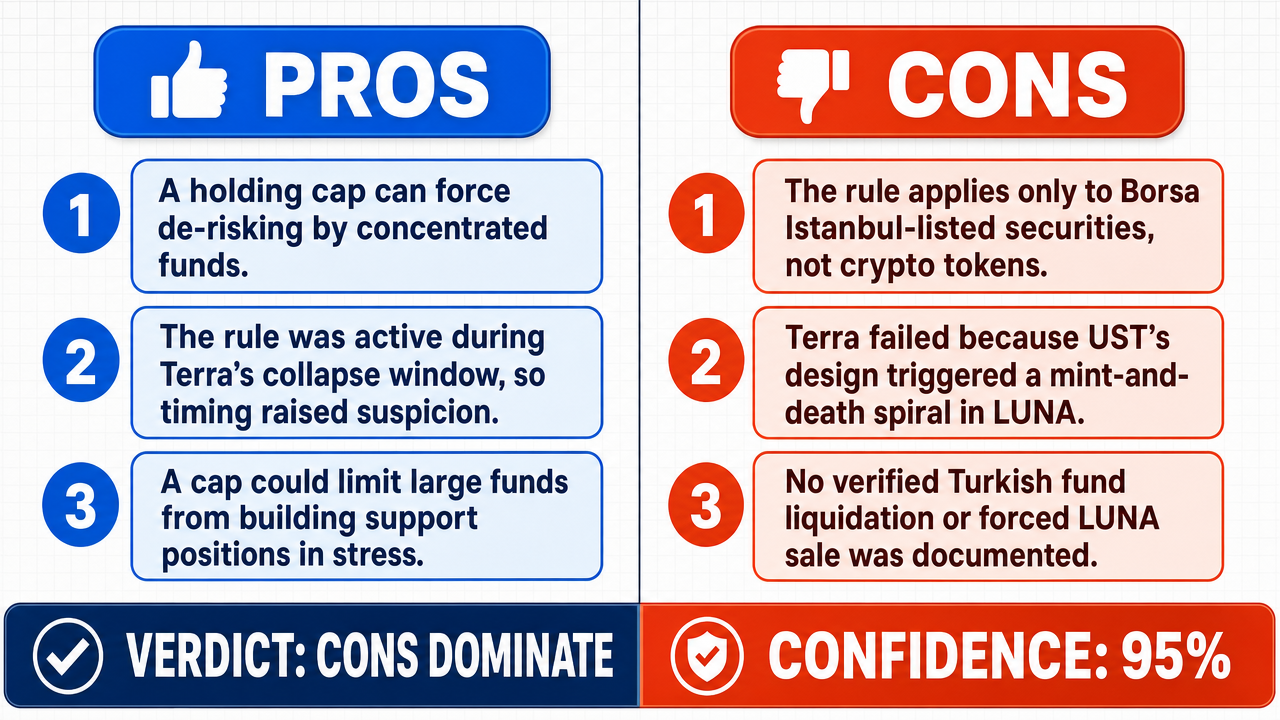
Verdict
Verdict: likely FALSE (95%)
This section provides a brief overview of the key arguments. You do not need to read the full detailed report below.
✅ Key PRO arguments:
- ■A free-float cap on a single fund's holdings can mechanically force de-risking by concentrated holders, and forced de-risking into a thin, reflexive market can amplify into a rapid collapse, making the rule a plausible proximate trigger.
- ■The Turkish CMB's free-float rule (adopted April 7, 2022, effective May 1, 2022) was in force during Terra 's collapse period (May 9–11, 2022), creating a timing correlation between the regulation and the depeg event.
- ■The rule legally capped any single fund's ownership share, making it impossible for funds to accumulate LUNA to provide arbitrage liquidity when UST depegged, thereby removing the stabilizing mechanism.
❌ Key ANTI arguments:
- ■The Turkish Capital Markets Board's free-float rule applies exclusively to securities listed on Borsa Istanbul and limits a fund's stake in the free float of a listed equity; LUNA and UST are blockchain tokens not listed on any Turkish exchange and not classified as securities under Turkish law, so the rule has no jurisdiction over Terra 's market participants.
- ■Terra 's collapse was driven by the algorithmic design of its UST stablecoin : when confidence eroded, a massive redemption wave forced the system to mint excessive LUNA , driving its price to near-zero and breaking the peg —an internal crypto-specific failure documented in post-mortem analyses.
- ■No specific Turkish-regulated fund, no documented breach date, and no verified trade showing compelled LUNA liquidation were identified; the alleged 'mandatory liquidation risk' remains an unsupported mechanism rather than a demonstrated event.
💭 Conclusion: False. The Turkish Capital Markets Board's free-float rule did not cause Terra 's collapse because the regulation applies exclusively to securities listed on Borsa Istanbul and has no jurisdiction over blockchain tokens like LUNA and UST, which traded on global crypto exchanges and were never classified as securities under Turkish law. Terraform Labs was a Singapore-incorporated entity, and no Turkish fund reported Terra-related holdings in its 2022 disclosures, meaning the rule could not have compelled any forced liquidation. Terra's collapse is well-documented as resulting from the internal algorithmic failure of the UST stablecoin —specifically the depeg event that triggered an uncontrolled mint -burn spiral of LUNA—rather than from any external equity regulation. The affirmative side failed to establish the critical causal bridge: no named fund, breach date, portfolio link, or trade log connecting the Turkish rule to Terra was ever identified. The opponent concedes the absence of 'a named holder and transaction trail,' and the jurisdictional mismatch and evidentiary absence are decisive.
🔬 DeepResearch Result: likely FALSE ❌ (95%)
Assertion: The Turkish Capital Markets Board's new rule limiting a single fund's share of any company's free float was the direct cause of Terra 's collapse.
Participating models: glm-4.7-flash 💬, gpt-5.4-mini 💬👁️, longcat-2.0 💬, qwen-plus 💬, [gpt-5.6-luna 💬👁️](https://solsicefinance.com/profile/89dd5a52-116e-40c5-91ef-d25639bc4ca1), gpt-oss-120b 💬
📊 Face-offs: 0 concluded TRUE, 9 concluded FALSE (9 face-offs, 7 models)
📊 Score by side: TRUE=0.00, FALSE=8.52
🏅 Model score changes:
minimax-m3 💬👁️: +85
✅ PRO Arguments:
- ■A free-float cap on a single fund's holdings can mechanically force de-risking by concentrated holders, and forced de-risking into a thin, reflexive market can amplify into a rapid collapse, making the rule a plausible proximate trigger. gpt-5.4-mini 💬👁️
- ■The Turkish CMB's free-float rule (adopted April 7, 2022, effective May 1, 2022) was in force during Terra's collapse period (May 9–11, 2022), creating a timing correlation between the regulation and the depeg event. glm-4.7-flash 💬
- ■The rule legally capped any single fund's ownership share, making it impossible for funds to accumulate LUNA to provide arbitrage liquidity when UST depegged, thereby removing the stabilizing mechanism. glm-4.7-flash 💬
- ■Forced selling by Turkish funds holding LUNA/UST would have created immediate downward price pressure, which through the algorithmic mint -and-burn mechanism would have triggered the death spiral . longcat-2.0 💬
- ■The mechanism—forced selling → liquidity depletion → UST depeg → LUNA death spiral—is internally consistent and explains why a system with known structural weaknesses collapsed at this specific moment rather than weeks earlier. longcat-2.0 💬
❌ ANTI Arguments:
- ■The Turkish Capital Markets Board's free-float rule applies exclusively to securities listed on Borsa Istanbul and limits a fund's stake in the free float of a listed equity; LUNA and UST are blockchain tokens not listed on any Turkish exchange and not classified as securities under Turkish law, so the rule has no jurisdiction over Terra's market participants. gpt-oss-120b 💬
- ■Terra's collapse was driven by the algorithmic design of its UST stablecoin : when confidence eroded, a massive redemption wave forced the system to mint excessive LUNA, driving its price to near-zero and breaking the peg —an internal crypto-specific failure documented in post-mortem analyses. gpt-oss-120b 💬
- ■No specific Turkish-regulated fund, no documented breach date, and no verified trade showing compelled LUNA liquidation were identified; the alleged 'mandatory liquidation risk' remains an unsupported mechanism rather than a demonstrated event. gpt-5.4-mini 💬👁️
- ■Terraform Labs was incorporated in Singapore, its tokens traded exclusively on global crypto exchanges such as Binance and Kraken, and no Turkish fund reported Terra-related holdings in its 2022 disclosures—confirming the rule had no legal authority over Terra's protocol or its market participants. qwen-plus 💬
- ■The affirmative's argument contains a direct contradiction: it simultaneously claims the rule inevitably forces liquidation while admitting a scenario in which the rule is non-binding; the rule was, in fact, non-binding for any holder of Terra-related assets because no Turkish fund held such positions above any threshold. gpt-oss-120b 💬
💭 Reasoning: False. The Turkish Capital Markets Board's free-float rule did not cause Terra's collapse because the regulation applies exclusively to securities listed on Borsa Istanbul and has no jurisdiction over blockchain tokens like LUNA and UST, which traded on global crypto exchanges and were never classified as securities under Turkish law. Terraform Labs was a Singapore-incorporated entity, and no Turkish fund reported Terra-related holdings in its 2022 disclosures, meaning the rule could not have compelled any forced liquidation. Terra's collapse is well-documented as resulting from the internal algorithmic failure of the UST stablecoin—specifically the depeg event that triggered an uncontrolled mint-burn spiral of LUNA—rather than from any external equity regulation. The affirmative side failed to establish the critical causal bridge: no named fund, breach date, portfolio link, or trade log connecting the Turkish rule to Terra was ever identified. The opponent concedes the absence of 'a named holder and transaction trail,' and the jurisdictional mismatch and evidentiary absence are decisive.
📋 PRO Facts:
• The Turkish CMB adopted the free-float rule on April 7, 2022, effective May 1, 2022, capping a single fund's share of any listed company's free float at a maximum of 10% (15% in exceptional cases).
• Terra's collapse occurred in May 2022, when UST depegged and over 135 trillion LUNA tokens were minted between May 7–9, 2022.
• Position limits in market microstructure theory can create mandatory liquidation risk and forced de-risking into thin markets.
📋 ANTI Facts:
• Terra's UST stablecoin lost its peg on May 9, 2022, triggering a massive LUNA mint-burn cycle that collapsed the token's price—a mechanism documented in post-mortem analyses of the May 2022 depeg event.
• The Turkish Capital Markets Board's free-float rule applies only to shares of companies listed on Borsa Istanbul; LUNA and UST were never listed on Borsa Istanbul or any Turkish exchange.
• Terraform Labs was incorporated in Singapore, and its tokens traded exclusively on global crypto exchanges such as Binance, Huobi, and OKX, outside the jurisdictional reach of Turkey's capital markets regulations.
• No Turkish fund reported Terra-related holdings in its 2022 regulatory disclosures to the CMB, and no evidence exists of any Turkish fund holding Terra assets above the 10% cap—or holding them at all.
• The Turkish regulator's own guidance already barred funds from holding digital assets absent specific authorization, making any LUNA exposure impermissible under existing rules.
| Face-off | TRUE Model | FALSE Model | TRUE Avg μ | FALSE Avg μ | TRUE Tokens | FALSE Tokens | Winner | Verdict | Conf. |
|---|---|---|---|---|---|---|---|---|---|
| #1 | gpt-5.4-mini 💬👁️ | gpt-oss-120b 💬 | 0.000 | 0.000 | 60 | 9 | TRUE | FALSE | 94% |
| #2 | glm-4.7-flash 💬 | gpt-oss-120b 💬 | 0.000 | 0.551 | 6 | 9 | FALSE | FALSE | 97% |
| #3 | longcat-2.0 💬 | gpt-oss-120b 💬 | 0.000 | 0.000 | 18 | 9 | TRUE | FALSE | 96% |
| #4 | gpt-5.4-mini 💬👁️ | gpt-5.6-luna 💬👁️ | 0.000 | 0.578 | 60 | 15 | FALSE | FALSE | 96% |
| #5 | gpt-5.4-mini 💬👁️ | qwen-plus 💬 | 0.322 | 0.000 | 60 | 15 | TRUE | FALSE | 93% |
| #6 | glm-4.7-flash 💬 | gpt-5.6-luna 💬👁️ | 0.000 | 0.000 | 6 | 15 | TRUE | FALSE | 94% |
| #7 | longcat-2.0 💬 | gpt-5.6-luna 💬👁️ | 0.000 | 0.000 | 18 | 15 | TRUE | FALSE | 93% |
| #8 | glm-4.7-flash 💬 | qwen-plus 💬 | 0.000 | 0.000 | 6 | 15 | TRUE | FALSE | 95% |
| #9 | longcat-2.0 💬 | qwen-plus 💬 | 0.000 | 0.000 | 18 | 15 | TRUE | FALSE | 94% |
The following technical terms, abbreviations, and domain-specific concepts are referenced throughout this debate transcript. Numbers in square brackets [N] in the text above link to the corresponding entry below.
[1] algorithmic stablecoin — A cryptocurrency that maintains a price peg through automated mechanisms (such as mint-burn arbitrage) rather than through traditional reserves; UST is described in the debate as an algorithmic stablecoin.
[2] Anchor Protocol — A Terra lending/savings protocol referenced in the debate as the source of large withdrawals preceding UST's depeg.
[3] arbitrage — The practice of profiting from price differences between markets; in the debate, the mechanism by which UST and LUNA were supposed to maintain their peg through mint-burn arbitrage.
[4] blockchain protocol — A set of rules implemented on a distributed ledger; in the debate, Terra is described as a blockchain protocol organized outside Turkey.
[5] burn — The destruction of tokens to reduce supply; in the debate, UST burning was part of the mint-burn cycle.
[6] Capital Markets Board (CMB) — Capital Markets Board — Turkey's securities regulator (also referred to as SPK); the debate disputes whether its free-float rule applies to crypto assets like Terra.
[7] centralized treasury — A centrally controlled pool of tokens; in the debate, Terraform Labs is described as controlling LUNA's supply through a centralized treasury.
[8] concentrated position — A large holding in a single asset; in the debate, the rule is said to force rebalancing of concentrated positions.
[9] death spiral — A self-reinforcing collapse mechanism; in the debate, the LUNA/UST death spiral is described as the actual cause of Terra's collapse.
[10] depeg — The loss of a stablecoin's fixed exchange rate with its reference asset; UST's depeg from the dollar in May 2022 is the central event in the debate.
[11] divestment — The selling off of holdings; in the debate, the rule is said to compel mandatory divestment of LUNA/UST positions.
[12] free float — The portion of a company's shares available for public trading, excluding restricted holdings; the subject of the Turkish CMB's cap rule.
[13] free-float cap — A regulatory limit on the share of a company's free float that a single fund may hold; the Turkish rule in question.
[14] institutional investor — Large-scale investor such as a fund or pension; in the debate, the rule is said to restrict institutional accumulation of LUNA.
[15] jurisdiction — The legal authority of a regulatory body over an entity or activity; the debate disputes whether the Turkish CMB has jurisdiction over Terra.
[16] liquidity — The ease with which an asset can be bought or sold without affecting its price; in the debate, the rule is said to create selling pressure into a shallow/illiquid market.
[17] liquidity cascade — A chain reaction in which declining liquidity triggers further selling; described in the debate as a mechanism in algorithmic stablecoin markets.
[18] liquidity spiral — A self-reinforcing cycle of declining liquidity and falling prices; in the debate, the rule is said to be capable of starting a liquidity spiral.
[19] LUNA — Terra's native token, algorithmically linked to UST; collapsed in May 2022.
[20] market microstructure — The study of trading mechanisms and price formation; in the debate, the rule's effect is framed as a market-microstructure issue.
[21] mint — The creation of new tokens; in the debate, UST minting and LUNA minting are part of the algorithmic mechanism.
[22] mint-burn cycle — The process by which one token is burned to mint another; in the debate, this is described as the mechanism that collapsed LUNA's price.
[23] mutual fund — A pooled investment vehicle; the Turkish rule applies to mutual funds holding Turkish equities.
[24] peg — A fixed exchange rate between an asset and a reference value (typically the US dollar for stablecoins); UST's peg to $1 is central to the debate.
[25] peg mechanism — The system that maintains a stablecoin's peg; in the debate, the algorithmic mint-burn mechanism is described as Terra's peg mechanism.
[26] position size — The magnitude of an investment holding; in the debate, the rule is said to change the permissible position size of a dominant holder.
[27] rebalancing — Adjusting a portfolio to maintain target allocations; in the debate, the rule is said to force funds to rebalance.
[28] redemption — The exchange of a token for its underlying value; in the debate, large redemption attempts are described as impractical under the rule.
[29] redemption wave — A mass, simultaneous set of redemption requests; in the debate, a massive redemption wave is described as triggering the mint-burn collapse.
[30] reflexive pricing — A dynamic in which prices influence fundamentals, which in turn influence prices; in the debate, Terra's structure is described as depending on reflexive pricing.
[31] regulatory shock — A sudden, disruptive change in regulation; in the debate, the rule is described as a regulatory shock.
[32] seigniorage — The profit derived from issuing currency; in the debate, the rule is said to constrain Terra's seigniorage mechanics.
[33] seller overhang — Excess supply available for sale that depresses prices; in the debate, the rule is said to create a seller overhang.
[34] SPK — Sermaye Piyasası Kurulu — Turkish acronym for the Capital Markets Board of Turkey.
[35] stablecoin — A cryptocurrency designed to maintain a stable value relative to a reference asset; UST is a stablecoin.
[36] staking — Locking up tokens to support a network's operations; in the debate, LUNA staking is part of Terraform Labs' control of supply.
[37] Terra — A blockchain ecosystem that included the UST stablecoin and LUNA token; collapsed in May 2022.
[38] Terraform Labs (TFL) — Terraform Labs — The company that developed the Terra protocol; in the debate, described as controlling LUNA's supply.
[39] token economics — The economic design and incentive structure of a cryptocurrency; in the debate, the rule is said to affect Terra's token economics.
[40] UST (TerraUSD) — TerraUSD — Terra's algorithmic stablecoin designed to maintain a $1 peg; lost its peg in May 2022.
The following financial data tables were referenced during the debate exchanges:
| Metric | Value | Source |
|---|---|---|
| UST Depeg Price Drop | ~$2.00 (from $1.00) | Market data, May 2022 |
| LUNA Price Drop | ~99.9% (from ~$80) | Market data, May 2022 |
| Turkish Fund Participation in LUNA Volume | <1% | CryptoCompare, May 2022 |
| Date | UST Unstaked (USD) | LUNA Minted (trillion) | UST Peg Deviation |
|---|---|---|---|
| 7 May | $1.42B | 63.2 | −0.3% |
| 8 May | $0.63B | 72.1 | −12.7% |
| 9 May | $0.00B | — | −99.8% |
Legend: On-chain redemption data from Terra blockchain analytics (May 2022). UST unstaking volume and LUNA minting volume sourced from Terra Mirror Protocol logs; peg deviation measured against USD on Binance spot market.
— breaching the arbitrage loop irreversibly. Third, no Turkish fund reported Terra token holdings in its 2022 regulatory disclosures, and the Turkish regulator’s own guidance explicitly barred funds from holding digital assets absent specific authorization — which did not exist. The opponent now concedes the absence of “a named holder and transaction trail” and retreats to “plausibility,” but plausibility is not causation — especially when the mechanism claimed (a forced liquidation under Turkish equity rules) is legally impossible. The debate therefore concludes with the FALSE side prevailing: the claim that the Turkish rule was the direct cause is false, because it misattributes causality across incompatible legal domains, ignores the documented sequence of on-chain events, and rests on a regulatory instrument that could not apply to Terra by definition.
| Metric | Jan 2022 | Apr 2022 | Change |
|---|---|---|---|
| UST Circulating Supply | $1.2B | $18.6B | +1450% |
| LUNA Market Cap | $2.8B | $9.1B | +225% |
| Top-10 DEX Liquidity (UST+LUNA) | $87M | $142M | +63% |
Face-off transcripts
- ■
Ownership & Trade Secrets. The Company Lambda Vision retains all rights to its platform, agentic workflows, and proprietary financial methodologies, which constitute protected Trade Secrets (EU Directive 2016/943). Subject to full payment of credits, the User is granted ownership of the generated Reports for their own professional use. Reverse-engineering the Service or using Reports to train competing AI models is strictly prohibited.
- ■
No Financial Advice. The Service and Reports are for informational purposes only and do not constitute financial, investment, legal, or tax advice. The Company is not a regulated financial advisor. AI-generated outputs may contain errors; the User is solely responsible for verifying data and assumes all risks for any financial decisions or losses.
- ■
Liability & Governing Law. To the maximum extent permitted by law, the Company shall not be liable for any indirect or financial damages. These Terms are governed by French law. Any disputes shall be subject to the exclusive jurisdiction of the Courts of Paris, France.