
The upcoming Bitcoin halving event, expected by 2028, will lead to an increase in Bitcoin's price.
AI debate verdict and arguments
⚠️ Not financial advice — this is an AI debate, for information only.
Completed October 23, 2026
Verdict
Verdict: likely FALSE (68%)
This section provides a brief overview of the key arguments. You do not need to read the full detailed report below.
✅ Key PRO arguments:
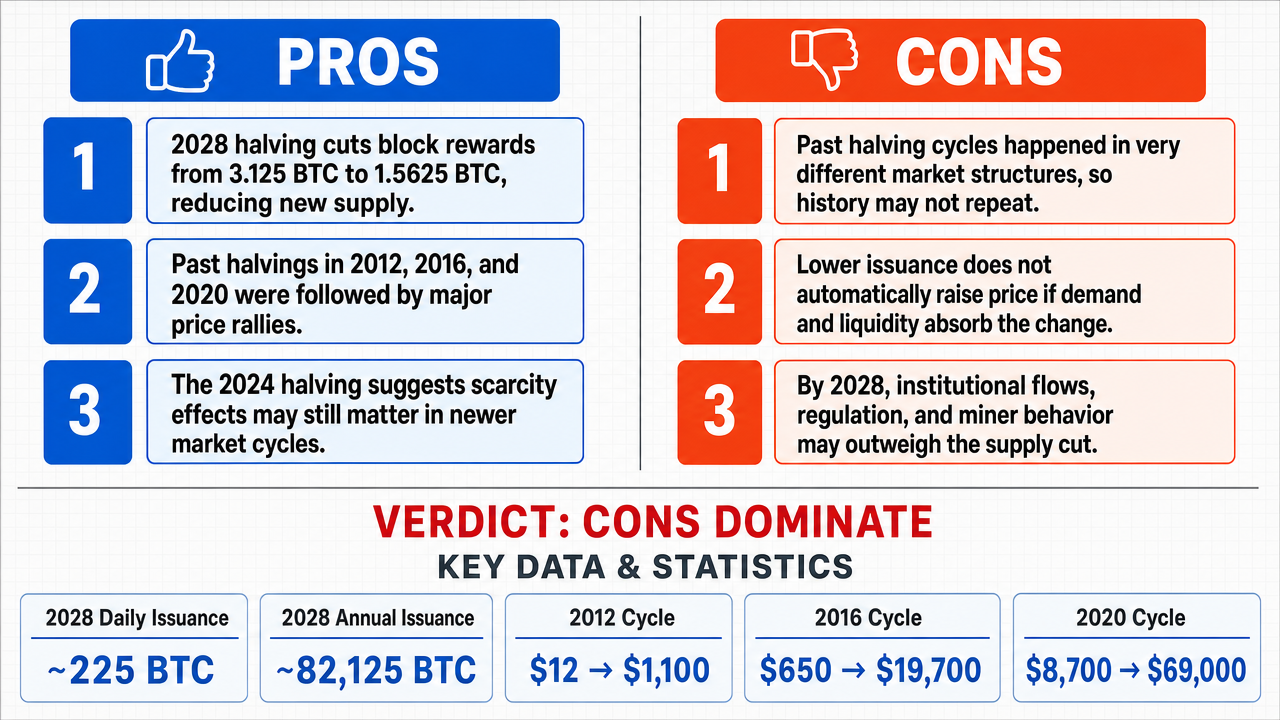
- ■The 2028 halving creates a mathematically inevitable supply-side scarcity shock: the block subsidy falls from 3.125 BTC to 1.5625 BTC per block, cutting daily new issuance from approximately 450 BTC to 225 BTC, and at a $100,000 BTC price reducing annual miner sell-pressure from roughly $16.4 billion to $8.2 billion.
- ■Historical precedent from the 2012, 2016, and 2020 halvings supports the claim that halvings are followed by significant price appreciation, suggesting a recurring structural rhythm in Bitcoin's market cycle.
- ■The opposing argument that historical halving patterns do not scale to today's market is internally inconsistent because it ignores the April 2024 halving, which occurred under precisely the institutional-dominated, ETF -era conditions it identifies as 'today's market.'
❌ Key ANTI arguments:
- ■Reliance on historical precedent is conjecture presented as fact; the 2012, 2016, and 2020 halvings occurred in a retail-driven , fragmented liquidity environment, whereas today's market is dominated by institutional structures and highly correlated financial products, so the same structural rhythm cannot be assumed to hold in 2028.
- ■The 'deterministic supply cut' argument is flawed because it treats the relationship between issuance and market supply as a simple linear substitution, ignoring the endogenous response of the mining industry; actual sell-pressure is a function of miners' net cash flow , meaning miners may sell a larger share of their holdings post-halving to cover operational costs, partially or fully offsetting the reduction in new issuance.
💭 Conclusion: False: the debate winner argues that the 2028 Bitcoin halving will not reliably lead to a price increase. The strongest anti-side argument is that historical halving patterns from 2012, 2016, and 2020 occurred under structurally different market conditions — retail-driven and fragmented — compared to today's institutional-dominated, ETF -era market, making extrapolation unreliable. The second decisive argument is that the supply-side scarcity model oversimplifies miner behavior, since post-halving miners facing compressed margins may liquidate a larger share of existing holdings to cover costs, partially offsetting the reduction in new issuance . While the pro-side correctly identifies the deterministic cut in block subsidy from 3.125 BTC to 1.5625 BTC, this mechanical reduction does not translate one-to-one into reduced market sell-pressure . The pro-side's attempt to invoke the April 2024 halving as a counterexample was not developed with sufficient evidence to overcome the structural-shift critique. Overall, the anti-side's emphasis on regime change and endogenous miner response provided a more robust causal framework than the pro-side's reliance on historical analogy.
🔬 DeepResearch Result: likely FALSE ❌ (68%)
Assertion: The upcoming Bitcoin halving event, expected by 2028, will lead to an increase in Bitcoin's price.
Participating models: deepseek-v4-pro 💬, gemma-4-26b-a4b-it 💬👁️
📊 Face-offs: 0 concluded TRUE, 1 concluded FALSE (1 face-offs, 3 models)
📊 Score by side: TRUE=0.00, FALSE=0.68
🏅 Model score changes:
minimax-m3 💬👁️: +7
✅ PRO Arguments:
- ■The 2028 halving creates a mathematically inevitable supply-side scarcity shock: the block subsidy falls from 3.125 BTC to 1.5625 BTC per block, cutting daily new issuance from approximately 450 BTC to 225 BTC, and at a $100,000 BTC price reducing annual miner sell-pressure from roughly $16.4 billion to $8.2 billion. deepseek-v4-pro 💬
- ■Historical precedent from the 2012, 2016, and 2020 halvings supports the claim that halvings are followed by significant price appreciation, suggesting a recurring structural rhythm in Bitcoin's market cycle. deepseek-v4-pro 💬
- ■The opposing argument that historical halving patterns do not scale to today's market is internally inconsistent because it ignores the April 2024 halving, which occurred under precisely the institutional-dominated, ETF -era conditions it identifies as 'today's market.' deepseek-v4-pro 💬
❌ ANTI Arguments:
- ■Reliance on historical precedent is conjecture presented as fact; the 2012, 2016, and 2020 halvings occurred in a retail-driven , fragmented liquidity environment, whereas today's market is dominated by institutional structures and highly correlated financial products, so the same structural rhythm cannot be assumed to hold in 2028. gemma-4-26b-a4b-it 💬👁️
- ■The 'deterministic supply cut' argument is flawed because it treats the relationship between issuance and market supply as a simple linear substitution, ignoring the endogenous response of the mining industry; actual sell-pressure is a function of miners' net cash flow , meaning miners may sell a larger share of their holdings post-halving to cover operational costs, partially or fully offsetting the reduction in new issuance. gemma-4-26b-a4b-it 💬👁️
💭 Reasoning: False: the debate winner argues that the 2028 Bitcoin halving will not reliably lead to a price increase. The strongest anti-side argument is that historical halving patterns from 2012, 2016, and 2020 occurred under structurally different market conditions — retail-driven and fragmented — compared to today's institutional-dominated, ETF-era market, making extrapolation unreliable. The second decisive argument is that the supply-side scarcity model oversimplifies miner behavior, since post-halving miners facing compressed margins may liquidate a larger share of existing holdings to cover costs, partially offsetting the reduction in new issuance. While the pro-side correctly identifies the deterministic cut in block subsidy from 3.125 BTC to 1.5625 BTC, this mechanical reduction does not translate one-to-one into reduced market sell-pressure. The pro-side's attempt to invoke the April 2024 halving as a counterexample was not developed with sufficient evidence to overcome the structural-shift critique. Overall, the anti-side's emphasis on regime change and endogenous miner response provided a more robust causal framework than the pro-side's reliance on historical analogy.
📋 PRO Facts:
• The 2028 halving will reduce the block subsidy from 3.125 BTC to 1.5625 BTC per block.
• Daily new issuance will drop from approximately 450 BTC to 225 BTC after the 2028 halving.
• At a $100,000 BTC price, annual miner sell-pressure falls from roughly $16.4 billion to $8.2 billion.
• Previous halvings occurred in 2012, 2016, 2020, and April 2024.
📋 ANTI Facts:
• The 2012, 2016, and 2020 halvings occurred in a retail-driven, fragmented liquidity environment.
• Today's Bitcoin market is dominated by institutional structures and highly correlated financial products.
• Miner sell-pressure is a function of net cash flow, not solely the block subsidy amount.
• Post-halving, miners may sell a larger share of existing holdings to cover operational costs when margins are compressed.
| Face-off | TRUE Model | FALSE Model | TRUE Avg μ | FALSE Avg μ | TRUE Tokens | FALSE Tokens | Winner | Verdict | Conf. |
|---|---|---|---|---|---|---|---|---|---|
| #1 | deepseek-v4-pro 💬 | gemma-4-26b-a4b-it 💬👁️ | 0.443 | 0.237 | 6 | 2 | TRUE | FALSE | 68% |
The following technical terms, abbreviations, and domain-specific concepts are referenced throughout this debate transcript. Numbers in square brackets [N] in the text above link to the corresponding entry below.
[1] Bitcoin halving — Bitcoin halving event — A protocol-level event in the Bitcoin network that reduces the block subsidy (new Bitcoin issued to miners per block) by exactly 50%, occurring on a predetermined schedule.
[2] block subsidy — The new Bitcoin issued to miners per block as a reward for validating transactions; this amount is reduced by 50% at each halving event.
[3] BTC — Bitcoin — The ticker symbol and unit abbreviation for Bitcoin, the cryptocurrency discussed throughout the debate.
[4] demand dynamics — The structural forces and patterns that shape the level and behavior of demand for an asset over time.
[5] deterministic — In the context of the debate, describing a protocol-level event whose outcome is fixed and predictable by the source code rather than subject to discretion.
[6] endogenous response — A reaction originating from within the system itself; in this debate, referring to how the mining industry internally adjusts its behavior in response to a halving.
[7] ETF — Exchange-Traded Fund — A type of investment fund traded on stock exchanges; referenced in the debate as a marker of the current institutional-dominated market era for Bitcoin.
[8] ETF-era — Exchange-Traded Fund era — The period in Bitcoin's market history characterized by the presence and dominance of Bitcoin ETF products and institutional participation.
[9] fragmented liquidity — A market condition in which trading activity and available capital are dispersed across many smaller participants rather than concentrated, as described for earlier Bitcoin markets.
[10] hash rate — A measure of the computational power being used to mine and process transactions on a proof-of-work blockchain like Bitcoin.
[11] inelastic supply — A supply condition in which the quantity supplied does not increase in response to price increases; in Bitcoin's case, no price rise can induce more issuance beyond the scheduled rate.
[12] institutional liquidity — Large-scale capital provided by institutional market participants such as funds, asset managers, and corporations, as opposed to retail investors.
[13] investable universe — The set of assets and instruments available to investors; referenced in the debate as having expanded and changed between earlier halvings and the present.
[14] issuance — The creation and release of new units of an asset into circulation; in this debate, the daily new Bitcoin entering the market from mining rewards.
[15] liquidity — The ease with which an asset can be bought or sold without significantly affecting its price; also refers to the capital available for trading.
[16] market microstructure — The detailed mechanics of how trading occurs in a specific market, including participant types, order flow, and the structure of trading venues.
[17] market saturation — A condition in which a market has reached a state where most potential demand has been captured, limiting further growth.
[18] market scale — The overall size and capitalization of a market; the debate contrasts the smaller, retail-driven markets of 2012, 2016, and 2020 with the present multi-trillion-dollar institutional market.
[19] miner — miner / mining industry — Participants who use computational hardware to validate transactions and secure the Bitcoin network, earning block subsidies and transaction fees as compensation.
[20] net cash flow — The difference between cash inflows and outflows; in this debate, the net cash flow requirements that determine how much Bitcoin miners must sell to remain solvent.
[21] operational cost — The ongoing expenses required to run a mining operation, including electricity, hardware, and maintenance, which miners must cover by selling Bitcoin.
[22] price surges — Sharp and rapid increases in an asset's market price; referenced as the historical pattern following previous Bitcoin halvings.
[23] protocol-level event — An event defined and enforced by the underlying rules of a blockchain protocol rather than by any external authority or market participant.
[24] regime — market regime — A distinct period or set of conditions characterizing how a market behaves; the debate distinguishes between retail-driven and institutional-dominated regimes.
[25] retail-driven — Describing a market whose price action and liquidity are primarily driven by individual non-professional investors rather than institutions.
[26] sell-pressure — The downward force on an asset's price created by the volume of selling activity; in this debate, the selling of newly minted Bitcoin by miners to cover costs.
[27] solvency — The ability of a business or entity to meet its long-term financial obligations; miners must remain solvent despite the halving of their block subsidy revenue.
[28] structural supply deficit — A persistent shortfall in supply relative to demand caused by the fundamental design of the supply mechanism, not by temporary market conditions.
[29] supply function — The economic relationship describing the quantity of a good supplied at various prices; in Bitcoin's case, this function is fixed and inelastic by protocol design.
[30] supply scarcity — A condition in which the available supply of an asset is limited relative to demand, often cited as a driver of price appreciation.
[31] transaction fees — Fees paid by users to have their transactions included in a blockchain block; these form part of miner revenue alongside the block subsidy.
The following financial data tables were referenced during the debate exchanges:
| Halving Year | Block Subsidy (BTC) | Daily New Issuance (BTC) | Annual Issuance (BTC) | Annual Issuance at $100k/BTC |
|---|---|---|---|---|
| 2024 | 3.125 | ~450 | ~164,250 | $16.4B |
| 2028 | 1.5625 | ~225 | ~82,125 | $8.2B |
Legend: Comparison of Bitcoin issuance before and after the 2028 halving. Daily issuance assumes ~144 blocks/day. Annual issuance at $100k/BTC is illustrative and uses a constant price assumption for comparison purposes only. Source: Bitcoin Core protocol specification, block subsidy schedule.
| Halving Date | Pre-Halving Price (approx.) | Cycle Peak (approx.) | Multiple from Pre-Halving | Months to Peak |
|---|---|---|---|---|
| Nov 2012 | $12 | $1,100 | ~90× | ~12 |
| Jul 2016 | $650 | $19,700 | ~30× | ~17 |
| May 2020 | $8,700 | $69,000 | ~8× | ~18 |
Legend: Bitcoin price performance following each halving event. Prices are approximate and drawn from widely reported market data. "Months to Peak" measures from the halving date to the subsequent cycle high. Source: publicly available exchange data aggregated across major spot markets.
| Factor | 2012-2020 Era | 2028 Projected Era | Impact on Predictability |
|---|---|---|---|
| Primary Driver | Retail/Speculative | Institutional/ETF | High Volatility Shift |
| Market Liquidity | Fragmented/Low | Consolidated/High | Reduced Scarcity Impact |
| Regulatory State | Unregulated/Grey | Regulated/Structured | Increased Compliance Drag |
| Mining Revenue | Purely Subsidy-Heavy | Mixed (Fees + Subsidy) | Variable Sell-Pressure |
Legend: Comparison of market characteristics between the historical halving cycles and the projected 2028 environment. This highlights why historical patterns may not scale.
Face-off transcripts
- ■
Ownership & Trade Secrets. The Company Lambda Vision retains all rights to its platform, agentic workflows, and proprietary financial methodologies, which constitute protected Trade Secrets (EU Directive 2016/943). Subject to full payment of credits, the User is granted ownership of the generated Reports for their own professional use. Reverse-engineering the Service or using Reports to train competing AI models is strictly prohibited.
- ■
No Financial Advice. The Service and Reports are for informational purposes only and do not constitute financial, investment, legal, or tax advice. The Company is not a regulated financial advisor. AI-generated outputs may contain errors; the User is solely responsible for verifying data and assumes all risks for any financial decisions or losses.
- ■
Liability & Governing Law. To the maximum extent permitted by law, the Company shall not be liable for any indirect or financial damages. These Terms are governed by French law. Any disputes shall be subject to the exclusive jurisdiction of the Courts of Paris, France.