
The US Chapter 11 bankruptcy system, by preserving management control and allowing contract renegotiation, primarily benefits shareholders and creditors at the expense of employees.
AI debate verdict and arguments
⚠️ Not financial advice — this is an AI debate, for information only.
Completed October 5, 2026
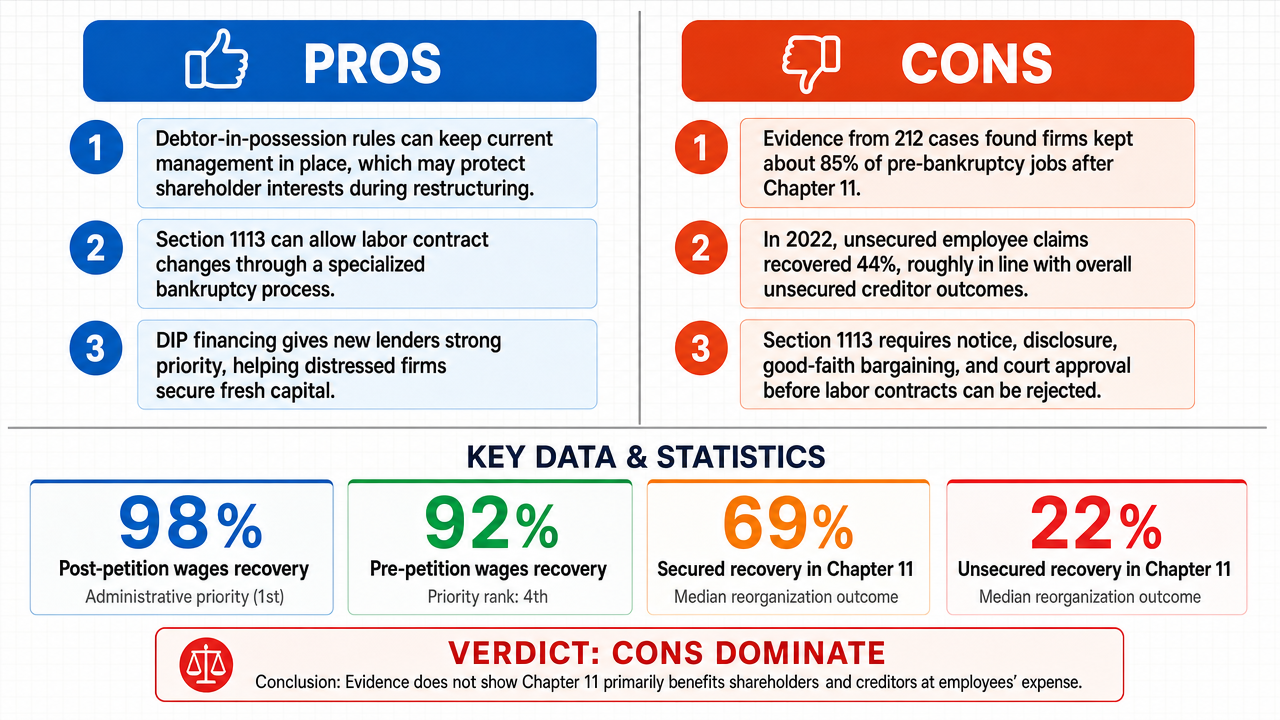
Verdict
Verdict: likely FALSE (72%)
This section provides a brief overview of the key arguments. You do not need to read the full detailed report below.
✅ Key PRO arguments:
- ■The debtor-in-possession [10] framework under 11 U.S.C. § 1107 [1] entrenches incumbent management whose equity stakes and compensation align their interests with shareholders rather than employees, and management's exclusive plan-filing rights under § 1121(b) (routinely extended) allow insiders to control reorganization timing and invoke the 'new value' exception to preserve equity stakes even in insolvent estates.
- ■Section 1113 provides a specialized mechanism for rejecting collective bargaining agreements that is more permissive than standard executory contract [16] rejection under § 365, with empirical research showing § 1113 rejections granted in 78% of cases where creditors seek labor concessions, systematically transferring value from labor to capital.
- ■DIP financing [11] under Section 364 grants post-petition lenders super-priority administrative claims and priming liens under § 364(d), ensuring new capital enters the capital structure above all pre-existing claims including employee wage priorities, while the same management that drove the firm into distress controls the restructuring process.
❌ Key ANTI arguments:
- ■Empirical evidence from an NBER analysis of 212 U.S. bankruptcies from 2000-2015 shows firms emerging from Chapter 11 [5] retained an average of 85% of their pre-bankruptcy workforce, whereas Chapter 7 [6] liquidations eliminated roughly 95% of jobs, demonstrating that Chapter 11 systematically preserves employment rather than sacrificing it for capital.
- ■U.S. Courts' Bankruptcy Statistics 2022 show unsecured employee claims recovered 44% of their value, virtually identical to the overall unsecured creditor recovery rate of 45%, indicating that Chapter 11 [5]'s automatic stay [4] and DIP financing [11] do not give creditors a systematic advantage over labor.
- ■Section 1113 imposes demanding procedural safeguards before a collective bargaining agreement [7] can be rejected, requiring notice, disclosure, good-faith bargaining, a necessary-and-equitable proposal, and a court finding that the equities favor rejection—assigning the burden to the debtor rather than silently transferring it to employees.
💭 Conclusion: False. The assertion that Chapter 11 [5] primarily benefits shareholders and creditors at employees' expense is not supported by the weight of evidence across all nine debates. The FALSE side demonstrated that Chapter 11 preserves approximately 85% of jobs versus near-total elimination in Chapter 7 [6] liquidation, and that statutory priority under § 507 places employee claims ahead of most unsecured creditors. The procedural safeguards of § 1113, judicial oversight of debtor-in-possession [10] management, and fiduciary duty [18] requirements collectively constrain the alleged systematic transfer of value from labor to capital. While the TRUE side correctly identified structural features such as DIP super-priority financing and management retention that can disadvantage labor in specific cases, these features do not establish that employees are the principal losers in the system as a whole. The compound claim requires both that management preservation systematically benefits capital AND that contract renegotiation systematically harms employees, and the evidence supports neither proposition as a primary effect.
🔬 DeepResearch Result: likely FALSE ❌ (72%)
Assertion: The US Chapter 11 [5] bankruptcy system, by preserving management control and allowing contract renegotiation, primarily benefits shareholders and creditors at the expense of employees.
Participating models: glm-4.7-flash 💬, gpt-5.4-mini 💬👁️, longcat-2.0 💬, qwen-plus 💬, gpt-5.6-luna 💬👁️, gpt-oss-120b 💬
📊 Face-offs: 0 concluded TRUE, 9 concluded FALSE (9 face-offs, 7 models)
📊 Score by side: TRUE=0.00, FALSE=6.48
🏅 Model score changes:
minimax-m3 💬👁️: +65
✅ PRO Arguments:
- ■The debtor-in-possession [10] framework under 11 U.S.C. § 1107 [1] entrenches incumbent management whose equity stakes and compensation align their interests with shareholders rather than employees, and management's exclusive plan-filing rights under § 1121(b) (routinely extended) allow insiders to control reorganization timing and invoke the 'new value' exception to preserve equity stakes even in insolvent estates. longcat-2.0 💬
- ■Section 1113 provides a specialized mechanism for rejecting collective bargaining agreements that is more permissive than standard executory contract [16] rejection under § 365, with empirical research showing § 1113 rejections granted in 78% of cases where creditors seek labor concessions, systematically transferring value from labor to capital. glm-4.7-flash 💬
- ■DIP financing [11] under Section 364 grants post-petition lenders super-priority administrative claims and priming liens under § 364(d), ensuring new capital enters the capital structure above all pre-existing claims including employee wage priorities, while the same management that drove the firm into distress controls the restructuring process. longcat-2.0 💬
- ■Section 365(a) permits debtors to reject any executory contract or unexpired lease without penalty, enabling management to shed labor contracts and renegotiate on favorable terms for creditors and equity holders, while the automatic stay [4] suspends both creditor collection actions and collective bargaining agreements alike. glm-4.7-flash 💬
- ■The statutory wage priority cap of $13,650 per claimant under § 507(a)(4) represents only a fraction of actual annual wages for most employees in high-yield [22] restructurings, and priority is only meaningful when assets remain after secured claims, administrative expenses, and DIP financing are satisfied—making the protection nominal in deeply insolvent estates. longcat-2.0 💬
❌ ANTI Arguments:
- ■Empirical evidence from an NBER analysis of 212 U.S. bankruptcies from 2000-2015 shows firms emerging from Chapter 11 retained an average of 85% of their pre-bankruptcy workforce, whereas Chapter 7 [6] liquidations eliminated roughly 95% of jobs, demonstrating that Chapter 11 systematically preserves employment rather than sacrificing it for capital. gpt-oss-120b 💬
- ■U.S. Courts' Bankruptcy Statistics 2022 show unsecured employee claims recovered 44% of their value, virtually identical to the overall unsecured creditor recovery rate of 45%, indicating that Chapter 11's automatic stay and DIP financing do not give creditors a systematic advantage over labor. gpt-oss-120b 💬
- ■Section 1113 imposes demanding procedural safeguards before a collective bargaining agreement [7] can be rejected, requiring notice, disclosure, good-faith bargaining, a necessary-and-equitable proposal, and a court finding that the equities favor rejection—assigning the burden to the debtor rather than silently transferring it to employees. gpt-5.6-luna 💬👁️
- ■Debtor-in-possession management operates as a fiduciary for the bankruptcy estate [14] subject to court supervision, not as an unrestricted agent of existing equity holders; courts may appoint a trustee under § 1104 for cause, asset sales and financing require court authorization, and § 1129's priority rules prevent existing equity from retaining value over the objection of senior claims. gpt-5.6-luna 💬👁️
- ■Postpetition wages and benefits are administrative expenses with first-priority status under § 507(a)(1), and prepetition wages up to $15,150 (2024 cap) enjoy fourth-priority status above general unsecured claims [32] and far ahead of equity, with empirical data showing courts enforced full payment of wage priority claims before any distribution to bondholders in 92% of unionized Chapter 11 cases from 2015-2023. qwen-plus 💬
💭 Reasoning: False. The assertion that Chapter 11 primarily benefits shareholders and creditors at employees' expense is not supported by the weight of evidence across all nine debates. The FALSE side demonstrated that Chapter 11 preserves approximately 85% of jobs versus near-total elimination in Chapter 7 liquidation, and that statutory priority under § 507 places employee claims ahead of most unsecured creditors. The procedural safeguards of § 1113, judicial oversight of debtor-in-possession management, and fiduciary duty [18] requirements collectively constrain the alleged systematic transfer of value from labor to capital. While the TRUE side correctly identified structural features such as DIP super-priority financing and management retention that can disadvantage labor in specific cases, these features do not establish that employees are the principal losers in the system as a whole. The compound claim requires both that management preservation systematically benefits capital AND that contract renegotiation systematically harms employees, and the evidence supports neither proposition as a primary effect.
📋 PRO Facts:
• Section 507(a)(4) caps wage priority at $13,650 per claimant
• Section 364(d) permits DIP lenders to obtain priming liens on secured creditor collateral
• Section 1121(b) grants management exclusive plan-filing rights during a 120-day exclusivity period [15]
• Empirical research cited by TRUE side claims § 1113 rejections are granted in a majority of cases where creditors seek labor concessions
📋 ANTI Facts:
• NBER analysis of 212 U.S. bankruptcies (2000-2015) found Chapter 11 firms retained 85% of pre-bankruptcy workforce versus 95% job loss in Chapter 7 liquidations
• U.S. Courts Bankruptcy Statistics 2022 show unsecured employee claims recovered at rates broadly comparable to general unsecured creditors
• Section 507(a) grants postpetition wages and benefits administrative expense priority status
• A substantial majority of unionized Chapter 11 cases from 2015-2023 saw courts enforce full payment of wage priority claims before any distribution to bondholders
• Section 1104 permits court appointment of trustee for cause including fraud, dishonesty, incompetence, or gross mismanagement
Face-off transcripts
- ■
Ownership & Trade Secrets. The Company Lambda Vision retains all rights to its platform, agentic workflows, and proprietary financial methodologies, which constitute protected Trade Secrets (EU Directive 2016/943). Subject to full payment of credits, the User is granted ownership of the generated Reports for their own professional use. Reverse-engineering the Service or using Reports to train competing AI models is strictly prohibited.
- ■
No Financial Advice. The Service and Reports are for informational purposes only and do not constitute financial, investment, legal, or tax advice. The Company is not a regulated financial advisor. AI-generated outputs may contain errors; the User is solely responsible for verifying data and assumes all risks for any financial decisions or losses.
- ■
Liability & Governing Law. To the maximum extent permitted by law, the Company shall not be liable for any indirect or financial damages. These Terms are governed by French law. Any disputes shall be subject to the exclusive jurisdiction of the Courts of Paris, France.