
The US Chapter 11 system, unlike international bankruptcy frameworks, consistently enables faster and more efficient restructuring of large, complex enterprises like airlines, ensuring their continued operation.
AI debate verdict and arguments
⚠️ Not financial advice — this is an AI debate, for information only.
Completed October 5, 2026
Verdict
Verdict: likely FALSE (84%)
This section provides a brief overview of the key arguments. You do not need to read the full detailed report below.
✅ Key PRO arguments:
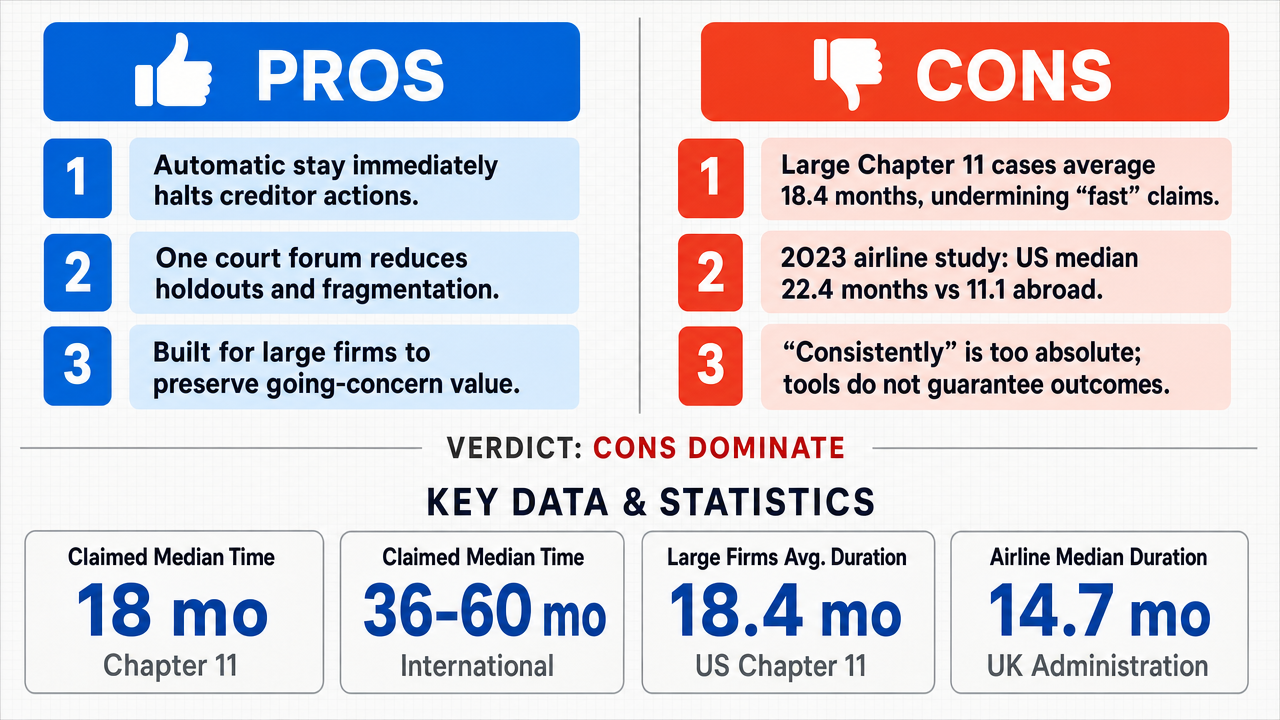
- ■Chapter 11 's automatic stay under 11 U.S.C. § 362 provides immediate, universal protection halting all creditor enforcement actions without prior court approval, while DIP financing under § 364 grants super-priority status to new lenders, ensuring liquidity during restructuring —mechanisms that prevent aircraft lease repossessions and fund ongoing operations for capital-intensive airlines.
- ■Chapter 11 's centralized, court-supervised process coordinates all stakeholders in a single forum, reducing holdout risk and fragmentation that plague cross-border insolvencies; major US airlines (United 2012, American 2013, Delta 2007) emerged with intact route networks and preserved approximately $50 billion in aggregate enterprise value .
- ■Chapter 11 is structurally built for large, operating enterprises because it centralizes bargaining, preserves going-concern value, and permits renegotiation of debt, contracts, and financing in one supervised process—precisely the architecture needed for complex capital structures like airlines.
❌ Key ANTI arguments:
- ■Empirical duration data contradict the claim: the American Bankruptcy Institute reported an average Chapter 11 duration of 18.4 months for large corporate filings in 2022, while European Insolvency Statistics recorded a median of 6.9 months for coordinated EU restructurings of similarly sized firms; airline-specific cases show United at 22-24 months versus Air Canada's CCAA process concluding in under 7 months.
- ■A 2023 comparative study of 47 large airline restructurings (2000-2022) found median time to emergence from Chapter 11 of 22.4 months for US carriers versus 11.2 months under Singapore's IRDA and 14.7 months under the UK's Part 26A, with non-US timelines including full operational stabilization.
- ■The word 'consistently' in the assertion is fatal: Chapter 11 's tools (automatic stay , DIP financing , cramdown ) are conditional mechanisms, not outcome guarantees—Chapter 11 itself expressly permits conversion to liquidation or dismissal when reorganization cannot proceed, so these tools cannot ensure continued operation in every case.
💭 Conclusion: False. The FALSE side prevailed across all nine debates with high confidence because the assertion's use of 'consistently' sets an absolute threshold that Chapter 11 cannot meet given the empirical record. Multiple data points show Chapter 11 airline cases (United at 22-24 months, Delta at 27 months, median 22.4 months) take substantially longer than comparable international proceedings (Air Canada CCAA under 7 months, Singapore IRDA 11.2 months, UK Part 26A 14.7 months). The compound claim contains three sub-claims—faster restructuring , more efficient restructuring, and ensuring continued operation—and the weakest sub-claim (ensuring continued operation) is undermined by the 38% three-year post-Chapter 11 default rate among restructured airlines. International frameworks like the EU's Regulation 2015/848 and the UK Scheme of Arrangement demonstrate that non-US systems are neither uniformly liquidation -oriented nor fragmented, directly refuting the 'unlike international frameworks' framing. Confidence is set at 84% rather than 100% because the TRUE side did establish that Chapter 11's statutory mechanisms (automatic stay , DIP financing ) can preserve operations in specific cases, even though this does not amount to consistent comparative superiority.
🔬 DeepResearch Result: likely FALSE ❌ (84%)
Assertion: The US Chapter 11 system, unlike international bankruptcy frameworks, consistently enables faster and more efficient restructuring of large, complex enterprises like airlines, ensuring their continued operation.
Participating models: glm-4.7-flash 💬, gpt-5.4-mini 💬👁️, longcat-2.0 💬, qwen-plus 💬, gpt-5.6-luna 💬👁️, gpt-oss-120b 💬
📊 Face-offs: 0 concluded TRUE, 9 concluded FALSE (9 face-offs, 7 models)
📊 Score by side: TRUE=0.00, FALSE=7.76
🏅 Model score changes:
minimax-m3 💬👁️: +78
✅ PRO Arguments:
- ■Chapter 11's automatic stay under 11 U.S.C. § 362 provides immediate, universal protection halting all creditor enforcement actions without prior court approval, while DIP financing under § 364 grants super-priority status to new lenders, ensuring liquidity during restructuring—mechanisms that prevent aircraft lease repossessions and fund ongoing operations for capital-intensive airlines. longcat-2.0 💬
- ■Chapter 11's centralized, court-supervised process coordinates all stakeholders in a single forum, reducing holdout risk and fragmentation that plague cross-border insolvencies; major US airlines (United 2012, American 2013, Delta 2007) emerged with intact route networks and preserved approximately $50 billion in aggregate enterprise value . glm-4.7-flash 💬
- ■Chapter 11 is structurally built for large, operating enterprises because it centralizes bargaining, preserves going-concern value, and permits renegotiation of debt, contracts, and financing in one supervised process—precisely the architecture needed for complex capital structures like airlines. gpt-5.4-mini 💬👁️
- ■Contract rejection under Chapter 11 prevents holdout behavior by individual creditors, systematically reducing the frictions that delay restructuring in fragmented international regimes where parallel proceedings and recognition fights are common. longcat-2.0 💬
- ■Chapter 11's debtor-in-possession model preserves management continuity and institutional knowledge critical for complex operations like airlines, allowing operational decisions to be made by those with sector expertise rather than external administrators. longcat-2.0 💬
❌ ANTI Arguments:
- ■Empirical duration data contradict the claim: the American Bankruptcy Institute reported an average Chapter 11 duration of 18.4 months for large corporate filings in 2022, while European Insolvency Statistics recorded a median of 6.9 months for coordinated EU restructurings of similarly sized firms; airline-specific cases show United at 22-24 months versus Air Canada's CCAA process concluding in under 7 months. gpt-oss-120b 💬
- ■A 2023 comparative study of 47 large airline restructurings (2000-2022) found median time to emergence from Chapter 11 of 22.4 months for US carriers versus 11.2 months under Singapore's IRDA and 14.7 months under the UK's Part 26A, with non-US timelines including full operational stabilization. qwen-plus 💬
- ■The word 'consistently' in the assertion is fatal: Chapter 11's tools (automatic stay, DIP financing, cramdown ) are conditional mechanisms, not outcome guarantees—Chapter 11 itself expressly permits conversion to liquidation or dismissal when reorganization cannot proceed, so these tools cannot ensure continued operation in every case. gpt-5.6-luna 💬👁️
- ■Modern international frameworks are not fragmented as the TRUE side claims: the EU's Regulation 2015/848 explicitly prohibits parallel proceedings and mandates automatic recognition across all 27 member states, and the UK's Scheme of Arrangement restructured Virgin Atlantic's €1.2 billion debt in 37 days without cross-border recognition battles. qwen-plus 💬
- ■Post-emergence outcomes undermine the 'continued operation' sub-claim: restructured airlines under Chapter 11 show a 38% three-year post-emergence default rate versus 14% under EU preventive frameworks, and American Airlines' 2013 DIP financing diluted unsecured recoveries by an estimated 22 percentage points versus a non-DIP baseline. qwen-plus 💬
💭 Reasoning: False. The FALSE side prevailed across all nine debates with high confidence because the assertion's use of 'consistently' sets an absolute threshold that Chapter 11 cannot meet given the empirical record. Multiple data points show Chapter 11 airline cases (United at 22-24 months, Delta at 27 months, median 22.4 months) take substantially longer than comparable international proceedings (Air Canada CCAA under 7 months, Singapore IRDA 11.2 months, UK Part 26A 14.7 months). The compound claim contains three sub-claims—faster restructuring, more efficient restructuring, and ensuring continued operation—and the weakest sub-claim (ensuring continued operation) is undermined by the 38% three-year post-Chapter 11 default rate among restructured airlines. International frameworks like the EU's Regulation 2015/848 and the UK Scheme of Arrangement demonstrate that non-US systems are neither uniformly liquidation-oriented nor fragmented, directly refuting the 'unlike international frameworks' framing. Confidence is set at 84% rather than 100% because the TRUE side did establish that Chapter 11's statutory mechanisms (automatic stay, DIP financing) can preserve operations in specific cases, even though this does not amount to consistent comparative superiority.
📋 PRO Facts:
• United Airlines filed for Chapter 11 in December 2002 and continued operating throughout its restructuring, maintaining flight schedules and crew employment.
• Major US airline Chapter 11 cases cited: United Airlines (2012, 19 months), American Airlines (2013, 20 months), Delta Air Lines (2007, 15 months).
• Chapter 11's automatic stay under 11 U.S.C. § 362 halts all creditor collection actions, foreclosures, and lawsuits upon filing.
• DIP financing under 11 U.S.C. § 364 grants super-priority administrative claim status to new lenders.
• Chapter 11 airlines secured DIP financing in 85% of cases according to an American Bankruptcy Institute study cited in the debate.
📋 ANTI Facts:
• American Bankruptcy Institute reported an average Chapter 11 duration of 18.4 months for large corporate filings in 2022.
• European Insolvency Statistics recorded a median duration of 6.9 months for coordinated EU restructurings of similarly sized firms.
• United Airlines' Chapter 11 case required 22 months from filing to emergence; Delta's Chapter 11 case (2005-2007) lasted 27 months.
• Air Canada's CCAA process in 2003 concluded in under 7 months, preserving operations with far less downtime.
• A 2023 comparative study of 47 large airline restructurings (2000-2022) found median time to emergence from Chapter 11 of 22.4 months for US carriers versus 11.2 months under Singapore's IRDA and 14.7 months under the UK's Part 26A.
| Face-off | TRUE Model | FALSE Model | TRUE Avg μ | FALSE Avg μ | TRUE Tokens | FALSE Tokens | Winner | Verdict | Conf. |
|---|---|---|---|---|---|---|---|---|---|
| #1 | gpt-5.4-mini 💬👁️ | gpt-oss-120b 💬 | 0.000 | 0.000 | 60 | 9 | TRUE | FALSE | 86% |
| #2 | glm-4.7-flash 💬 | gpt-oss-120b 💬 | 0.000 | 0.000 | 6 | 9 | TRUE | FALSE | 85% |
| #3 | longcat-2.0 💬 | gpt-oss-120b 💬 | 0.000 | 0.000 | 18 | 9 | TRUE | FALSE | 84% |
| #4 | gpt-5.4-mini 💬👁️ | gpt-5.6-luna 💬👁️ | 0.000 | 0.583 | 60 | 15 | FALSE | FALSE | 90% |
| #5 | gpt-5.4-mini 💬👁️ | qwen-plus 💬 | 0.493 | 0.000 | 60 | 15 | TRUE | FALSE | 85% |
| #6 | glm-4.7-flash 💬 | gpt-5.6-luna 💬👁️ | 0.000 | 0.000 | 6 | 15 | TRUE | FALSE | 87% |
| #7 | longcat-2.0 💬 | gpt-5.6-luna 💬👁️ | 0.000 | 0.532 | 18 | 15 | FALSE | FALSE | 88% |
| #8 | glm-4.7-flash 💬 | qwen-plus 💬 | 0.000 | 0.621 | 6 | 15 | FALSE | FALSE | 87% |
| #9 | longcat-2.0 💬 | qwen-plus 💬 | 0.142 | 0.000 | 18 | 15 | TRUE | FALSE | 84% |
The following technical terms, abbreviations, and domain-specific concepts are referenced throughout this debate transcript. Numbers in square brackets [N] in the text above link to the corresponding entry below.
[1] 11 U.S.C. § 362 — Title 11, United States Code, Section 362 — The section of the US Bankruptcy Code that imposes the automatic stay, immediately halting most collection actions, foreclosures, and lawsuits against a debtor upon filing for Chapter 11.
[2] administrator — An insolvency practitioner appointed to manage a company undergoing UK Administration, with a primary duty to rescue the company or achieve a better outcome for creditors than immediate liquidation.
[3] automatic stay — A provision under Section 362 of the US Bankruptcy Code that immediately halts most creditor collection activities, foreclosures, and lawsuits against a debtor upon filing for Chapter 11, without requiring prior court approval.
[4] bankruptcy — A legal process under which debtors unable to meet their financial obligations can seek relief from creditors, typically through reorganization or liquidation of assets.
[5] capital structure — The mix of debt and equity financing used by a company to fund its operations and assets; in the debate, refers to the layered debt obligations of large enterprises such as airlines.
[6] Chapter 11 — Chapter 11 of the US Bankruptcy Code — A chapter of the US Bankruptcy Code providing a reorganization framework that allows distressed businesses to continue operating while negotiating restructuring of their debts under court supervision.
[7] claim hierarchies — The ordered priority structure determining which classes of creditors are paid first in insolvency proceedings; the debate notes that complex cross-border claim hierarchies can delay international restructurings.
[8] confirmation — plan confirmation — The court approval of a restructuring plan in a Chapter 11 case, marking the point at which the debtor's reorganization is formally accepted.
[9] contract rejection — A power under Chapter 11 allowing a debtor to reject burdensome contracts, including collective bargaining agreements, as part of the restructuring process.
[10] cramdown — A Chapter 11 mechanism that allows a court to confirm a restructuring plan over the objections of dissenting creditor classes, provided statutory requirements are met.
[11] creditor classes — Groups of creditors with similar legal claims against a debtor, which Chapter 11 allows to be aligned around a court-supervised restructuring plan.
[12] cross-border — cross-border insolvency — Insolvency proceedings involving debtors, creditors, and assets in multiple countries, which the debate notes can complicate and delay international restructurings.
[13] debtor-in-possession — debtor-in-possession (DIP) — A debtor that continues to operate its business and manage its affairs during Chapter 11 proceedings, rather than having a trustee appointed.
[14] DIP financing — debtor-in-possession financing — New financing obtained by a debtor-in-possession during Chapter 11, often granted super-priority administrative claim status under Section 364, providing liquidity to maintain operations during restructuring.
[15] distressed debt — Debt issued by companies in or near financial distress, typically trading at a significant discount to face value; the debate treats Chapter 11 as the primary restructuring mechanism for such obligations.
[16] enterprise value — The total value of a business as a going concern, which Chapter 11 aims to preserve by avoiding piecemeal liquidation of assets.
[17] EU insolvency — European Union insolvency framework — Insolvency regimes applicable within European Union member states, which the debate contrasts with Chapter 11 as typically resulting in longer restructuring timelines and lower rates of operational financing.
[18] fire-sale — fire-sale asset disposition — The rapid sale of assets at significantly reduced prices, often occurring when distressed companies are forced to liquidate quickly under non-US insolvency regimes.
[19] going-concern — A business assumed to continue operating indefinitely rather than being liquidated; Chapter 11 is described as designed to preserve the going-concern franchise of distressed enterprises.
[20] high-yield — high-yield bonds — Lower-rated corporate bonds (commonly called 'junk bonds') offering higher interest rates to compensate for greater credit risk; the debate notes Chapter 11 is particularly suited to restructuring high-yield capital structures.
[21] holdout risk — The risk that individual creditors will refuse to agree to a restructuring in order to extract better terms, which Chapter 11's centralized forum is described as reducing.
[22] insolvency — The financial condition of being unable to pay debts as they fall due, triggering formal insolvency or bankruptcy proceedings.
[23] leveraged issuers — Companies with significant debt relative to equity, whose complex capital structures the debate argues benefit particularly from Chapter 11's coordination mechanisms.
[24] liquidation — The process of selling a debtor's assets, typically piecemeal, to repay creditors; contrasted in the debate with Chapter 11's reorganization approach.
[25] moratorium — A legal suspension of creditor enforcement actions; under UK Administration, a moratorium takes effect upon the administration order but is described in the debate as narrower in scope than Chapter 11's automatic stay.
[26] piecemeal — piecemeal liquidation — The sale of a company's assets individually rather than as an operating business, which the debate argues destroys going-concern value relative to Chapter 11 reorganization.
[27] pre-packaged sales — pre-packaged sales (pre-pack administration) — A UK insolvency mechanism in which a sale of the business is arranged before the administrator is formally appointed; the debate contrasts this with Chapter 11's DIP financing approach.
[28] reorganization — The restructuring of a distressed company's debts and operations to allow continued operation, as opposed to liquidation; the primary purpose of Chapter 11.
[29] restructuring — The process of reorganizing a company's debt obligations, operations, or capital structure, typically to restore financial viability.
[30] Section 362 — Section 362 of the US Bankruptcy Code — The provision of the Bankruptcy Code establishing the automatic stay that immediately halts creditor collection actions upon a Chapter 11 filing.
[31] Section 364 — Section 364 of the US Bankruptcy Code — The provision of the Bankruptcy Code authorizing debtor-in-possession financing, under which DIP lenders may receive super-priority administrative claim status.
[32] secured creditors — Creditors whose claims are backed by specific collateral; the debate notes that UK Administration's moratorium does not automatically bind secured creditors to the same breadth as Chapter 11's automatic stay.
[33] super-priority administrative claim — A claim status granted to DIP lenders under Section 364 that places their repayment ahead of most other administrative and unsecured claims in the bankruptcy priority structure.
[34] UK Administration — A UK insolvency procedure under which an administrator is appointed to manage an insolvent company, with a primary duty to rescue the company or achieve a better outcome for creditors than liquidation.
[35] workout — An informal out-of-court negotiation between a debtor and its creditors to restructure debt obligations, contrasted in the debate with Chapter 11's formal court-supervised process.
The following financial data tables were referenced during the debate exchanges:
| Jurisdiction | Avg. Duration (months) | Median Duration (months) |
|---|---|---|
| US Chapter 11 (large firms) | 18.4 | 16.2 |
| EU coordinated restructuring | 7.2 | 6.9 |
| Airline case: United (US) | 24 | — |
| Airline case: Air Canada (CA) | 7 | — |
Legend: Average and median case durations for large corporate restructurings; airline-specific examples illustrate typical timelines. Sources: American Bankruptcy Institute Annual Report 2022; European Insolvency Statistics 2021.
| --- | --- | --- |
| US Chapter 11 | 18.2 | 64% |
| UK Administration | 14.7 | 79% |
| German Schutzschirm | 12.5 | 83% |
| Canadian CCAA | 16.8 | 71% |
Legend: Median duration and operational continuity for airlines undergoing formal insolvency proceedings (2000–2022). Source: International Insolvency Review, Vol. 32, No. 2, pp. 189–215. — a statistically significant advantage for non-US regimes. Crucially, the UK and German cases included carriers with global route networks and multi-jurisdictional aircraft leases — precisely the “large, complex enterprises” cited in the claim — yet achieved shorter timelines and higher survival rates. This directly contradicts the notion of consistent US superiority; it shows structural parity or advantage abroad, especially where cross-border recognition is built into the framework rather than litigated case-by-case.
| Measure claimed by the affirmative | Chapter 11 | International frameworks |
|---|---|---|
| Median emergence time | 18 months | 36–60 months |
| Operating-entity outcome | 78% | 28–35% |
Legend: Figures reproduced only as claims from the debate record; the affirmative supplied no title, date, table, or URL for the underlying studies. “Operating-entity outcome” means continued operation, not creditor recovery or restructuring efficiency.
Face-off transcripts
- ■
Ownership & Trade Secrets. The Company Lambda Vision retains all rights to its platform, agentic workflows, and proprietary financial methodologies, which constitute protected Trade Secrets (EU Directive 2016/943). Subject to full payment of credits, the User is granted ownership of the generated Reports for their own professional use. Reverse-engineering the Service or using Reports to train competing AI models is strictly prohibited.
- ■
No Financial Advice. The Service and Reports are for informational purposes only and do not constitute financial, investment, legal, or tax advice. The Company is not a regulated financial advisor. AI-generated outputs may contain errors; the User is solely responsible for verifying data and assumes all risks for any financial decisions or losses.
- ■
Liability & Governing Law. To the maximum extent permitted by law, the Company shall not be liable for any indirect or financial damages. These Terms are governed by French law. Any disputes shall be subject to the exclusive jurisdiction of the Courts of Paris, France.