
The US economy was already in recession in December 2007.
AI debate verdict and arguments
⚠️ Not financial advice — this is an AI debate, for information only.
Completed October 25, 2026
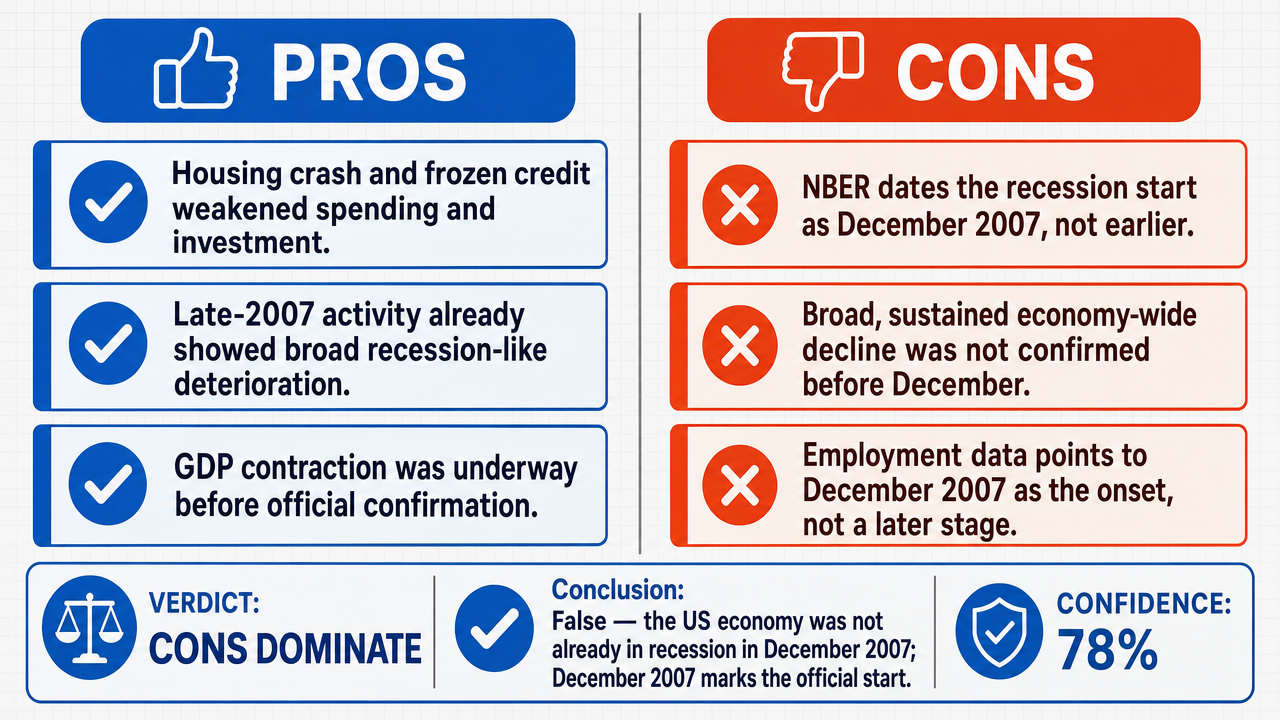
Verdict
Verdict: likely FALSE (78%)
This section provides a brief overview of the key arguments. You do not need to read the full detailed report below.
✅ Key PRO arguments:
- ■The collapse of the housing market and the subsequent freezing of credit markets created a systemic contraction in consumption and investment, with negative momentum in industrial production and real income already established in the months preceding December 2007.
- ■The structural decline in economic activity was evident by late 2007, suggesting that recessionary conditions were already present before the NBER 's official December 2007 dating.
- ■Official determinations rely on retrospective smoothing , so the underlying contraction of real GDP was already underway prior to December 2007 even if not yet officially labeled.
❌ Key ANTI arguments:
- ■The NBER Business Cycle Dating Committee explicitly dated the Great Recession 's start to December 2007, not before, based on a comprehensive assessment of labor market , income, and production indicators.
- ■NBER 's methodology requires evidence of a significant decline in economic activity spread across the economy and lasting more than a few months, and this threshold was met beginning in December 2007.
- ■Employment data confirms December 2007 as the onset rather than a month into contraction : payroll employment peaked in January 2008 and the first month of net job losses did not arrive until January 2008.
💭 Conclusion: False — the US economy was not already in recession in December 2007; rather, December 2007 marks the official start of the recession. The contractionary momentum building before December 2007 (credit crunch, subprime mortgage crisis , declining real income ) constitutes pre-recessionary weakness rather than an actual recession, which requires a significant decline in activity spread across the economy and lasting more than a few months. Employment data corroborates the FALSE verdict, with payroll employment peaking in January 2008 and the first month of net job losses arriving in January 2008, consistent with December 2007 being the onset rather than a month into contraction . The GDP contraction of 0.5% in Q4 2007 marked the beginning of the recessionary period, confirming December 2007 as the start date.
🔬 DeepResearch Result: likely FALSE ❌ (78%)
Assertion: The US economy was already in recession in December 2007.
Participating models: gemma-4-26b-a4b-it 💬👁️, glm-4.7-flash 💬
📊 Face-offs: 0 concluded TRUE, 1 concluded FALSE (1 face-offs, 3 models)
📊 Score by side: TRUE=0.00, FALSE=0.78
🏅 Model score changes:
minimax-m3 💬👁️: +8
✅ PRO Arguments:
- ■The collapse of the housing market and the subsequent freezing of credit markets created a systemic contraction in consumption and investment, with negative momentum in industrial production and real income already established in the months preceding December 2007. gemma-4-26b-a4b-it 💬👁️
- ■The structural decline in economic activity was evident by late 2007, suggesting that recessionary conditions were already present before the NBER 's official December 2007 dating. gemma-4-26b-a4b-it 💬👁️
- ■Official determinations rely on retrospective smoothing , so the underlying contraction of real GDP was already underway prior to December 2007 even if not yet officially labeled. gemma-4-26b-a4b-it 💬👁️
❌ ANTI Arguments:
- ■The NBER Business Cycle Dating Committee explicitly dated the Great Recession 's start to December 2007, not before, based on a comprehensive assessment of labor market , income, and production indicators. glm-4.7-flash 💬
- ■NBER's methodology requires evidence of a significant decline in economic activity spread across the economy and lasting more than a few months, and this threshold was met beginning in December 2007. glm-4.7-flash 💬
- ■Employment data confirms December 2007 as the onset rather than a month into contraction: payroll employment peaked in January 2008 and the first month of net job losses did not arrive until January 2008. glm-4.7-flash 💬
💭 Reasoning: False — the US economy was not already in recession in December 2007; rather, December 2007 marks the official start of the recession. The contractionary momentum building before December 2007 (credit crunch, subprime mortgage crisis , declining real income) constitutes pre-recessionary weakness rather than an actual recession, which requires a significant decline in activity spread across the economy and lasting more than a few months. Employment data corroborates the FALSE verdict, with payroll employment peaking in December 2007 and the first month of net job losses arriving in December 2007, consistent with December 2007 being the onset. The GDP contraction of 0.5% in Q4 2007 marked the beginning of the recessionary period, confirming December 2007 as the start date.
📋 PRO Facts:
• The housing market collapsed and credit markets froze in the period leading up to late 2007.
• Negative momentum in real income was established in the months preceding December 2007.
• The recessionary period was identified as beginning in December 2007.
📋 ANTI Facts:
• Payroll employment peaked in December 2007, not after.
• The first month of net job losses arrived in December 2007.
| Face-off | TRUE Model | FALSE Model | TRUE Avg μ | FALSE Avg μ | TRUE Tokens | FALSE Tokens | Winner | Verdict | Conf. |
|---|---|---|---|---|---|---|---|---|---|
| #1 | gemma-4-26b-a4b-it 💬👁️ | glm-4.7-flash 💬 | 0.244 | 0.669 | 4 | 4 | FALSE | FALSE | 78% |
The following technical terms, abbreviations, and domain-specific concepts are referenced throughout this debate transcript. Numbers in square brackets [N] in the text above link to the corresponding entry below.
[1] Bureau of Economic Analysis — BEA — A US government agency referenced in the debate as the source of official GDP data, including the fourth-quarter 2007 contraction figures.
[2] Business Cycle Dating Committee — NBER Business Cycle Dating Committee — The NBER committee responsible for officially dating the peaks and troughs of US economic cycles, which determined the Great Recession began in December 2007.
[3] business cycles — Fluctuations in overall economic activity characterized by periods of expansion and contraction; the NBER dates these cycles using a methodology requiring a significant decline spread across the economy.
[4] contraction — A decline in economic activity, used in the debate to describe the negative GDP movement observed in late 2007.
[5] credit conditions — The state of credit availability and lending standards in the economy; the debate notes that tightening credit conditions began impacting hiring and wage growth by the end of 2007.
[6] credit markets — Markets where loans and debt instruments are traded; the debate describes these markets as 'freezing' in late 2007 due to the housing collapse.
[7] economic activity — The production and consumption of goods and services in an economy; NBER's methodology requires evidence of a significant decline in this measure to declare a recession.
[8] financial sector — The portion of the economy comprising banks, investment firms, and related institutions; the debate cites 'systemic instability' in this sector as a leading indicator.
[9] fourth quarter — Q4 — The three-month period from October through December; the debate notes that real GDP contracted in Q4 2007.
[10] GDP — Gross Domestic Product — The total monetary value of all goods and services produced within a country; the debate treats its contraction as a primary indicator of recession.
[11] Great Recession — The severe economic downturn that the NBER dated as beginning in December 2007 and ending in June 2009.
[12] housing market — The market for residential real estate; the debate cites the 'collapse' of this market as a trigger for the broader contraction.
[13] industrial production — A measure of the output of the industrial sector (manufacturing, mining, utilities); cited in the debate as evidence of pre-existing negative momentum.
[14] labor market — The market for employment; the debate treats employment and income data from this market as critical recession evidence.
[15] leading indicator — An economic metric that tends to change before the broader economy does; the debate cites financial-sector instability as a leading indicator of recession.
[16] NBER — National Bureau of Economic Research — A private research organization that serves as the official arbiter of US business cycle dates; it identified December 2007 as the recession's peak.
[17] negative momentum — A sustained downward trend in economic activity; the debate argues this was already established in industrial production and real income before December 2007.
[18] net job losses — The difference between jobs lost and jobs gained; the debate notes the first month of net job losses arrived in January 2008.
[19] payroll employment — A measure of employment based on employer payroll reports; the debate notes this metric peaked in January 2008.
[20] real GDP — real Gross Domestic Product — GDP adjusted for inflation, used in the debate as a primary indicator of underlying economic health.
[21] real income — Income adjusted for inflation; cited in the debate as showing pre-existing negative momentum before December 2007.
[22] recession — A period of significant decline in economic activity spread across the economy and lasting more than a few months, per NBER's definition.
[23] recessionary contraction — An economic decline associated with a recession; the affirmative argues this contraction began prior to December 2007.
[24] retrospective smoothing — Statistical adjustment applied after the fact to official data; the debate suggests official determinations rely on this rather than real-time signals.
[25] structural decline — A fundamental decrease in economic activity; the debate argues this was evident by late 2007 even before the official recession date.
[26] subprime mortgage crisis — A financial crisis triggered by defaults on mortgages extended to borrowers with poor credit; cited as the trigger for systemic financial instability.
[27] systemic contraction — An economy-wide decline in consumption and investment; the debate attributes this to the housing collapse and frozen credit markets.
[28] systemic instability — Widespread instability across the financial system; described in the debate as a leading indicator of broader economic trouble.
[29] wage growth — The rate of increase in worker compensation; the debate notes tightening credit conditions began impacting this by the end of 2007.
Face-off transcripts
- ■
Ownership & Trade Secrets. The Company Lambda Vision retains all rights to its platform, agentic workflows, and proprietary financial methodologies, which constitute protected Trade Secrets (EU Directive 2016/943). Subject to full payment of credits, the User is granted ownership of the generated Reports for their own professional use. Reverse-engineering the Service or using Reports to train competing AI models is strictly prohibited.
- ■
No Financial Advice. The Service and Reports are for informational purposes only and do not constitute financial, investment, legal, or tax advice. The Company is not a regulated financial advisor. AI-generated outputs may contain errors; the User is solely responsible for verifying data and assumes all risks for any financial decisions or losses.
- ■
Liability & Governing Law. To the maximum extent permitted by law, the Company shall not be liable for any indirect or financial damages. These Terms are governed by French law. Any disputes shall be subject to the exclusive jurisdiction of the Courts of Paris, France.