
The VIX (Volatility Index) will experience a significant spike by October 21, 2026, triggered by a 'scary' event.
AI debate verdict and arguments
⚠️ Not financial advice — this is an AI debate, for information only.
Completed October 8, 2026
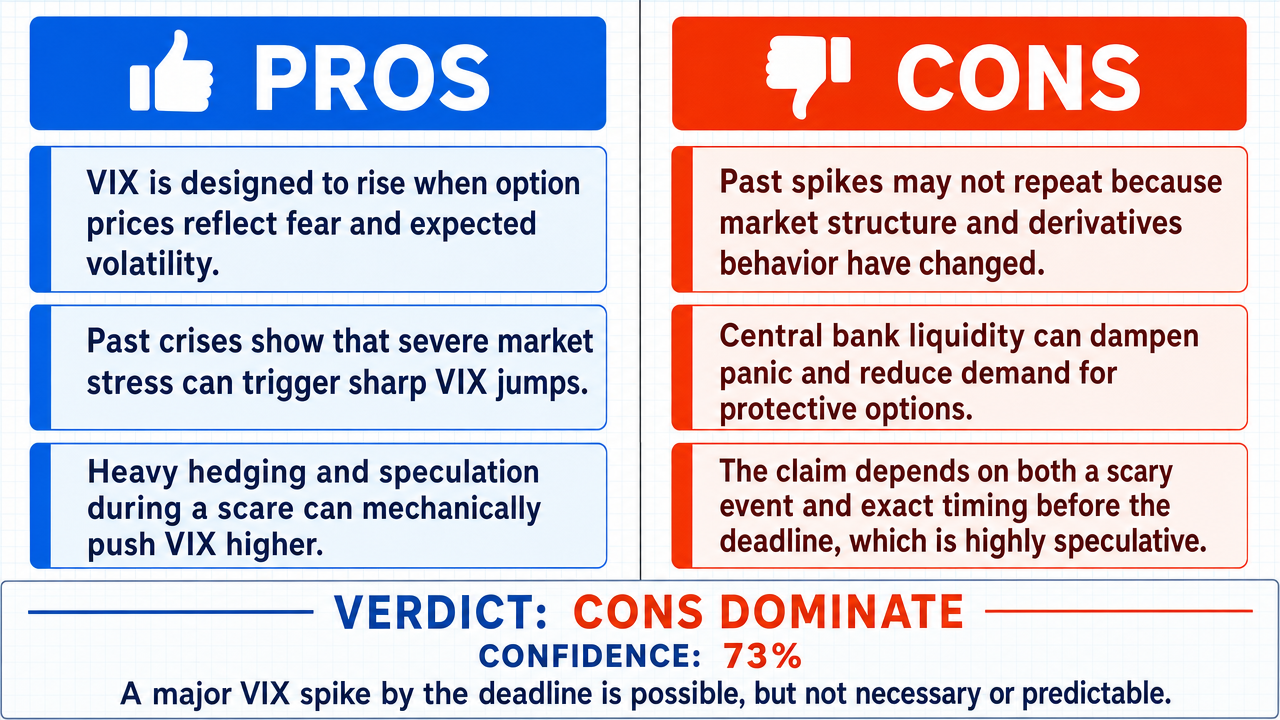
Verdict
Verdict: likely FALSE (73%)
This section provides a brief overview of the key arguments. You do not need to read the full detailed report below.
✅ Key PRO arguments:
- ■The VIX is a forward-looking index derived from S&P 500 options prices measuring expected 30-day volatility , and its design inherently amplifies during market stress as option demand surges and implied volatility rises.
- ■Historical evidence shows consistent dramatic VIX spikes during major crises: 80.86 in 2008, 82.69 in March 2020, and 48.00 during the 2011 US debt ceiling crisis, demonstrating a persistent structural relationship between scary events and volatility spikes.
- ■The derivatives market structure mechanically ensures that any scary event triggering widespread hedging and speculation will translate into a VIX spike, as the index directly reflects option pricing dynamics.
❌ Key ANTI arguments:
- ■The affirmative's reliance on historical volatility spikes is a fallacy of non-invariance: the investable universe , structural composition of the derivatives market , scale of liquidity, prevalence of algorithmic HFT, and volume of institutional hedging through complex multi-asset derivatives have undergone massive transformations since the cited crises, meaning the market impact of a single scary event is processed differently.
- ■Central bank interventions can decouple market shocks from volatility spikes by providing liquidity that preemptively suppresses the demand for protective options , undermining the mechanical link between scary events and VIX spikes.
- ■The claim requires predicting both the occurrence of a specific scary event and its precise timing by October 2026, which is inherently speculative; the exhaustive set of possible drivers does not guarantee that any particular shock will materialize within that timeframe.
💭 Conclusion: False. The VIX will not necessarily experience a significant spike by October 21, 2026 triggered by a scary event. The FALSE side's strongest argument is that structural transformations in the derivatives market have altered how shocks translate into volatility. Additionally, central bank intervention capabilities can preemptively suppress VIX spikes, decoupling scary events from the mechanical response the affirmative assumes. The affirmative's reliance on historical precedents like the 2008, 2020, and 2011 spikes fails to account for these structural changes. The compound nature of the claim—requiring both a specific scary event to occur and a significant VIX spike to result—further weakens the affirmative's position, as neither sub-claim is independently guaranteed.
🔬 DeepResearch Result: likely FALSE ❌ (73%)
Assertion: The VIX (Volatility Index) will experience a significant spike by October 21, 2026, triggered by a 'scary' event.
Participating models: deepseek-v3.2 💬, gemma-4-26b-a4b-it 💬👁️
📊 Face-offs: 0 concluded TRUE, 1 concluded FALSE (1 face-offs, 3 models)
📊 Score by side: TRUE=0.00, FALSE=0.73
🏅 Model score changes:
minimax-m3 💬👁️: +7
✅ PRO Arguments:
- ■The VIX is a forward-looking index derived from S&P 500 options prices measuring expected 30-day volatility , and its design inherently amplifies during market stress as option demand surges and implied volatility rises. deepseek-v3.2 💬
- ■Historical evidence shows consistent dramatic VIX spikes during major crises: 80.86 in 2008, 82.69 in March 2020, and 48.00 during the 2011 US debt ceiling crisis, demonstrating a persistent structural relationship between scary events and volatility spikes. deepseek-v3.2 💬
- ■The derivatives market structure mechanically ensures that any scary event triggering widespread hedging and speculation will translate into a VIX spike, as the index directly reflects option pricing dynamics. deepseek-v3.2 💬
❌ ANTI Arguments:
- ■The affirmative's reliance on historical volatility spikes is a fallacy of non-invariance: the investable universe , structural composition of the derivatives market, scale of liquidity, prevalence of algorithmic HFT, and volume of institutional hedging through complex multi-asset derivatives have undergone massive transformations since the cited crises, meaning the market impact of a single scary event is processed differently. gemma-4-26b-a4b-it 💬👁️
- ■Central bank interventions can decouple market shocks from volatility spikes by providing liquidity that preemptively suppresses the demand for protective options, undermining the mechanical link between scary events and VIX spikes. gemma-4-26b-a4b-it 💬👁️
- ■The claim requires predicting both the occurrence of a specific scary event and its precise timing by October 2026, which is inherently speculative; the exhaustive set of possible drivers does not guarantee that any particular shock will materialize within that timeframe. gemma-4-26b-a4b-it 💬👁️
💭 Reasoning: False. The VIX will not necessarily experience a significant spike by October 21, 2026 triggered by a scary event. The FALSE side's strongest argument is that structural transformations in the derivatives market have altered how shocks translate into volatility. Additionally, central bank intervention capabilities can preemptively suppress VIX spikes, decoupling scary events from the mechanical response the affirmative assumes. The affirmative's reliance on historical precedents like the 2008, 2020, and 2011 spikes fails to account for these structural changes. The compound nature of the claim—requiring both a specific scary event to occur and a significant VIX spike to result—further weakens the affirmative's position, as neither sub-claim is independently guaranteed.
📋 PRO Facts:
• The VIX reached a peak during the 2008 financial crisis.
• The VIX reached a peak in March 2020 during COVID-19 pandemic fears.
• The VIX reached a peak during the 2011 US debt ceiling crisis.
• The VIX is derived from S&P 500 options prices and measures expected 30-day volatility.
📋 ANTI Facts:
• Central bank intervention can preemptively suppress VIX spikes even during scary events.
• Structural transformations in the derivatives market have altered how shocks translate into volatility.
| Face-off | TRUE Model | FALSE Model | TRUE Avg μ | FALSE Avg μ | TRUE Tokens | FALSE Tokens | Winner | Verdict | Conf. |
|---|---|---|---|---|---|---|---|---|---|
| #1 | deepseek-v3.2 💬 | gemma-4-26b-a4b-it 💬👁️ | 0.276 | 0.240 | 12 | 3 | TRUE | FALSE | 73% |
The following technical terms, abbreviations, and domain-specific concepts are referenced throughout this debate transcript. Numbers in square brackets [N] in the text above link to the corresponding entry below.
[1] 30-day volatility — A measure of expected price fluctuation over a one-month horizon, commonly used as the reference period for the VIX index.
[2] Algorithmic trading — The use of computer programs to automatically execute trades based on predefined criteria, often at high speed and frequency.
[3] Central bank interventions — Actions taken by a central bank (such as the Federal Reserve) to influence financial conditions, often through liquidity provision or asset purchases during periods of market stress.
[4] Demand for protection — In options markets, the buying of put options or other hedging instruments to insure against potential losses, which tends to rise during periods of market stress.
[5] Derivatives market — A financial market where instruments such as options, futures, and swaps are traded, with values derived from underlying assets like stocks, bonds, or indices.
[6] Fallacy of non-invariance d'échelle — scale invariance fallacy — A logical error in which one assumes that a statistical relationship observed at one scale or market regime remains valid at a fundamentally different scale, such as extrapolating historical correlations from a smaller, less liquid market to today's much larger derivatives market.
[7] Federal Reserve — Fed — The central bank of the United States, responsible for monetary policy and often intervening in financial markets during crises.
[8] Feedback loop — A self-reinforcing cycle in which an initial market movement triggers further movements in the same direction, such as hedging demand driving up implied volatility, which in turn drives further hedging.
[9] Forward-looking index — An index that reflects market expectations of future conditions rather than past or current values; the VIX is forward-looking because it prices expected 30-day volatility.
[10] Hedging — A risk management strategy in which an investor takes a position to offset potential losses in another asset, commonly executed through derivatives such as options.
[11] High-frequency trading — HFT — A form of algorithmic trading characterized by extremely rapid execution of large numbers of orders, often providing liquidity and absorbing market shocks.
[12] Implied volatility — IV — The market's forecast of a security's likely price fluctuation, derived from the market price of an option; a key input in the VIX calculation.
[13] Institutional hedging — Risk-offsetting strategies employed by large financial institutions, often using complex multi-asset derivatives to manage portfolio-level exposures.
[14] Investable universe — The total set of financial instruments available to investors; its expansion over time has changed the scale and liquidity of the derivatives market.
[15] Liquidity density — The concentration of available trading liquidity at various price levels in a market, affecting how easily large orders can be absorbed without significant price impact.
[16] Liquidity injections — The introduction of new money into the financial system by a central bank, typically through asset purchases or lending facilities, intended to stabilize markets during stress.
[17] Liquidity provision — The act of placing orders to facilitate trading, typically by market makers, thereby enabling other participants to buy or sell with minimal price impact.
[18] Long-dated volatility protection — The purchase of options or similar instruments with far-off expiration dates to hedge against volatility over an extended horizon.
[19] Market impact — The effect that a trade or series of trades has on the market price of an asset, often larger in less liquid markets.
[20] Market microstructure — The study of how the mechanics of trading—including order types, matching systems, and participant behavior—affect price formation and liquidity.
[21] Market shock — A sudden, unexpected event that causes a sharp and significant movement in asset prices or market volatility.
[22] Market-making — The activity of continuously quoting both buy and sell prices for a financial instrument to provide liquidity and earn the bid-ask spread.
[23] Multi-asset derivatives — Derivative instruments whose payoff depends on multiple underlying asset classes, used by institutions for complex hedging strategies.
[24] Options — Financial contracts granting the right, but not the obligation, to buy or sell an underlying asset at a specified price within a set time period; the VIX is calculated from S&P 500 index options.
[25] S&P 500 — Standard & Poor's 500 — A stock market index tracking the performance of 500 large-cap U.S. companies, used as the underlying for the options that feed into the VIX calculation.
[26] Scale invariance — The property that a statistical relationship remains unchanged across different scales; the debate disputes whether VIX-shock correlations are scale-invariant across market regimes.
[27] Speculation — Trading activity aimed at profiting from anticipated price movements, often increasing demand for options and contributing to volatility spikes.
[28] VIX — Volatility Index — A forward-looking index measuring the market's expectation of 30-day volatility on the S&P 500, derived from the prices of S&P 500 index options.
[29] VIX futures — Standardized futures contracts whose value is based on the expected future value of the VIX, used by traders to take positions on volatility.
[30] Volatility compression — An extended period during which realized and implied volatility remain unusually low, often interpreted as building potential energy for a future spike.
[31] Volatility suppression — The dampening of market volatility, sometimes attributed to central bank liquidity provision or structural changes in market participants.
Face-off transcripts
- ■
Ownership & Trade Secrets. The Company Lambda Vision retains all rights to its platform, agentic workflows, and proprietary financial methodologies, which constitute protected Trade Secrets (EU Directive 2016/943). Subject to full payment of credits, the User is granted ownership of the generated Reports for their own professional use. Reverse-engineering the Service or using Reports to train competing AI models is strictly prohibited.
- ■
No Financial Advice. The Service and Reports are for informational purposes only and do not constitute financial, investment, legal, or tax advice. The Company is not a regulated financial advisor. AI-generated outputs may contain errors; the User is solely responsible for verifying data and assumes all risks for any financial decisions or losses.
- ■
Liability & Governing Law. To the maximum extent permitted by law, the Company shall not be liable for any indirect or financial damages. These Terms are governed by French law. Any disputes shall be subject to the exclusive jurisdiction of the Courts of Paris, France.