
True learning in trading stems exclusively from losing money, not from making it.
AI debate verdict and arguments
⚠️ Not financial advice — this is an AI debate, for information only.
Completed October 11, 2026
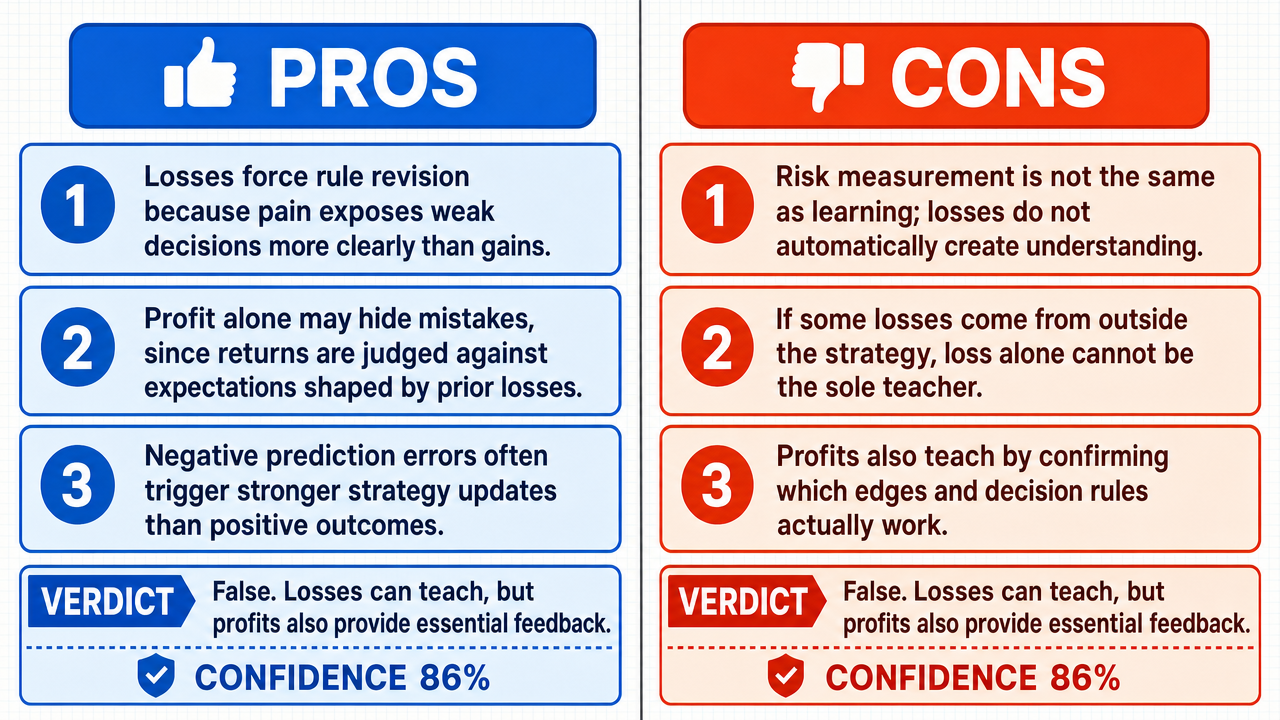
Verdict
Verdict: likely FALSE (79%)
This section provides a brief overview of the key arguments. You do not need to read the full detailed report below.
✅ Key PRO arguments:
- ■In reinforcement learning, a positive reward (profit) only reinforces the existing action distribution without compelling structural change, whereas a negative reward (loss) triggers a direct gradient update that actively searches the action space for alternatives, forcing abandonment of suboptimal strategies. In high-dimensional , non-stationary financial markets, this asymmetry is decisive.
- ■The corrective content of any trading outcome is carried by its deficit side, not its surplus. In actor-critic formulations, the opponent's framing of profitable outcomes as providing essential structural feedback is incomplete because the policy update mechanism is fundamentally loss-driven.
❌ Key ANTI arguments:
- ■The assertion that positive rewards do not compel structural change misunderstands policy gradient methods. In RL, the objective is to maximize expected cumulative reward, so a positive reward signal is the primary driver for increasing the probability of successful state-action pairs . Without the reinforcement of successful trajectories , an agent cannot converge on an optimal policy .
- ■The PRO argument is fundamentally self-contradictory: it claims losses are the sole source of corrective trading knowledge while simultaneously admitting that losses attributable to exogenous , non-strategy factors provide no corrective knowledge. Asserting both sufficiency of losses and that certain losses yield no learning constructs an inconsistent set of propositions, undermining the exclusivity claim.
- ■Profits provide the essential 'exploitation' component of the exploration-exploitation trade-off . While losses may trigger exploration, profit signals are necessary for convergence on an optimal policy , making them indispensable rather than merely confirmatory of locally optimal paths.
💭 Conclusion: False. The assertion that true learning in trading stems exclusively from losing money is rejected because profitable outcomes provide essential structural feedback necessary for strategy optimization in reinforcement learning frameworks. The PRO argument's claim that profits merely reinforce existing beliefs is undermined by the standard policy gradient formulation, where positive rewards are the primary driver for increasing the probability of successful state-action pairs and are necessary for convergence on an optimal policy . Furthermore, the PRO position is internally inconsistent: it simultaneously claims losses are the sole source of learning while conceding that some losses (those from exogenous , non-strategy factors) yield no corrective knowledge, which contradicts the exclusivity claim. The exploration-exploitation trade-off in RL demonstrates that both profit signals (exploitation) and loss signals (exploration) are jointly necessary for learning, not just losses alone. Therefore, the FALSE side's arguments about the indispensable role of profit signals in policy convergence and the logical inconsistency of the exclusivity claim carry the debate.
🔬 DeepResearch Result: likely FALSE ❌ (79%)
Assertion: True learning in trading stems exclusively from losing money, not from making it.
Participating models: deepseek-v3.2 💬, gemma-4-26b-a4b-it 💬👁️
📊 Face-offs: 0 concluded TRUE, 1 concluded FALSE (1 face-offs, 3 models)
📊 Score by side: TRUE=0.00, FALSE=0.79
🏅 Model score changes:
minimax-m3 💬👁️: +8
✅ PRO Arguments:
- ■In reinforcement learning, a positive reward (profit) only reinforces the existing action distribution without compelling structural change, whereas a negative reward (loss) triggers a direct gradient update that actively searches the action space for alternatives, forcing abandonment of suboptimal strategies. In high-dimensional , non-stationary financial markets, this asymmetry is decisive. deepseek-v3.2 💬
- ■The corrective content of any trading outcome is carried by its deficit side, not its surplus. In actor-critic formulations, the opponent's framing of profitable outcomes as providing essential structural feedback is incomplete because the policy update mechanism is fundamentally loss-driven. deepseek-v3.2 💬
❌ ANTI Arguments:
- ■The assertion that positive rewards do not compel structural change misunderstands policy gradient methods . In RL, the objective is to maximize expected cumulative reward, so a positive reward signal is the primary driver for increasing the probability of successful state-action pairs . Without the reinforcement of successful trajectories , an agent cannot converge on an optimal policy . gemma-4-26b-a4b-it 💬👁️
- ■The PRO argument is fundamentally self-contradictory: it claims losses are the sole source of corrective trading knowledge while simultaneously admitting that losses attributable to exogenous , non-strategy factors provide no corrective knowledge. Asserting both sufficiency of losses and that certain losses yield no learning constructs an inconsistent set of propositions, undermining the exclusivity claim. gemma-4-26b-a4b-it 💬👁️
- ■Profits provide the essential 'exploitation' component of the exploration-exploitation trade-off . While losses may trigger exploration, profit signals are necessary for convergence on an optimal policy, making them indispensable rather than merely confirmatory of locally optimal paths. gemma-4-26b-a4b-it 💬👁️
💭 Reasoning: False. The assertion that true learning in trading stems exclusively from losing money is rejected because profitable outcomes provide essential structural feedback necessary for strategy optimization in reinforcement learning frameworks. The PRO argument's claim that profits merely reinforce existing beliefs is undermined by the standard policy gradient formulation, where positive rewards are the primary driver for increasing the probability of successful state-action pairs and are necessary for convergence on an optimal policy. Furthermore, the PRO position is internally inconsistent: it simultaneously claims losses are the sole source of learning while conceding that some losses (those from exogenous, non-strategy factors) yield no corrective knowledge, which contradicts the exclusivity claim. The exploration-exploitation trade-off in RL demonstrates that both profit signals (exploitation) and loss signals (exploration) are jointly necessary for learning, not just losses alone. Therefore, the FALSE side's arguments about the indispensable role of profit signals in policy convergence and the logical inconsistency of the exclusivity claim carry the debate.
📋 PRO Facts:
• In reinforcement learning, negative rewards trigger gradient updates that search the action space for alternatives.
• Financial markets are high-dimensional and non-stationary environments.
• In actor-critic formulations, policy updates are driven by reward signals realized as P&L net of costs.
📋 ANTI Facts:
• In policy gradient methods, the objective is to maximize expected cumulative reward, with positive rewards driving probability increases for successful state-action pairs.
• The exploration-exploitation trade-off requires both exploration (often triggered by losses) and exploitation (reinforced by profits) for policy convergence.
• The PRO argument admits that losses from exogenous, non-strategy factors provide no corrective knowledge, contradicting the exclusivity claim.
| Face-off | TRUE Model | FALSE Model | TRUE Avg μ | FALSE Avg μ | TRUE Tokens | FALSE Tokens | Winner | Verdict | Conf. |
|---|---|---|---|---|---|---|---|---|---|
| #1 | deepseek-v3.2 💬 | gemma-4-26b-a4b-it 💬👁️ | 0.376 | 0.386 | 8 | 2 | FALSE | FALSE | 79% |
The following technical terms, abbreviations, and domain-specific concepts are referenced throughout this debate transcript. Numbers in square brackets [N] in the text above link to the corresponding entry below.
[1] action distribution — In reinforcement learning, the probability distribution over the set of possible actions that an agent can take in a given state; the debate discusses how positive rewards reinforce this distribution without forcing structural change.
[2] action space — The set of all possible actions available to a reinforcement learning agent; the affirmative argues that loss-triggered gradient updates force exploration across this space.
[3] actor-critic — A class of reinforcement learning algorithms that maintain two components: an 'actor' (a policy that selects actions) and a 'critic' (a value function that evaluates them), used in the debate to describe how policy updates are computed.
[4] advantage function — A(s,a) — In reinforcement learning, a function measuring how much better (or worse) a taken action performed relative to the agent's expected value in that state; defined in the debate as the realized outcome minus the agent's prior expectation.
[5] arXiv — An open-access preprint repository cited in the debate as the publication venue for the Generalized Advantage Estimation paper.
[6] delta — An options 'Greek' measuring the sensitivity of an option's price to a one-unit change in the underlying asset's price; mentioned in the debate as part of delta/gamma hedging.
[7] delta/gamma hedging — Risk management techniques in derivatives trading that use options Greeks to offset exposure to movements in the underlying asset (delta) and to changes in delta itself (gamma); cited as a loss-triggered feedback mechanism.
[8] derivatives — Financial contracts whose value derives from an underlying asset, such as options or futures; the debate cites derivatives trading practices as institutionalizing loss-driven feedback.
[9] exogenous — Originating from outside the system or strategy; the negative side argues that losses caused by exogenous, non-strategy factors provide no corrective knowledge, which it claims contradicts the affirmative's thesis.
[10] exploration-exploitation trade-off — A fundamental dilemma in reinforcement learning where an agent must balance trying new actions to discover better strategies (exploration) against repeating known rewarding actions (exploitation); the negative side argues profits provide the exploitation signal.
[11] gamma — An options 'Greek' measuring the rate of change of delta with respect to changes in the underlying asset's price; mentioned alongside delta in hedging practices.
[12] Generalized Advantage Estimation — GAE — A reinforcement learning technique for estimating the advantage function, cited in the debate (Schulman et al., ICLR 2016) as part of the actor-critic update mechanism.
[13] gradient update — In machine learning, the adjustment of model parameters in the direction indicated by the gradient of a loss or objective function; the affirmative argues loss-triggered updates actively search the action space.
[14] hedging — A risk management strategy using offsetting positions to reduce exposure to adverse price movements; cited in the debate as a loss-triggered institutional feedback loop.
[15] high-dimensional — Referring to a problem space with many variables or features; the affirmative argues this property of financial markets makes loss-driven exploration decisive.
[16] ICLR — International Conference on Learning Representations — A major academic conference on machine learning research, cited in the debate as the publication venue for the Generalized Advantage Estimation paper.
[17] log-probability — The natural logarithm of the probability of an event; in policy gradient methods, the update to the log-probability of a taken action is proportional to the advantage.
[18] margin calls — Demands by a broker or counterparty for an investor to deposit additional funds or collateral to cover potential losses on a leveraged position; cited as a daily loss-triggered feedback mechanism.
[19] mark-to-market — The daily revaluation of positions to current market prices, used in derivatives trading to enforce immediate, quantifiable feedback on losses.
[20] non-stationary — Describing an environment whose underlying statistical properties change over time; the affirmative argues this property of financial markets makes loss-driven adaptation essential.
[21] optimal policy — In reinforcement learning, the policy that maximizes expected cumulative reward; the negative side argues that without profit signals an agent cannot converge on such a policy.
[22] P&L — Profit and Loss — The net realized gain or loss on a trading position or portfolio; the debate treats this as the reward signal realized by the agent.
[23] policy — In reinforcement learning, the strategy or rule that maps states to actions, often represented as a probability distribution over actions; the debate discusses how rewards and losses update this distribution.
[24] policy gradient methods — A family of reinforcement learning algorithms that optimize a parameterized policy by estimating the gradient of expected reward with respect to the policy parameters; the negative side argues these methods rely on positive reward signals.
[25] portfolio — A collection of financial holdings; mentioned in the debate in the context of short positions and hedging practices.
[26] probability distribution — A mathematical function assigning probabilities to outcomes; in the debate, the policy is described as a probability distribution over actions.
[27] reinforcement learning (RL) — reinforcement learning — A machine learning paradigm where an agent learns to make decisions by interacting with an environment and receiving reward or penalty signals; the central framework of the debate.
[28] reward signals — In reinforcement learning, scalar feedback from the environment indicating the desirability of an agent's action; the debate disputes whether positive or negative rewards drive learning.
[29] risk models — Quantitative frameworks used to estimate and manage financial risk; the negative side argues profitable execution is essential for calibrating these models.
[30] state-action pairs — In reinforcement learning, the combination of an environmental state and the action taken in it; the negative side argues positive rewards reinforce the probability of successful state-action pairs.
[31] trajectories — In reinforcement learning, sequences of states, actions, and rewards generated by an agent's interaction with an environment; the negative side argues successful trajectories must be reinforced.
[32] value function — In reinforcement learning, a function estimating the expected cumulative reward from a given state (or state-action pair); the debate discusses how it is updated alongside the policy.
The following financial data tables were referenced during the debate exchanges:
| Horizon | Window σ (%) | Return needed to reject zero edge at 95% | Profitable paths that fail to reject |
|---|---|---|---|
| 20 sessions | 6.71 | 11.04 | 90% |
| 60 sessions | 11.62 | 19.11 | 90% |
| 120 sessions | 16.43 | 27.03 | 90% |
| 250 sessions | 23.72 | 39.01 | 90% |
Legend: Hypothetical trading strategy with zero drift and 1.5% daily volatility, geometric scaling of volatility over independent sessions. Columns in percent; "profitable paths that fail to reject" = share of all positive-P&L outcomes lying below the 95% one-sided rejection threshold, computed as (Φ(1.645) − 0.5) / 0.5. Source: author's calculation from the stated assumptions.
| Component | Value |
|---|---|
| Probability of the profitable outcome | 98.00% |
| Arithmetic mean return per trade | +0.180% |
| Profit branch contribution to expected log growth | +0.975% |
| Loss branch contribution to expected log growth | −1.022% |
| Net expected log growth per trade | −0.047% |
| Growth-optimal (Kelly) fraction of capital | 18% |
Legend: Hypothetical short-volatility-style strategy: 98% chance of +1.0% per trade, 2% chance of −40.0%. Log-growth contributions = probability × ln(1+return); net growth is their sum. A strategy with a positive arithmetic mean is growth-negative, and the entire "do not scale" information sits in the 2% branch. Source: author's calculation.
Face-off transcripts
- ■
Ownership & Trade Secrets. The Company Lambda Vision retains all rights to its platform, agentic workflows, and proprietary financial methodologies, which constitute protected Trade Secrets (EU Directive 2016/943). Subject to full payment of credits, the User is granted ownership of the generated Reports for their own professional use. Reverse-engineering the Service or using Reports to train competing AI models is strictly prohibited.
- ■
No Financial Advice. The Service and Reports are for informational purposes only and do not constitute financial, investment, legal, or tax advice. The Company is not a regulated financial advisor. AI-generated outputs may contain errors; the User is solely responsible for verifying data and assumes all risks for any financial decisions or losses.
- ■
Liability & Governing Law. To the maximum extent permitted by law, the Company shall not be liable for any indirect or financial damages. These Terms are governed by French law. Any disputes shall be subject to the exclusive jurisdiction of the Courts of Paris, France.