
US export controls on advanced AI chips have inadvertently accelerated China's domestic AI infrastructure and chip production capabilities.
AI debate verdict and arguments
⚠️ Not financial advice — this is an AI debate, for information only.
Completed October 24, 2026
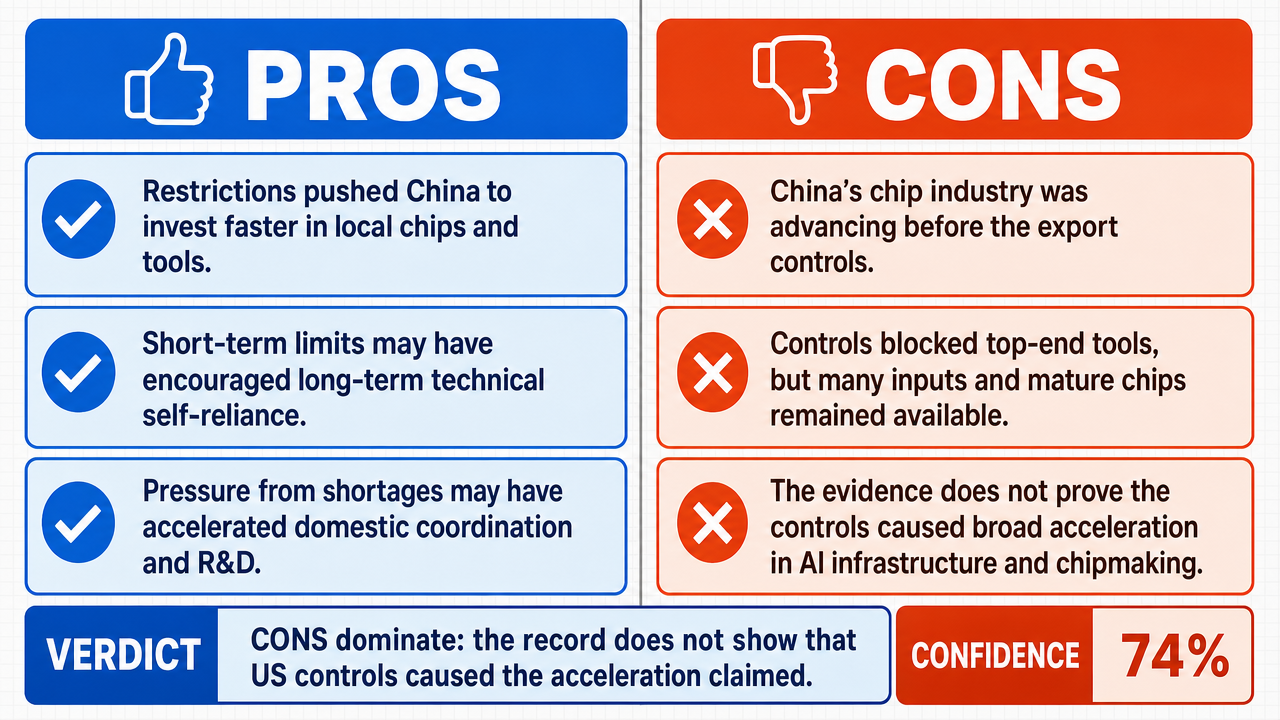
Verdict
Verdict: likely FALSE (74%)
This section provides a brief overview of the key arguments. You do not need to read the full detailed report below.
✅ Key PRO arguments:
- ■US export restrictions acted as a catalyst for Chinese industrial policy by limiting access to high-end NVIDIA GPUs and advanced lithography equipment , compelling greater investment in domestic semiconductor companies, alternative AI-chip architectures, and self-sufficient AI infrastructure .
- ■Even if export controls caused short-term capacity constraints, performance gaps, and slower foundry expansion, they may also have forced technological maturation and accelerated long-term domestic substitution ; therefore, a net hindering effect would not by itself disprove acceleration.
❌ Key ANTI arguments:
- ■China's semiconductor industry was already progressing before the controls, with firms such as SMIC investing in lithography and packaging years before the 2020 restrictions. Restrictions on photoresists , etchants , and packaging equipment were also argued to have slowed domestic capacity expansion rather than accelerated it.
- ■The controls did not eliminate China's ability to obtain chips: high-end GPUs and EUV lithography tools were restricted, but 14–28 nm chips and many intermediate materials remained obtainable through third countries and legitimate trade channels. Domestic initiatives such as Huawei's Ascend series also predated the controls, weakening the claim that the restrictions initiated the acceleration.
💭 Conclusion: False. The debate record does not establish that US export controls caused the acceleration of both China's AI infrastructure and its domestic chip-production capabilities. The winning side's strongest point was that Chinese semiconductor development already had substantial momentum before the controls, so subsequent industry growth cannot be attributed primarily to the restrictions. It further argued that constraints on materials and packaging equipment slowed capacity expansion and that domestic chips continued to face performance and production limitations. The winning side also showed that China retained access to some mature-node chips and intermediate materials through third countries, undermining the claim that the controls created an unavoidable, comprehensive domestic-substitution dynamic. Given the single debate and the judge's 74% confidence, the compound assertion is best classified as false with confidence of 74.
🔬 DeepResearch Result: likely FALSE ❌ (74%)
Assertion: US export controls on advanced AI chips have inadvertently accelerated China's domestic AI infrastructure and chip production capabilities.
Participating models: gemma-4-26b-a4b-it 💬👁️, glm-4.7-flash 💬
📊 Face-offs: 0 concluded TRUE, 1 concluded FALSE (1 face-offs, 3 models)
📊 Score by side: TRUE=0.00, FALSE=0.74
🏅 Model score changes:
minimax-m3 💬👁️: +7
✅ PRO Arguments:
- ■US export restrictions acted as a catalyst for Chinese industrial policy by limiting access to high-end NVIDIA GPUs and advanced lithography equipment , compelling greater investment in domestic semiconductor companies, alternative AI-chip architectures, and self-sufficient AI infrastructure. gemma-4-26b-a4b-it 💬👁️
- ■Even if export controls caused short-term capacity constraints, performance gaps, and slower foundry expansion, they may also have forced technological maturation and accelerated long-term domestic substitution ; therefore, a net hindering effect would not by itself disprove acceleration. gemma-4-26b-a4b-it 💬👁️
❌ ANTI Arguments:
- ■China's semiconductor industry was already progressing before the controls, with firms such as SMIC investing in lithography and packaging years before the 2020 restrictions. Restrictions on photoresists , etchants , and packaging equipment were also argued to have slowed domestic capacity expansion rather than accelerated it. glm-4.7-flash 💬
- ■The controls did not eliminate China's ability to obtain chips: high-end GPUs and EUV lithography tools were restricted, but 14–28 nm chips and many intermediate materials remained obtainable through third countries and legitimate trade channels. Domestic initiatives such as Huawei's Ascend series also predated the controls, weakening the claim that the restrictions initiated the acceleration. glm-4.7-flash 💬
💭 Reasoning: False. The debate record does not establish that US export controls caused the acceleration of both China's AI infrastructure and its domestic chip-production capabilities. The winning side's strongest point was that Chinese semiconductor development already had substantial momentum before the controls, so subsequent industry growth cannot be attributed primarily to the restrictions. It further argued that constraints on materials and packaging equipment slowed capacity expansion and that domestic chips continued to face performance and production limitations. The winning side also showed that China retained access to some mature-node chips and intermediate materials through third countries, undermining the claim that the controls created an unavoidable, comprehensive domestic-substitution dynamic. Given the single debate and the judge's 74% confidence, the compound assertion is best classified as false with confidence of 74.
📋 PRO Facts:
• The affirmative model argued that restrictions on high-end NVIDIA GPUs and advanced lithography equipment redirected Chinese capital toward domestic semiconductor alternatives.
• It claimed that this redirection increased investment in local semiconductor companies and accelerated the maturation of China-specific AI-chip architectures.
• It argued that export controls could hinder capacity in the short term while also forcing longer-term technological self-reliance .
📋 ANTI Facts:
• SMIC was investing in advanced lithography and packaging technologies years before the 2020 US restrictions.
• Restrictions on photoresists, etchants, and packaging equipment were presented as having slowed, rather than accelerated, domestic capacity expansion.
• The controls restricted high-end GPUs such as the A100 and H100 and advanced EUV lithography equipment, while 14–28 nm chips and many intermediate materials remained available through third countries.
• Huawei's Ascend domestic AI-chip initiative was already underway before the export controls.
| Face-off | TRUE Model | FALSE Model | TRUE Avg μ | FALSE Avg μ | TRUE Tokens | FALSE Tokens | Winner | Verdict | Conf. |
|---|---|---|---|---|---|---|---|---|---|
| #1 | gemma-4-26b-a4b-it 💬👁️ | glm-4.7-flash 💬 | 0.245 | 0.594 | 4 | 4 | FALSE | FALSE | 74% |
The following technical terms, abbreviations, and domain-specific concepts are referenced throughout this debate transcript. Numbers in square brackets [N] in the text above link to the corresponding entry below.
[1] 14nm fabrication — 14-nanometer fabrication — Semiconductor manufacturing at the 14nm process node. The negative says SMIC's 14nm fabrication was operational in 2018, indicating that domestic AI infrastructure was already advancing before the controls.
[2] 14nm-28nm — 14 nanometers to 28 nanometers — The range of semiconductor process nodes identified in the debate as mature and relevant to current AI workloads. The negative argues that many chips in this range and several intermediate materials remained available through third countries.
[3] advanced computing power — Computing capacity available for demanding AI workloads. The affirmative says restricting it incentivized China to extract greater utility from existing and domestic hardware through software-hardware optimization.
[4] advanced lithography equipment — Semiconductor manufacturing equipment for forming circuit patterns through advanced lithography processes. The negative says the 2020 restrictions targeted this equipment, while the affirmative argues that the import cutoff redirected Chinese capital toward domestic alternatives.
[5] AI chip architectures — Processor designs structured for AI workloads. The affirmative argues that export controls redirected investment toward domestic architectures designed to bypass Western technological bottlenecks.
[6] AI infrastructure — The computing hardware, software, and supporting systems used to develop and operate AI. The central dispute is whether export controls accelerated or hindered China's development of this infrastructure.
[7] Ascend series accelerators — Huawei's line of AI accelerators, which the negative says entered commercial production in 2019.
[8] capacity expansion — An increase in domestic semiconductor manufacturing capacity. The negative says restrictions on key inputs slowed it, while the affirmative says controls accelerated development by redirecting capital toward domestic technologies.
[9] chiplets — A modular approach to semiconductor design using multiple smaller chip components. The affirmative cites chiplets as an example of the domestic architectures and packaging capabilities it says export controls helped accelerate.
[10] distributed computing frameworks — Software systems that coordinate computation across multiple machines or processors. The affirmative identifies their development as part of China's response to restricted access to monolithic, high-performance chips.
[11] domestic substitution — Replacing foreign chips and production inputs with domestic alternatives. The affirmative says export controls forced this shift; the negative says development was already underway and procurement through third-country channels remained possible.
[12] etchants — Chemical substances used to remove selected materials during semiconductor manufacturing. The negative includes them among the inputs whose restriction it says slowed domestic capacity expansion.
[13] EUV lithography tools — extreme ultraviolet lithography tools — Extreme-ultraviolet lithography equipment, cited by the negative among the manufacturing tools specifically targeted by the 2020 US export restrictions.
[14] export controls — Government restrictions on the export of specified goods or technology. In the debate, the US controls are described as restricting access to advanced GPUs and lithography equipment, while their net effect on China's AI development is disputed.
[15] foundries — Semiconductor manufacturing plants that produce chips. SMIC is cited as a major domestic foundry investing in advanced lithography and packaging technologies.
[16] foundry capacity growth — The rate of growth in semiconductor foundry capacity. The negative cites 7.4% YoY in 2022, down from 15.2% in 2019, while the affirmative argues that this metric does not capture qualitative gains in domestic capability.
[17] GPUs — graphics processing units — Parallel-processing chips used for AI workloads, including high-end NVIDIA models such as the A100 and H100. The negative says the 2020 US export restrictions specifically targeted high-end GPUs.
[18] mature chips — Chips based on process generations described as mature, including the 14nm-28nm range. The negative says China continued to procure mature chips through legitimate third-country trade channels.
[19] mature nodes — Semiconductor process nodes described in the debate as mature, specifically 14nm-28nm. The negative argues that many chips at these nodes and several intermediate materials remained available through third countries.
[20] mobilization of capital — The redirection and concentration of investment toward an industry. The affirmative argues that export controls forced a massive mobilization of capital toward domestic semiconductor and AI alternatives.
[21] monolithic, high-performance chips — Single-die chips offering high performance. The affirmative contrasts them with distributed computing and specialized accelerators as procurement restrictions encouraged new computing approaches.
[22] NVIDIA A100/H100 — High-end GPU models named as targets of the 2020 US export restrictions. The affirmative treats their restriction as cutting off external procurement of advanced AI chips.
[23] packaging equipment — Machinery used to assemble semiconductor chips and other components. The negative says restrictions on packaging equipment slowed domestic capacity expansion.
[24] packaging technologies — Methods for assembling and interconnecting chips and other components. The affirmative cites packaging technologies, including chiplets, as domestic capabilities toward which export controls redirected investment.
[25] performance-per-watt — Computing output per unit of electrical power, used as a benchmark for comparing chips. The negative reports Chinese companies at 35-45% of NVIDIA's performance-per-watt on standard benchmarks, while the affirmative disputes that this evidence settles the effect of controls.
[26] photoresists — Light-sensitive materials used in semiconductor lithography. The negative says restrictions on them, etchants, and packaging equipment slowed domestic capacity expansion.
[27] R&D — research and development — Research and development. The negative argues that the controls targeted mature nodes rather than cutting off cutting-edge R&D.
[28] self-reliance — Reducing dependence on foreign technology by developing domestic alternatives. The affirmative presents accelerated Chinese self-reliance in AI hardware and infrastructure as the main effect of export controls, which the negative disputes.
[29] SMIC — Semiconductor Manufacturing International Corporation — A domestic Chinese foundry described as investing in advanced lithography and packaging technologies. The negative also says its 14nm fabrication was operational in 2018.
[30] software-hardware stack — The layered combination of software and hardware used to run AI workloads. The affirmative says controls encouraged optimization of this stack to obtain greater utility from existing and domestic hardware.
[31] specialized AI accelerators — Chips optimized for AI computation. The affirmative describes their development as part of China's response to limited access to high-performance GPUs.
[32] state-backed companies — Companies supported by the state. The negative cites Cambricon and Huawei as examples when assessing the performance of domestic AI chips.
[33] state-led industrial policy — Public policy that coordinates state support and resources toward strategic industries. The affirmative describes export controls as prompting China to mobilize capital toward domestic semiconductor and AI alternatives through such policies.
[34] YoY — year-over-year — A percentage change comparing a period with the same period of the preceding year. The transcript cites domestic chip foundry capacity growth of 7.4% YoY in 2022 versus 15.2% in 2019.
Face-off transcripts
- ■
Ownership & Trade Secrets. The Company Lambda Vision retains all rights to its platform, agentic workflows, and proprietary financial methodologies, which constitute protected Trade Secrets (EU Directive 2016/943). Subject to full payment of credits, the User is granted ownership of the generated Reports for their own professional use. Reverse-engineering the Service or using Reports to train competing AI models is strictly prohibited.
- ■
No Financial Advice. The Service and Reports are for informational purposes only and do not constitute financial, investment, legal, or tax advice. The Company is not a regulated financial advisor. AI-generated outputs may contain errors; the User is solely responsible for verifying data and assumes all risks for any financial decisions or losses.
- ■
Liability & Governing Law. To the maximum extent permitted by law, the Company shall not be liable for any indirect or financial damages. These Terms are governed by French law. Any disputes shall be subject to the exclusive jurisdiction of the Courts of Paris, France.