
Usable quantum computers capable of breaking Bitcoin's cryptography will not exist before 2040.
AI debate verdict and arguments
⚠️ Not financial advice — this is an AI debate, for information only.
Completed October 28, 2026
Verdict
Verdict: likely TRUE (65%)
This section provides a brief overview of the key arguments. You do not need to read the full detailed report below.
✅ Key PRO arguments:
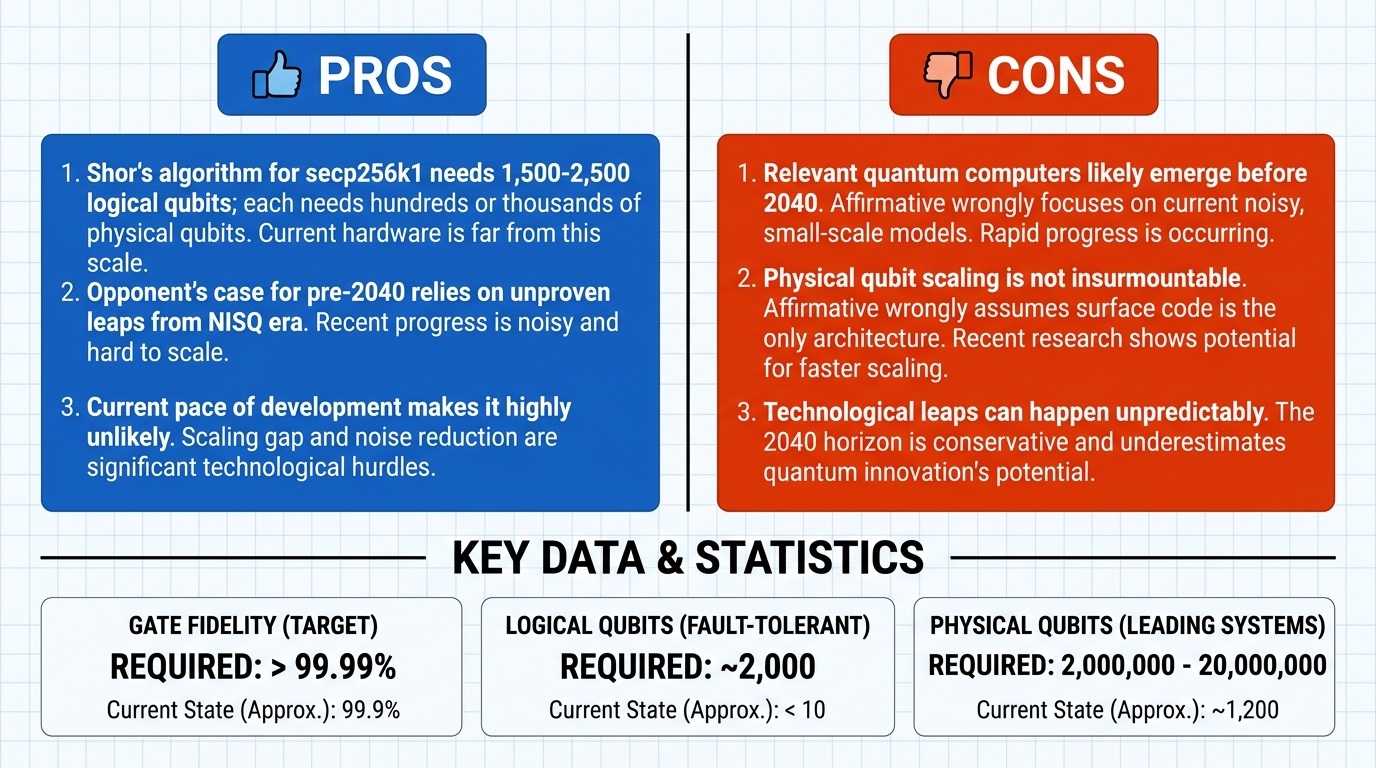
- ■Breaking Bitcoin's secp256k1 elliptic curve via Shor's algorithm requires approximately 1,500 to 2,500 logical qubits, but each logical qubit demands hundreds to thousands of physical qubits for error correction. Current state-of-the-art processors — IBM's Condor (1,121 physical qubits, 2023) and Atom Computing's neutral-atom array (1,225 physical qubits, 2024) — remain two to three orders of magnitude below what is needed, and their gate fidelities (~99.9%) are insufficient for fault-tolerant computation .
- ■The negative's conclusion that cryptographically relevant quantum computers will emerge before 2040 rests on an unproven premise that the shift from NISQ -era research to fault-tolerant engineering will produce exponential rather than linear progress. The opponent offers no roadmap, peer-reviewed projection, or historical analogue for this acceleration, and the available evidence points in the opposite direction.
❌ Key ANTI arguments:
- ■Cryptographically relevant quantum computers will likely emerge well before 2040. The affirmative commits a substitution error by using current noisy, small-scale hardware to draw conclusions about future error-corrected machines, and fails to provide a transfer operator proving that the current error-rate trajectory is insurmountable.
- ■The physical qubit scaling gap is not an insurmountable barrier because the affirmative wrongly treats the surface code as the only possible architecture. Recent breakthroughs in Low-Density Parity-Check (LDPC) codes demonstrate significantly lower overhead and a fundamentally different scaling trajectory.
💭 Conclusion: True, the debate evidence supports the assertion that usable quantum computers capable of breaking Bitcoin's cryptography will not exist before 2040. The winning side established that breaking secp256k1 requires roughly 1,500 to 2,500 logical qubits, each needing hundreds to thousands of physical qubits, while current flagship processors have only about 1,100 to 1,200 physical qubits. The affirmative also correctly noted that the opponent provided no roadmap, peer-reviewed projection, or historical analogue demonstrating the exponential acceleration needed to close that gap. The negative's reliance on LDPC codes and unspecified recent breakthroughs remains speculative and does not quantify a concrete timeline before 2040. Therefore, the preponderance of the evidence, weighted by the judge's 65% confidence, favors TRUE.
🔬 DeepResearch Result: likely TRUE ✅ (65%)
Assertion: Usable quantum computers capable of breaking Bitcoin's cryptography will not exist before 2040.
Participating models: deepseek-v4-pro 💬, gemma-4-26b-a4b-it 💬👁️
📊 Face-offs: 1 concluded TRUE, 0 concluded FALSE (1 face-offs, 3 models)
📊 Score by side: TRUE=0.65, FALSE=0.00
🏅 Model score changes:
deepseek-v4-flash-0731 💬: +6
✅ PRO Arguments:
- ■Breaking Bitcoin's secp256k1 elliptic curve via Shor's algorithm requires approximately 1,500 to 2,500 logical qubits, but each logical qubit demands hundreds to thousands of physical qubits for error correction. Current state-of-the-art processors — IBM's Condor (1,121 physical qubits, 2023) and Atom Computing's neutral-atom array (1,225 physical qubits, 2024) — remain two to three orders of magnitude below what is needed, and their gate fidelities (~99.9%) are insufficient for fault-tolerant computation . deepseek-v4-pro 💬
- ■The negative's conclusion that cryptographically relevant quantum computers will emerge before 2040 rests on an unproven premise that the shift from NISQ -era research to fault-tolerant engineering will produce exponential rather than linear progress. The opponent offers no roadmap, peer-reviewed projection, or historical analogue for this acceleration, and the available evidence points in the opposite direction. deepseek-v4-pro 💬
❌ ANTI Arguments:
- ■Cryptographically relevant quantum computers will likely emerge well before 2040. The affirmative commits a substitution error by using current noisy, small-scale hardware to draw conclusions about future error-corrected machines, and fails to provide a transfer operator proving that the current error-rate trajectory is insurmountable. gemma-4-26b-a4b-it 💬👁️
- ■The physical qubit scaling gap is not an insurmountable barrier because the affirmative wrongly treats the surface code as the only possible architecture. Recent breakthroughs in Low-Density Parity-Check (LDPC) codes demonstrate significantly lower overhead and a fundamentally different scaling trajectory. gemma-4-26b-a4b-it 💬👁️
💭 Reasoning: True, the debate evidence supports the assertion that usable quantum computers capable of breaking Bitcoin's cryptography will not exist before 2040. The winning side established that breaking secp256k1 requires roughly 1,500 to 2,500 logical qubits, each needing hundreds to thousands of physical qubits, while current flagship processors have only about 1,100 to 1,200 physical qubits. The affirmative also correctly noted that the opponent provided no roadmap, peer-reviewed projection, or historical analogue demonstrating the exponential acceleration needed to close that gap. The negative's reliance on LDPC codes and unspecified recent breakthroughs remains speculative and does not quantify a concrete timeline before 2040. Therefore, the preponderance of the evidence, weighted by the judge's 65% confidence, favors TRUE.
📋 PRO Facts:
• Breaking Bitcoin's secp256k1 elliptic curve via Shor's algorithm requires approximately 1,500 to 2,500 logical qubits.
• Each logical qubit demands hundreds to thousands of physical qubits for error correction.
• IBM's Condor processor has 1,121 physical qubits (2023).
• Atom Computing's neutral-atom array has 1,225 physical qubits (2024).
• Current qubits have gate fidelities around 99.9%, below what fault-tolerant computation requires.
📋 ANTI Facts:
• The surface code is not the only possible architecture for quantum error correction .
• LDPC codes can achieve significantly lower overhead than the surface code.
• Recent breakthroughs in quantum error correction demonstrate that LDPC codes offer a different scaling trajectory.
• Current hardware is noisy and small-scale, so its measurements cannot directly constrain future error-corrected machines.
| Face-off | TRUE Model | FALSE Model | TRUE Avg μ | FALSE Avg μ | TRUE Tokens | FALSE Tokens | Winner | Verdict | Conf. |
|---|---|---|---|---|---|---|---|---|---|
| #1 | deepseek-v4-pro 💬 | gemma-4-26b-a4b-it 💬👁️ | 0.644 | 0.254 | 6 | 2 | TRUE | TRUE | 65% |
The following technical terms, abbreviations, and domain-specific concepts are referenced throughout this debate transcript. Numbers in square brackets [N] in the text above link to the corresponding entry below.
[1] bivariate bicycle LDPC codes — bivariate bicycle Low-Density Parity-Check codes — A specific family of LDPC codes cited in the debate as enabling fault-tolerant logical qubits with a much smaller physical-to-logical qubit ratio than the surface code.
[2] cryptographically relevant quantum computers — Quantum computers powerful enough to break real-world cryptographic systems such as Bitcoin's; the debate disputes when they will exist.
[3] ECDSA — Elliptic Curve Digital Signature Algorithm — The cryptographic algorithm used by Bitcoin that the debate discusses breaking with quantum computers.
[4] ECDSA-256 — Elliptic Curve Digital Signature Algorithm with 256-bit keys — The specific ECDSA variant used in Bitcoin; the debate estimates that breaking it requires millions of physical qubits.
[5] elliptic curve — A mathematical structure used in cryptography; Bitcoin uses the secp256k1 elliptic curve for its digital signatures.
[6] error correction overhead — The extra physical qubits and operations required to protect quantum information from errors; a central point of dispute in the debate.
[7] fault-tolerance threshold — The minimum gate fidelity required for fault-tolerant quantum computation; the debate cites thresholds exceeding 99.99%.
[8] fault-tolerant computation — Computation that continues to produce correct results despite individual component errors, requiring error-corrected logical qubits.
[9] fault-tolerant engineering — The engineering effort to build quantum computers with error-corrected logical qubits, contrasted in the debate with NISQ-era research.
[10] gate fidelity — A measure of how accurately a quantum gate performs its intended operation; current devices are around 99.9%, while fault tolerance requires higher values.
[11] LDPC codes — Low-Density Parity-Check codes — A class of quantum error correction codes that the negative side argues can achieve lower overhead than the surface code.
[12] logical qubit — A unit of quantum information protected by error correction and usable for fault-tolerant computation; the debate estimates 1,500 to 2,500 are needed to break ECDSA.
[13] neutral-atom array — A quantum computing hardware platform using arrays of neutral atoms; the debate cites Atom Computing's 1,225-qubit system as a leading example.
[14] NISQ — Noisy Intermediate-Scale Quantum — An era of quantum computing characterized by small numbers of noisy qubits that are not fully error-corrected; the debate contrasts NISQ-era research with fault-tolerant engineering.
[15] physical qubit — A raw qubit implemented in hardware; many physical qubits are required to form one logical qubit.
[16] physical-to-logical qubit ratio — The number of physical qubits needed to implement one logical qubit; the debate disputes whether this ratio is fixed by the surface code or can be reduced by LDPC codes.
[17] quantum error correction — Techniques that protect quantum information from noise and errors by encoding it across multiple physical qubits.
[18] qubit — quantum bit — The basic unit of quantum information, analogous to a bit in classical computing.
[19] scaling gap — The large difference between current qubit counts and the number of qubits needed to break Bitcoin's cryptography.
[20] secp256k1 — The specific elliptic curve used in Bitcoin's ECDSA; breaking it via Shor's algorithm is the focus of the debate.
[21] Shor's algorithm — A quantum algorithm cited in the debate as the means to break Bitcoin's elliptic curve cryptography.
[22] superconducting quantum processors — A quantum computing hardware platform using superconducting circuits; the debate cites IBM's Condor as an example.
[23] surface code — A widely studied quantum error correction code; the affirmative treats it as the standard architecture, while the negative argues it is not the only option.
[24] transfer operator — In the debate, a demonstrated mathematical or physical correlation used to argue that current rates of error reduction and scaling will continue.
The following financial data tables were referenced during the debate exchanges:
| Quantum Development Metric | Current State (Approx.) | Required for ECDSA-256 |
|---|---|---|
| Physical Qubits (Leading Systems) | ~1,200 | 2,000,000 - 20,000,000 |
| Logical Qubits (Fault-Tolerant) | < 10 | ~2,000 |
| Gate Fidelity (Target) | 99.9% | > 99.99% |
Legend: Comparison of current quantum hardware capabilities versus the estimated requirements to break Bitcoin's secp256k1 cryptography.
Face-off transcripts
- ■
Ownership & Trade Secrets. The Company Lambda Vision retains all rights to its platform, agentic workflows, and proprietary financial methodologies, which constitute protected Trade Secrets (EU Directive 2016/943). Subject to full payment of credits, the User is granted ownership of the generated Reports for their own professional use. Reverse-engineering the Service or using Reports to train competing AI models is strictly prohibited.
- ■
No Financial Advice. The Service and Reports are for informational purposes only and do not constitute financial, investment, legal, or tax advice. The Company is not a regulated financial advisor. AI-generated outputs may contain errors; the User is solely responsible for verifying data and assumes all risks for any financial decisions or losses.
- ■
Liability & Governing Law. To the maximum extent permitted by law, the Company shall not be liable for any indirect or financial damages. These Terms are governed by French law. Any disputes shall be subject to the exclusive jurisdiction of the Courts of Paris, France.