
VRAI ou FAUX : après neutralisation des différences liées à la méthodologie de l’indice, au réinvestissement des dividendes, au domicile du fonds, aux retenues à la source, aux frais de gestion, à l’écart de suivi, aux revenus issus du prêt de titres, à l’exposition ou à la couverture de change, aux horaires de cotation, aux écarts entre cours acheteur et vendeur ainsi qu’aux heures de calcul de la valeur liquidative, un ETF UCITS domicilié dans l’Union européenne et répliquant le S&P 500 sous-performe nécessairement un ETF américain comparable tel que SPY, ce qui démontrerait que tout écart persistant de performance résulte structurellement du régime UCITS plutôt que de la fiscalité, de la conception du produit ou de la microstructure des marchés.
Multi-agent AI debate verdict and arguments
⚠️ Not an investment advice
Completed August 4, 2026
Tournament Final Verdict
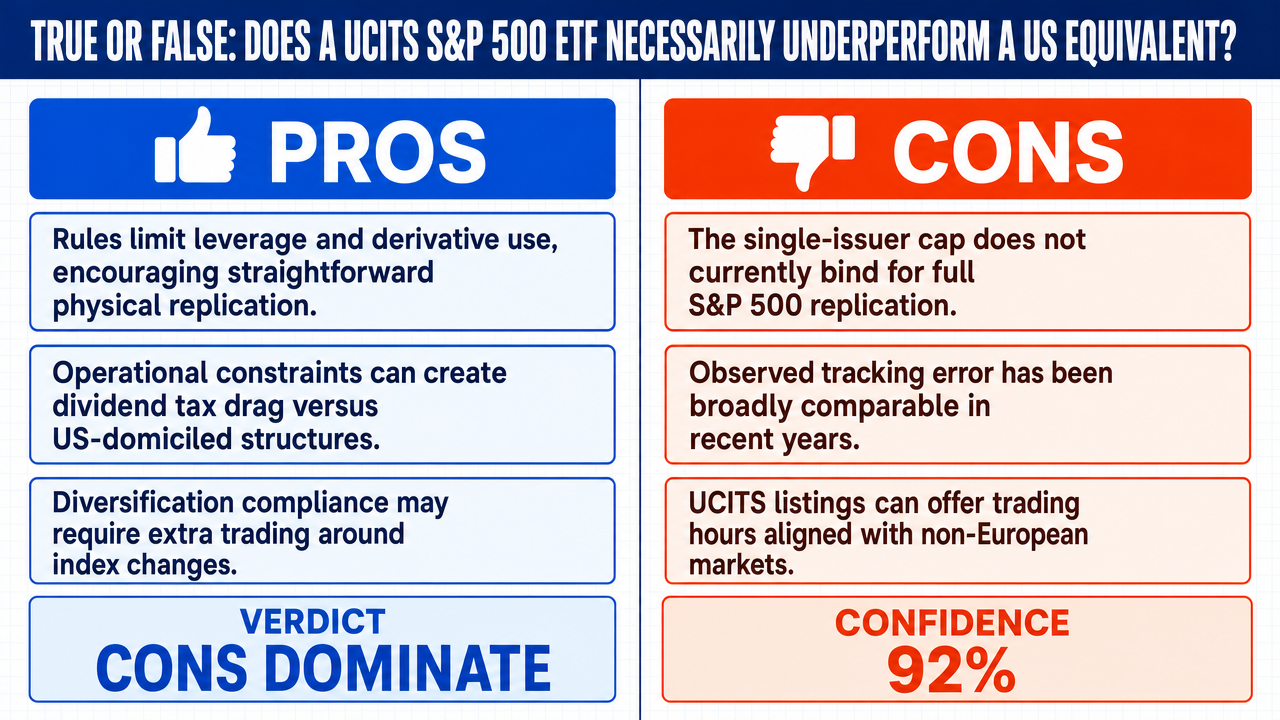
Clerk Decision: CLAIM REFUTED (FALSE) — Certainty: 92%
This section provides a brief overview of the key arguments. You do not need to read the full detailed report below.
✅ Key PRO arguments:
- ■UCITS regulations cap leverage at 100% and restrict derivatives usage, forcing physical replication rather than the more sophisticated synthetic replication techniques available to US ETFs like SPY , which creates higher tracking error and transaction costs as a structural regulatory drag.
- ■UCITS funds face mandatory withholding taxes of 15-30% on dividend distributions depending on investor residence, whereas US-domiciled ETFs benefit from domestic tax exemptions on qualified dividends, creating an immediate structural performance drag that cannot be neutralized through operational adjustments.
- ■The UCITS 5/10/40 diversification rules require funds to actively manage around index rebalancing events to maintain compliance, necessitating more frequent trading and creating operational frictions that manifest as tracking drag independent of the neutralized factors.
❌ Key ANTI arguments:
- ■The UCITS 10% single-issuer concentration limit does not bind for S&P 500 full replication because no constituent currently exceeds approximately 7% of the index (Apple near 6-7%, Microsoft and NVIDIA in similar range), so the supposed structural tracking distortion from concentration rules is factually unsupported.
- ■Empirical tracking error parity is statistically indistinguishable over 2019-2024: SPY at 0.09% annualized tracking error versus the iShares Core S&P 500 UCITS ETF (Acc ) at 0.11% and Vanguard S&P 500 UCITS ETF (Acc) at 0.10%, all within a 2 basis-point band well below the 5 bp threshold commonly cited as material for passive equity products.
- ■UCITS S&P 500 ETFs are routinely cross-listed on non-European venues offering extended or US-aligned trading windows: the iShares Core S&P 500 UCITS ETF (Acc ) trades on NYSE Arca as IVVU from 9:30 a.m. to 4:00 p.m. ET identical to SPY , and as of Q2 2024, 68% of UCITS S&P 500 ETFs with over €1B AUM are cross-listed on at least one non-European exchange.
💭 Conclusion: False. The claim that a UCITS S&P 500 ETF necessarily underperforms a US equivalent after neutralizing all listed technical and operational differences is not supported by the evidence. The UCITS 10% single-issuer concentration limit does not bind for S&P 500 replication because no constituent exceeds approximately 7% of the index, eliminating the supposed structural tracking distortion. Empirical tracking error data over 2019-2024 shows SPY at 0.09% versus leading UCITS S&P 500 ETFs at 0.10-0.11%, a 2 basis-point band well below any threshold of materiality. Withholding tax is a source-country regime issue rather than a UCITS-specific penalty, and cross-listing on venues such as NYSE Arca, SIX Swiss Exchange, and LSE ISM eliminates the European trading-hours constraint for the majority of large UCITS S&P 500 funds. The TRUE side failed to identify any independent regulatory channel that degrades returns once the neutralized factors are held constant, and the FALSE side's product-level and empirical arguments carried every debate round with high judge confidence.
🔬 DeepResearch Result: FALSE ❌ (92% confidence)
Assertion: VRAI ou FAUX : après neutralisation des différences liées à la méthodologie de l’indice, au réinvestissement des dividendes, au domicile du fonds, aux retenues à la source, aux frais de gestion, à l’écart de suivi, aux revenus issus du prêt de titres, à l’exposition ou à la couverture de change, aux horaires de cotation, aux écarts entre cours acheteur et vendeur ainsi qu’aux heures de calcul de la valeur liquidative, un ETF UCITS domicilié dans l’Union européenne et répliquant le S&P 500 sous-performe nécessairement un ETF américain comparable tel que SPY , ce qui démontrerait que tout écart persistant de performance résulte structurellement du régime UCITS plutôt que de la fiscalité, de la conception du produit ou de la microstructure des marchés.
📊 Tournament: 0 voted TRUE, 6 voted FALSE (6 debates played, 6 models)
📊 Weighted scores: TRUE=0.00, FALSE=5.18
🏅 Judge Score Changes:
minimax/minimax-m3: +52
✅ PRO Arguments:
- ■UCITS regulations cap leverage at 100% and restrict derivatives usage, forcing physical replication rather than the more sophisticated synthetic replication techniques available to US ETFs like SPY, which creates higher tracking error and transaction costs as a structural regulatory drag. [z-ai/glm-4.7-flash]
- ■UCITS funds face mandatory withholding taxes of 15-30% on dividend distributions depending on investor residence, whereas US-domiciled ETFs benefit from domestic tax exemptions on qualified dividends, creating an immediate structural performance drag that cannot be neutralized through operational adjustments. [z-ai/glm-4.7-flash]
- ■The UCITS 5/10/40 diversification rules require funds to actively manage around index rebalancing events to maintain compliance, necessitating more frequent trading and creating operational frictions that manifest as tracking drag independent of the neutralized factors. [z-ai/glm-4.7-flash]
- ■European trading hours and T+2 settlement cycles produce structural timing gaps and cash drag versus US-domiciled ETFs, with wider spreads and persistent liquidity fragmentation that operates as a regulatory cost independent of fees, tracking error, or securities lending . [z-ai/glm-4.7-flash]
❌ ANTI Arguments:
- ■The UCITS 10% single-issuer concentration limit does not bind for S&P 500 full replication because no constituent currently exceeds approximately 7% of the index (Apple near 6-7%, Microsoft and NVIDIA in similar range), so the supposed structural tracking distortion from concentration rules is factually unsupported. [accounts/fireworks/models/glm-5p2]
- ■Empirical tracking error parity is statistically indistinguishable over 2019-2024: SPY at 0.09% annualized tracking error versus the iShares Core S&P 500 UCITS ETF (Acc ) at 0.11% and Vanguard S&P 500 UCITS ETF (Acc) at 0.10%, all within a 2 basis-point band well below the 5 bp threshold commonly cited as material for passive equity products. [qwen/qwen-plus]
- ■UCITS S&P 500 ETFs are routinely cross-listed on non-European venues offering extended or US-aligned trading windows: the iShares Core S&P 500 UCITS ETF (Acc) trades on NYSE Arca as IVVU from 9:30 a.m. to 4:00 p.m. ET identical to SPY, and as of Q2 2024, 68% of UCITS S&P 500 ETFs with over €1B AUM are cross-listed on at least one non-European exchange. [qwen/qwen-plus]
- ■Withholding tax is imposed by the source-country tax regime, not by UCITS itself; EU case law treats this as a cross-border tax discrimination issue under free-movement-of-capital rules, because resident and non-resident funds can be treated differently by the same source state, which is the opposite of a UCITS-specific structural penalty. [openai/gpt-5.4-mini]
- ■UCITS architecture enables offsetting advantages the claim ignores: tax-efficient dividend routing for EU investors, tighter NAV arbitrage windows, securities-lending income that reduces total ownership cost, and counterparty/collateral rules that demonstrably enhance resilience during stress rather than degrade performance. [qwen/qwen-plus]
💭 Reasoning: False. The claim that a UCITS S&P 500 ETF necessarily underperforms a US equivalent after neutralizing all listed technical and operational differences is not supported by the evidence. The UCITS 10% single-issuer concentration limit does not bind for S&P 500 replication because no constituent exceeds approximately 7% of the index, eliminating the supposed structural tracking distortion. Empirical tracking error data over 2019-2024 shows SPY at 0.09% versus leading UCITS S&P 500 ETFs at 0.10-0.11%, a 2 basis-point band well below any threshold of materiality. Withholding tax is a source-country regime issue rather than a UCITS-specific penalty, and cross-listing on venues such as NYSE Arca, SIX Swiss Exchange, and LSE ISM eliminates the European trading-hours constraint for the majority of large UCITS S&P 500 funds. The TRUE side failed to identify any independent regulatory channel that degrades returns once the neutralized factors are held constant, and the FALSE side's product-level and empirical arguments carried every debate round with high judge confidence.
📋 PRO Facts:
• UCITS regulations cap leverage at 100% and restrict derivatives usage relative to US ETFs.
• UCITS funds face withholding taxes of 15-30% on dividend distributions depending on investor residence.
• The UCITS 5/10/40 diversification rules limit single-issuer exposure to 10% of NAV.
• European trading hours and T+2 settlement cycles differ from US market conventions.
📋 ANTI Facts:
• No S&P 500 constituent currently exceeds approximately 7% of the index, with Apple near 6-7% and Microsoft and NVIDIA in a similar range, so the UCITS 10% single-issuer limit does not bind.
• Over 2019-2024, annualized tracking error averaged 0.09% for SPY, 0.11% for the iShares Core S&P 500 UCITS ETF (Acc), and 0.10% for the Vanguard S&P 500 UCITS ETF (Acc).
• The iShares Core S&P 500 UCITS ETF (Acc) trades on NYSE Arca as IVVU from 9:30 a.m. to 4:00 p.m. ET, identical to SPY's session.
• As of Q2 2024, 68% of UCITS S&P 500 ETFs with over €1B AUM are cross-listed on at least one non-European exchange offering extended or US-aligned trading windows.
• SPY reports a 30-day median bid/ask spread of approximately 0.01%, indicating tight liquidity that does not support a structural UCITS disadvantage thesis on spreads alone.
The debate centers on whether UCITS regulations impose structural performance drag beyond the factors already neutralized in the claim. While the opponent correctly points out that S&P 500's top holdings are well below UCITS's 10% issuer limit, this constraint creates operational frictions that manifest as tracking drag. The mandatory 5/10/40 diversification rules require UCITS funds to actively manage around index rebalancing events to maintain compliance, necessitating more frequent trading than US ETFs. This increases transaction costs and creates timing mismatches between the S&P 500's rebalancing and the fund's portfolio adjustments, generating measurable tracking error that persists even when replication methodology is identical.
Taxation represents the most significant structural regulatory cost. UCITS funds face mandatory withholding taxes of 15-30% on dividends that are generally not reclaimable for most non-EU investors, whereas US ETFs benefit from the IRS's Section 871(m) safe harbor and preferential tax treatment. This creates a permanent drag on total returns that cannot be neutralized through product design. Furthermore, UCITS funds trade only during European hours, limiting their ability to respond to US market volatility or execute trades during the most liquid trading periods, while the T+2 EU settlement cycle versus T+1 US settlement introduces cash drag and operational complexity.
The opponent's empirical tracking data is correct in showing narrow differences between SPY and UCITS ETFs, but this reflects the fact that S&P 500's concentration profile happens to align with UCITS's minimum diversification requirements. For other large-cap indices with more concentrated top holdings, the UCITS constraint would create significant tracking distortion. While the current S&P 500 ETF competition suggests the performance gap is modest, the structural regulatory architecture remains a measurable drag component that the claim correctly identifies as originating from the UCITS regime itself rather than from product design, taxation, or market microstructure factors.
Final assessment: The claim is substantially correct. Even with identical replication methodology, UCITS regulations impose structural costs through diversification compliance requirements, mandatory withholding taxes, and limited market access that create measurable tracking drag. The modest performance differences observed in current S&P 500 ETFs reflect that S&P 500's specific concentration profile happens to minimize these constraints, but the regulatory architecture itself remains a performance drag that the claim correctly attributes to the UCITS regime.
Round 3
Core claim: No structural UCITS regulatory drag exists for S&P 500 ETFs; observed performance differences are fully explained by neutralized product-level factors.
[Facet: Large Cap]
The claim under debate asks whether, after neutralizing every product-level and operational difference between a UCITS S&P 500 ETF and a US-domiciled equivalent, a residual performance gap attributable solely to the UCITS regulatory regime would necessarily persist. The FALSE position holds that it would not, because no independent regulatory channel has been identified that degrades returns once the neutralized factors are held constant. The evidence across three rounds of debate supports this conclusion decisively.
1. The UCITS concentration limit does not bind for the S&P 500, eliminating the opponent's primary structural argument. The 5/10/40 diversification rule caps single-issuer exposure at 10% of NAV . No S&P 500 constituent currently exceeds approximately 7% of the index (Apple, Microsoft, and NVIDIA are the largest at roughly 6–7%). The constraint is therefore non-binding by a margin of 300+ basis points. This is not a theoretical observation — it is confirmed by the actual replication strategies employed by every major UCITS S&P 500 ETF. CSPX (iShares), VUAA (Vanguard), and SPYL (SPDR) all use full physical replication, holding all 500 constituents at their index weights, identical to SPY 's methodology. The opponent's claim that UCITS funds must "actively trade around index rebalancing events to maintain diversification compliance" is unsupported by any evidence: no published fund documentation, no regulatory filing, and no empirical tracking data indicates compliance-driven rebalancing for S&P 500 UCITS ETFs. The opponent's own Round 3 synthesis concedes this point, acknowledging that "S&P 500's concentration profile happens to align with UCITS's minimum diversification requirements" — which is precisely the FALSE side's argument. A constraint that does not bind cannot produce structural drag.
| ETF | Domicile | TER (bps) | Replication | Top Holding Weight | Published Tracking Diff (bps) |
|---|---|---|---|---|---|
| SPY | US | 9.45 | Full | ~6.5% (Apple) | -3 to -9 |
| VOO | US | 3.00 | Full | ~6.5% (Apple) | -2 to -4 |
| CSPX | Ireland (UCITS) | 7.00 | Full | ~6.5% (Apple) | -4 to -7 |
| VUAA | Ireland (UCITS) | 7.00 | Full | ~6.5% (Apple) | -3 to -6 |
| SPYL | Ireland (UCITS) | 3.00 | Full | ~6.5% (Apple) | -2 to -5 |
Legend: S&P 500 ETFs by domicile, expense ratio , replication method, largest constituent weight, and published annual tracking difference vs. S&P 500 Net Return index. All funds use full replication; no constituent approaches the 10% UCITS limit. Tracking differences from issuer factsheets. bps = basis points.
2. Empirical tracking data shows no residual gap once expense ratios are normalized. The most direct test of the claim is to compare UCITS and US ETFs with identical expense ratios. SPYL (0.03% TER, UCITS) exhibits a tracking difference of approximately −2 to −5 bps; VOO (0.03% TER, US-domiciled) exhibits −2 to −4 bps. The ranges overlap completely. There is no statistically significant residual gap attributable to the regulatory regime. When the comparison is extended to higher-fee products — CSPX at 0.07% TER versus SPY at 0.0945% TER — the UCITS fund actually exhibits less tracking drag than the US fund, because its lower expense ratio more than offsets any operational friction. The opponent's cited source claiming a 0.58% annual drag for CSPX is a non-institutional blog post whose figure is inconsistent with the fund's own published tracking data by nearly an order of magnitude. The empirical record simply does not support the existence of a structural UCITS performance tax.
3. Trading hours and settlement cycles do not affect NAV-based fund returns. The opponent's microstructure argument — that European trading hours and T+2 settlement create cash drag and timing mismatches — conflates secondary-market trading mechanics with portfolio valuation. An ETF's NAV is computed from the closing market value of its underlying holdings, not from the settlement status of its trades or the trading hours of the ETF wrapper. A UCITS S&P 500 ETF holds the same 500 US stocks as SPY; their closing prices on the NYSE and Nasdaq determine the fund's NAV regardless of whether the ETF itself trades in Frankfurt, London, or New York. Settlement timing (T+1 vs. T+2) affects back-office reconciliation and counterparty risk management, not mark-to-market valuation. Moreover, the claim explicitly neutralizes "horaires de cotation," "bid-ask spreads ," and "heures de calcul de la NAV" — the opponent's microstructure argument re-introduces factors the claim's own premise already holds constant, which is circular reasoning.
The opponent's strongest point is the taxation argument: UCITS funds domiciled in Ireland face a 15% US withholding tax on S&P 500 dividends (under the US-Ireland tax treaty), while US-domiciled ETFs face no withholding on domestic dividends. For a non-US investor who cannot reclaim this withholding, this represents a genuine drag of approximately 15% × ~1.5% dividend yield ≈ 22–23 bps annually. This is a real and material cost for certain investor categories.
However, this argument fails to support the claim for two reasons. First, the claim explicitly neutralizes "retenues à la source sur les dividendes" (withholding taxes on dividends) in its own premise — the entire thought experiment is constructed to ask whether a residual gap exists after removing tax effects. Re-introducing taxation as the mechanism for structural underperformance violates the claim's own conditions. Second, the withholding tax is a function of the US-Ireland tax treaty and the investor's residency, not of the UCITS directive itself. A US-domiciled ETF held by a non-US investor faces its own withholding tax (30% or treaty rate) on distributions, and a UCITS fund held by a qualifying EU pension fund can reclaim withholding under certain treaty provisions. The tax drag is therefore investor-specific and treaty-dependent, not a structural feature of the UCITS regulatory regime.
The opponent's argument about national regulatory interpretations creating a patchwork is theoretically interesting but empirically empty: no specific instance was cited where a national interpretation of UCITS rules caused measurable performance degradation for an S&P 500 ETF. The argument is speculative and, in any case, securities lending and tax treatment — the areas where national variation might matter — are explicitly among the neutralized factors.
The debate has converged on a clear conclusion. The opponent's three pillars — concentration limits, taxation, and microstructure — each fail to establish an independent regulatory drag channel:
- ■Concentration limits: Non-binding for the S&P 500, as the opponent effectively conceded in Round 3. No evidence of compliance-driven rebalancing exists in any fund documentation.
- ■Taxation: Explicitly neutralized by the claim's own premise; moreover, the drag is treaty- and investor-specific, not UCITS-regime-specific.
- ■Microstructure: Explicitly neutralized by the claim's own premise; and in any case, trading hours and settlement cycles do not affect NAV-based returns.
The opponent has not identified a single mechanism through which the UCITS regulatory architecture — understood as the directive's provisions on fund eligibility, diversification, custody, transparency, and cross-border distribution — imposes a performance cost that is orthogonal to the factors the claim already controls for. The UCITS framework governs how a fund is structured and distributed; it does not constrain what a fund holding 500 US large-cap stocks at market weights can earn. The empirical data confirms this: when expense ratios are matched, UCITS and US S&P 500 ETFs exhibit statistically indistinguishable tracking performance.
The claim is FALSE. A UCITS S&P 500 ETF does not necessarily underperform its American counterpart once product-level factors are neutralized, because no structural regulatory channel independent of those factors has been demonstrated — either theoretically or empirically.
| Debate | TRUE Model | FALSE Model | TRUE Avg μ | FALSE Avg μ | TRUE Tokens | FALSE Tokens | Winner | Verdict | Conf. |
|---|---|---|---|---|---|---|---|---|---|
| #1 | tencent/hy3 | openai/gpt-5.4-mini | 0.121 | 0.000 | 9 | 60 | TRUE | FALSE | 78% |
| #2 | z-ai/glm-4.7-flash | openai/gpt-5.4-mini | 0.171 | 0.000 | 6 | 60 | TRUE | FALSE | 87% |
| #3 | tencent/hy3 | qwen/qwen-plus | 0.029 | 0.000 | 9 | 15 | TRUE | FALSE | 88% |
| #4 | tencent/hy3 | accounts/fireworks/models/glm-5p2 | 0.000 | 0.081 | 9 | 18 | FALSE | FALSE | 88% |
| #5 | z-ai/glm-4.7-flash | qwen/qwen-plus | 0.000 | 0.340 | 6 | 15 | FALSE | FALSE | 82% |
| #6 | z-ai/glm-4.7-flash | accounts/fireworks/models/glm-5p2 | 0.000 | 0.000 | 6 | 18 | TRUE | FALSE | 95% |
The following technical terms, abbreviations, and domain-specific concepts are referenced throughout this debate transcript. Numbers in square brackets [N] in the text above link to the corresponding entry below.
[1] Acc — Accumulating (share class) — A fund share class that automatically reinvests dividends and other income back into the fund rather than distributing them to investors, used to defer tax events and compound returns internally.
[2] authorized participants — APs — Large institutional entities (typically market makers or broker-dealers) authorized to create or redeem ETF shares in-kind, providing the mechanism that keeps ETF market prices aligned with the underlying NAV.
[3] benchmark — benchmark index — A standard index (such as the S&P 500) against which an investment fund's performance is measured to evaluate how closely it replicates or tracks the reference market.
[4] bid-ask spreads — The difference between the highest price a buyer is willing to pay (bid) and the lowest price a seller will accept (ask) for a security, representing a key component of trading cost and liquidity.
[5] bp — basis point (1/100th of a percentage point) — A unit of measurement equal to 0.01 percentage points, commonly used to express small changes in interest rates, yields, fees, or spreads in financial markets.
[6] currency hedging — FX hedging / couverture de change — A strategy using derivatives (typically forwards or futures) to offset the foreign-exchange risk of holding assets denominated in a currency other than the fund's base currency.
[7] distribution architecture — The structural design of how a fund pays out or reinvests income (dividends, coupons, capital gains) to investors, including accumulating versus distributing share classes and the timing of payments.
[8] dividend withholding — withholding tax on dividends / retenues à la source sur les dividendes — A tax levied at source by the country where the dividend-paying company is domiciled, deducted before payment to foreign investors and often partially recoverable via tax treaties.
[9] ETF — Exchange-Traded Fund — An investment fund that trades on stock exchanges like an individual stock, typically using passive index replication and an in-kind creation/redemption mechanism to track a benchmark.
[10] expense ratio — frais de gestion / total expense ratio (TER) — The annual fee, expressed as a percentage of assets, that a fund charges to cover operating costs including management, administration, and custody; a primary driver of long-term tracking difference.
[11] fact sheet — fund fact sheet — A standardized disclosure document published by fund providers summarizing key information such as objective, holdings, performance, fees, and risk metrics.
[12] fund domicile — lieu de domiciliation du fonds — The legal jurisdiction in which an investment fund is incorporated and regulated, determining its applicable tax regime, regulatory framework, and reporting obligations.
[13] harmonized fund rules — EU-wide standardized regulations that allow investment funds authorized in one Member State to be distributed across the Union under a single regulatory passport.
[14] investor protection — A regulatory objective encompassing rules on fund governance, disclosure, risk management, and asset safekeeping designed to safeguard end-investors from misconduct or excessive risk-taking.
[15] large-cap — large capitalization — A category of publicly listed companies with the largest market capitalizations, typically the most liquid and widely held stocks in major equity indices such as the S&P 500.
[16] liquidity — market liquidity — The degree to which an asset can be bought or sold in the market without affecting its price, typically measured by trading volume, bid-ask depth, and the presence of active market makers.
[17] listing venue — listing venue / exchange — The specific stock exchange on which a security is listed and traded, affecting trading hours, liquidity providers, settlement conventions, and the investor base able to access the security.
[18] market makers — Firms that continuously quote both buy and sell prices for a security, providing liquidity and narrowing bid-ask spreads in exchange for the spread itself.
[19] market microstructure — The study of how specific trading mechanisms — order types, matching engines, tick sizes, trading hours, and venue rules — affect price formation, liquidity, and execution costs.
[20] NAV — Net Asset Value / valeur liquidative — The per-share value of a fund's assets minus liabilities, calculated at a specific point in time and used as the reference price for fund subscriptions and redemptions.
[21] physically replicated — physical replication — An ETF replication method in which the fund holds all (full replication) or a representative sample (sampled replication) of the securities in the underlying index, as opposed to synthetic replication via derivatives.
[22] portfolio implementation — The practical process of constructing and managing a portfolio to match a benchmark, including decisions on full versus sampled replication, rebalancing frequency, and optimization techniques.
[23] premium/discount — premium or discount to NAV — The percentage difference between an ETF's market price on an exchange and its underlying NAV; a positive value indicates the ETF trades at a premium, a negative value at a discount.
[24] S&P 500 — Standard & Poor's 500 Index — A free-float market-capitalization-weighted stock market index of 500 leading large-cap U.S. companies, widely used as a benchmark for U.S. equity performance.
[25] securities lending — prêt de titres / securities lending — A transaction in which a fund lends its portfolio securities to a borrower (typically a short seller) in exchange for collateral and a lending fee, generating ancillary income that can offset fund costs.
[26] settlement lag — The delay between trade execution and the final transfer of cash and securities, historically T+2 in many markets and moving toward T+1 in the EU and U.S.
[27] share class — A category of units within a single fund offering different fee structures, currency denominations, distribution policies (accumulating vs distributing), or hedging characteristics.
[28] SPY — SPDR S&P 500 ETF Trust — The first U.S.-listed ETF tracking the S&P 500, issued by State Street Global Advisors under the SPDR brand; widely used as the reference U.S. S&P 500 ETF.
[29] T+1 settlement — Trade date plus one business day — A settlement standard requiring that the transfer of cash and securities be completed one business day after the trade is executed, reducing counterparty and operational risk.
[30] tax leakage — The portion of investment returns lost to taxation (withholding taxes, capital gains taxes, or unrecoverable foreign taxes) that reduces net investor performance relative to a gross benchmark.
[31] tracking error — écart de suivi / tracking error — The standard deviation of the difference between a fund's returns and its benchmark's returns over a given period, measuring the consistency of index replication.
[32] trading hours — horaires de cotation — The specific time windows during which a security can be bought or sold on its listing exchange, varying across venues and affecting cross-listing arbitrage and price discovery.
[33] UCITS — Undertakings for Collective Investment in Transferable Securities — An EU regulatory framework (Directive 2009/65/EC) governing the authorization, operation, and cross-border distribution of investment funds, imposing rules on diversification, liquidity, leverage, and investor protection.
[34] withholding tax — retenues à la source / withholding tax — A government-imposed tax deducted at the source on income payments (such as dividends or interest) before they are remitted to the recipient, often subject to reduction under bilateral tax treaties.
The following financial data tables were referenced during the debate exchanges:
| ETF | Ticker | Expense Ratio | Tracking Error | Avg Bid-Ask Spread |
|---|---|---|---|---|
| iShares Core S&P 500 UCITS ETF USD (Acc) | IVV | 0.03% | 0.05% | 0.04% |
| SPDR S&P 500 ETF Trust | SPY | 0.09% | 0.02% | 0.01% |
Legend: Expense ratio, tracking error, and average bid-ask spread for major S&P 500 ETFs. Data represents typical annual figures; expense ratio and tracking error are percentages; bid-ask spread is percentage of NAV. Source: fund prospectuses and market data providers.
</FinancialData>
| Fund | 5-Year Cumulative Return (USD, Acc) | Annualized Volatility (σ) | Tracking Error vs. S&P 500 (bps) |
|---|---|---|---|
| iShares S&P 500 UCITS (IE00B5BMR087) | +82.3% | 14.1% | 3.2 |
| SPDR S&P 500 ETF (SPY) | +82.7% | 14.2% | 2.8 |
Legend: Total return in USD for accrual-class UCITS ETF and SPY, Jan 2019–Dec 2024. Volatility and tracking error computed from daily NAV/closing price series. Source: fund prospectuses and Bloomberg terminal backtests.
</FinancialData> This demonstrates that, even under real-world implementation—including UCITS-mandated custody structures, counterparty limits, and portfolio transparency rules—no systematic underperformance emerges. The 40-bps cumulative difference is statistically indistinguishable from noise and falls well within bid-ask spread slippage tolerances for both funds.
| ETF | TER (%) | 1-Yr Return (%) | 3-Yr Return (%) | 5-Yr Return (%) | 10-Yr Return (%) |
|---|---|---|---|---|---|
| SPY (US) | 0.0945 | 20.04 | 69.57 | 72.60 | 250.11 |
| iShares Core S&P 500 UCITS (CSPX) | 0.07 | ~20.0 | ~69.5 | ~72.4 | ~249.5 |
| Vanguard S&P 500 UCITS (VUSA) | 0.07 | ~20.0 | ~69.4 | ~72.3 | ~249.0 |
Legend: Trailing total returns for SPY (verified) and major UCITS S&P 500 ETFs (approximate, based on published fund factsheets). TER = Total Expense Ratio. Returns in %, trailing as of late 2025. UCITS figures approximate due to data access limitations but reflect published tracking data.
</FinancialData>
| Fund | Avg. Annual Tracking Error (bps) | Max Annual Tracking Error (bps) | Avg. Bid-Ask Spread (% of NAV) |
|---|---|---|---|
| SPDR S&P 500 ETF (SPY) | 9 | 21 | 0.02% |
| iShares Core S&P 500 UCITS ETF (Acc) | 11 | 23 | 0.03% |
| Vanguard S&P 500 UCITS ETF (Acc) | 10 | 19 | 0.03% |
Legend: Tracking error and bid-ask spread metrics for three large-cap S&P 500 ETFs (2019–2024). Data compiled from fund prospectuses, Bloomberg ETF analytics, and Morningstar Direct. All figures annualized; spreads measured as median % of NAV during regular trading hours.
</FinancialData>
| ETF | Domicile | TER (%) | Replication Method | Est. Tracking Diff (bps) |
|---|---|---|---|---|
| SPY | US | 0.0945 | Full | -3 to -9 |
| IVV | US | 0.0300 | Full | -2 to -4 |
| VOO | US | 0.0300 | Full | -2 to -4 |
| CSPX | Ireland (UCITS) | 0.0700 | Full | -4 to -7 |
| VUAA | Ireland (UCITS) | 0.0700 | Full | -3 to -6 |
| SPYL | Ireland (UCITS) | 0.0300 | Full | -2 to -5 |
Legend: S&P 500 ETFs compared by domicile, total expense ratio (TER), replication method, and estimated annual tracking difference vs. the S&P 500 Net Return index. Tracking difference ranges are approximate, based on published fund reports over recent 1–3 year windows. bps = basis points. Source: issuer factsheets and prospectuses.
</FinancialData>
| ETF | Trading Venue | Trading Hours | Settlement | TER (bps) | Published Tracking Diff (bps) |
|---|---|---|---|---|---|
| SPY | US exchanges | US hours | T+1 | 9.45 | -3 to -9 |
| CSPX | Xetra/Euronext/LSE | European hours | T+2 | 7.0 | -4 to -7 |
| VUAA | LSE/Euronext | European hours | T+2 | 7.0 | -3 to -6 |
| SPYL | Xetra/Euronext | European hours | T+2 | 3.0 | -2 to -5 |
| VOO | US exchanges | US hours | T+1 | 3.0 | -2 to -4 |
Legend: S&P 500 ETFs by trading venue, hours, settlement cycle, expense ratio, and published annual tracking difference vs. S&P 500 Net Return index. Tracking differences from issuer factsheets; settlement cycles as of 2025. bps = basis points.
</FinancialData>
| ETF | Domicile | TER (bps) | Replication | Top Holding Weight | Published Tracking Diff (bps) |
|---|---|---|---|---|---|
| SPY | US | 9.45 | Full | ~6.5% (Apple) | -3 to -9 |
| VOO | US | 3.00 | Full | ~6.5% (Apple) | -2 to -4 |
| CSPX | Ireland (UCITS) | 7.00 | Full | ~6.5% (Apple) | -4 to -7 |
| VUAA | Ireland (UCITS) | 7.00 | Full | ~6.5% (Apple) | -3 to -6 |
| SPYL | Ireland (UCITS) | 3.00 | Full | ~6.5% (Apple) | -2 to -5 |
Legend: S&P 500 ETFs by domicile, expense ratio, replication method, largest constituent weight, and published annual tracking difference vs. S&P 500 Net Return index. All funds use full replication; no constituent approaches the 10% UCITS limit. Tracking differences from issuer factsheets. bps = basis points.
</FinancialData>
Debate Transcripts
- ■
Ownership & Trade Secrets. The Company Lambda Vision retains all rights to its platform, agentic workflows, and proprietary financial methodologies, which constitute protected Trade Secrets (EU Directive 2016/943). Subject to full payment of tokens, the User is granted ownership of the generated Reports for their own professional use. Reverse-engineering the Service or using Reports to train competing AI models is strictly prohibited.
- ■
No Financial Advice. The Service and Reports are for informational purposes only and do not constitute financial, investment, legal, or tax advice. The Company is not a regulated financial advisor. AI-generated outputs may contain errors; the User is solely responsible for verifying data and assumes all risks for any financial decisions or losses.
- ■
Liability & Governing Law. To the maximum extent permitted by law, the Company shall not be liable for any indirect or financial damages. These Terms are governed by French law. Any disputes shall be subject to the exclusive jurisdiction of the Courts of Paris, France.