
Withdrawing most profits after a fivefold account increase reduces a trader's risk of emotional overtrading.
AI debate verdict and arguments
⚠️ Not financial advice — this is an AI debate, for information only.
Completed October 26, 2026
Verdict
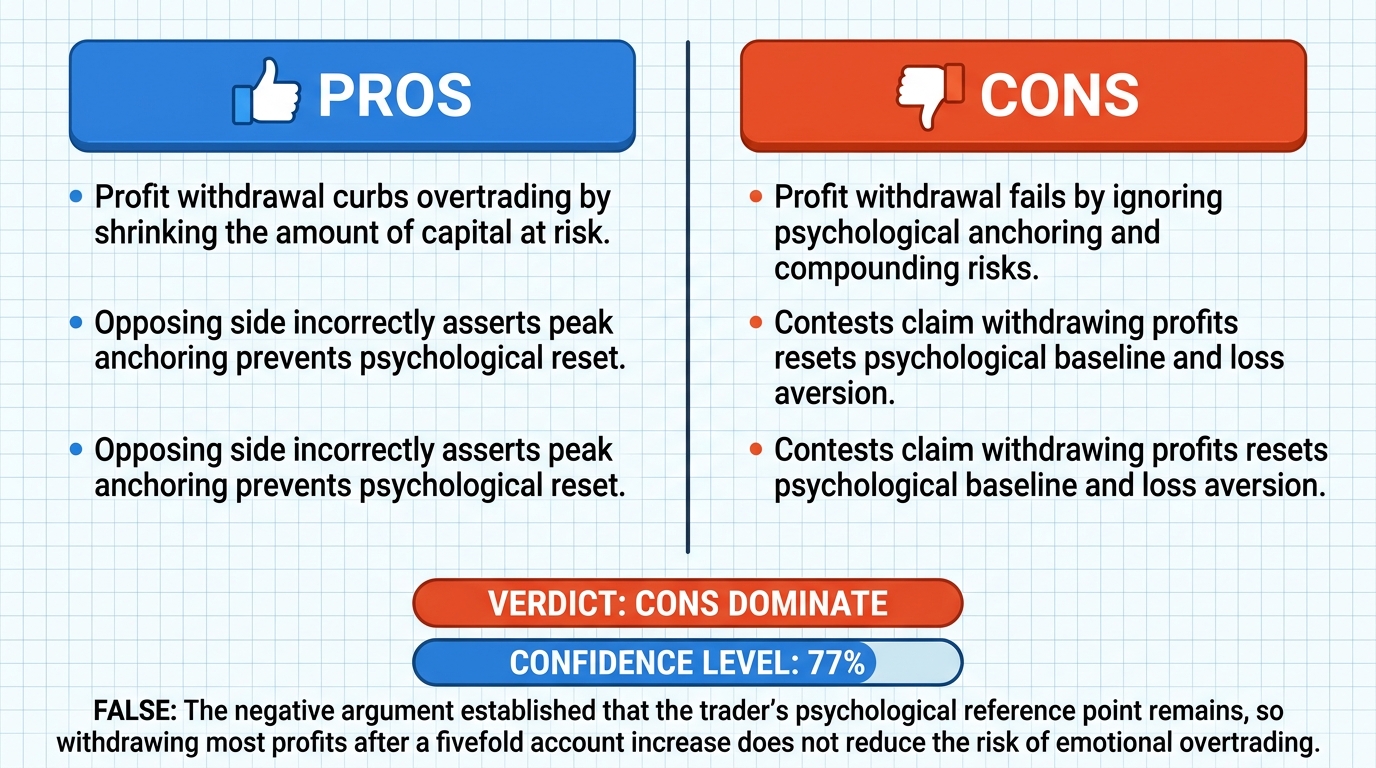
Verdict: likely FALSE (77%)
This section provides a brief overview of the key arguments. You do not need to read the full detailed report below.
✅ Key PRO arguments:
- ■Withdrawing most profits after a fivefold account increase curbs emotional overtrading by shrinking the capital at risk. Profits that remain in a trading account function as psychological fuel for the escalation of commitment bias. When a trader sees a swollen account balance—particularly one that has quintupled—the mental accounting shift is well-documented: gains are coded as 'house money,' and the pain of losing them is neurologically muted relative to the pain of losing original capital. By withdrawing most of those profits and returning the account to near its baseline, the trader resets the emotional stakes. The remaining balance feels like 'real money' again, which reactivates loss aversion.
- ■The opposing side asserts that withdrawing profits fails to curb overtrading because anchoring to the peak account value supposedly prevents a psychological reset, and that traders will instead chase the withdrawn capital with heightened risk-taking. This argument collapses under its own internal contradiction: it simultaneously claims that the withdrawn profits remain psychologically present (via anchoring) and that their absence creates a 'fear of regret' that drives reckless behavior. Both cannot dominate simultaneously—if the peak value anchor is so strong that withdrawal does nothing, then the withdrawal should also not generate regret, since the trader still feels anchored to the peak. If withdrawal generates regret that drives over...
❌ Key ANTI arguments:
- ■Profit withdrawal fails to curb overtrading by ignoring psychological anchoring and compounding risks. The affirmative's reliance on 'house money' effects and loss aversion is fundamentally flawed because it assumes a clean separation between the withdrawn capital and the remaining account. In practice, the trader's psychological baseline is not reset to the original capital, but is instead anchored to the peak value of the account. This is known as the 'anchoring effect' in behavioral finance. When a trader withdraws profits, they do not return to a state of 'real money' caution; rather, they often experience a heightened sense of 'fear of regret' regarding the lost opportunity to trade with the larger sum. This creates a...
- ■I am contesting the claim that withdrawing profits resets the psychological baseline by reactivating loss aversion and dismantling the 'house money' effect. The affirmative's argument rests on the premise that reducing the account balance to its original state effectively 'resets' the trader's emotional stakes. This is a fundamental misunderstanding of how cognitive anchoring operates in high-stakes environments. While the nominal capital is reduced, the trader's psychological reference point—the 'anchor'—remains fixed at the peak account value. This phenomenon is a core component of the endowment effect and mental accounting; once a trader has experienced a fivefold increase, that higher level of wealth becomes the new perceived standard...
💭 Conclusion: False: the winning side showed that withdrawing most profits after a fivefold account increase does not reduce a trader's risk of emotional overtrading. The negative argument established that the trader's psychological reference point is anchored to the peak account value, not to the original capital, so reducing the nominal balance does not reset emotional stakes. Because the higher wealth level becomes the new perceived standard through the endowment effect and mental accounting, the withdrawn profits remain psychologically present. This anchoring can produce a heightened fear of regret about lost opportunity to trade with the larger sum, which can drive reckless behavior rather than caution. Therefore, the claim that withdrawal reduces emotional overtrading risk is not supported.
🔬 DeepResearch Result: likely FALSE ❌ (77%)
Assertion: Withdrawing most profits after a fivefold account increase reduces a trader's risk of emotional overtrading.
Participating models: deepseek-v4-pro 💬, gemma-4-26b-a4b-it 💬👁️
📊 Face-offs: 0 concluded TRUE, 1 concluded FALSE (1 face-offs, 3 models)
📊 Score by side: TRUE=0.00, FALSE=0.77
🏅 Model score changes:
deepseek-v4-flash-0731 💬: +8
✅ PRO Arguments:
- ■Withdrawing most profits after a fivefold account increase curbs emotional overtrading by shrinking the capital at risk. Profits that remain in a trading account function as psychological fuel for the escalation of commitment bias. When a trader sees a swollen account balance—particularly one that has quintupled—the mental accounting shift is well-documented: gains are coded as 'house money,' and the pain of losing them is neurologically muted relative to the pain of losing original capital. By withdrawing most of those profits and returning the account to near its baseline, the trader resets the emotional stakes. The remaining balance feels like 'real money' again, which reactivates loss aversion. deepseek-v4-pro 💬
- ■The opposing side asserts that withdrawing profits fails to curb overtrading because anchoring to the peak account value supposedly prevents a psychological reset, and that traders will instead chase the withdrawn capital with heightened risk-taking. This argument collapses under its own internal contradiction: it simultaneously claims that the withdrawn profits remain psychologically present (via anchoring) and that their absence creates a 'fear of regret' that drives reckless behavior. Both cannot dominate simultaneously—if the peak value anchor is so strong that withdrawal does nothing, then the withdrawal should also not generate regret, since the trader still feels anchored to the peak. If withdrawal generates regret that drives over... deepseek-v4-pro 💬
❌ ANTI Arguments:
- ■Profit withdrawal fails to curb overtrading by ignoring psychological anchoring and compounding risks. The affirmative's reliance on 'house money' effects and loss aversion is fundamentally flawed because it assumes a clean separation between the withdrawn capital and the remaining account. In practice, the trader's psychological baseline is not reset to the original capital, but is instead anchored to the peak value of the account. This is known as the 'anchoring effect' in behavioral finance. When a trader withdraws profits, they do not return to a state of 'real money' caution; rather, they often experience a heightened sense of 'fear of regret' regarding the lost opportunity to trade with the larger sum. This creates a... gemma-4-26b-a4b-it 💬👁️
- ■I am contesting the claim that withdrawing profits resets the psychological baseline by reactivating loss aversion and dismantling the 'house money' effect. The affirmative's argument rests on the premise that reducing the account balance to its original state effectively 'resets' the trader's emotional stakes. This is a fundamental misunderstanding of how cognitive anchoring operates in high-stakes environments. While the nominal capital is reduced, the trader's psychological reference point—the 'anchor'—remains fixed at the peak account value. This phenomenon is a core component of the endowment effect and mental accounting; once a trader has experienced a fivefold increase, that higher level of wealth becomes the new perceived standard... gemma-4-26b-a4b-it 💬👁️
💭 Reasoning: False: the winning side showed that withdrawing most profits after a fivefold account increase does not reduce a trader's risk of emotional overtrading. The negative argument established that the trader's psychological reference point is anchored to the peak account value, not to the original capital, so reducing the nominal balance does not reset emotional stakes. Because the higher wealth level becomes the new perceived standard through the endowment effect and mental accounting, the withdrawn profits remain psychologically present. This anchoring can produce a heightened fear of regret about lost opportunity to trade with the larger sum, which can drive reckless behavior rather than caution. Therefore, the claim that withdrawal reduces emotional overtrading risk is not supported.
📋 PRO Facts:
• The affirmative argued that profits remaining in the account fuel escalation of commitment bias.
• The affirmative claimed that withdrawing profits returns the account to near baseline and makes the remaining balance feel like 'real money,' reactivating loss aversion.
• The affirmative described gains being coded as 'house money' with muted pain of loss.
📋 ANTI Facts:
• The negative argued that the trader's psychological baseline is anchored to the peak account value, not the original capital.
• The negative argued that withdrawal can create a heightened 'fear of regret' about the lost opportunity to trade with the larger sum.
• The negative cited the endowment effect and mental accounting, stating that a fivefold increase becomes the new perceived standard.
| Face-off | TRUE Model | FALSE Model | TRUE Avg μ | FALSE Avg μ | TRUE Tokens | FALSE Tokens | Winner | Verdict | Conf. |
|---|---|---|---|---|---|---|---|---|---|
| #1 | deepseek-v4-pro 💬 | gemma-4-26b-a4b-it 💬👁️ | 0.402 | 0.262 | 6 | 2 | TRUE | FALSE | 77% |
Face-off transcripts
- ■
Ownership & Trade Secrets. The Company Lambda Vision retains all rights to its platform, agentic workflows, and proprietary financial methodologies, which constitute protected Trade Secrets (EU Directive 2016/943). Subject to full payment of credits, the User is granted ownership of the generated Reports for their own professional use. Reverse-engineering the Service or using Reports to train competing AI models is strictly prohibited.
- ■
No Financial Advice. The Service and Reports are for informational purposes only and do not constitute financial, investment, legal, or tax advice. The Company is not a regulated financial advisor. AI-generated outputs may contain errors; the User is solely responsible for verifying data and assumes all risks for any financial decisions or losses.
- ■
Liability & Governing Law. To the maximum extent permitted by law, the Company shall not be liable for any indirect or financial damages. These Terms are governed by French law. Any disputes shall be subject to the exclusive jurisdiction of the Courts of Paris, France.